


Researchers from the Changchun University of Science and Technology have published a dissertation titled "Self-Powered Wavelength-Selective Ultraviolet Bipolar Photodetector Based on Al/p-GaN/In:Ga2O3/SnO2 Structure for Secure Optical Communication" in ACS Applied Materials & Interfaces
Background
With the advent of the digital era, optical communication technology has been widely applied in critical domains such as intelligent transportation, underwater detection, and military defense, owing to its distinct advantages, including high data rate, high reliability, strong immunity to electromagnetic interference, and low power consumption. However, optical signals transmitted at high frequencies through open channels are susceptible to attenuation and leakage from scattering and refraction, which can lead to information security concerns. Therefore, developing novel encryption schemes to ensure the security and reliability of data transmission has become a pressing challenge in the field of optical communication.
Abstract
Free-space optical (FSO) communication is widely employed in critical sectors owing to its advantages such as high data rate and high reliability. However, signal attenuation and leakage during transmission pose significant information security challenges. In contrast to the visible and infrared (IR) spectral regions, which are susceptible to background light interference, solar-blind ultraviolet (UV) communication offers an inherent advantage of a high signal-to-noise ratio (SNR). However, novel cryptographic photodetectors operating in this waveband have been insufficiently explored. In this work, a self-powered ultraviolet (UV) photodetector based on an Al/p-GaN/In:Ga2O3/SnO2 structure was designed and fabricated, featuring synergistic regulation by a heterojunction and a Schottky junction. The photodetector exhibits a unique wavelength-selective bipolar photoresponse, generating a negative photocurrent under 254 nm illumination and a positive photocurrent under 365 nm illumination. Under zero bias, the detector achieves responsivities of −5 mA/W and 0.52 mA/W, and specific detectivities of up to −7.2 × 10¹¹ Jones and 7.47 × 10¹⁰ Jones, for 254 and 365 nm illumination, respectively. Leveraging the unique physical properties of the photodetector, a secure optical communication (SOC) system is demonstrated. This system utilizes the positive and negative photocurrents, generated by distinct UV wavelengths, as binary signals (“1” and “0”) to encrypt information, while decryption is performed at the receiving end using a preset key file. The experimental results demonstrate that the system successfully achieved the encrypted transmission and accurate decryption of the string “CUST” at zero bias. This work not only presents a new strategy for developing high-performance, multifunctional bipolar UV photodetectors but also offers an innovative and viable technological pathway for fabricating next-generation, high-security, and low-power optical communication systems.
Conclusion
In summary, a self-powered ultraviolet (UV) photodetector based on an Al/p-GaN/In:Ga2O3/SnO2 heterostructure was designed and fabricated. By virtue of an ingenious energy band design, the photodetector achieves a unique bipolar photoresponse, namely, generating a negative photocurrent under 254 nm deep-UV illumination and a positive photocurrent under 365 nm near-UV illumination. The photodetector exhibits robust response capability at zero bias. Furthermore, leveraging this distinct bipolar characteristic, a novel secure optical communication system was innovatively constructed. In this system, the wavelength-dependent positive and negative photocurrents are employed as initial signals. Through the superposition of these signals with a secret key, the string “CUST” was successfully transmitted in an encrypted form and accurately decrypted at zero bias. This work validates both the feasibility and superiority of the proposed scheme in guaranteeing the security and reliability of information transmission. Moreover, this study offers a viable strategy for the development of multifunctional UV bipolar photodetectors and their application in the field of secure communications.
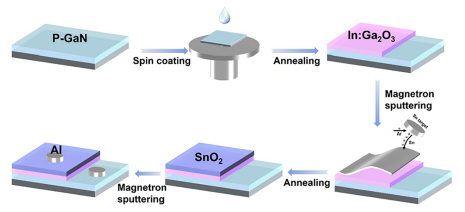
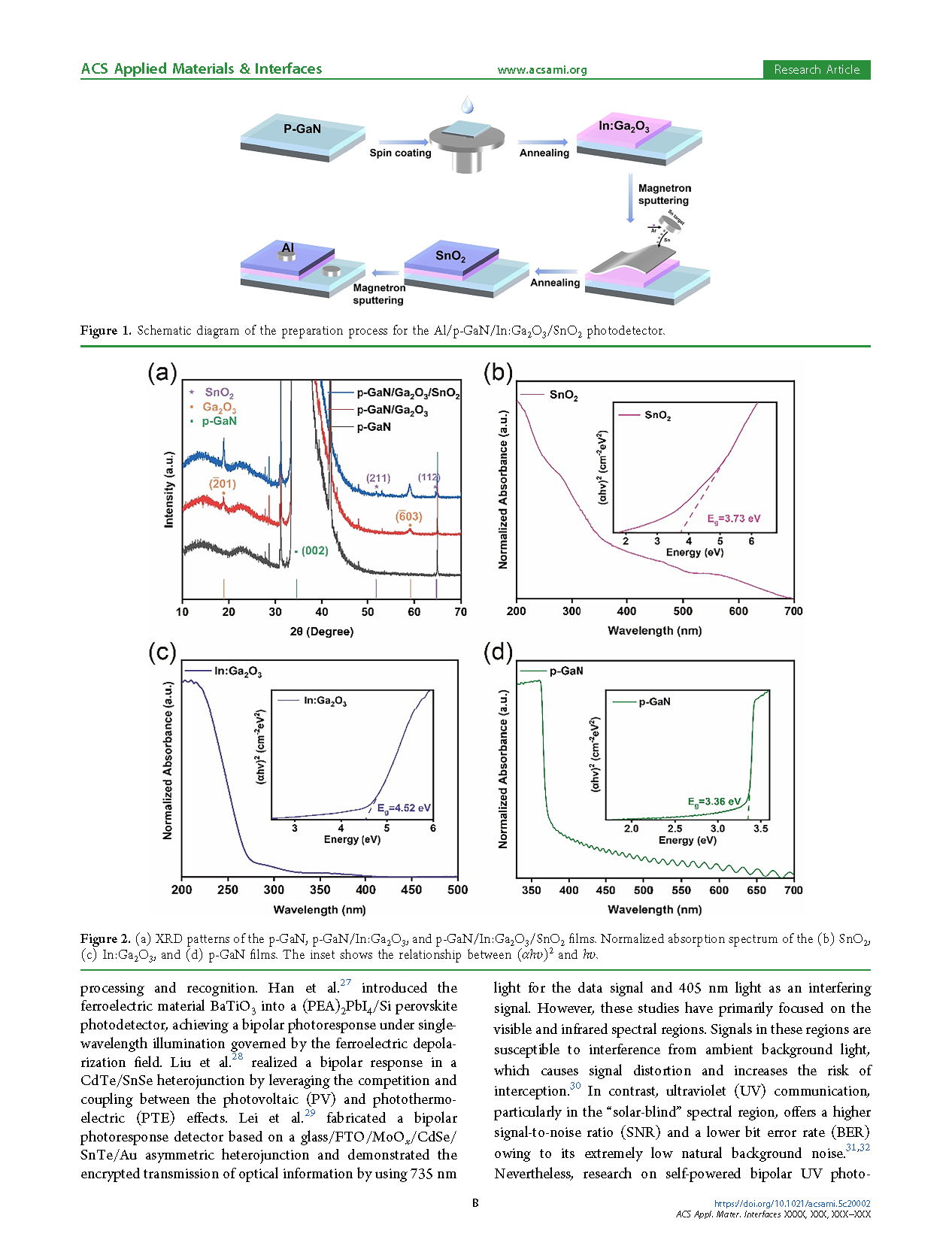
Figure 1. Schematic diagram of the preparation process for the Al/p-GaN/In:Ga2O3/SnO2 photodetector.
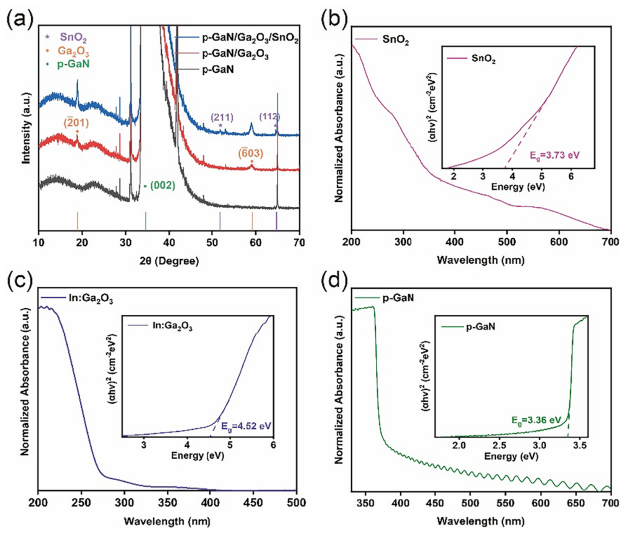
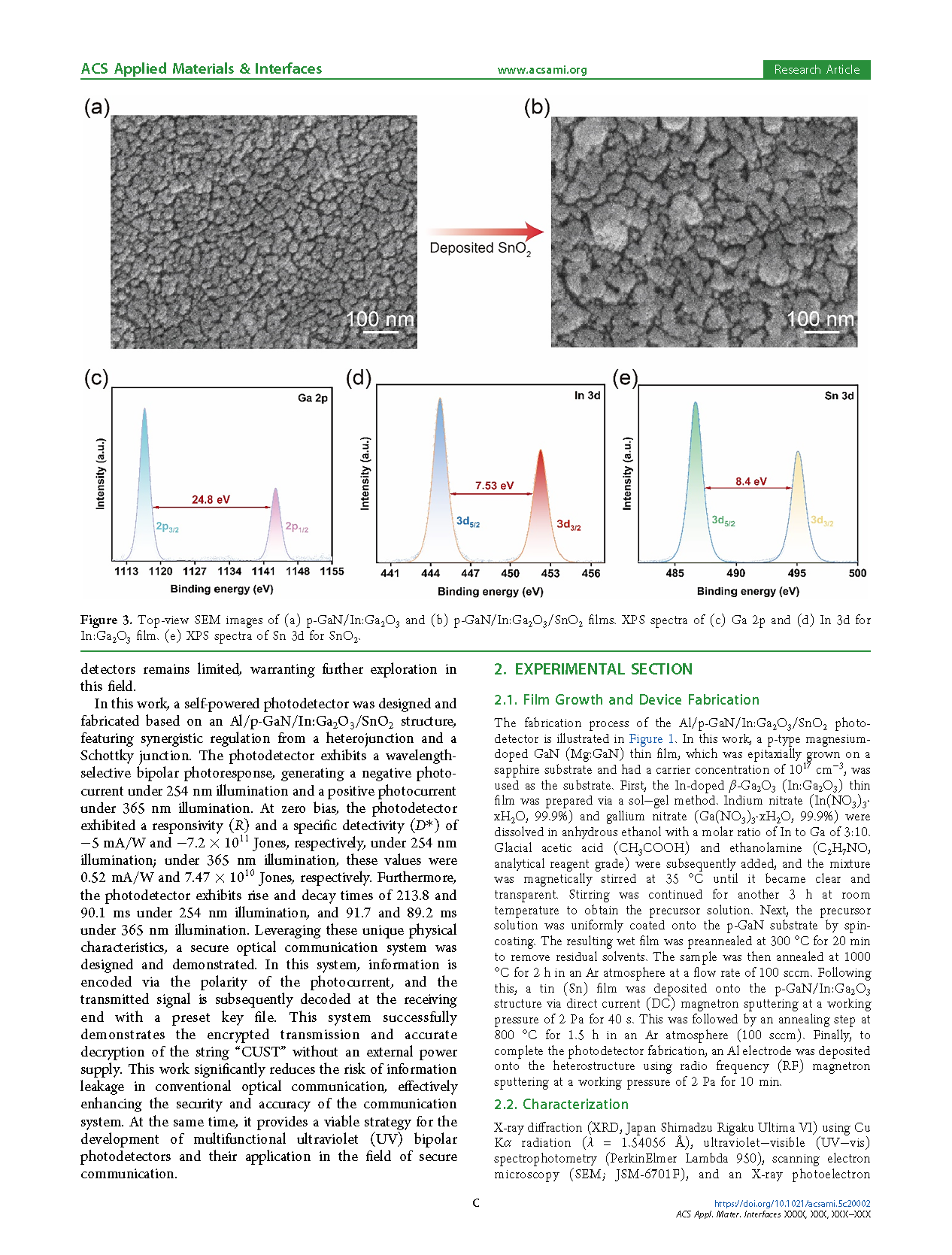
Figure 2. (a) XRD patterns of the p-GaN, p-GaN/In:Ga2O3, and p-GaN/In:Ga2O3/SnO2 films. Normalized absorption spectrum of the (b) SnO2, (c) In:Ga2O3, and (d) p-GaN films. The inset shows the relationship between (αhυ)2 and hυ.
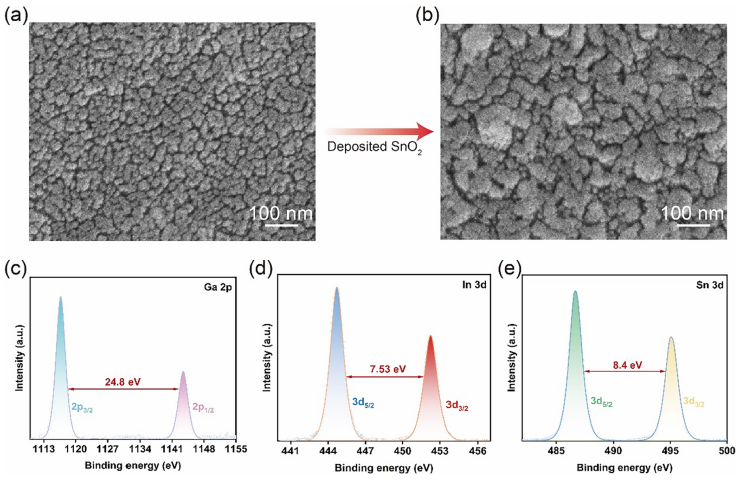
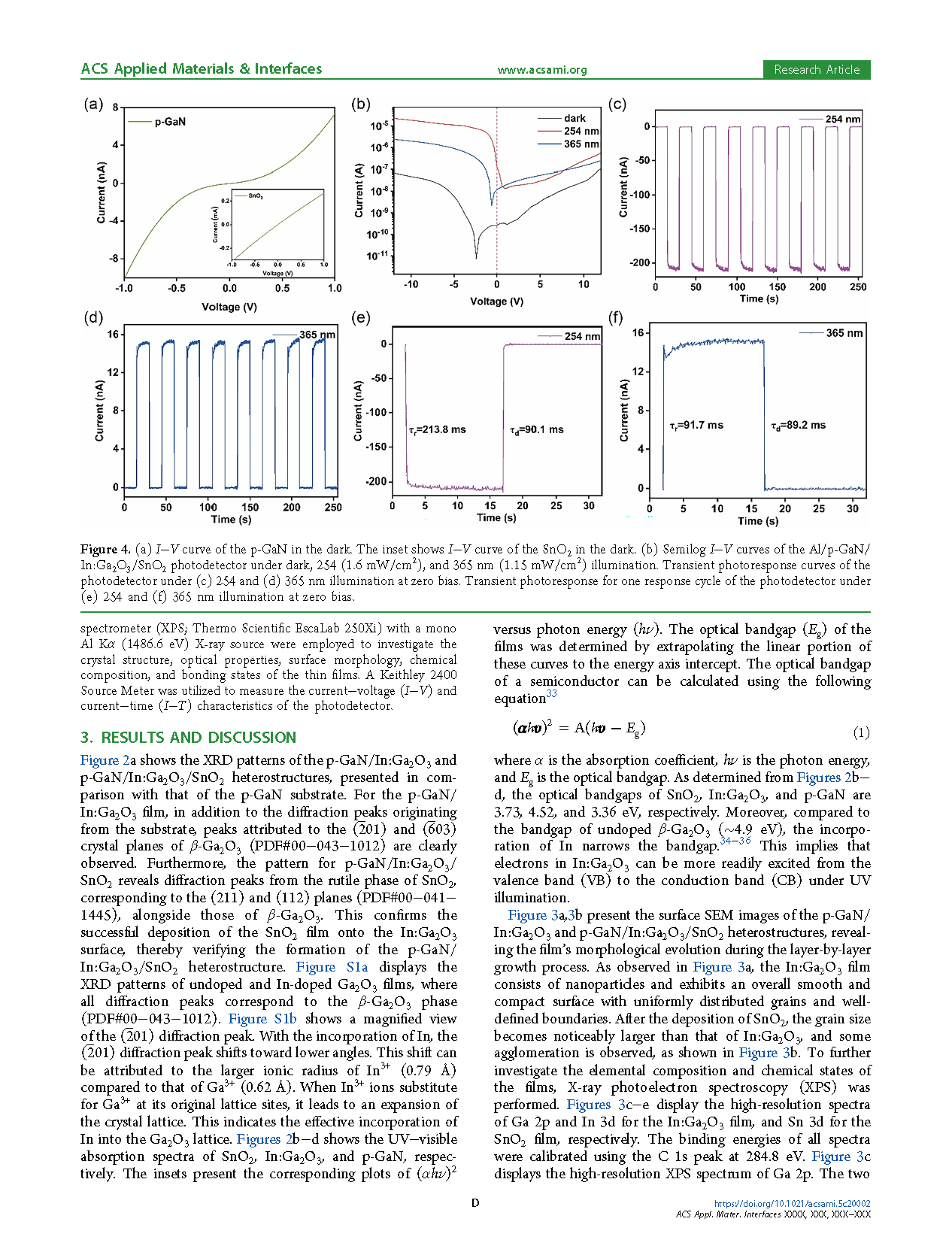
Figure 3. Top-view SEM images of (a) p-GaN/In:Ga2O3 and (b) p-GaN/In:Ga2O3/SnO2 films. XPS spectra of (c) Ga 2p and (d) In 3d for In:Ga2O3 film. (e) XPS spectra of Sn 3d for SnO2.
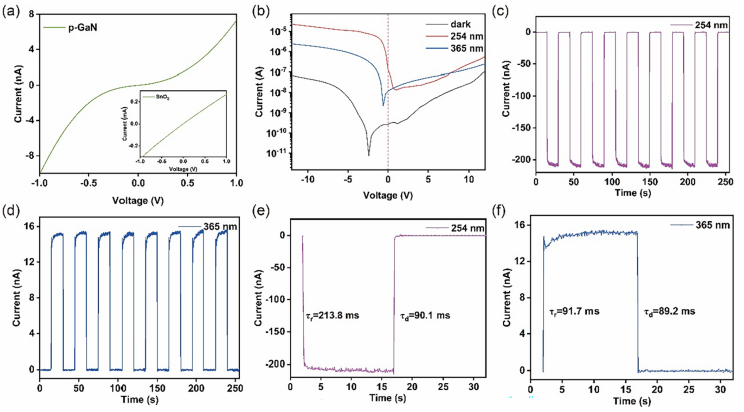
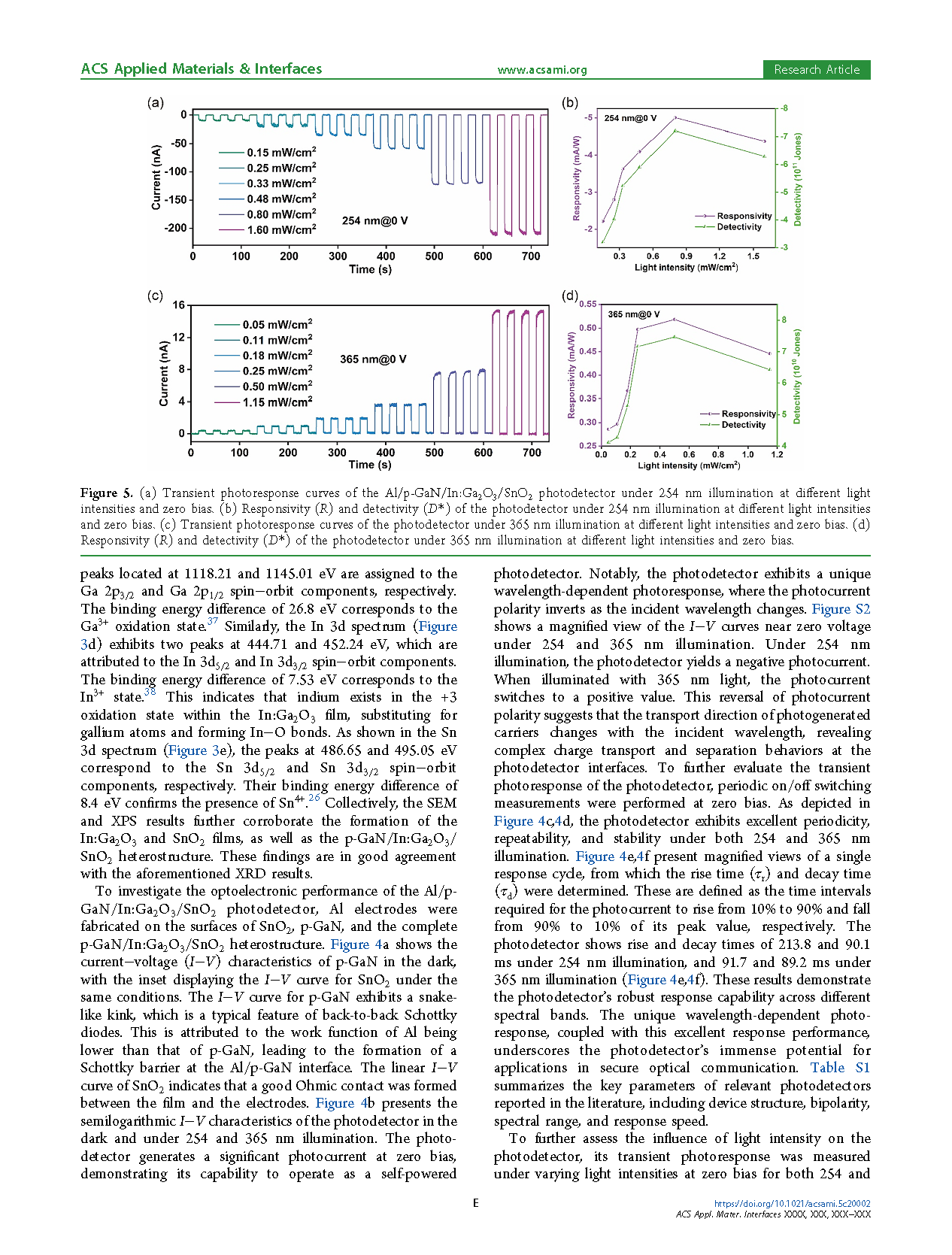
Figure 4. (a) I−V curve of the p-GaN in the dark. The inset shows I−V curve of the SnO2 in the dark. (b) Semilog I−V curves of the Al/p-GaN/ In:Ga2O3/SnO2 photodetector under dark, 254 (1.6 mW/cm2), and 365 nm (1.15 mW/cm2) illumination. Transient photoresponse curves of the photodetector under (c) 254 and (d) 365 nm illumination at zero bias. Transient photoresponse for one response cycle of the photodetector under (e) 254 and (f) 365 nm illumination at zero bias.
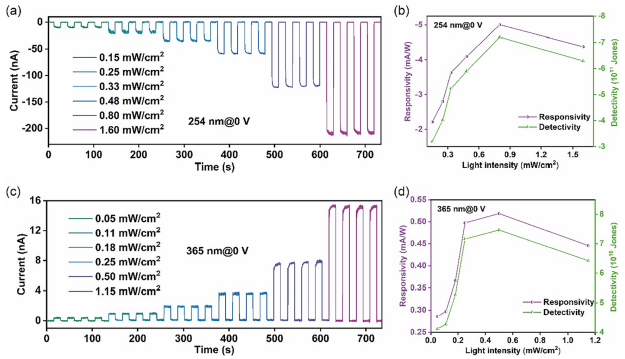
Figure 5. (a) Transient photoresponse curves of the Al/p-GaN/In:Ga2O3/SnO2 photodetector under 254 nm illumination at different light intensities and zero bias. (b) Responsivity (R) and detectivity (D*) of the photodetector under 254 nm illumination at different light intensities and zero bias. (c) Transient photoresponse curves of the photodetector under 365 nm illumination at different light intensities and zero bias. (d) Responsivity (R) and detectivity (D*) of the photodetector under 365 nm illumination at different light intensities and zero bias.
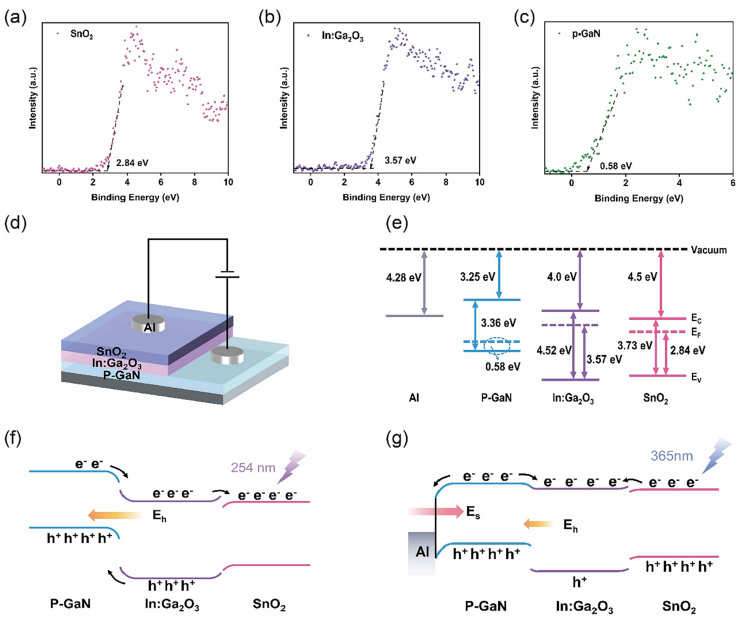
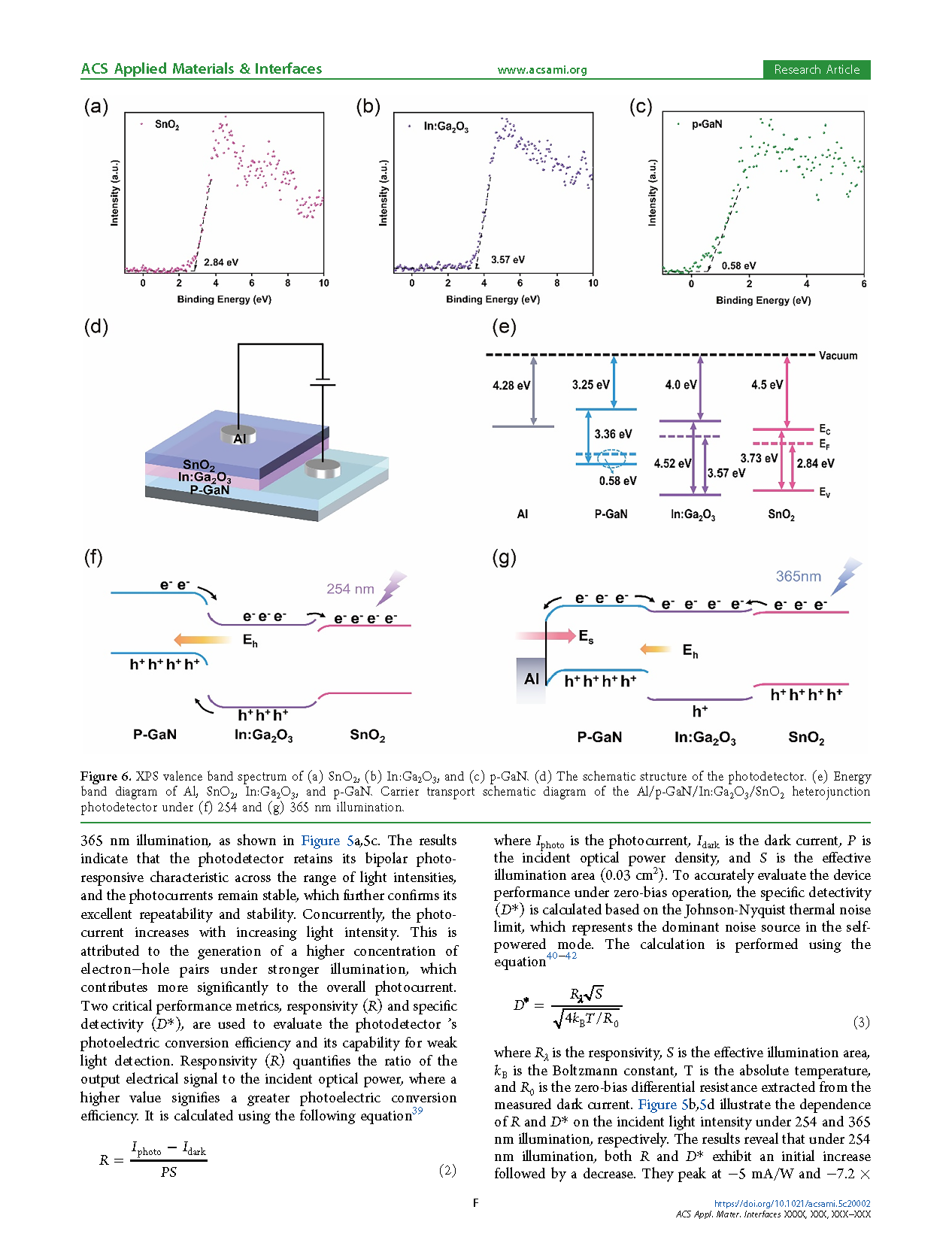
Figure 6. XPS valence band spectrum of (a) SnO2, (b) In:Ga2O3, and (c) p-GaN. (d) The schematic structure of the photodetector. (e) Energy band diagram of Al, SnO2, In:Ga2O3, and p-GaN. Carrier transport schematic diagram of the Al/p-GaN/In:Ga2O3/SnO2 heterojunction photodetector under (f) 254 and (g) 365 nm illumination.
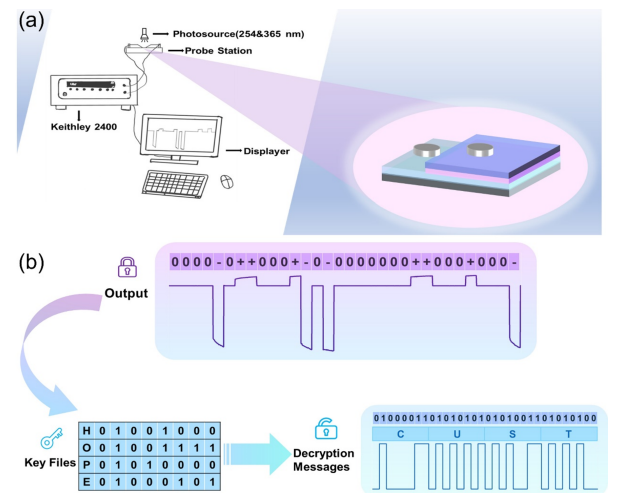
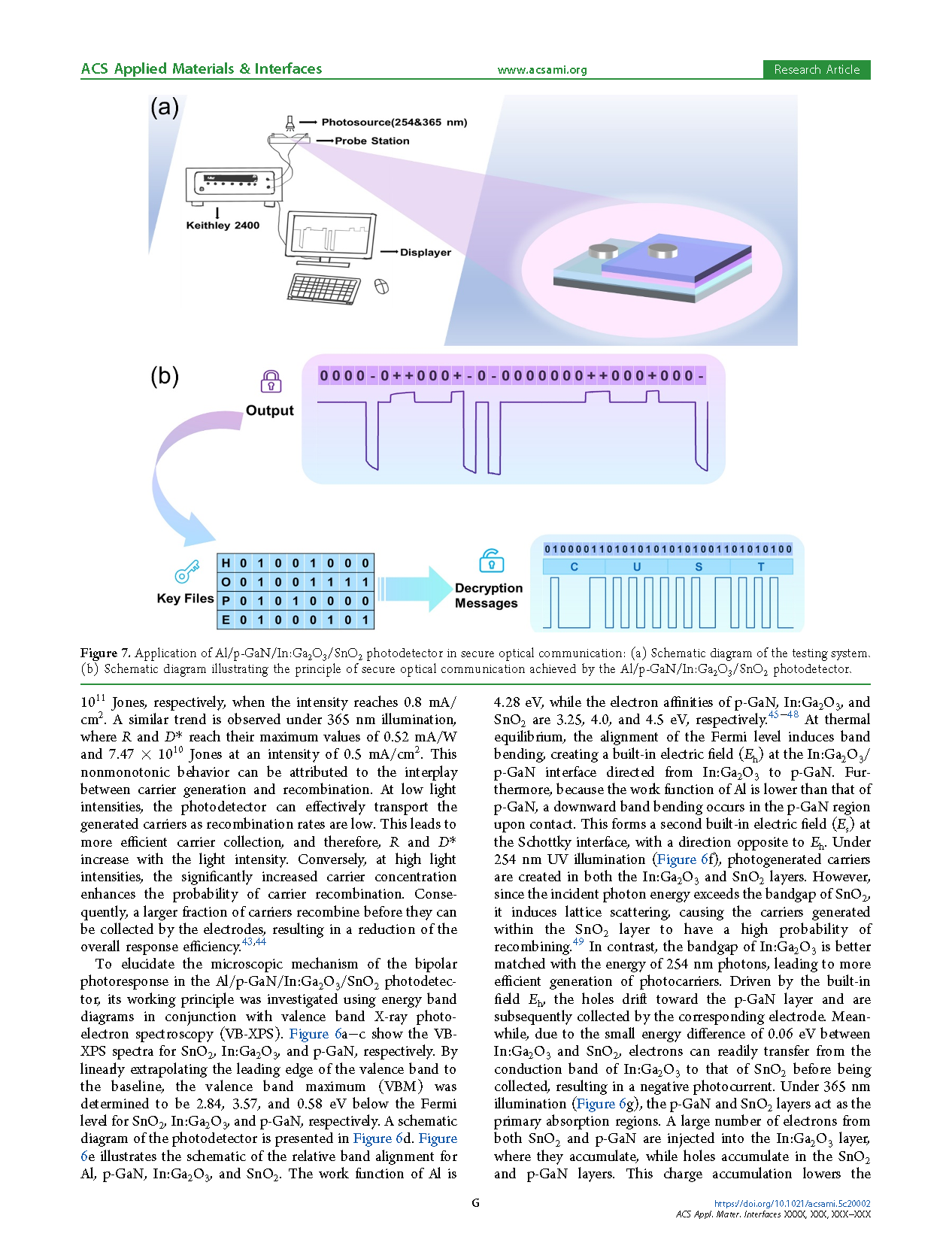
Figure 7. Application of Al/p-GaN/In:Ga2O3/SnO2 photodetector in secure optical communication: (a) Schematic diagram of the testing system. (b) Schematic diagram illustrating the principle of secure optical communication achieved by the Al/p-GaN/In:Ga2O3/SnO2 photodetector.
DOI:
doi.org/10.1021/acsami.5c20002

Instruction
Official Account

Cooperation
Top