

Foreword
As 2025 draws to a close, Gallium Oxide (Ga₂O₃), a wide-bandgap semiconductor, has achieved significant breakthroughs in both fundamental research and industrial applications. From the optimization of crystal growth processes to innovations in epitaxial thin-film fabrication, and from novel device structure design to validation in end-use scenarios, research papers and industry updates have continuously emerged, accelerating the commercialization of this strategic material. As a professional platform dedicated to Gallium Oxide, the Asian Gallium Oxide Alliance has closely tracked academic frontiers and industry developments. At the end of the year, we present a curated overview of representative research achievements from 2025, systematically reviewing innovations in crystal growth, epitaxial fabrication, device development, and application verification, to provide readers with a comprehensive view of Gallium Oxide technology development over the year.
Research Activity and Coverage
In 2025, the Alliance compiled and released a total of 940 researches related to Gallium Oxide (Ga₂O₃), reflecting the sustained high attention and intensive research activity in this field worldwide. Among these, 541 papers originated from China, far exceeding the 399 papers from other countries. Chinese publications accounted for 58% of the total, indicating that China has assumed a significant role in the global Gallium Oxide research landscape.
The regional distribution of these compiled publications is as follows:
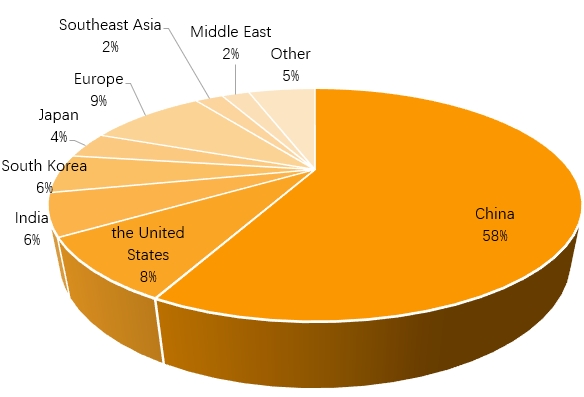
The regional distribution of publications indicates that Gallium Oxide research has formed a global pattern with China as a major growth center and multiple countries advancing in parallel. The United States, Japan, South Korea, India, and other countries maintain stable contributions, while emerging research forces continue to join, expanding the global research network. This multi-region parallel development reflects the long-term research value of Gallium Oxide in academia and lays a broad international foundation for subsequent technological breakthroughs and industrial collaboration.
Research Trends
Based on the Alliance’s compilation of 2025 researches, research was categorized into four directions: crystal growth, epitaxial research, device research, and others. The distribution of research directions is as follows:
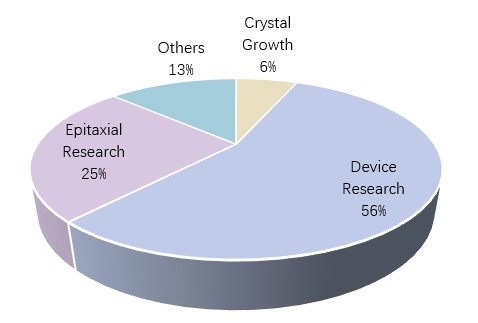
Among these, device-related studies accounted for 56% of the total, indicating that current research mainly focuses on device implementation and performance optimization. Epitaxial research accounted for 25%, showing steady progress in this area. Crystal growth studies accounted for only 6%, highlighting that high-quality Gallium Oxide crystal growth remains technically challenging, serving as a critical bottleneck for further research and scalable application.
Research Institutions
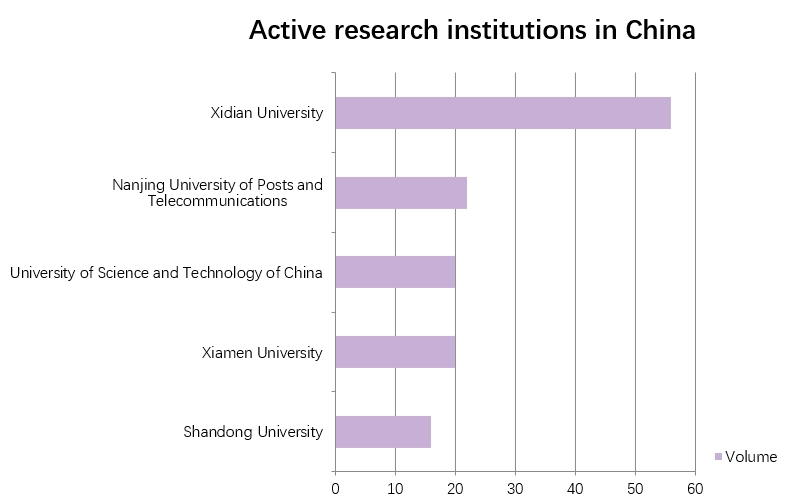
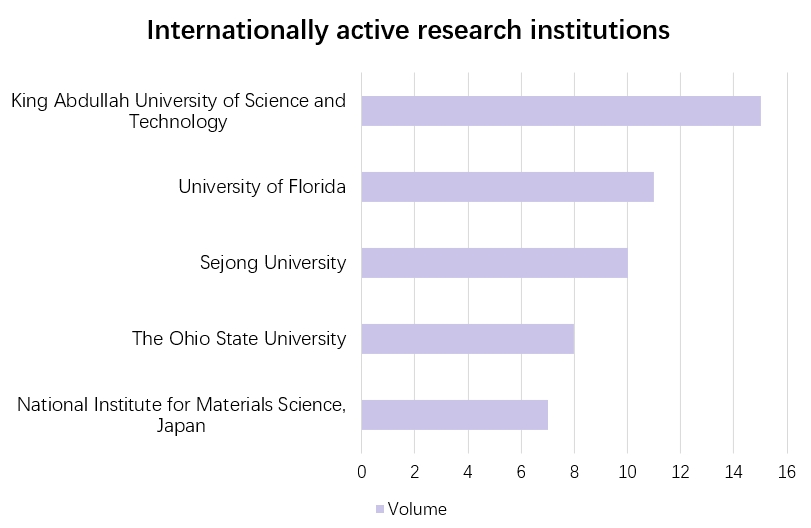
Through systematic compilation and analysis of 2025 Gallium Oxide publications, the Alliance identified the most frequently appearing domestic and international research institutions as a reflection of research activity and strength distribution. The top five active institutions are presented below (ranked by publication frequency).
The distribution of these active institutions shows that Gallium Oxide research has formed a group of entities with sustained output. Domestically, multiple universities continue to publish research results, indicating concentrated research activity, while internationally, several institutions maintain continuous contributions, demonstrating ongoing engagement in this field.
Academic Impact
Among the numerous publications in 2025, certain papers received high attention due to theoretical innovation, experimental breakthroughs, or application potential. The Alliance compiled viewership data and identified the ten most-read papers. These high-impact studies offer insightful perspectives on current research focuses and technological trends, reflecting both academic and industry interest in these topics.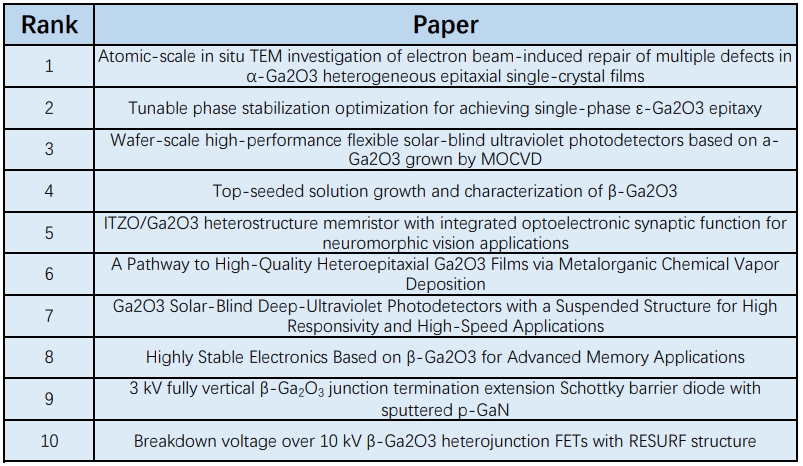
Additionally, Gallium Oxide research continued to appear in top-tier international journals, demonstrating stable and long-term attention and influence in the global academic community, with growing recognition of its scientific value and depth.

Summary
In 2025, Gallium Oxide research maintained high global activity and sustained investment, with a clearer and more structured research system. The research focus increasingly concentrated on devices, with epitaxial studies providing stable support for device development. Although crystal growth studies accounted for a smaller proportion, their fundamental importance is increasingly evident, remaining a key limiting factor for scalable applications. In terms of research strength distribution, domestic institutions have formed a relatively stable pattern of continuous output with high-frequency contributions across multiple areas, while international research forces advance concurrently, reflecting a multi-region, parallel development trend. Some research outcomes have attracted significant academic attention and continue to be published in leading international journals, demonstrating the long-term value and impact of Gallium Oxide research. Overall, 2025 saw steady progress in Gallium Oxide research, with increasingly focused directions and gradually formed structures, laying the foundation for further technological development and industrial integration. These trends underscore the strategic value and sustained evolution potential of Gallium Oxide as a next-generation wide-bandgap semiconductor material.
Instruction
Official Account

Cooperation
Top