


Researchers from the L.N. Gumilyov Eurasian National University have published a dissertation titled "Chemical analysis of ion traces in the betta Ga2O3 structure and fundamentals of molecular dynamics of mobilization hydrogen and helium molecules" in Results in Materials.
Background
Gallium oxide (Ga₂O₃), an ultra-wide-bandgap semiconductor (4.7–4.9 eV), has attracted significant attention due to its high melting point, high density, and stable electronic structure, enabling applications in high-temperature gas sensors, photodetectors, transistors, and optical and medical devices. Ga₂O₃ exists in five crystal phases—α, β, γ, δ, and ε—with the α and β phases being the most widely used. The monoclinic β-Ga₂O₃, with a wide bandgap and favorable conduction and valence band structures, is suitable for radiation detection, including neutron and high-energy particle detection, and exhibits long-term structural stability, making it a potential alternative to 4H-SiC detectors. In nuclear technology, the need for materials with high-temperature tolerance, low neutron absorption, and corrosion resistance has driven research into Zr-based alloys, Cr₂O₃/Al₂O₃/TiN-modified materials, nanoscale polycrystalline Mo, and GO/ZrO₂ composite coatings. Additionally, three-dimensional graphene, with its high Young’s modulus, chemical stability, hydrophobicity, and exceptional thermal conductivity, shows promise for electrical and thermal management in high-temperature corrosive environments. Moreover, molecular dynamics simulations of Cu surfaces implanted with high-energy clusters, combined with graphene layers, provide insights into material modification mechanisms and radiation response behaviors.
Abstract
In the presented work, the molecular dynamics simulation and thermal conductivity mechanism of implantation of beta Ga2O3 structure with hydrogen and helium ions with energy 100 eV were analyzed. The mechanism of the initial formation stages of gas-atom-gas clustering in the β-Ga2O3 structure by proton and helium implantation was simulated using the LAMMPS package. The thermal conductivity is anisotropic in the crystal structure, and varies depending on the crystal orientation, with the highest conductivity observed along the k(001) direction.
Conclusion
In this research, the dynamics of ion penetration depth in the crystal structure of β-Ga2O3 implanted with hydrogen and helium ions were simulated using the molecular dynamics method. Initial data on the kinetics of the transition from the ionic state to the molecular state, as well as changes in the structural, optical, and mechanical properties of the material, were obtained. The transition of ions to the molecular state in the material's structure was demonstrated after implantation times of 137.1 fs and 158.9 fs. The anisotropic properties of thermal conductivity in β-Ga2O3 were analyzed, revealing that the material exhibits the highest thermal conductivity in the k[001] direction. Future studies will focus on mechanisms for maintaining structural stability under various types of irradiation, as well as the formation of free volume and radicals. Additionally, research should aim to develop advanced composite structures and radiation-resistant materials that can operate under severe irradiation and implantation conditions, thereby expanding their potential applications.

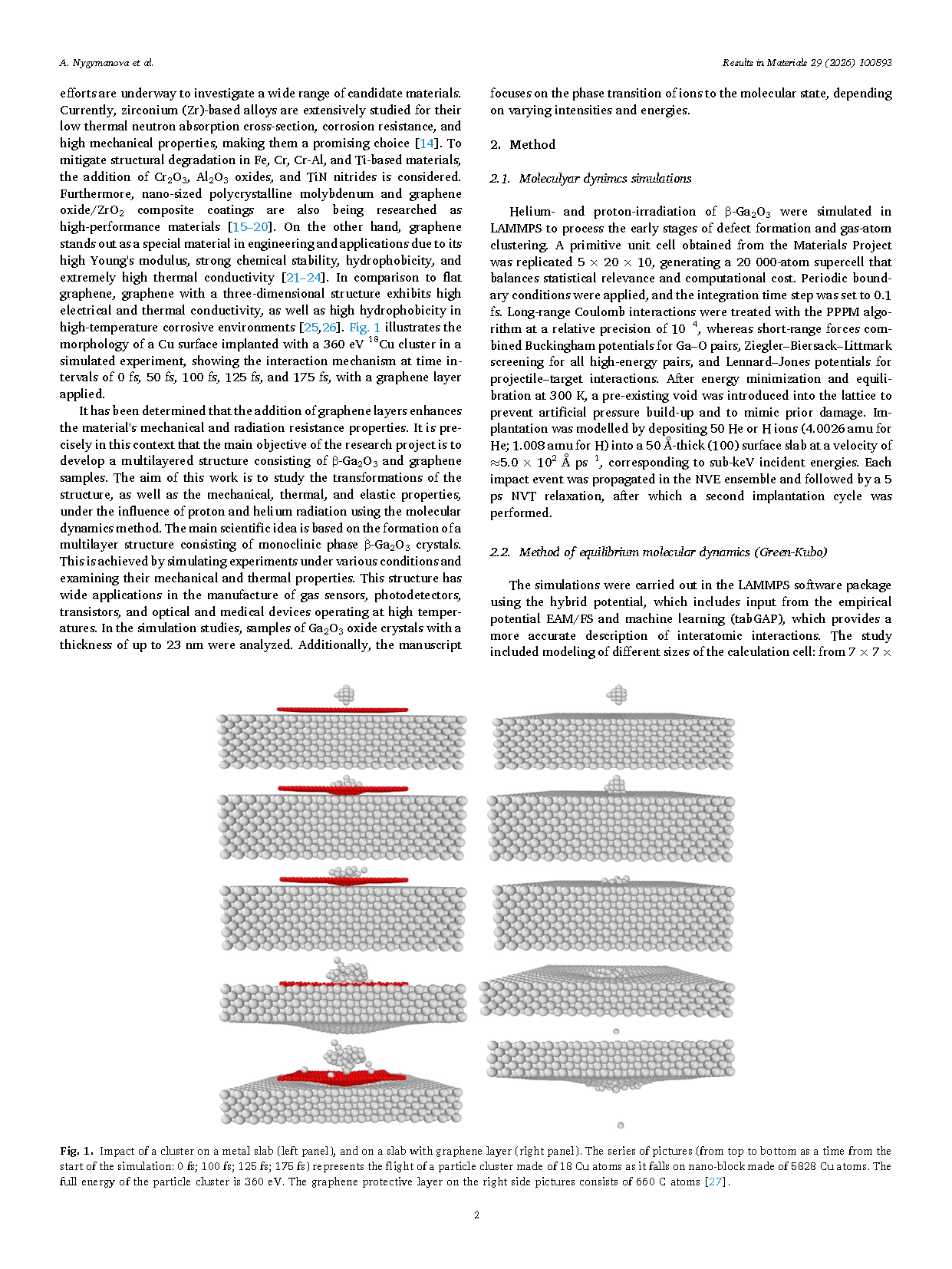
Fig. 1. Impact of a cluster on a metal slab (left panel), and on a slab with graphene layer (right panel). The series of pictures (from top to bottom as a time from the start of the simulation: 0 fs; 100 fs; 125 fs; 175 fs) represents the flight of a particle cluster made of 18 Cu atoms as it falls on nano-block made of 5828 Cu atoms. The full energy of the particle cluster is 360 eV. The graphene protective layer on the right side pictures consists of 660 C atoms.

Fig. 2. Molecular dynamics of the interaction of H+ ions with energy 100 eV with a β-Ga2O3 crystal at 2.2 Fs, 11.8 Fs, 34.4 Fs, 55.7 Fs, 76.4 Fs, 91.5 Fs, 114.5 Fs, 125.3, and 131.8 Fs.

Fig. 3. Molecular dynamics of the interaction of He2+ ions with energy 100 eV with a β-Ga2O3 crystal at 0 Fs, 27.8 Fs, 64.5 Fs, 91.7 Fs, 137.1, and 158.9 Fs.
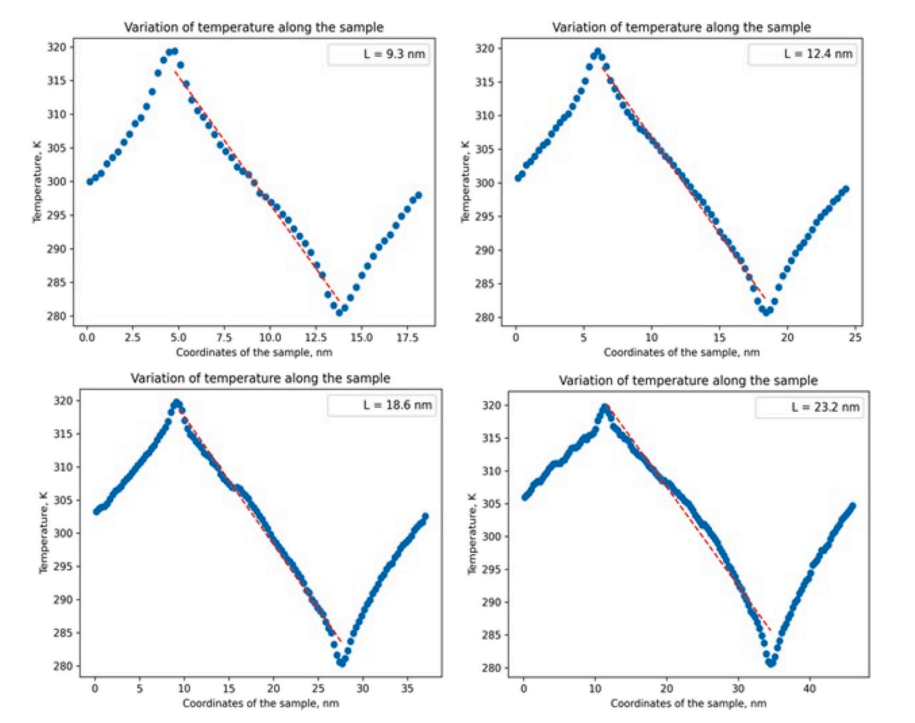
Fig. 4. Temperature profiles and fit.
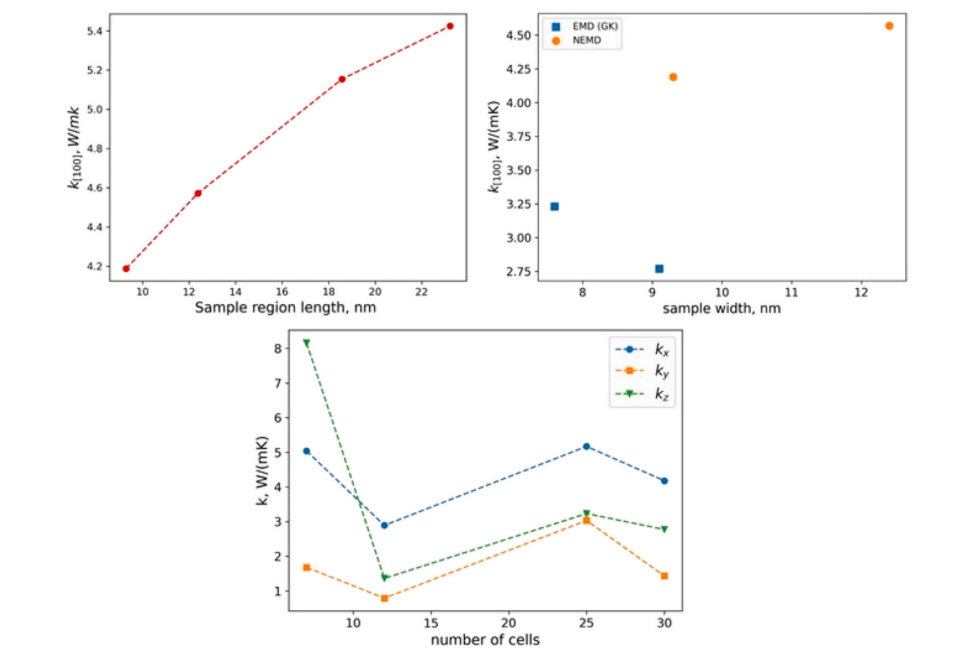
Fig. 5. Thermal conductivity vs. sample length in β-Ga2O3 ([100], NEMD), Thermal conductivity of β-Ga2O3 vs cell size (Green-Cubo) and comparison of thermal conductivity of β-Ga2O3 along [100]: Green-Cubo method (EMD) and non-equilibrium method (NEMD).
DOI:
doi.org/10.1016/j.rinma.2026.100893

Instruction
Official Account

Cooperation
Top