


Researchers from the South China University of Technologyhave published a dissertation titled " NiO/Ga2O3 Heterojunction with Tunable Oxygen Vacancies for Efficient Self-Powered Solar-Blind UV Detection " in Materials
Background
Solar-blind ultraviolet (UV) photodetectors operating in the 200–280 nm spectral range have attracted considerable attention for applications in space communication, disaster early-warning, environmental monitoring, and military reconnaissance, owing to their intrinsically high signal-to-noise ratio under Earth’s background radiation. Compared with visible and near-UV photodetectors, solar-blind devices are immune to solar interference and therefore enable reliable detection without additional optical filtering, which is highly desirable for low-power and high-selectivity sensing systems. Among various wide-bandgap semiconductor materials, gallium oxide (Ga2O3) is considered an ideal candidate for high-performance solar-blind UV detection due to its exceptionally wide direct bandgap (4.6–5.2 eV), and intrinsic absorption edge near 253 nm, which enables a high rejection ratio between deep-UV (254 nm) and near-UV (365 nm) wavelengths. While the broader landscape of Ga2O3-based solar-blind photodetectors has been comprehensively reviewed recently, the specific impact of oxygen-vacancy modulation on sputtered amorphous Ga2O3 remains insufficiently understood. In particular, the correlation between sputtering atmospheres, defect chemistry, and NiO/Ga2O3 interfacial energies has not been systematically explored. This work focuses on how the Ar/O2 ratio regulates oxygen-vacancy concentration and band alignment, directly influencing the performance of self-powered solar-blind photodetectors.
Abstract
Solar-blind ultraviolet (UV) photodetectors based on wide-bandgap oxide semiconductors are highly desirable for environmental monitoring, flame sensing, and secure optical communication. Among them, Ga2O3 has attracted extensive attention due to its ultra-wide bandgap and intrinsic solar-blind response; however, its high dark current, weak built-in electric field, and defect-induced instability remain critical challenges, particularly for amorphous films prepared by scalable sputtering processes. Herein, a self-powered solar-blind UV photodetector based on a NiO/Ga2O3 heterojunction is demonstrated, in which the oxygen-vacancy concentration and band structure of sputtered Ga2O3 are systematically regulated by tailoring the Ar/O2 sputtering atmosphere. Combined X-ray photoelectron spectroscopy, UV photoelectron spectroscopy, and optical measurements reveal that the variation in oxygen-vacancy concentration simultaneously modulates the Fermi-level position, band-edge alignment, and built-in potential at the NiO/Ga2O3 interface. As a result, the optimized heterojunction device exhibits a low dark current, pronounced rectifying behavior, and efficient carrier separation under zero bias, enabling self-powered operation. The photodetector delivers a responsivity of 47 mA W−1, a detectivity of 7.52 × 10¹¹ Jones, and a high rejection ratio exceeding 104 between 254 and 365 nm. Furthermore, stable and high-contrast UV imaging is successfully demonstrated, highlighting the practical applicability of the device. This work provides an effective methodology for modulating defects and band structure in high-performance solar-blind UV photodetectors based on sputtered wide-bandgap oxide heterojunctions.
Conclusion
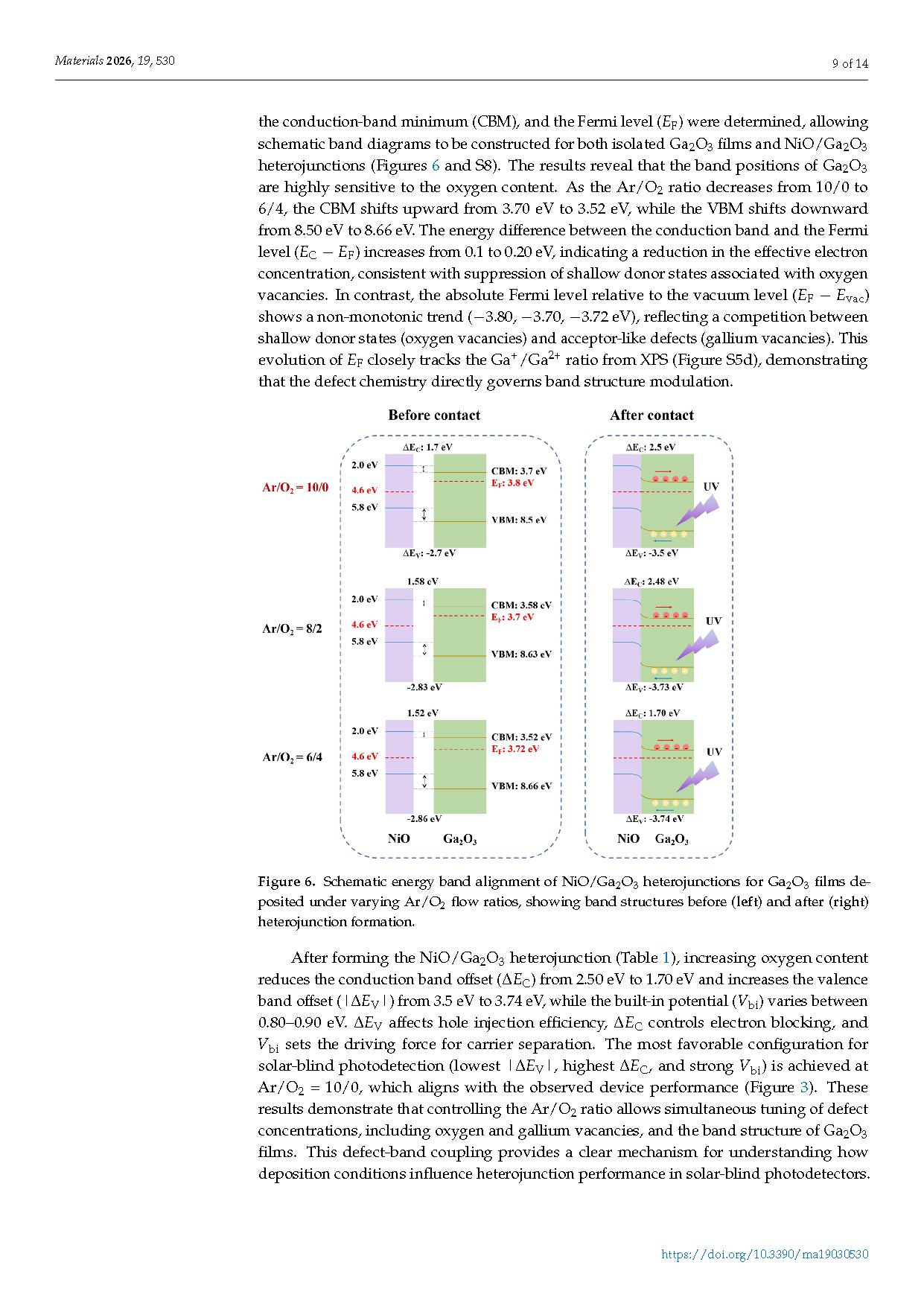
In this study, a synergistic optimization of the material properties and optoelectronic performance of Ga2O3 thin films was achieved by systematically controlling the Ar/O2 ratio during magnetron sputtering. As the oxygen proportion increased from 0% to 40%, the chemical composition of the films evolved markedly, with the oxygen-vacancy fraction decreasing from 36.7% to 31.2%, demonstrating effective regulation of intrinsic defect states. Although all Ga2O3 films remained amorphous, the controlled variation in the defect concentration induced pronounced modulation of the electronic structure and heterojunction energetics. In particular, with increasing oxygen content, the ΔEC decreases from 2.50 eV to 1.70 eV, the |ΔEV| increases from 3.5 eV to 3.74 eV, and Vbi varies from 0.80 eV to 0.90 eV, revealing the strong sensitivity of band alignment to oxygen-vacancy concentration.
Based on the optimized defect configuration and band alignment, the NiO/Ga2O3 vertical heterojunction device exhibits excellent self-powered solar-blind UV photodetector performance. Under zero bias, the optimized device achieves a responsivity of 47 mA W−1 at 254 nm, an ultrahigh wavelength rejection ratio (R254/R365) exceeding 104, and fast photoresponse characteristics with a rise time of 25 ms and a fall time of 63 ms. These results confirm the dual role of oxygen vacancies in solar-blind photodetection, simultaneously influencing UV absorption and heterojunction band alignment. More importantly, this work elucidates the critical correlation between process-induced defect density, band alignment, and device performance in Ga2O3-based solar-blind photodetectors.
Project Support
This work was supported by the Advanced Materials-National Science and Technology Major Project under Grant 2025ZD0615900 and 2024ZD0604100; and was supported in part by the National Key Research and Development Program of China (2024YFF1504501, 2022YFB3603805), the National Natural Science Foundation of China (62474070, 62074059), and the Natural Science Foundation of Guangdong (2025A1515010023).
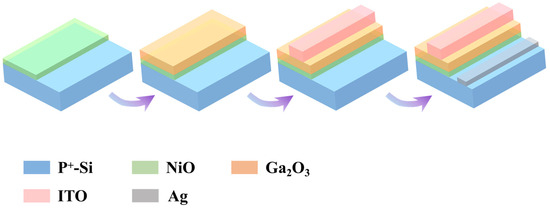
Figure 1. Schematic illustration of the sequential fabrication process for the NiO/Ga2O3 heterojunction UV photodetector.
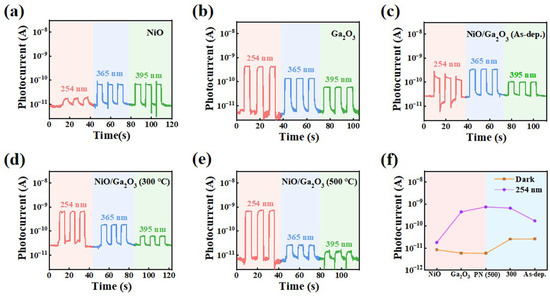
Figure 2. Time-dependent photocurrent responses of (a) single-layer NiO film, (b) single-layer Ga2O3 film, and NiO/Ga2O3 heterojunction devices under different annealing conditions: (c) as-deposited, (d) annealed at 300 °C, and (e) annealed at 500 °C. (f) Comparison of the dark current and photocurrent at 254 nm for all devices at zero bias.
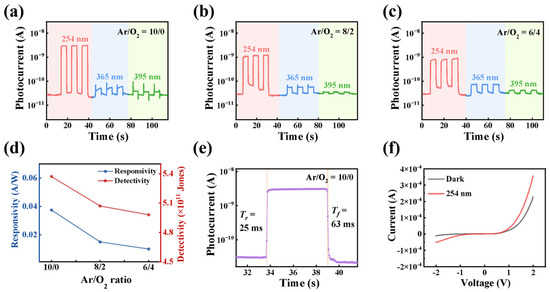
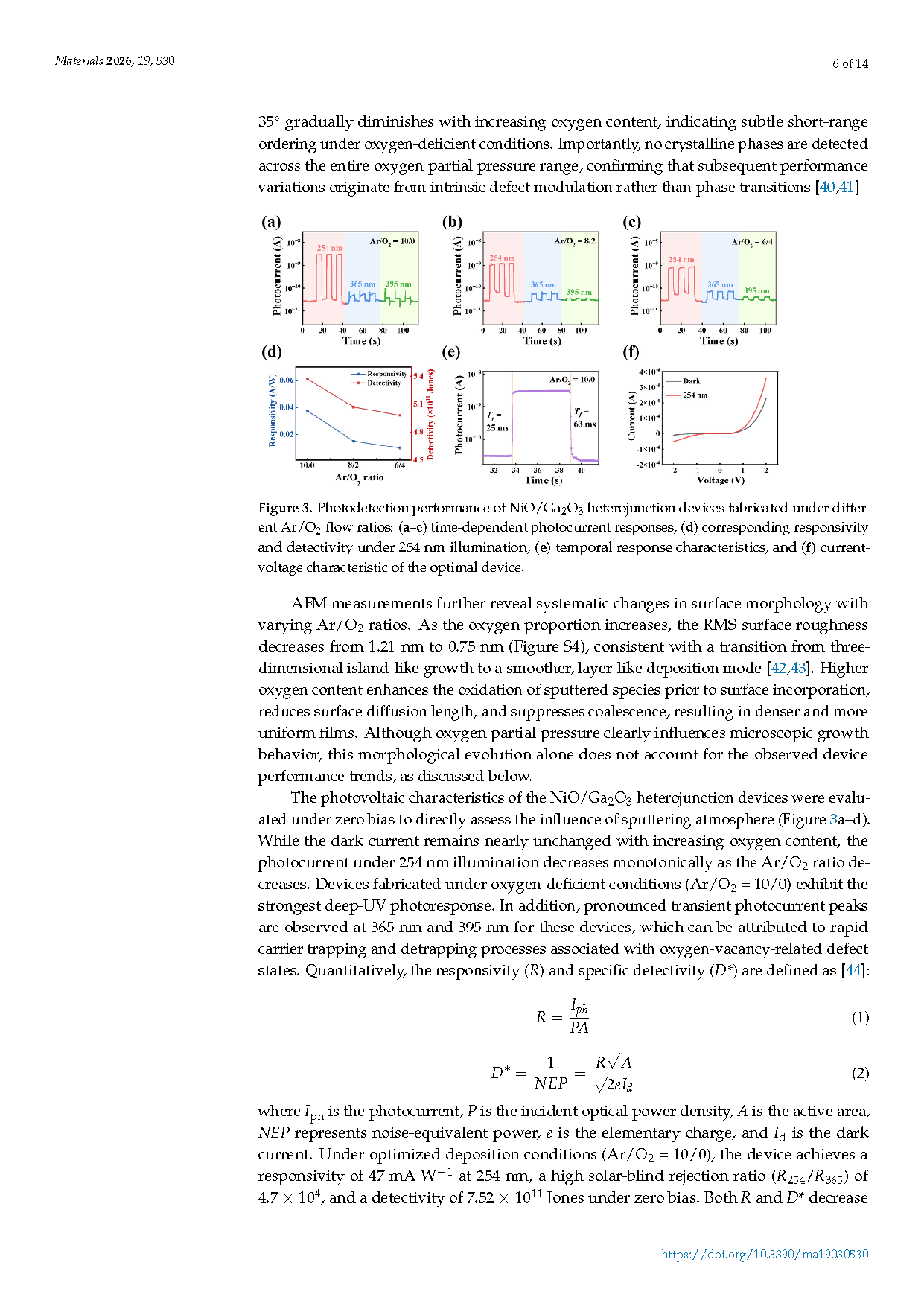
Figure 3. Photodetection performance of NiO/Ga2O3 heterojunction devices fabricated under different Ar/O2 flow ratios: (a–c) time-dependent photocurrent responses, (d) corresponding responsivity and detectivity under 254 nm illumination, (e) temporal response characteristics, and (f) current-voltage characteristic of the optimal device.
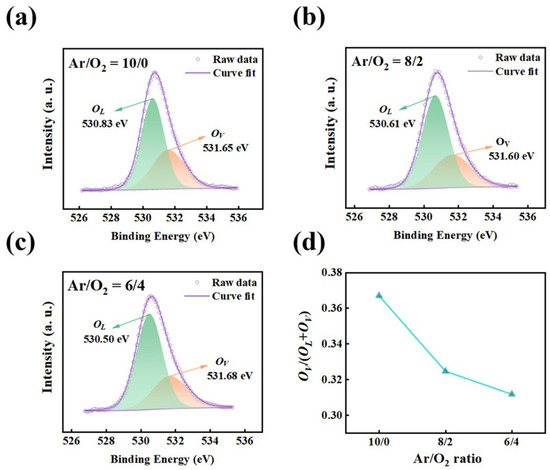
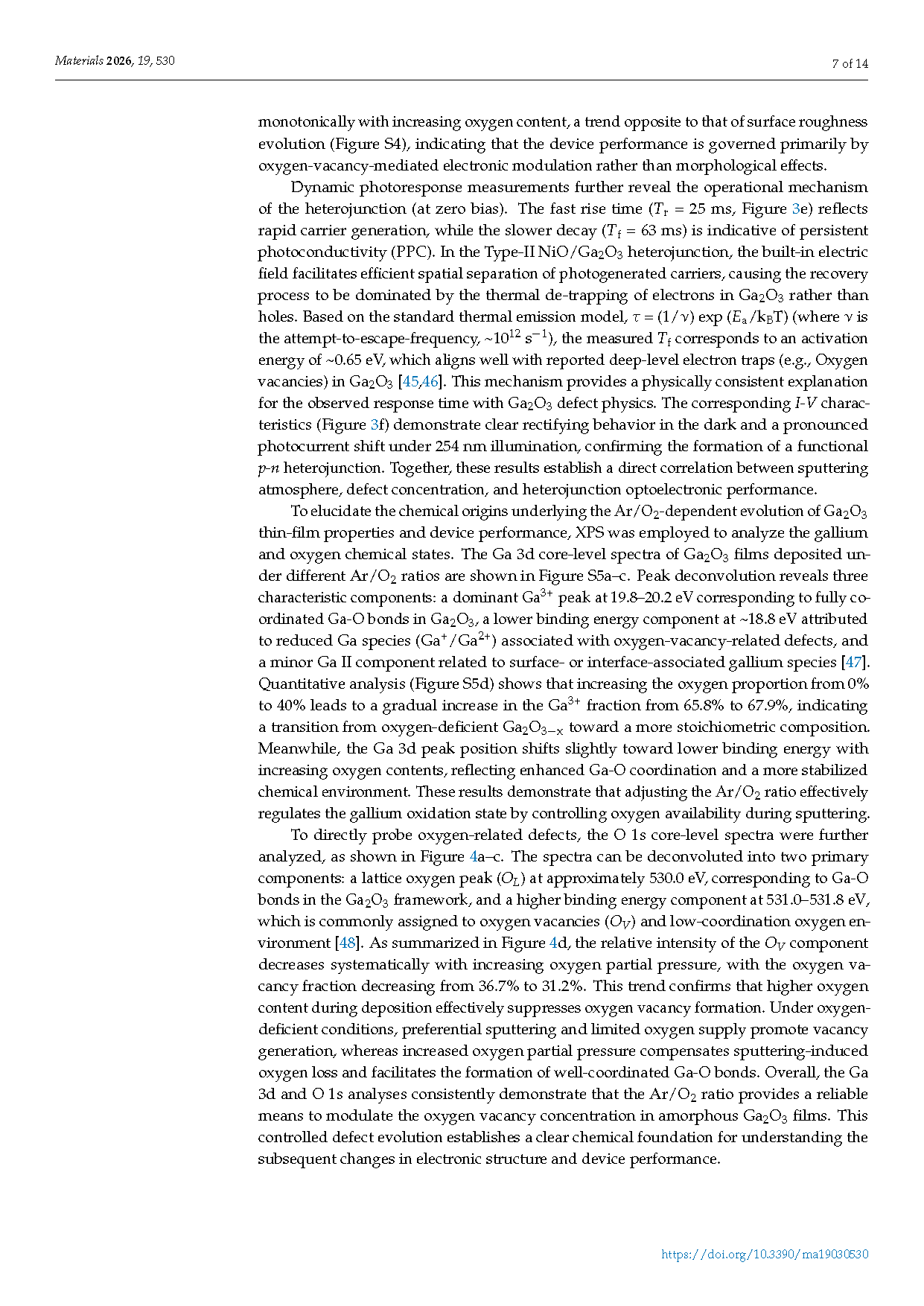
Figure 4. XPS analysis of Ga2O3 films deposited under different Ar/O2 flow ratios: (a–c) O 1s core-level spectra with peak deconvolution and (d) quantified oxygen vacancy fraction as a function of Ar/O2 ratio.
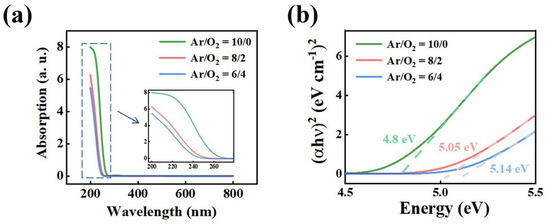
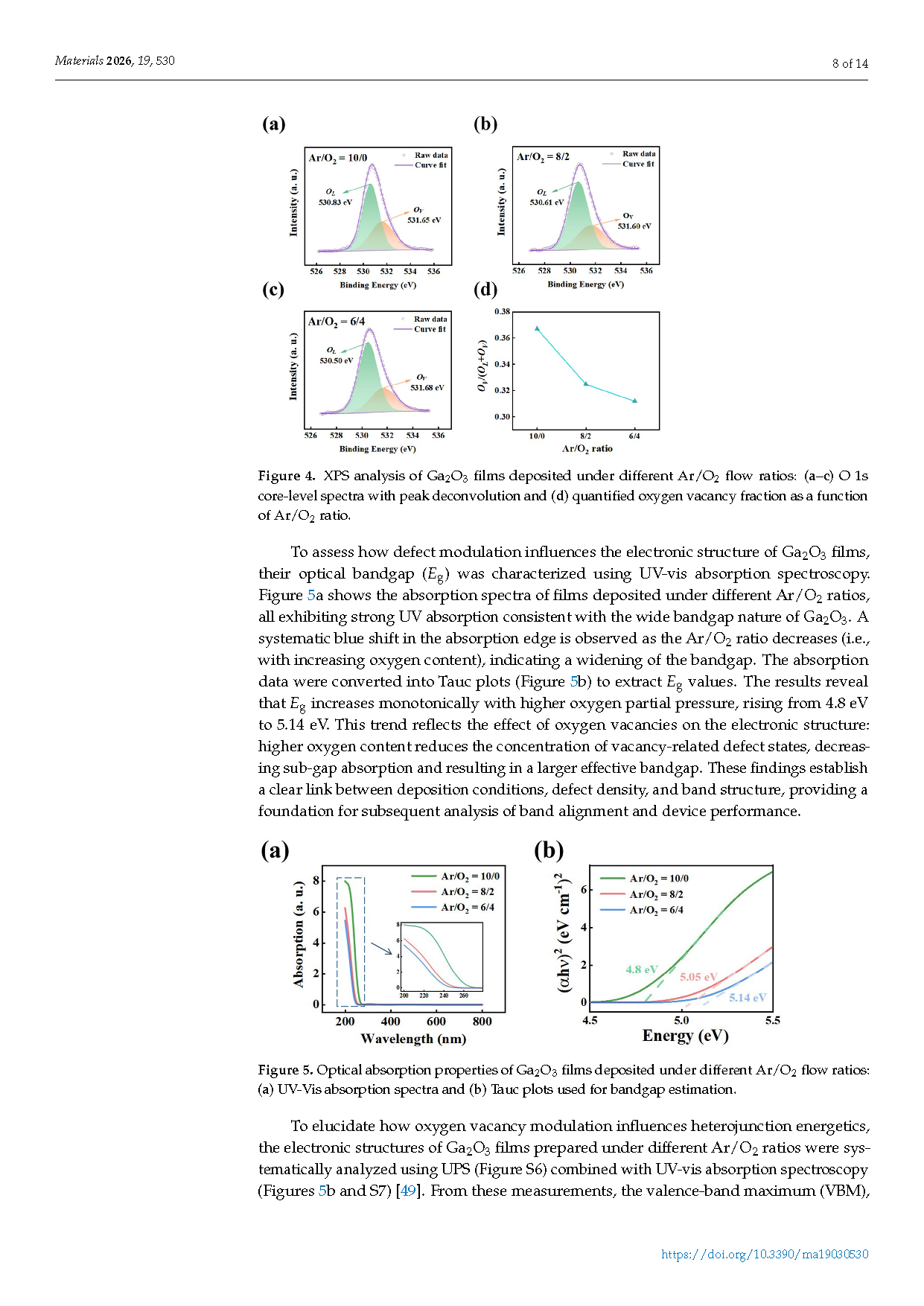
Figure 5. Optical absorption properties of Ga2O3 films deposited under different Ar/O2 flow ratios: (a) UV-Vis absorption spectra (b) Tauc plots used for bandgap estimation.
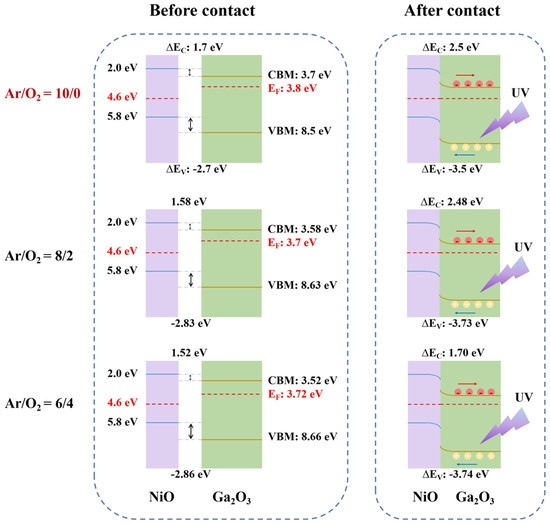
Figure 6. Schematic energy band alignment of NiO/Ga2O3 heterojunctions for Ga2O3 films deposited under varying Ar/O2 flow ratios, showing band structures before (left) and after (right) heterojunction formation.
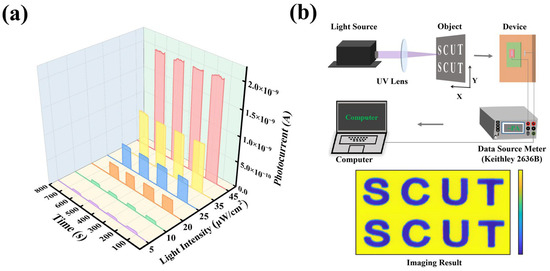
Figure 7. (a) Photocurrent response of the optimized NiO/Ga2O3 heterojunction device under 254 nm illumination, and (b) schematic of the solar-blind UV imaging setup with the reconstructed “SCUT” pattern.
DOI:
doi.org/10.3390/ma19030530
Instruction
Official Account

Cooperation
Top