

From April 23 to 25, 2026, the Jiufengshan Forum successfully concluded at the China Optics Valley Convention & Exhibition Center in Wuhan. As a flagship annual event in China’s compound semiconductor sector, this year’s forum was structured around the theme of “New Tracks, New Technologies, New Products, New Markets.” It brought together over a thousand enterprises and tens of thousands of professional attendees, showcasing the industry’s phased achievements and overall momentum across a 20,000-square-meter exhibition area.
During the forum, the “30 Years of China’s New-Quality Semiconductor Innovation and Development” exhibition was presented alongside the documentary New Power of Chips. Organized around the narrative of “foundation, surge, transformation, and renewal,” they systematically traced the evolution of China’s compound semiconductor industry. By intersecting historical context with current developments, they distilled key pathways of industrial progression and provided a clear reference framework for today’s industry landscape.
As one of the key highlights of the forum, the “New Product Launch Event” was held in the central exhibition area, where multiple companies across the industry chain unveiled their latest achievements spanning materials, devices, and equipment. From technological breakthroughs to product-level expression, the release of new products not only reflected a significant leap in corporate innovation capabilities, but also signaled an accelerating transition of the industry from technological accumulation to real-world application.
As technology, products, and industrial narratives increasingly align within a shared platform, what the Jiufengshan Forum conveys goes beyond scale and visibility—it signals a clearer shift: China’s compound semiconductor industry is moving from isolated technological breakthroughs toward systematic, integrated development.
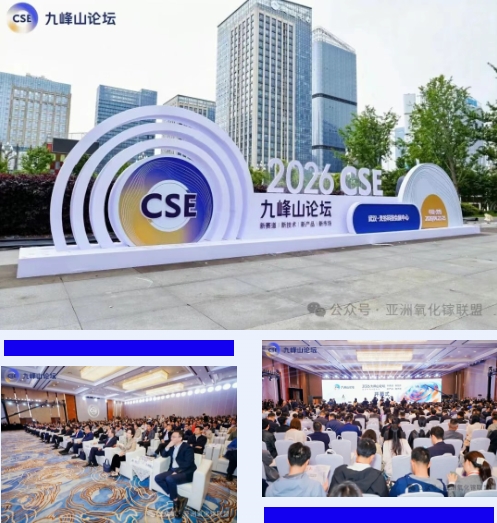
Over the course of three days, eight high-level forums led by leading academicians and experts were held, with more than 200 presentations delivered in intensive sessions. Over 300 leading enterprises showcased their latest developments, spanning the full value chain from materials and devices to applications. From technological breakthroughs to product deployment, multiple signals converged, not only demonstrating phased achievements but also reinforcing industry collaboration and alignment on development pathways.
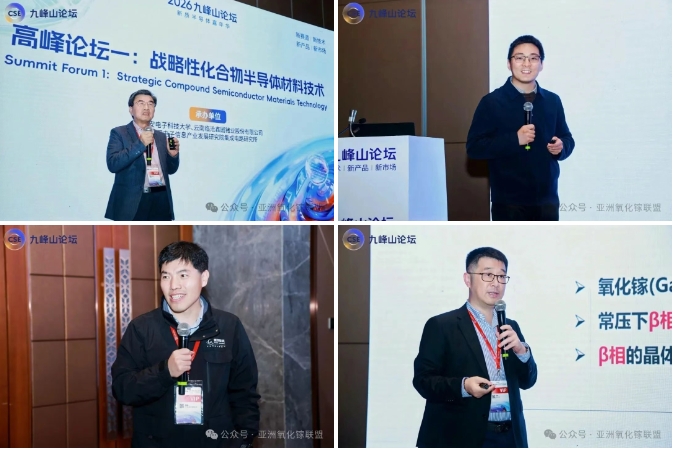
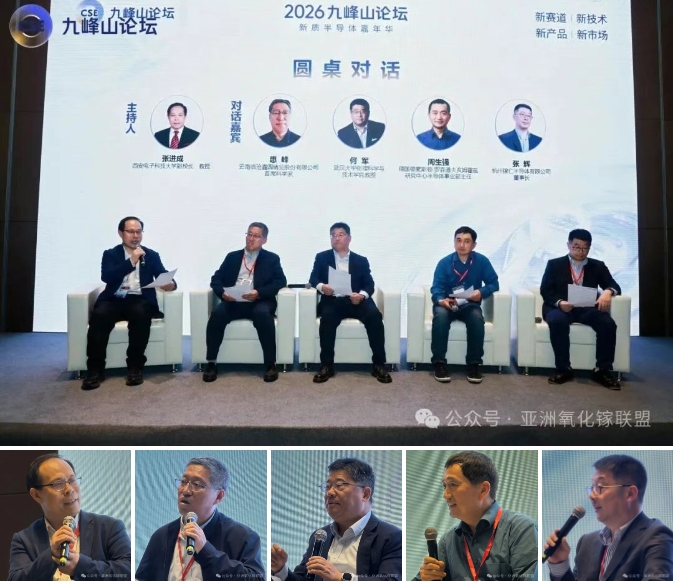
At the Strategic Compound Semiconductor Materials Technology Summit Forum led by Academician Hao Yue of Xidian University, the Alliance placed particular focus on several developments in the Gallium Oxide field. Zhang Daohua, Chief Scientist for fourth-generation semiconductors at Shenzhen Pinghu Laboratory, shared the latest research on ultra-wide bandgap semiconductors, further extending the performance boundaries of material systems. Qi Hongji, Deputy Researcher at the Shanghai Institute of Optics and Fine Mechanics, Director of Hangzhou Institute of Optics and Fine Mechanics, and Founder of Hangzhou Fujia Gallium Technology Co., Ltd., elaborated on the industrialization pathway through the breakthrough of 12-inch Gallium Oxide single crystals.
On the fundamental research front, Professor Zhang Zhaofu from the School of Integrated Circuits at Wuhan University presented recent progress in anisotropic irradiation damage and phase transition dynamics, providing key support for device reliability. From an industrial perspective, Zhang Hui, Chairman of Hangzhou GAREN Semiconductor Co., Ltd., systematically outlined six major challenges facing Gallium Oxide industrialization and shared the company’s latest progress based on its practical experience.
The roundtable session was moderated by Professor Zhang Jincheng, Vice President of Xidian University. The panel featured Hui Feng, Chief Scientist of Yunnan Germanium; He Jun, Professor at Wuhan University’s School of Physics and Technology; Zhou Shengqiang, Head of the Semiconductor Division at HZDR (Germany); and Zhang Hui, Chairman of Hangzhou GaRen Semiconductor. These experts engaged in a strategic dialogue on compound semiconductor materials and their industrialization, covering topics from material bottlenecks to industry–academia–research synergy and future applications.
Looking ahead to the 15th Five-Year Plan (2026-2030), fourth-generation ultra-wide bandgap (UWBG) semiconductors have been clearly identified as a strategic priority. Their significance in high-voltage, high-power applications and power electronics is becoming increasingly prominent. Specifically, gallium oxide—bolstered by its superior material properties and rapid industrial progress—is accelerating its transition from technical validation to commercial deployment, serving as a pivotal lever in the next evolution of the semiconductor industry.
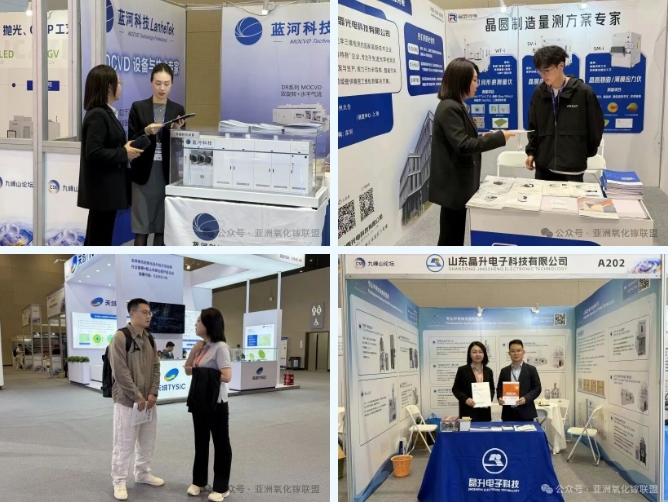
Additionally, ten alliance member units showcased their latest achievements in material preparation, equipment processes, and device applications at the forum's exhibition area. These included Jiufengshan Laboratory (JFS), SINANO (CAS), Shandong Jingsheng Electronics, Hangzhou GAREN Semiconductor, Shanghai Maotoo Specialty Gases, Vector Group, Fermion Instruments (Nanjing), Lanhe Technology (Shaoxing), Suzhou Raphael Optech , and Beijing Orient Semi.
Notably, Changlong Zhixin unveiled its pre-sale product matrix and officially joined the alliance by signing a strategic cooperation agreement. The two parties will focus on collaborative R&D in key segments—including epitaxial growth, device fabrication, and packaging/testing—to accelerate the transition of domestic products from engineering prototypes to large-scale commercial applications.
Overall, the exhibitors demonstrated significant progress in breaking through material bottlenecks, enhancing process capabilities, and expanding application horizons. This collective presentation highlights a development trend characterized by accelerated supply chain synergy and the continuous release of innovative momentum.
Leveraging the forum as a strategic opportunity, the Alliance conducted field visits and engaged with member units to gain in-depth insights into their progress and core needs across R&D, industrial promotion, and market expansion. These efforts provide a solid basis for optimizing the Alliance’s service system and resource allocation in a more targeted manner. Simultaneously, multi-dimensional exchanges were held regarding upstream-downstream synergy, technical cooperation, and application deployment, further strengthening the foundation for collaboration.
In terms of media partnership, the Alliance engaged in deep communication with industry media outlets such as Xiechuangwei (XC Micro) and DT Semiconductor. Discussions focused on content dissemination, brand co-building, and resource integration, laying the groundwork for enhancing industry influence, improving information outreach efficiency, and ensuring the continuous output of high-quality research and industrial achievements.
Overall, this year’s Jiufengshan Forum, centered on “New Tracks, New Technologies, New Products, New Markets,” showcased the phased achievements of the compound semiconductor industry while further strengthening collaboration and consensus on development pathways. From the continuous expansion of new material systems, to ongoing breakthroughs in key technologies, and the rapid evolution of product forms and application scenarios, the industry is accelerating its transition from point-based innovation to systematic, integrated development.
Looking ahead, with the continued focus on fourth-generation ultra-wide bandgap semiconductors during the “15th Five-Year Plan” period and the deepening of industrial chain collaboration, next-generation materials represented by Ga₂O₃ are poised to achieve large-scale breakthroughs in key areas such as high-voltage and high-power applications. This will further open up new application spaces and market boundaries, driving China’s compound semiconductor industry toward a higher-quality stage of development.
Instruction
Official Account

Cooperation
Top