


Researchers from the Nanjing University have published a dissertation titled "Strain transition and mosaicity evolution in m-plane nonpolar α-Ga2O3 heteroepitaxy" in Applied Physics Letters.
Background
Gallium oxide (Ga2O3), an ultra-wide-bandgap semiconductor with a critical breakdown field exceeding 8 MV/cm, has emerged as a promising platform for high-power electronics and deep-ultraviolet optoelectronics. While research has predominantly focused on the thermodynamically stable β-Ga2O3 due to the availability of large-scale melt-grown substrates, the corundum α-phase gallium oxide (α-Ga2O3) offers unique opportunities for heteroepitaxy on sapphire owing to their shared crystal symmetry. This compatibility enables oriented growth despite lattice mismatch and facilitates full-range AlxGa1-x)2O3 and (InxGa1-x)2O3 alloying for bandgap engineering, as well as the integration with p-type corundum oxides for all-oxide bipolar device architectures.
Abstract
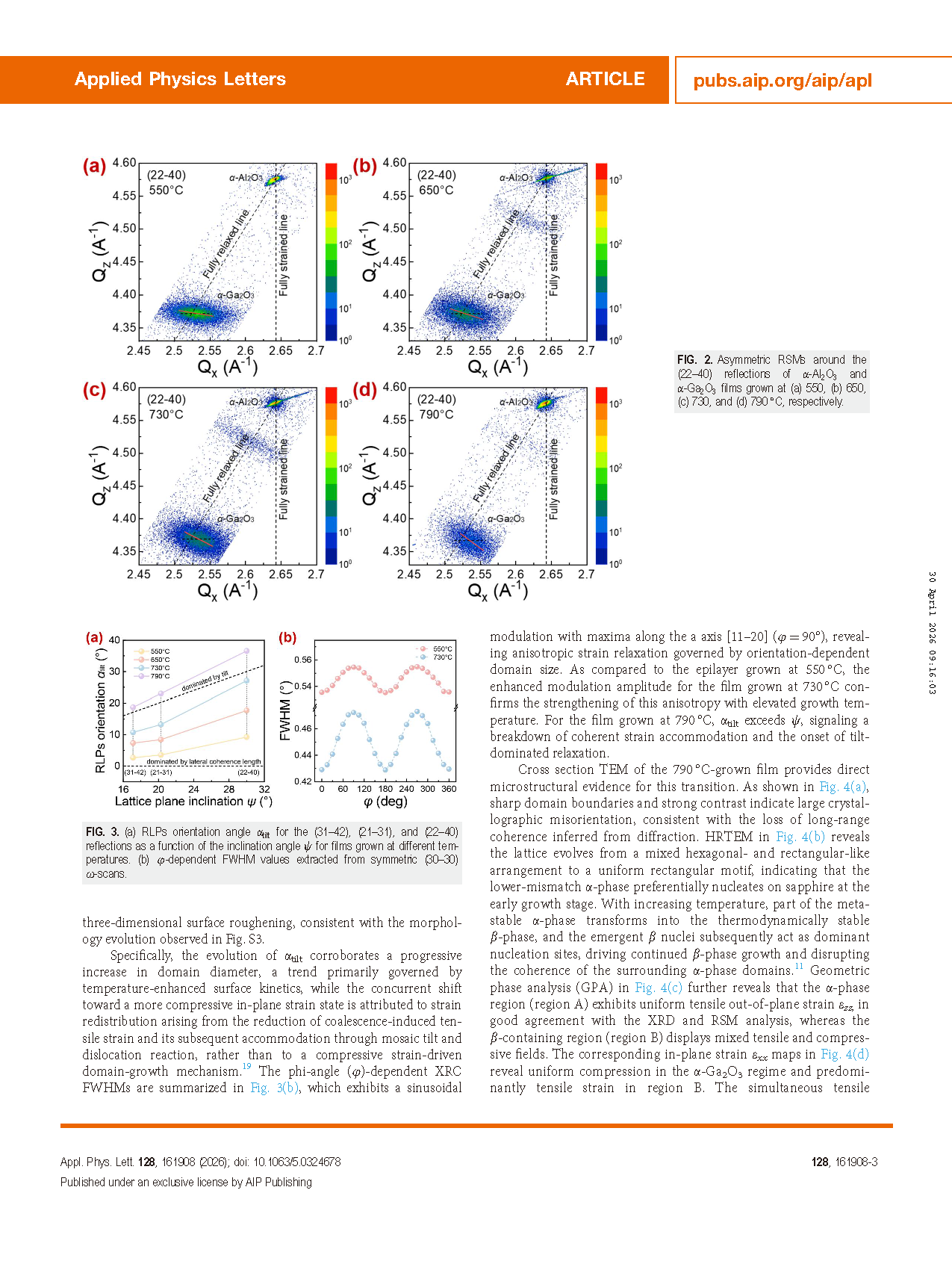
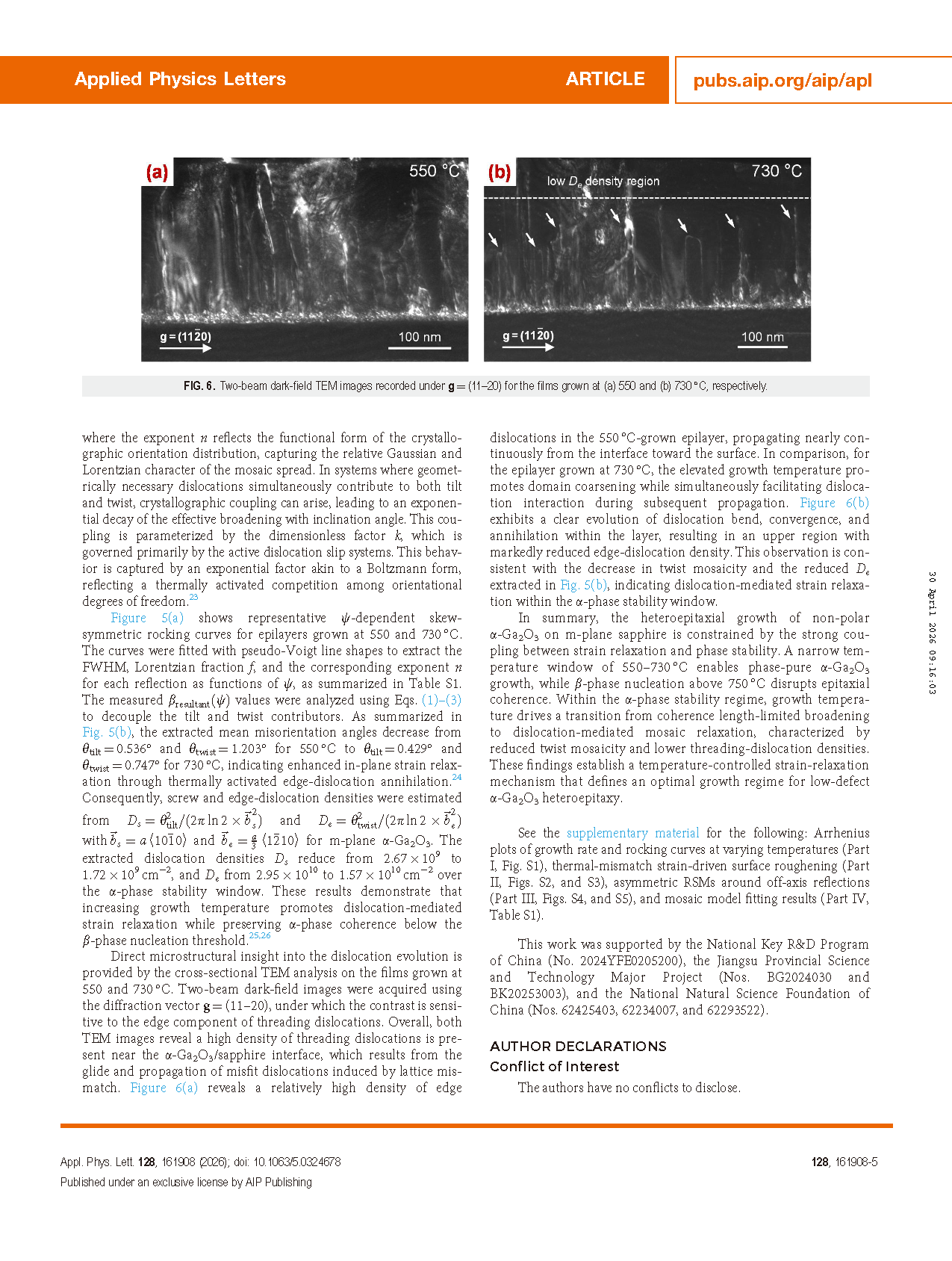
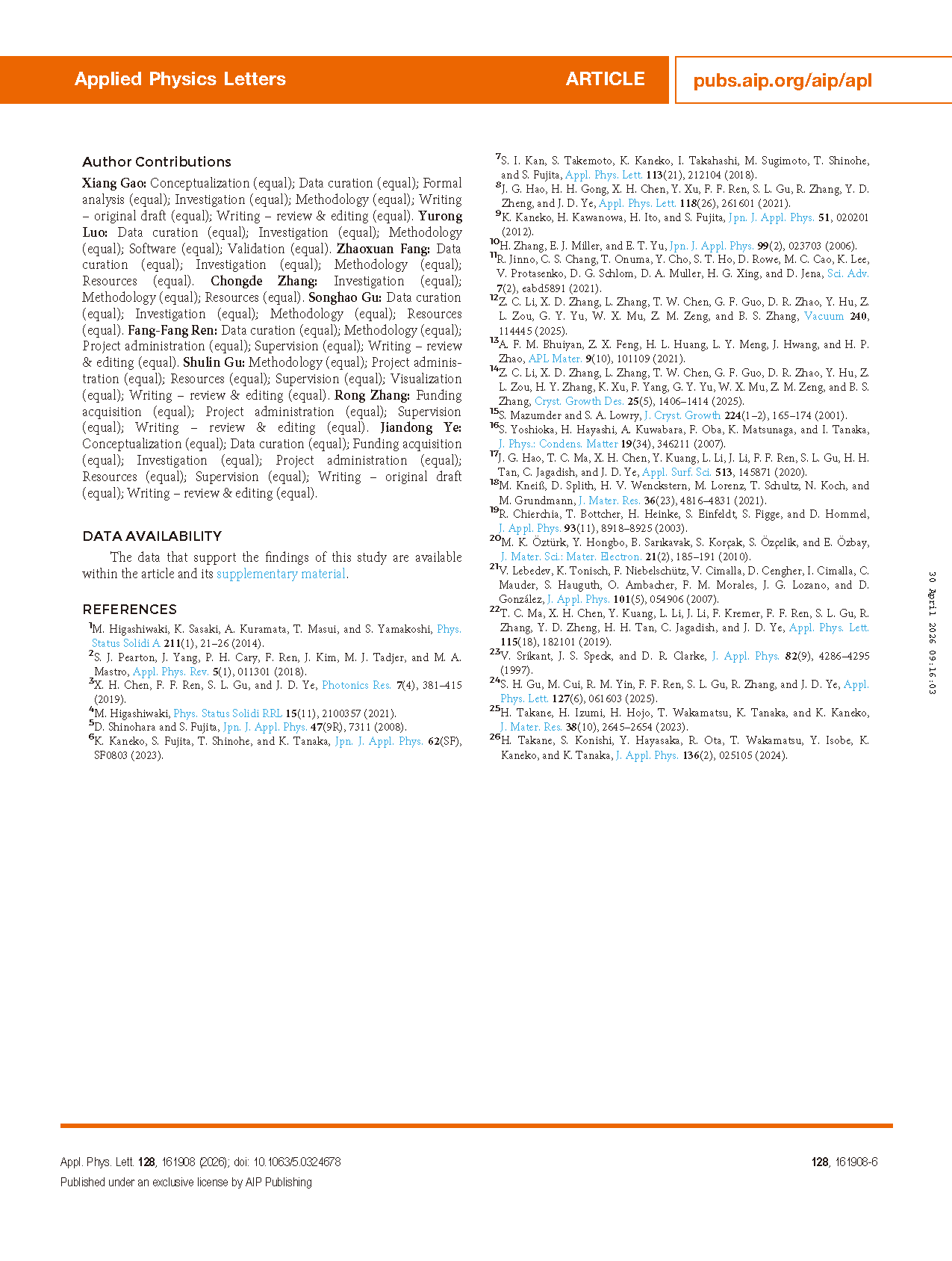
The heteroepitaxy of α-phase gallium oxide (α-Ga2O3) is fundamentally limited by its metastability and the strong coupling between strain relaxation and phase transformation. Here, non-polar α-Ga2O3 films were grown on m-plane sapphire by metal-organic chemical vapor deposition at 550–790 °C to elucidate growth temperature-driven strain evolution, lattice mosaicity, and phase stability. Phase-pure α-Ga2O3 is obtained within a narrow growth window of 550–730 °C, whereas β-phase nucleation above 750 °C disrupts epitaxial coherence. Reciprocal-space mapping reveals a temperature-driven transition from out-of-plane compressive to tensile strain accompanied by increasing in-plane compression, reflecting a crossover from coherent-length limited growth to tilt-dominated strain relaxation. ψ-dependent rocking-curve analysis reveals reduced twist mosaicity and threading-dislocation densities within the α-phase stability window, as confirmed by two-beam transmission electron microscopy, which also identifies α-to-β transformation and domain-boundary strain accumulation. These results establish a temperature-controlled strain-relaxation framework that defines an optimal growth regime for low-defect α-Ga2O3 heteroepitaxy.
Highlights
A pure-phase growth temperature window of 550–730 °C is determined for m-plane nonpolar α-Ga2O3, and α→β phase transformation occurs above 750 °C.
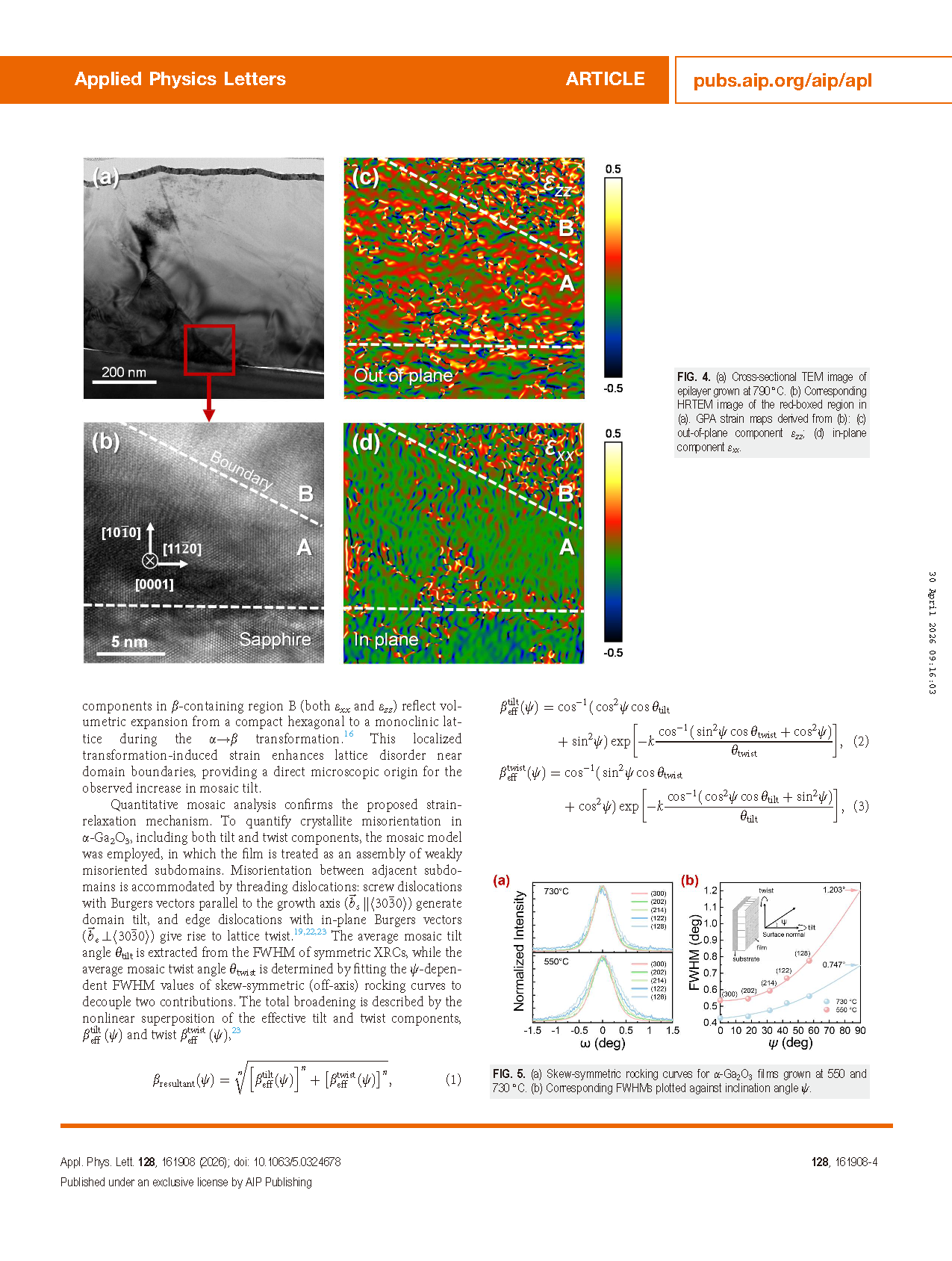
Temperature drives out-of-plane strain from compressive to tensile, and the growth mechanism transitions from coherence limitation to dislocation-dominated mosaic relaxation.
Twist mosaicity and threading dislocation density are significantly reduced within the α-phase stable temperature window, establishing a temperature-controlled mechanism for low-defect epitaxy.
Conclusion
In summary, the heteroepitaxial growth of non-polar α-Ga2O3 on m-plane sapphire is constrained by the strong coupling between strain relaxation and phase stability. A narrow temperature window of 550–730 °C enables phase-pure α-Ga2O3 growth, while β-phase nucleation above 750 °C disrupts epitaxial coherence. Within the α-phase stability regime, growth temperature drives a transition from coherence length-limited broadening to dislocation-mediated mosaic relaxation, characterized by reduced twist mosaicity and lower threading-dislocation densities. These findings establish a temperature-controlled strain-relaxation mechanism that defines an optimal growth regime for low-defect α-Ga2O3 heteroepitaxy.
Project Support
This work was supported by the National Key R&D Program of China (No. 2024YFE0205200), the Jiangsu Provincial Science and Technology Major Project (Nos. BG2024030 and BK20253003), and the National Natural Science Foundation of China (Nos. 62425403, 62234007, and 62293522).
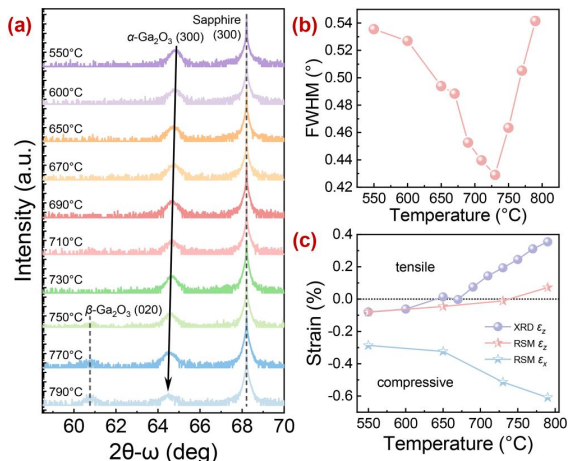
Fig. 1 (a) XRD 2θ–ω patterns of α-Ga2O3 epilayers grown on m-plane sapphire substrates at different temperatures. (b) FWHM of rocking curves as a function of growth temperature. (c) Extracted strain values from XRD and RSM shifts.
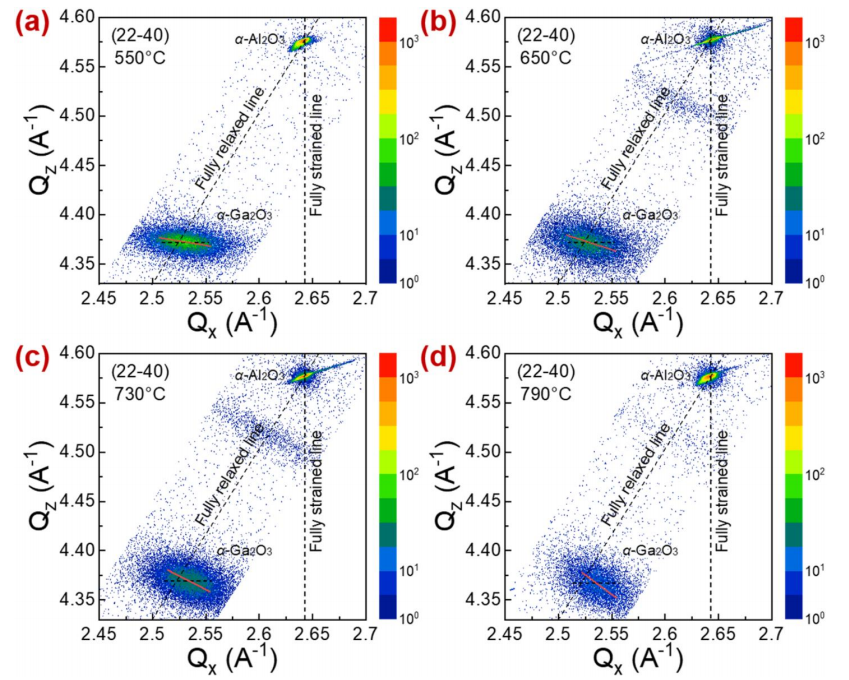
Figure 2.Asymmetric RSMs around the (22–40) reflections of α-Al2O3 and α-Ga2O3 films grown at (a) 550, (b) 650, (c) 730, and (d) 790 °C, respectively.
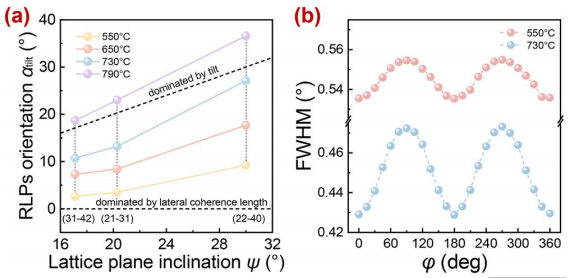
Figure 3. (a) RLPs orientation angle αtilt for the (31–42), (21–31), and (22–40) reflections as a function of the inclination angle ψ for films grown at different temperatures. (b) ψ-dependent FWHM values extracted from symmetric (30–30) x-scans.
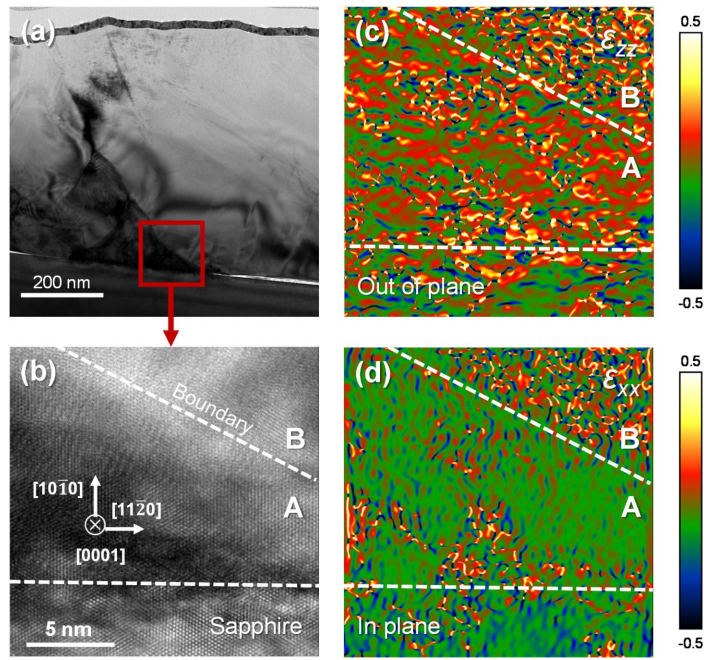
Figure 4. (a) Cross-sectional TEM image of epilayer grown at 790 °C. (b) Corresponding HRTEM image of the red-boxed region in (a). GPA strain maps derived from (b): (c) out-of-plane component εzz; (d) in-plane component εxx.
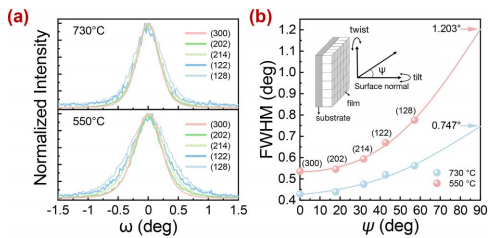
Figure 5. (a) Skew-symmetric rocking curves for α- films grown at 550 and 730 °C. (b) Corresponding FWHMs plotted against inclination angle ψ.
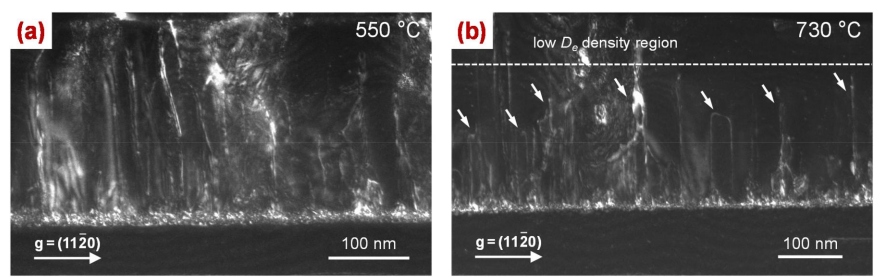
Figure 6. Two-beam dark-field TEM images recorded under g=(11–20) for the films grown at (a) 550 and (b) 730 °C, respectively.
DOI:
doi.org/10.1063/5.0324678
Instruction
Official Account

Cooperation
Top