


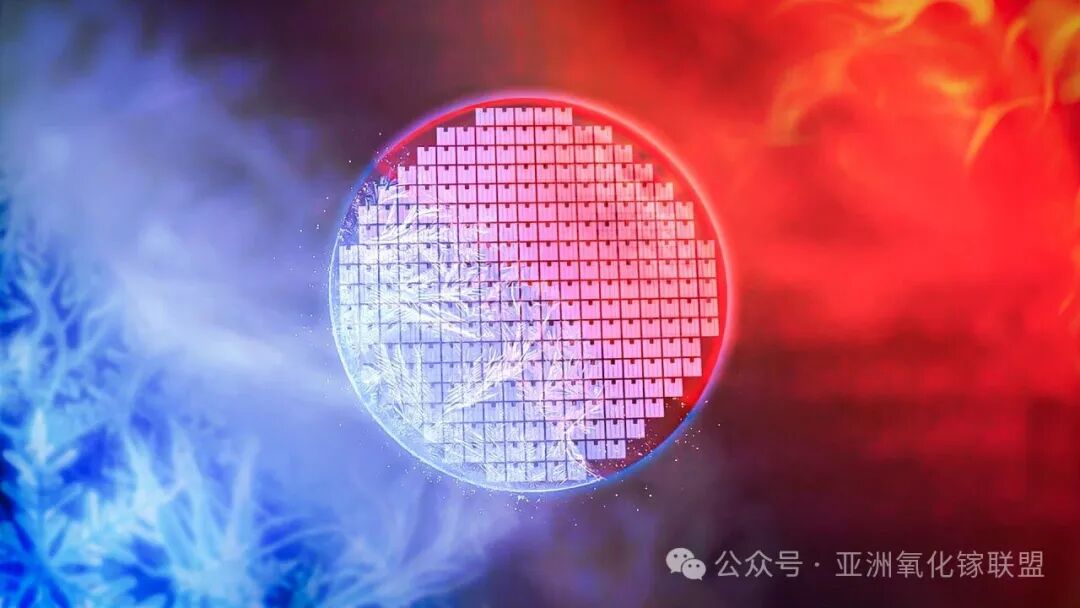
“Space probes face huge temperature swings, so devices that work from a few kelvin to hundreds of kelvin — like beta-gallium oxide — could reduce the need for bulky thermal protection.”— KAUST Research Team
In conventional understanding, electronic devices have always had clear “operating temperature limits.”
At high temperatures, excessive leakage currents degrade device performance. At extremely low temperatures, electrons become “frozen,” losing their ability to move freely. In applications such as deep-space exploration and quantum computing, electronic systems therefore rely heavily on complex and bulky thermal management infrastructure to remain operational.
Now, an ultrawide-bandgap semiconductor is beginning to challenge that boundary.
Researchers at King Abdullah University of Science and Technology (KAUST) recently demonstrated that electronic devices based on beta-gallium oxide (β-Ga₂O₃) can operate stably at just 2 K — a temperature colder than most deep-space environments and close to the operating regime of quantum computing systems.
The result suggests that gallium oxide is not only a high-temperature semiconductor, but also a promising candidate for electronics designed to function across extreme cryogenic conditions.
Computer chips, sensors, and virtually all modern electronic systems rely on semiconductors to conduct electricity.
Inside a semiconductor lies an energy barrier known as the “band gap.” Electrons must gain sufficient energy to cross this gap and contribute to electrical conduction. However, as temperature decreases, thermal energy diminishes, and electrons become trapped near their parent atoms instead of moving freely through the material.
This phenomenon is known as “freeze-out.”
According to Vishal Khandelwal, a former Ph.D. student in Xiaohang Li’s group at KAUST and the lead experimental researcher on the project: “In practice, most conventional electronics start to fail as you go below about 100 K (−173 °C).”
Ironically, many frontier technologies require precisely these ultralow-temperature environments.
Quantum computers commonly operate near 4 K, while space probes must survive dramatic temperature fluctuations far beyond those experienced on Earth. As a result, these systems often require elaborate cryogenic control and thermal shielding systems, significantly increasing cost, size, and system complexity.
For years, β-Ga₂O₃ has primarily been recognized for its exceptional high-voltage and high-temperature capabilities.
As an ultrawide-bandgap semiconductor, gallium oxide exhibits a critical breakdown field far higher than that of conventional silicon while maintaining low leakage currents. Previous studies from the KAUST team already demonstrated that gallium oxide devices could operate at temperatures as high as 500°C and withstand harsh radiation environments.
This time, however, the researchers pushed the material toward the opposite extreme: ultracold operation.
The team developed two silicon-doped β-Ga₂O₃ devices:
A fin field-effect transistor (FinFET)
A logic inverter (NOT gate)
The FinFET employs fin-shaped channels that provide improved stability and electrical performance compared with traditional transistor architectures. The inverter, meanwhile, is one of the most fundamental building blocks in digital circuits.
Remarkably, both devices maintained stable operation at just 2 K.
Under normal circumstances, there is almost no thermal energy available at 2 K to help electrons enter the conduction band.
However, silicon doping introduced an alternative conduction mechanism.
According to the researchers, silicon atoms create a special “impurity band” inside β-Ga₂O₃. Instead of relying on conventional thermal activation, electrons can move through hopping transport between these impurity states, allowing current to continue flowing even under extreme cryogenic conditions.
In other words:
While electrons in many conventional semiconductors become immobilized at ultralow temperatures, electrons in gallium oxide can still find another pathway to move.
Although electronic devices operating at 2 K have been demonstrated before, this marks the first time an ultrawide-bandgap semiconductor has been used to realize both transistors and logic inverters at such low temperatures.
The significance of this achievement goes beyond simply proving that the devices “work.”
More importantly, it points toward the possibility of building complete cryogenic electronic systems based on a single material platform.
“As a practical matter, it allows the development of compact cryogenic circuits made from one material,” said Xiaohang Li.
For quantum computing, this could simplify cryogenic electronic architectures. For space applications, the implications may be even more substantial.
“Space probes face huge temperature swings, so devices that work from a few kelvin to hundreds of kelvin — like beta-gallium oxide — could reduce the need for bulky thermal protection,” Li added.
Instruction
Official Account

Cooperation
Top