


In the semiconductor world, there exists a class of devices known as the “lifeline of high-voltage systems” — photoconductive switches. These devices are at the core of high-voltage direct current (HVDC) transmission, advanced radar systems, and pulsed power technologies. Whoever masters photoconductive switches with higher breakdown voltage and faster response speed holds the key to future ultra-high-voltage technologies.
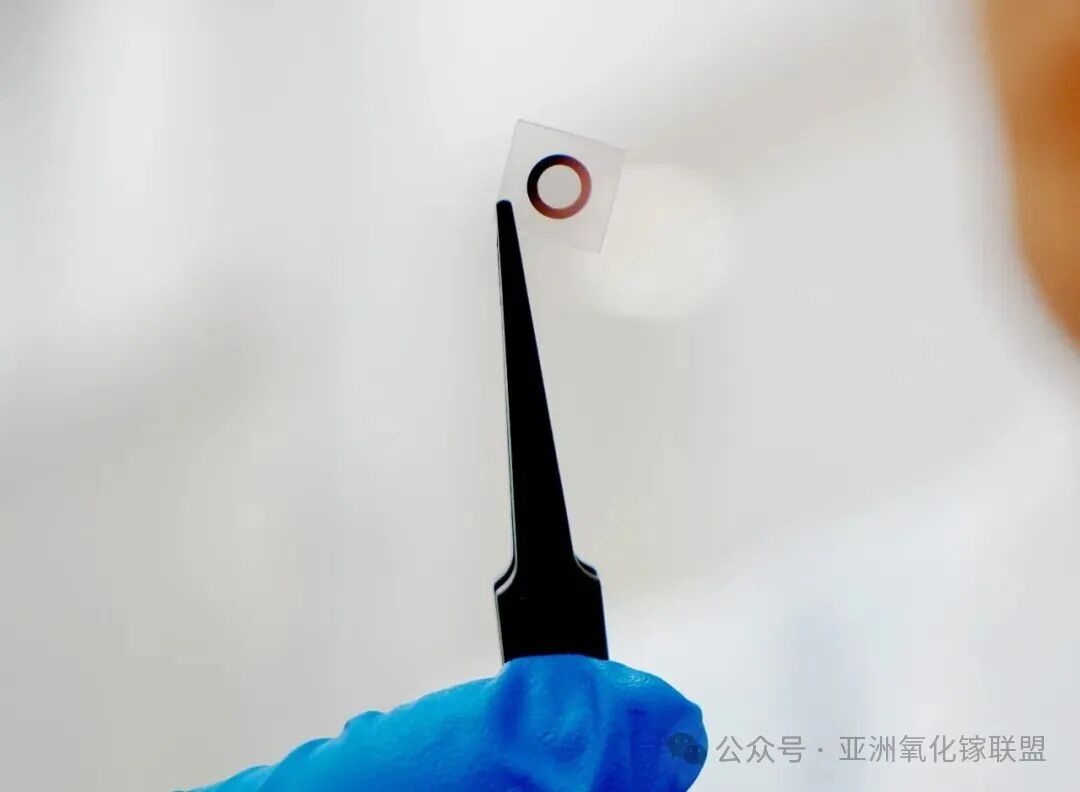
Recently, the fourth-generation semiconductor team at Shenzhen Pinghu Laboratory achieved another major breakthrough. Following the successful development of a 10 kV-class vertical-structure gallium oxide photoconductive switch, the team has now developed an Mg-doped gallium oxide photoconductive switch using domestically produced gallium oxide materials supplied by Hangzhou GAREN SEMI.
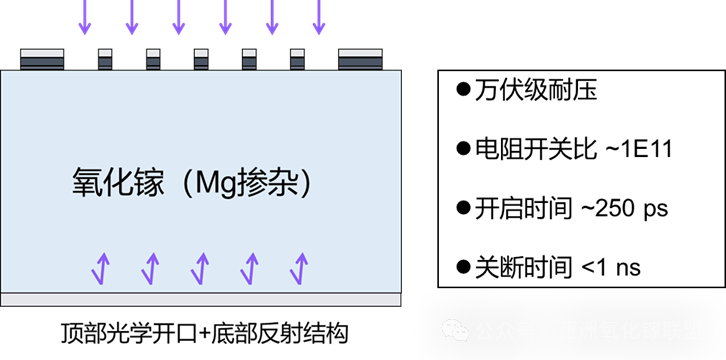
The new device features ultrafast response speed, an ultra-high switching ratio, and ultra-high voltage endurance exceeding 10 kV. Benefiting from the deep-level compensation effect introduced by Mg doping, the device achieved a breakdown field exceeding 220 kV/cm, an on/off ratio as high as 1×10¹¹, and a turn-off time of less than 1 ns. This breakthrough sets a new performance benchmark and represents a major leap forward in the fourth-generation semiconductor field.
PART 01 Endless Pursuit of Higher Performance: Further Advancing Ultra-High-Voltage Gallium Oxide Photoconductive Switches
Looking back to February 2026, the fourth-generation semiconductor team at Shenzhen Pinghu Laboratory successfully developed a 10 kV-class vertical gallium oxide photoconductive switch. The device achieved a breakdown voltage exceeding 10,000 V, a dynamic on-resistance below 10 Ω, and a sub-nanosecond response time, laying a solid foundation for the industrialization of China’s high-voltage gallium oxide devices.
But scientific exploration never stops.
Driven by a determination to continuously push technological boundaries and achieve rapid new breakthroughs, the team launched a new round of research challenges. The core strategy focused on dopant engineering optimization — replacing traditional Fe doping with Mg doping. In collaboration with domestic material supplier Hangzhou GAREN SEMI and based on its independently produced high-quality gallium oxide materials, the team initiated a new phase of technological advancement.
PART 02 Key Breakthrough: Mg Doping Unlocks Three “Super Switch” Capabilities
After countless experiments and repeated parameter optimizations, the team finally achieved a major breakthrough: the successful development of the first gallium oxide 10 kV-class photoconductive switch device, delivering a qualitative leap in three core performance metrics.
Part.01 Ultra-High Voltage Endurance: Withstanding Electric Fields Above 220 kV/cm
Benefiting from the deep-level compensation effect introduced by Mg doping, the device can stably withstand ultra-high electric fields exceeding 220 kV/cm. It is truly a “high-voltage powerhouse,” capable of operating reliably under extreme high-voltage conditions.
Part.02 Ultra-Low Dark Current with an On/Off Ratio Reaching 1×10¹¹
Dark current is one of the key indicators of switch performance. Higher leakage current leads to greater power loss and poorer stability. The Mg-doped device achieved an extremely low dark-state current, increasing the on/off ratio to the 1×10¹¹ level — approximately two orders of magnitude higher than current mainstream industry standards. This effectively overcomes the longstanding challenge of conventional devices suffering from incomplete turn-off and excessive leakage.
Part.03 Ultrafast Response Speed with Turn-Off Time Below 1 ns
Beyond high-voltage endurance and low power loss, switching speed is equally critical. Thanks to the unique advantages of Mg doping, the device achieved a turn-off time of less than 1 ns and an ultra-fast turn-on response of 250 ps, enabling both “ultra-fast switching on” and “ultra-fast switching off.” This makes it ideally suited for applications with extreme speed requirements, such as pulsed power systems and advanced radar technologies.
A core team member stated:“Doping engineering is the key to optimizing the performance of gallium oxide photoconductive switches. This breakthrough with Mg doping not only validates the feasibility of this approach, but also paves the way for the practical application of next-generation high-performance optically controlled power devices.”
Equally noteworthy is that this “super switch” was developed entirely using domestically produced materials, representing a fully homegrown device and further strengthening the foundation for independent and controllable fourth-generation semiconductor technologies in China.
Closing Remarks
This ultra-high-voltage Mg-doped gallium oxide photoconductive switch is aimed at addressing major national strategic needs, with application scenarios spanning multiple critical fields, including high-voltage direct current (HVDC) transmission, pulsed power scientific facilities, and advanced radar systems.
Through two milestone breakthroughs, the fourth-generation semiconductor team at Pinghu Laboratory has enabled China to maintain a leading position in the field of gallium oxide photoconductive switches.
Looking ahead, as gallium oxide material growth and doping technologies continue to advance, photoconductive switches based on different doping strategies are expected to emerge one after another. These devices will play important roles across a growing number of strategic sectors and become a key driving force for technological self-reliance and innovation.
Instruction
Official Account

Cooperation
Top