


Researchers from the Xidian University have published a dissertation titled " Ultrafast and Sensitive NiO/Ga2O3 Lateral Superjunction Photodetectors for Solar-Blind Ultraviolet Detection " in IEEE Electron Device Letters.
Background
Ga₂O₃ has become a core candidate for solar‑blind ultraviolet photodetectors owing to its ultra‑wide bandgap of 4.9–5.2 eV and excellent chemical and thermal stability. In recent years, Ga₂O₃‑based solar‑blind photodetectors have achieved ultrahigh responsivity of hundreds to thousands of A/W, but generally suffer from a critical bottleneck of slow response speed (mostly tens of milliseconds or even seconds). The incompatibility between high responsivity and fast response greatly restricts their practical applications in UV sensing, imaging and other scenarios. At present, there are two main approaches to improve performance: one is to enhance material quality to reduce defect density and suppress carrier recombination; the other is to optimize device structures (such as Schottky diodes, p‑n junctions) to accelerate carrier separation via strong built‑in electric fields. However, it is still challenging to simultaneously achieve high sensitivity and fast response under weak UV illumination. To this end, this work proposes a lateral superjunction strategy, which introduces multiple localized built‑in electric fields using periodically arranged NiO/Ga₂O₃ heterojunctions to break the trade‑off between gain and speed, and realize high photoresponse and fast transient characteristics simultaneously.
Abstract
Ultrahigh responsivity has been reported in Ga₂O₃ solar-blind photodetectors, but their response speed still remains a significant challenge for practical applications. Here,lateral NiO/Ga₂O₃ superjunction p-n photodetectors are demonstrated, simultaneously achieving high responsivity and fast response. The devices exhibit a record photo to dark current ratio of 8.50 × 10⁸, a high responsivity of 3.92 A/W, an excellent detectivity of 1.02 ×10¹⁵ Jones at 254 nm, and fast rise/decay times of 493/477 µs. The excellent performance is attributed to the periodically arranged NiO/Ga₂O₃ heterointerfaces, which introduce multiple localized built-in electric fields that promote efficient carrier separation, suppress recombination, and shorten the effective carrier transit distance. These results demonstrate the great potential of Ga₂O₃ superjunctions for solar-blind photodetection.
Highlights
A lateral NiO/Ga₂O₃ superjunction solar‑blind UV photodetector is firstly proposed and realized, breaking the trade‑off between gain and speed in conventional structures.
Periodic heterointerfaces construct multiple localized built‑in electric fields, greatly improving carrier separation efficiency, suppressing recombination and shortening transit paths.
Achieves a record PDCR of 8.50×10⁸, a detectivity of 1.02×10¹⁵ Jones and an ultra‑fast response of 493/477 µs.
The device maintains high sensitivity and fast response under weak light, suitable for weak solar‑blind UV signal detection.
Conclusion
In summary, we have demonstrated a p-NiO/n-Ga₂O₃ heterojunction photodetector with lateral superjunction structure. The periodically arranged NiO/Ga₂O₃ p-n heterointerfaces generate multiple localized built-in electric fields, enabling efficient carrier separation, reduced recombination, and shortened carrier transit paths, thus improving both carrier collection efficiency and response speed. As a result, the photodetector achieves a record PDCR 8.50 ×10⁸, a high R of 3.92 A/W, an excellent detectivity (D*) of 1.02 ×10¹⁵ Jones and fast rise/decay times of 493/477 µs. This work provides an innovative structure of a lateral superjunction, which exhibits tremendous potential for weak-light-sensitive solar-blind photodetection.
Project Support
National Natural Science Foundation of China (Grant No. 62404176); the Fundamental Research Funds for the Central Universities (XJSJ24100)
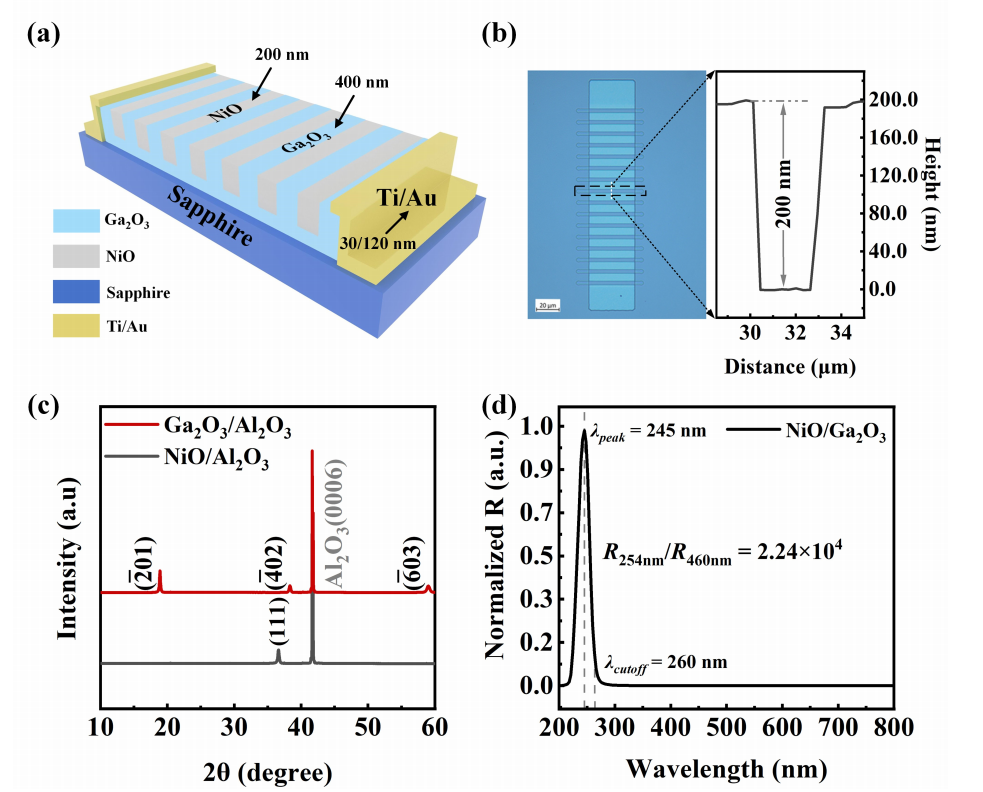
Figure 1. (a) Schematic and (b) optical microscope images (left) and AFM diagram (right) of the Ga₂O₃ superjunction photodetector. (c) XRD patterns of the Ga₂O₃ and NiO epitaxial film. (d) Spectral responsivity of the Ga₂O₃ superjunction photodetector.
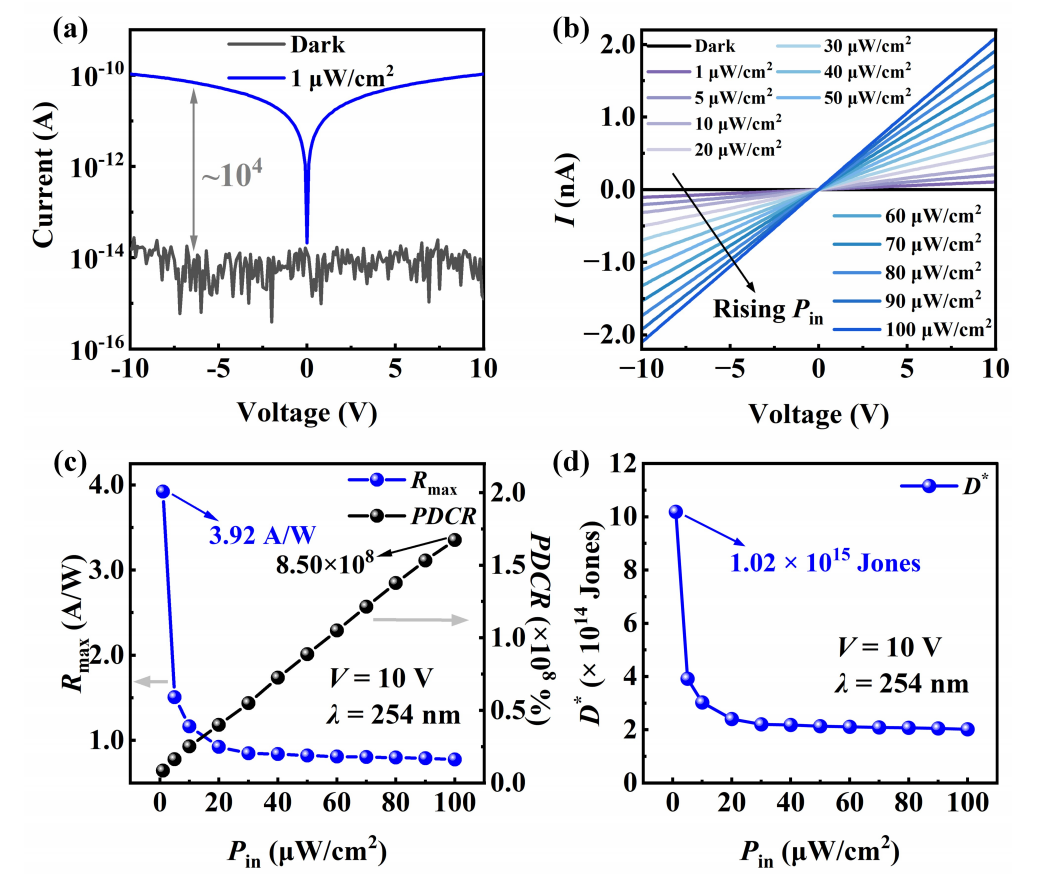
Figure 2. (a) Semi-log I-V characteristics under dark and 254 nm UV illumination at 1 μW/cm². (b) I-V characteristics of the photodetector under illumination of 254 nm with various light intensities. The dependence of (c) R, PDCR and (d) D* on the light power density.
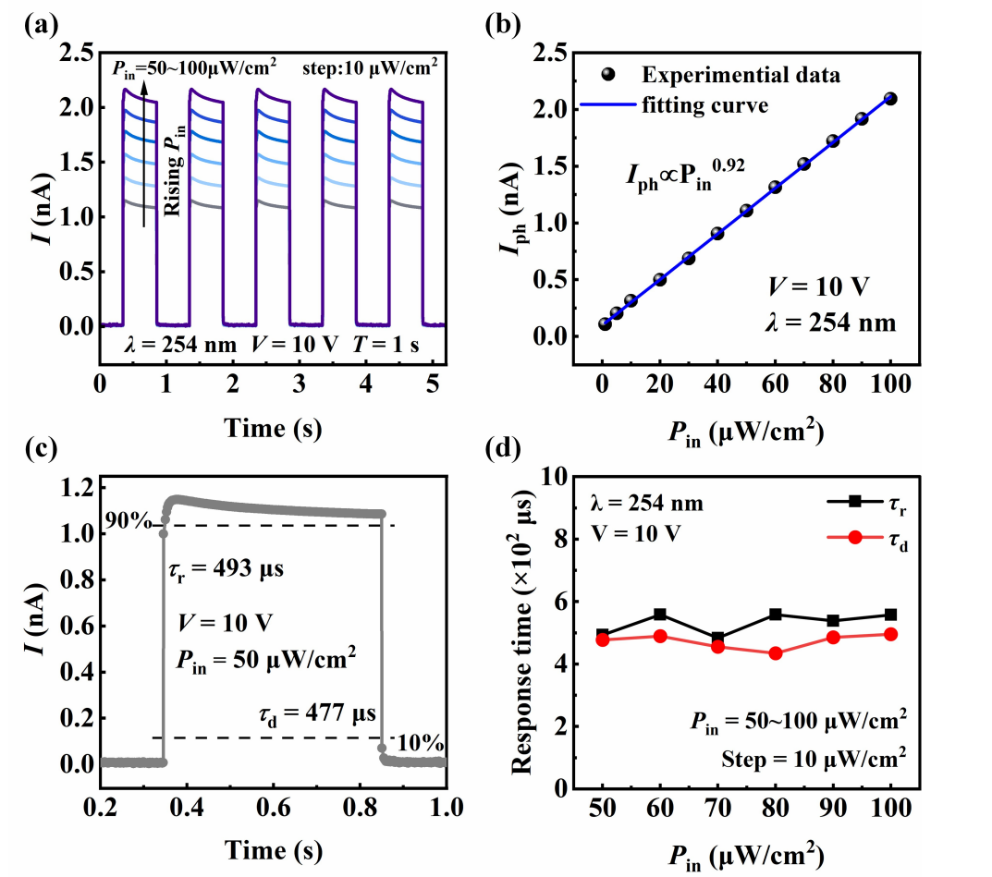
Figure 3. (a) Time-dependent response under 254 nm illumination with different light intensities. (b) The dependence of Iph on the light power density. (c) Enlarged rise and decay edge in one typical I-T period of the Ga₂O₃ superjunction photodetector. (d) The dependence of response time on the measured light power density.
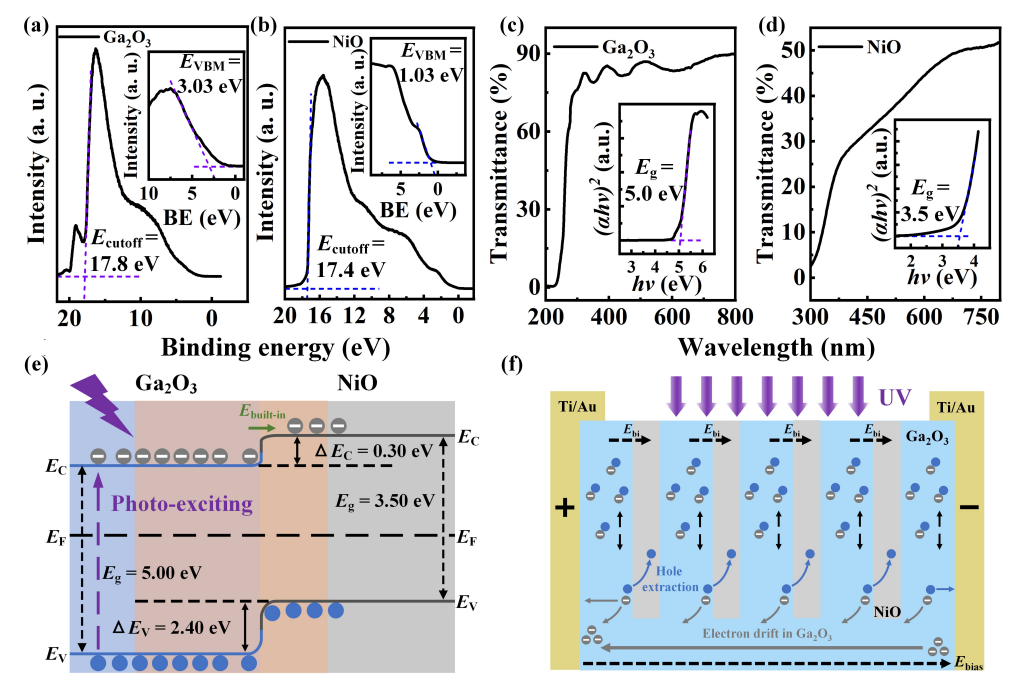
Figure 4. UPS spectra of (a) Ga₂O₃ and (b) NiO thin films. UV-vis transmittance and corresponding Tauc plots for (c) Ga₂O₃ and (d) NiO. (e) Schematic of the NiO/Ga₂O₃ band alignment before contact. (f) Schematic of carrier transport process for the NiO/Ga₂O₃ SJPDs.
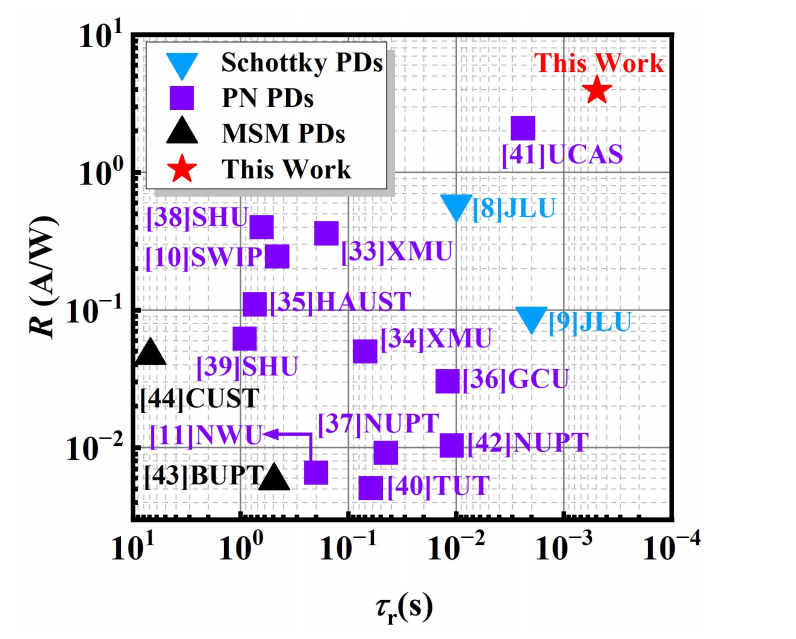
Figure 5. τr versus R of this work compared with other reported PDs.
DOI :
10.1109/LED.2026.3691571
Instruction
Official Account

Cooperation
Top