


Researchers from the Chongqing Normal University have published a dissertation titled "Wavelength- and intensity-tunable self-powered bipolar photodetectors based on a-Ga₂O₃ heterostructures for encrypted communication" in Applied Physics Letters.
Background
The rapid development of optical communication, logic computing and imaging technologies has put forward higher requirements for the function and energy efficiency of photodetectors. Conventional unipolar photodetectors have fixed response modes and are limited in complex information processing. Bipolar photodetectors can switch photocurrent polarity by regulating optical signals, which greatly improves information processing capacity. For the Internet of Things and edge computing, self-powered bipolar photodetectors working at zero bias can reduce power consumption and become a key research direction.
Current bipolar photodetection technologies have many defects. Some devices rely on external electric fields, liquid electrolytes or thermal effects, leading to high energy consumption, difficult miniaturization and slow response. Amorphous gallium oxide (a-Ga₂O₃) features deep ultraviolet absorption and low preparation cost, which is an ideal material for bipolar photodetectors. However, most existing a-Ga₂O₃ based devices adopt static structures and cannot realize dynamic programmable regulation of response modes. Hence, it is urgent to develop all-solid-state self-powered bipolar photodetectors with simple fabrication, stable performance and dynamic modulation capability, which will promote the development of multifunctional optoelectronic devices and secure communication.
Abstract
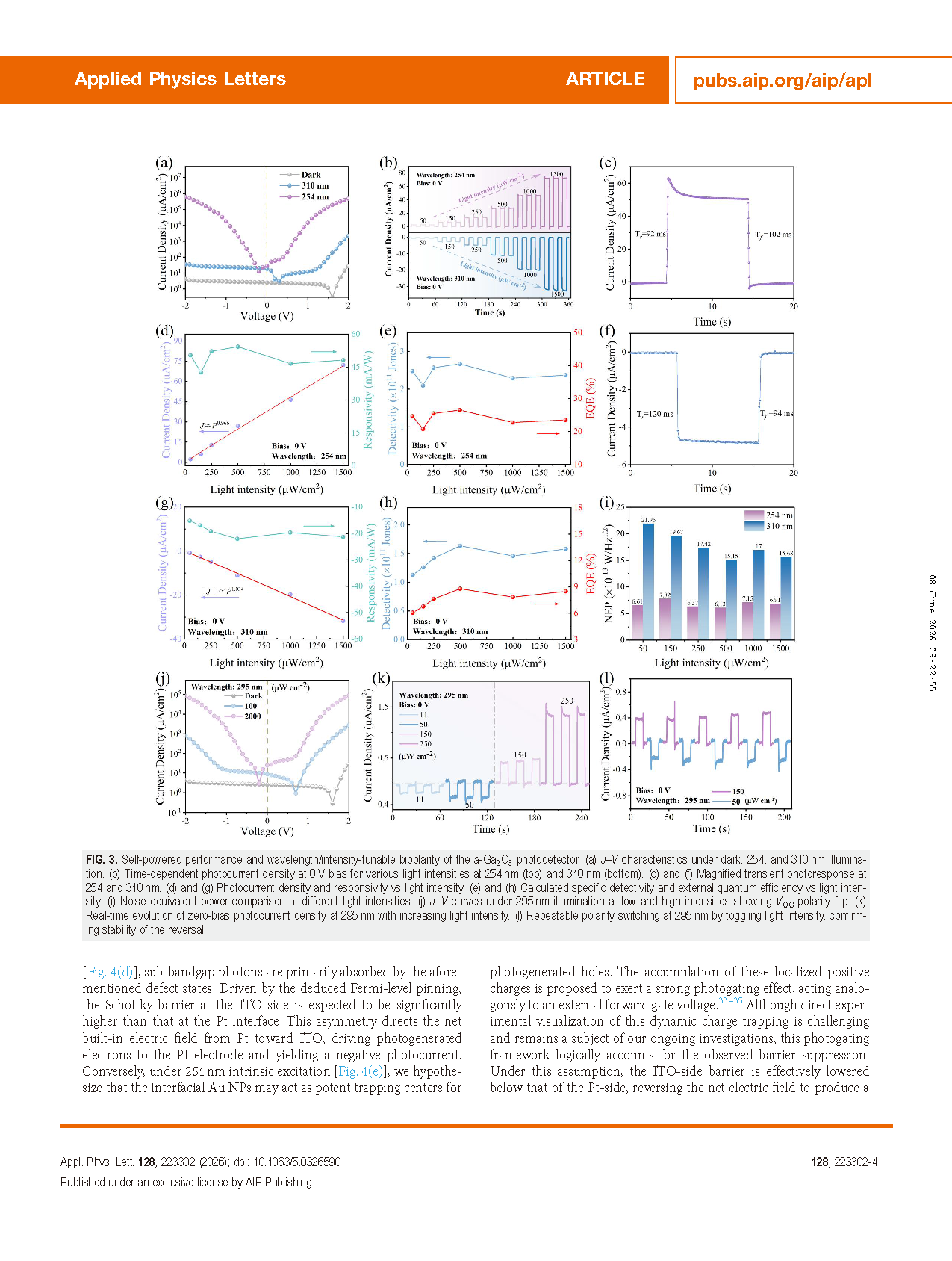
Bipolar photodetectors are promising for optical logic and communication but often suffer from structural complexity and high power consumption. Here, we report a self-powered, vertical photodetector based on an ITO/Au NPs/a-Ga₂O₃/Pt heterojunction. By leveraging Au nanoparticles to engineer interfacial oxygen vacancies and the synergistic modulation of the Schottky barrier by the light field, the device achieves a distinct bidirectional photoresponse at zero bias. Specifically, it exhibits wavelength-dependent polarity switching, generating positive photocurrent at 254 nm and negative at 310 nm. Notably, under 295 nm illumination, the device displays an anomalous intensity-dependent polarity reversal, transitioning from negative to positive as light intensity increases. We demonstrate the potential of these tunable features in optical logic gates and encrypted communication systems, offering a new pathway for multifunctional self-powered optoelectronics.
Highlights
A vertical ITO/Au NPs/a-Ga₂O₃/Pt heterojunction device is constructed. Au nanoparticles are used to regulate interfacial oxygen vacancies and realize stable bipolar photoresponse at zero bias.
The device achieves polarity reversal regulated by both wavelength and light intensity. It produces opposite photocurrents under 254 nm and 310 nm illumination, and polarity can be switched by changing light intensity at 295 nm.
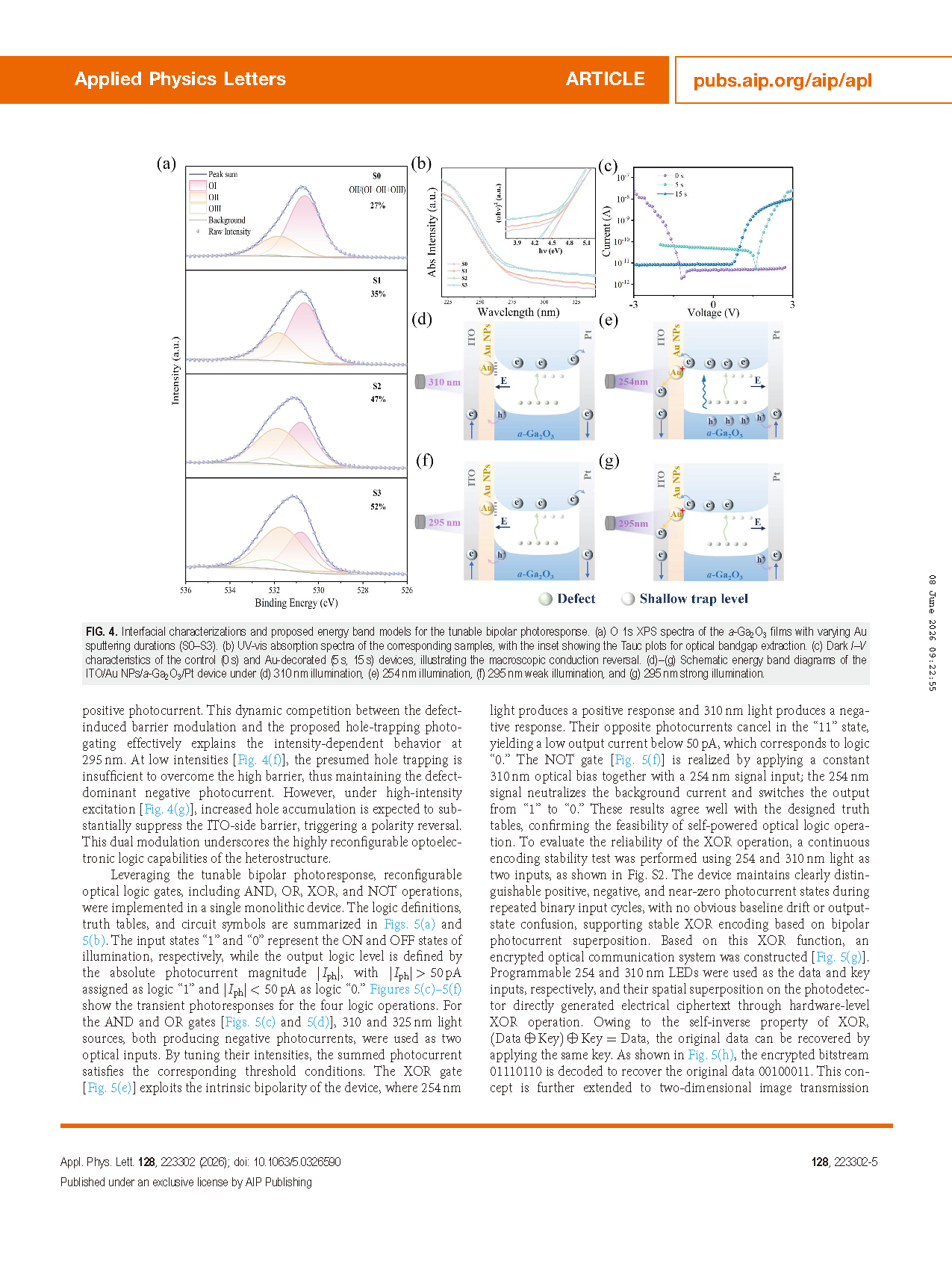
The physical mechanism of mutual competition between defect states and photogating effect caused by photogenerated hole trapping is clarified to explain the bipolar response.
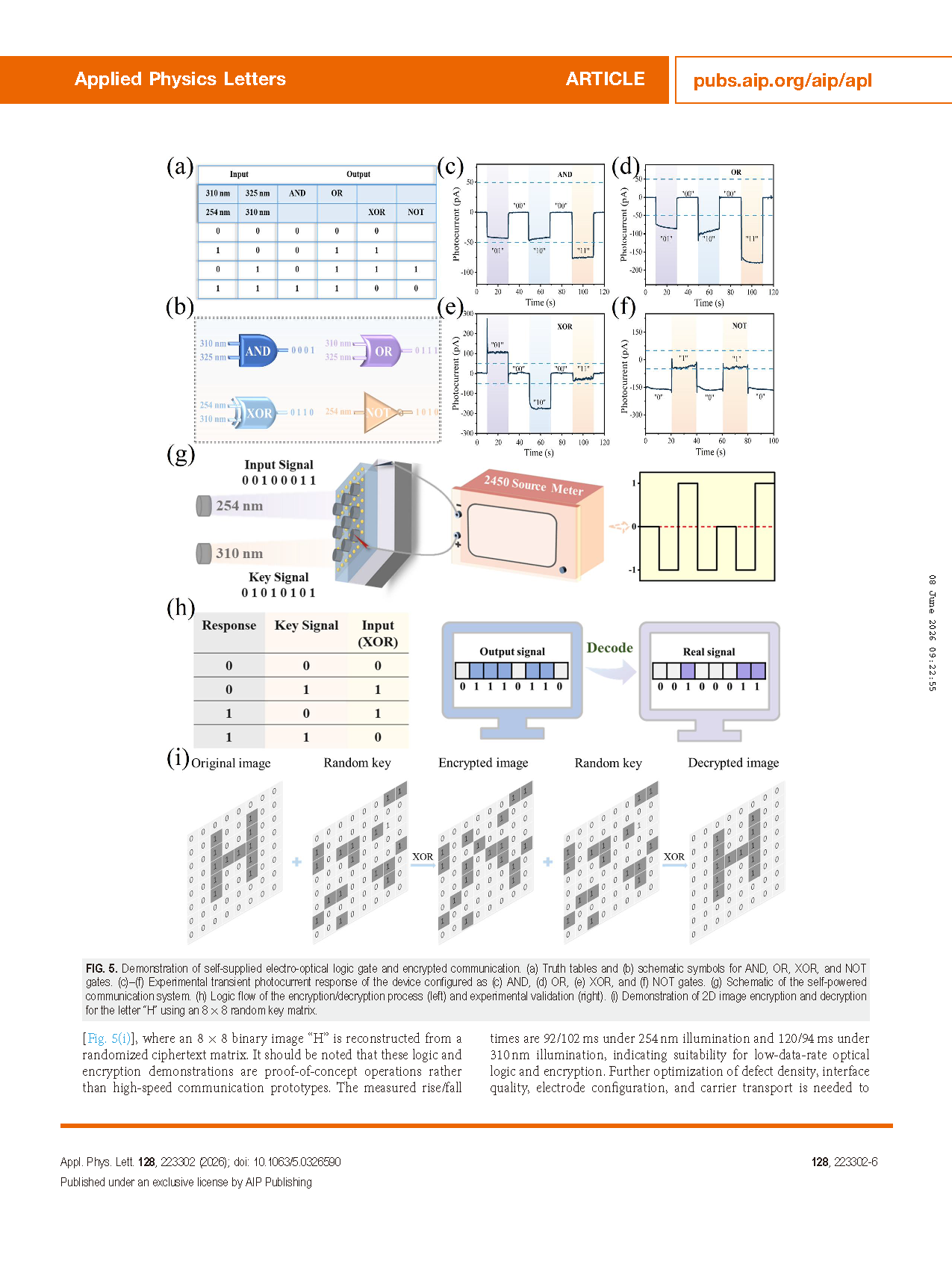
Various optical logic operations and encryption transmission of signals and images are realized, expanding the application of deep ultraviolet photodetectors in secure optical communication.
Conclusion
In summary, we demonstrated a self-powered all-solid-state bipolar photodetector based on a vertical ITO/Au NPs/a-Ga₂O₃/Pt heterostructure, featuring dual-mode polarity modulation by both wavelength and light intensity. The incorporation of Au nanoparticles significantly modifies the interfacial oxygen-vacancy-related defect states and electronic structure, enabling a stable bipolar photoresponse at zero bias. Under 310 nm illumination, defect-state absorption dominates and leads to a negative photocurrent, whereas under 254 nm illumination, interfacial charge trapping associated with Au NPs may alter the effective barrier and produce a positive response. This competition also gives rise to an intensity-dependent polarity reversal at 295 nm, allowing the photocurrent sign to be switched by tuning the light intensity. Based on these properties, reconfigurable optical logic gates (AND, OR, XOR, and NOT) and a proof-of-concept encrypted communication system were demonstrated. This work provides a useful strategy for polarity-tunable self-powered optoelectronic devices for logic operation and secure optical signal processing.
Project Support
This work was financially supported by the National Natural Science Foundation of China (12104077) and the Science and Technology Research Project of Chongqing Education Committee (KJQN202300563).
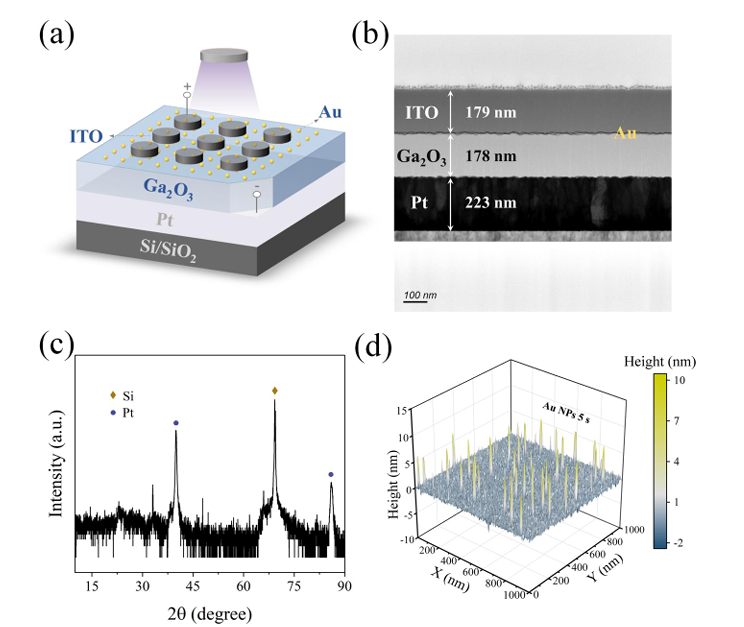
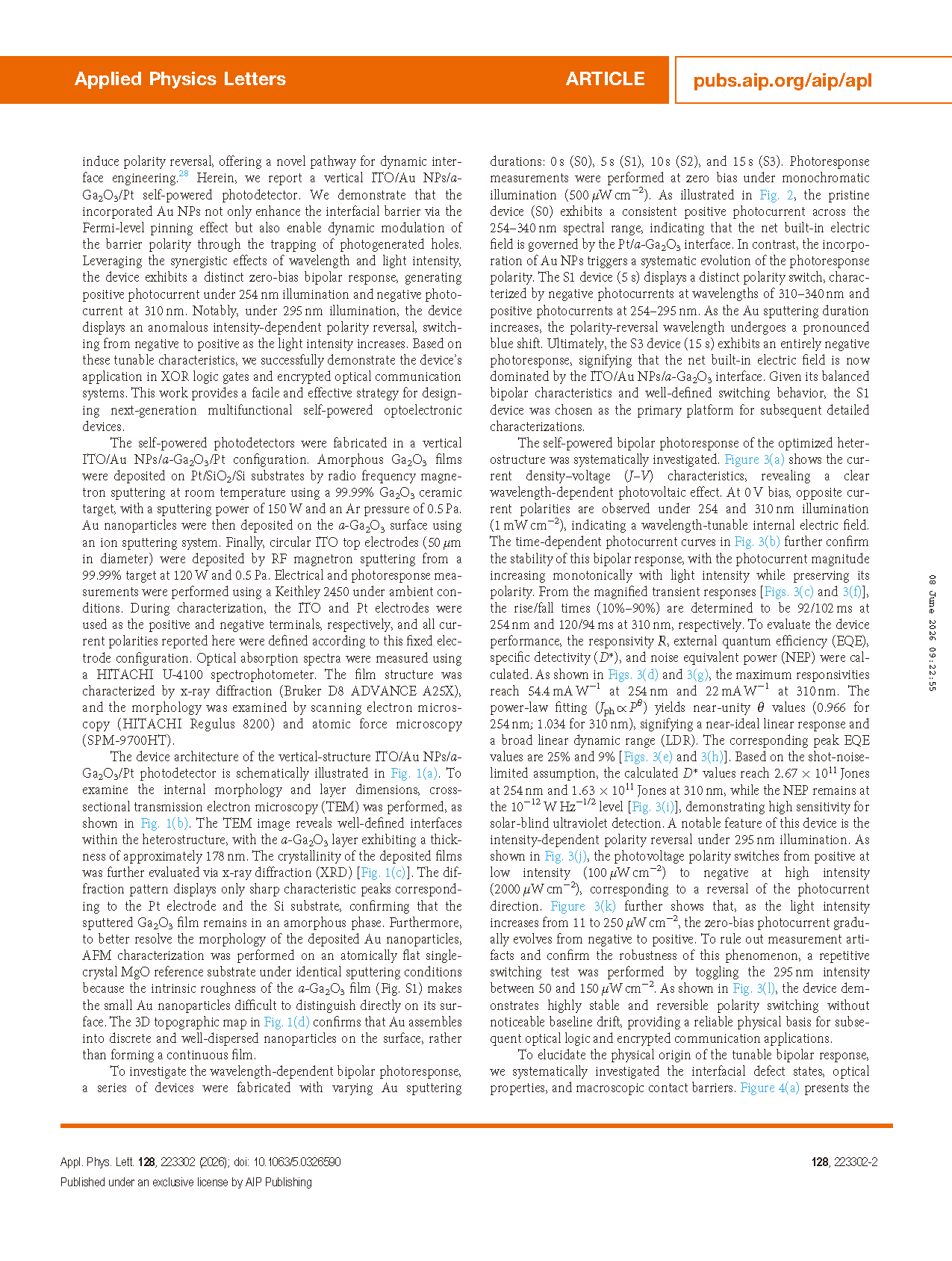
Figure 1 (a) Schematic illustration of the vertical self-powered ITO/Au NPs/a-Ga₂O₃ /Pt photodetector. (b) Cross-sectional TEM image. (c) XRD pattern of the a-Ga₂O₃ thin film. (d) 3D AFM image of Au NPs deposited on a reference single-crystal MgO substrate.
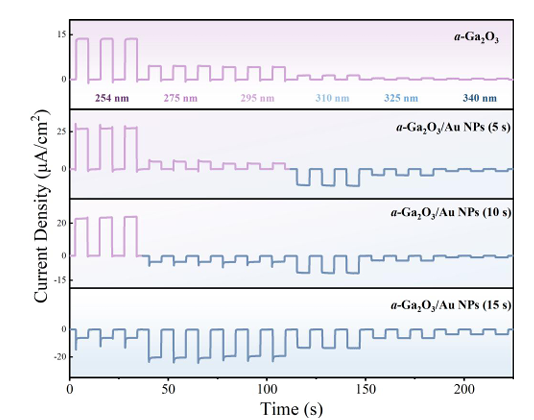
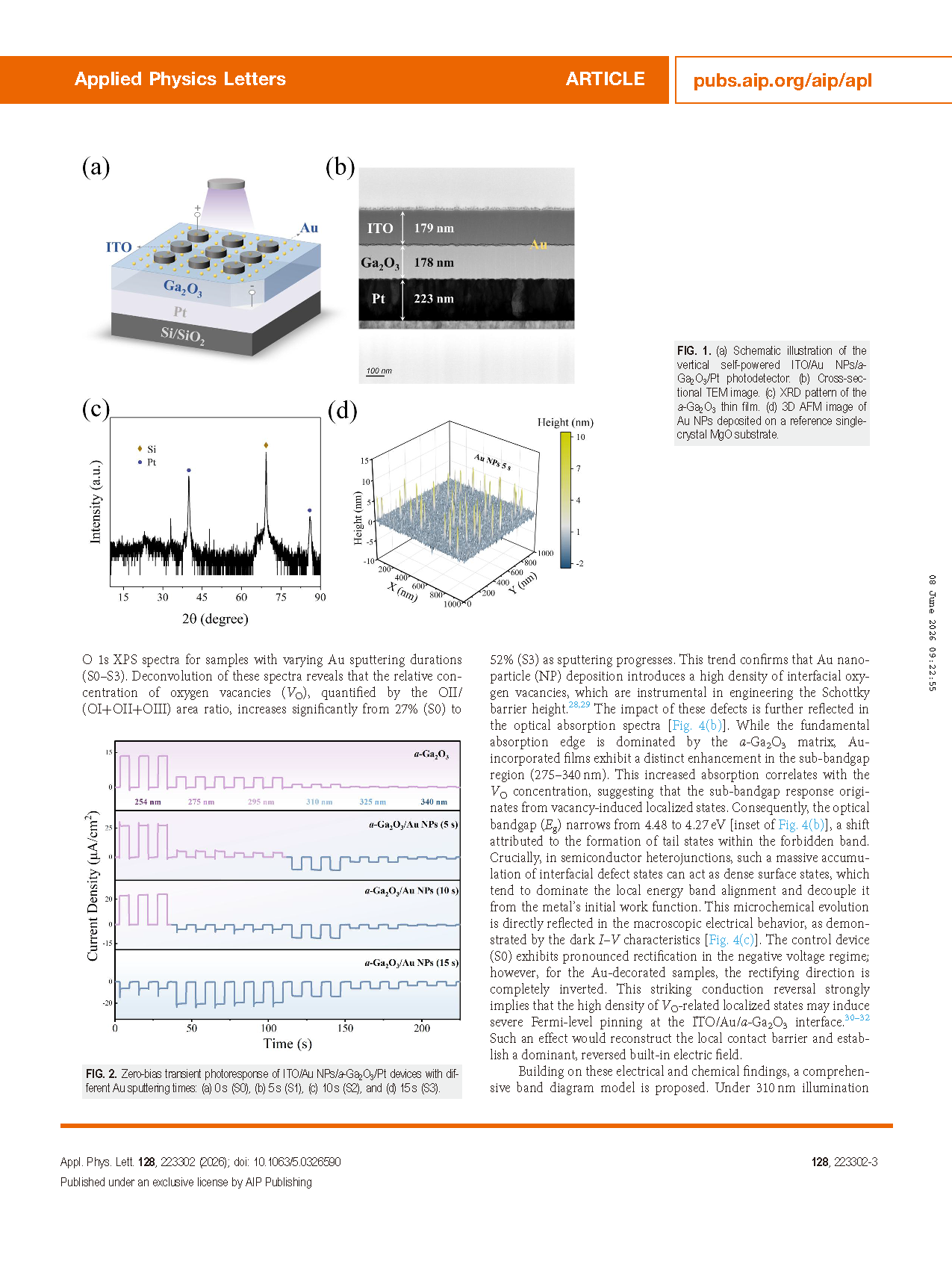
Figure 2 Zero-bias transient photoresponse of ITO/Au NPs/a-Ga₂O₃ /Pt devices with different Au sputtering times: (a) 0s (S0), (b) 5s (S1), (c) 10s (S2), and (d) 15s (S3).
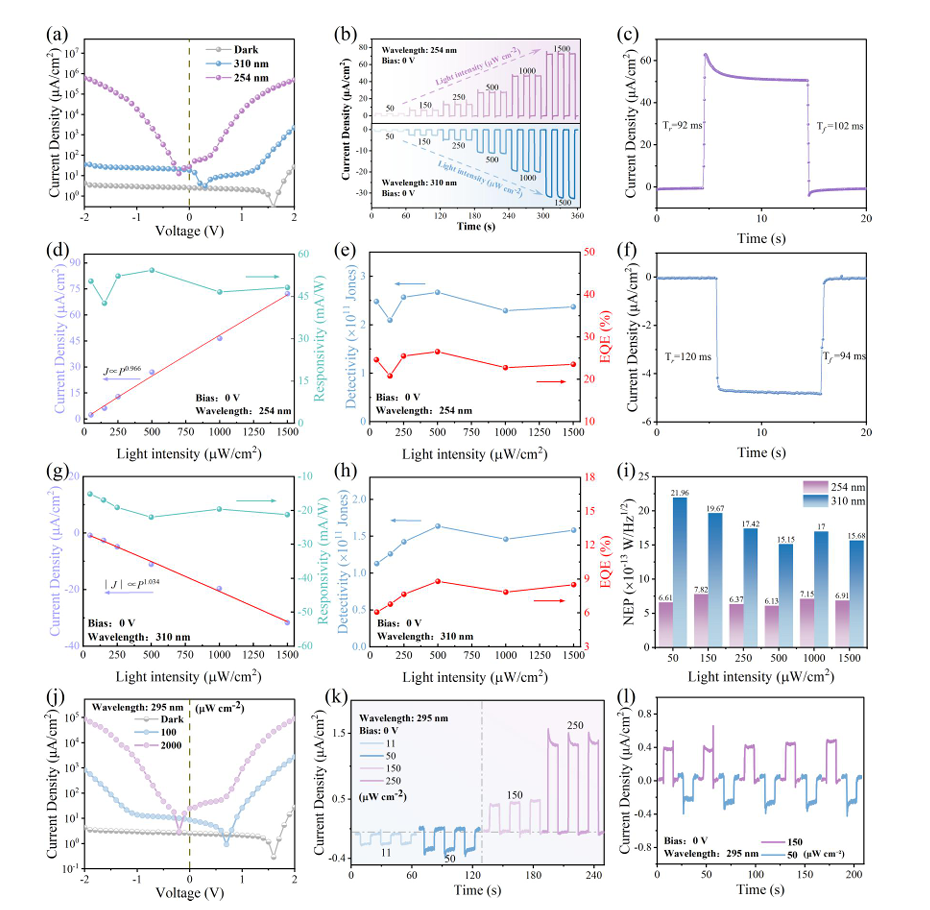
Figure 3 Self-powered performance and wavelength/intensity-tunable bipolarity of the a-Ga₂O₃ photodetector. (a) J–V characteristics under dark, 254, and 310 nm illumination. (b) Time-dependent photocurrent density at 0 V bias for various light intensities at 254 nm (top) and 310 nm (bottom). (c) and (f) Magnified transient photoresponse at 254 and 310 nm. (d) and (g) Photocurrent density and responsivity vs light intensity. (e) and (h) Calculated specific detectivity and external quantum efficiency vs light intensity. (i) Noise equivalent power comparison at different light intensities. (j) J–V curves under 295 nm illumination at low and high intensities showing VOC polarity flip. (k) Real-time evolution of zero-bias photocurrent density at 295 nm with increasing light intensity. (l) Repeatable polarity switching at 295 nm by toggling light intensity, confirming stability of the reversal.
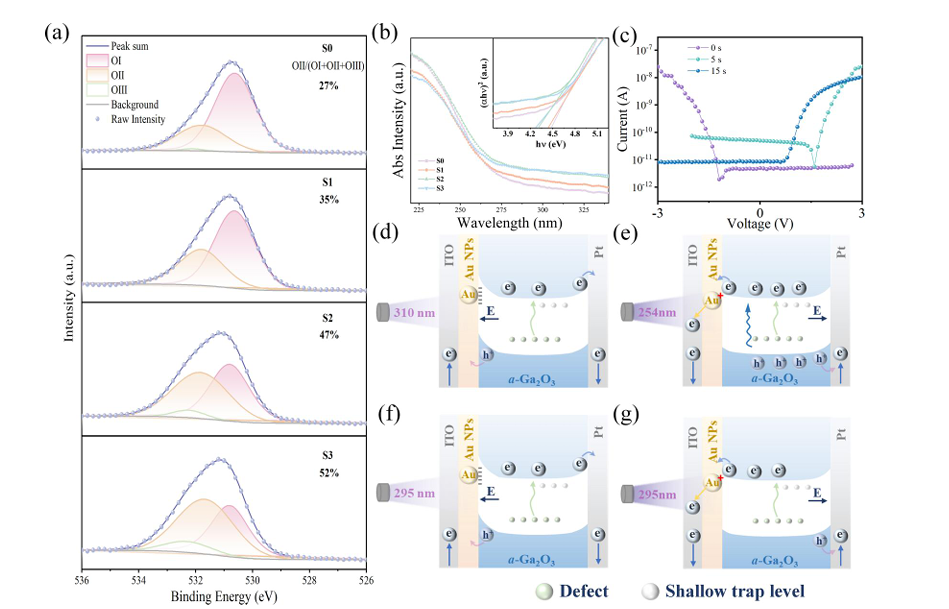
Figure 4 Interfacial characterizations and proposed energy band models for the tunable bipolar photoresponse. (a) O 1s XPS spectra of the a-Ga₂O₃ films with varying Au sputtering durations (S0–S3). (b) UV-vis absorption spectra of the corresponding samples, with the inset showing the Tauc plots for optical bandgap extraction. (c) Dark I–V characteristics of the control (0 s) and Au-decorated (5 s, 15 s) devices, illustrating the macroscopic conduction reversal. (d)–(g) Schematic energy band diagrams of the ITO/Au NPs/a-Ga₂O₃ /Pt device under (d) 310 nm illumination, (e) 254 nm illumination, (f) 295 nm weak illumination, and (g) 295 nm strong illumination.
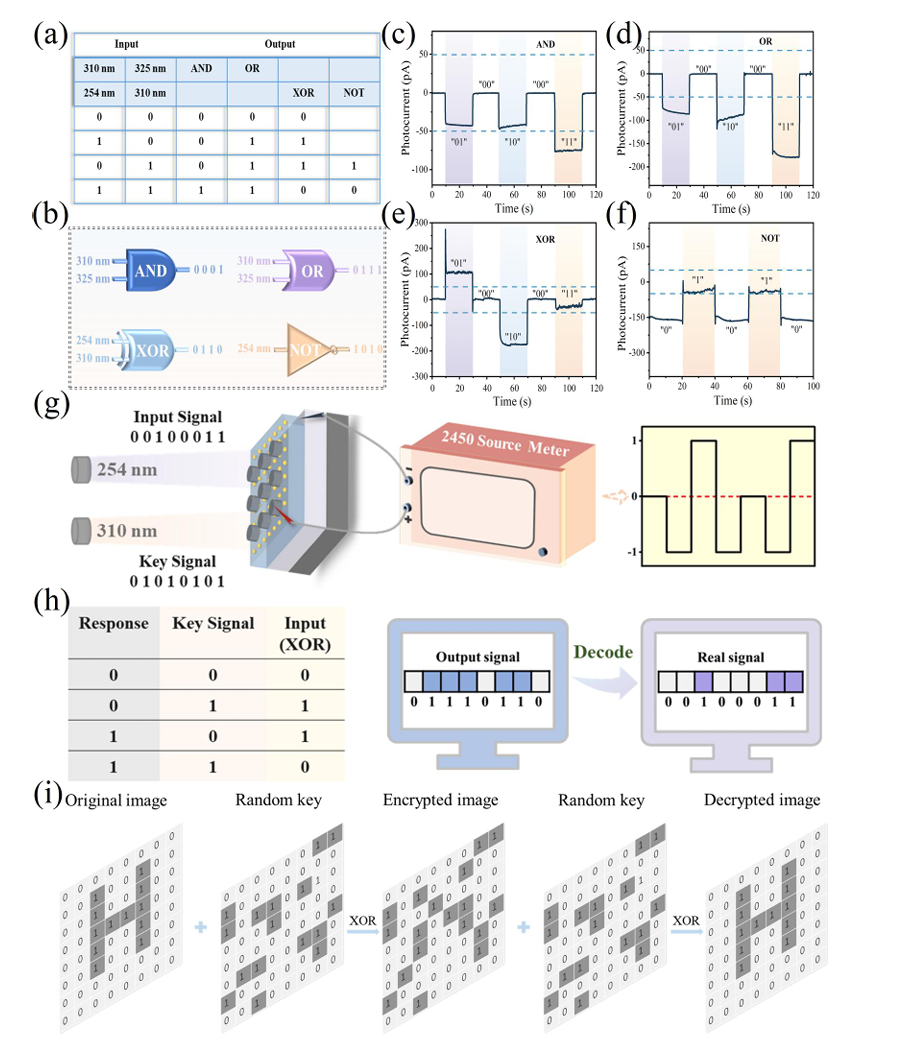
Figure 5 Demonstration of self-supplied electro-optical logic gate and encrypted communication. (a) Truth tables and (b) schematic symbols for AND, OR, XOR, and NOT gates. (c)–(f) Experimental transient photocurrent response of the device configured as (c) AND, (d) OR, (e) XOR, and (f) NOT gates. (g) Schematic of the self-powered communication system. (h) Logic flow of the encryption/decryption process (left) and experimental validation (right). (i) Demonstration of 2D image encryption and decryption for the letter “H” using an 8×8 random key matrix.
DOI:
doi.org/10.1063/5.0326590
Instruction
Official Account

Cooperation
Top