

On the morning of July 5, Professor Hao Yue, Academician of the Chinese Academy of Sciences, Director of the Department of Information Sciences at the National Natural Science Foundation of China (NSFC), and professor at Xidian University, was invited to attend the 2026 Singularity Science Conference · Flying Bird Camp. In recognition of his profound inspiration and guidance to the younger generation of researchers, he was presented with the "Flying Bird Thinker" commemorative plaque. Subsequently, Academician Hao delivered a keynote lecture entitled "Cultivating Innovative Talent Through the Lens of Semiconductor Chips," offering participants insightful perspectives on achieving breakthroughs in critical technologies and embracing the missions of a new era.

In his report, Academician Hao first reviewed the current development landscape of the global semiconductor industry, highlighting the fundamental role of semiconductor chips in the new economy, artificial intelligence, mobile communications, national security, and international technological competition. He noted that semiconductors serve as the underlying technology supporting the operation of modern information societies and have become a focal point of global scientific and technological competition. With the rapid advancement of artificial intelligence, fields such as AI computing chips, memory chips, and advanced manufacturing continue to gain momentum, making the semiconductor industry a key driving force behind future technological innovation and industrial transformation.
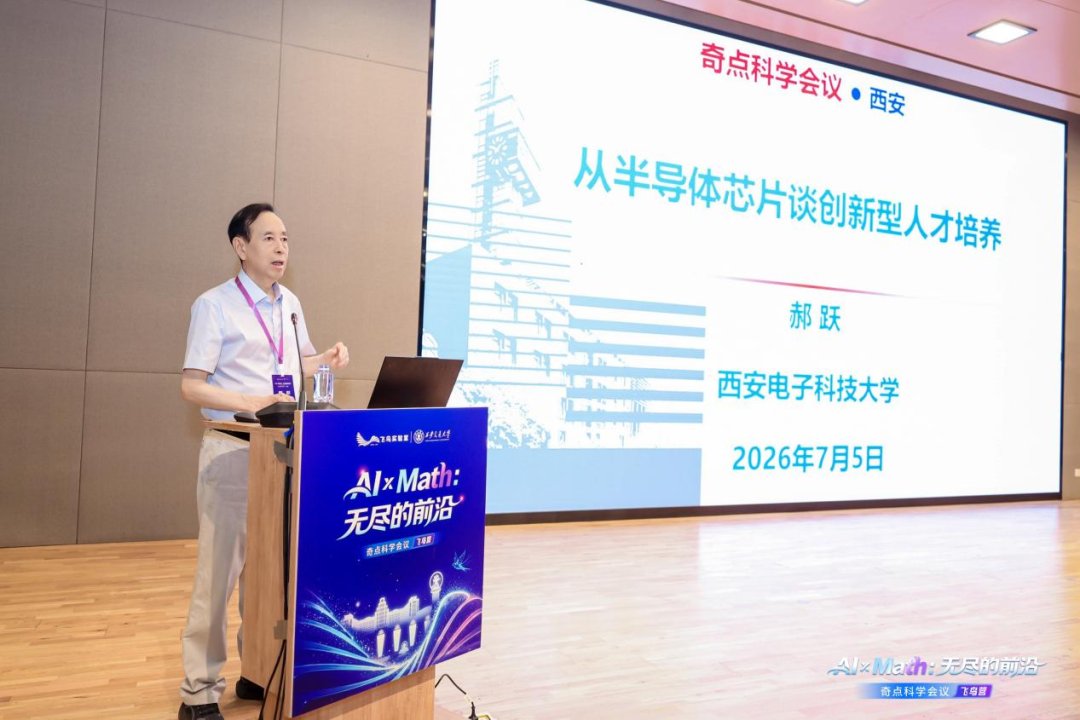
When analyzing the current development status of China’s semiconductor industry, Academician Hao noted that significant progress has been achieved in recent years in areas including mature process technologies, chip design, manufacturing equipment, packaging and testing, memory technologies, and key materials. However, challenges remain in critical areas such as advanced process nodes. Addressing the widely discussed issue of lithography machines, Academician Hao used detailed data and illustrations to introduce the evolution of lithography technology from the first generation to the fifth generation, with a particular focus on explaining the complex mechanisms behind the formation of the 13.5-nanometer light source used in extreme ultraviolet (EUV) lithography. He emphasized that breakthroughs in semiconductor chips cannot be achieved through isolated advances in a single area, but require a highly coordinated systems approach integrating fundamental research, materials, devices, processes, equipment, and precision engineering. Moving from industrial challenges to research methodologies, Academician Hao stressed that scientific research must focus on "real problems." He pointed out that valuable research should not remain at the stage of "me too" imitation, nor should it be limited to "me better" incremental improvements; instead, it should strive toward "me only" by proposing questions with genuine independent value and strategic significance. Particularly in critical fields such as semiconductor chips, young researchers should focus on global scientific frontiers, major national needs, and key industrial bottlenecks, seeking breakthroughs through addressing real-world challenges.
Focusing on the cultivation of outstanding innovative talent, Academician Hao brought years of experience and dedication as an educator into his deep reflections on the development of integrated circuit education systems. He candidly identified several challenges currently facing the field, including outdated textbooks, insufficient numbers of high-level faculty members, a lack of modern teaching methods, and inadequate integration between scientific research and education as well as between industry and education. To address these challenges, Academician Hao highlighted the latest progress of the “101 Plan” in the integrated circuit field. He emphasized that talent cultivation must move beyond fragmented knowledge accumulation and establish a core curriculum system that supports students throughout their entire growth journey. Education should not only impart knowledge, but also clearly explain “why to learn, what to learn, how courses are connected, and how they serve future innovation.” At the practical level, students should be immersed in real engineering environments and comprehensive experiments involving design, manufacturing, packaging, and testing, achieving a transition from intuitive understanding to rational comprehension. In addition, Academician Hao expressed high expectations for young students, encouraging them to cultivate the ability to think independently, innovate, and communicate effectively. He noted that students should have the courage to pursue unconventional ideas and develop independent judgment, while also improving their writing and presentation skills, so that excellent scientific achievements can be “created, clearly explained, and effectively communicated.” During the interactive session, participants actively raised questions on cutting-edge topics including three-dimensional integration, advanced packaging, research evaluation systems in the AI era, and the selection of outstanding innovative talent. Addressing the widespread anxiety among young researchers in the AI era, he offered warm encouragement: “Having a strong hand of cards is certainly fortunate, but what is even more valuable is playing a difficult hand well.” He encouraged young people to remain confident, maintain an optimistic and positive mindset, set higher goals, broaden their horizons, and remain resilient and determined in the face of challenges. From focusing on “real problems” and pursuing original breakthroughs of “me only,” to encouraging young researchers to remain confident and innovative, Academician Hao Yue’s sharing, as a leading scientist in the integrated circuit field, conveyed the essential qualities of scientific researchers while providing profound insights for the high-quality development of the semiconductor industry and offering clear guidance for future scientific innovation. The Asian Gallium Oxide Alliance will continue to uphold the spirit of seeking truth, pursuing practical solutions, collaborative innovation, and striving for “me only” breakthroughs. By leveraging its role as a platform connecting industry and academia, the Alliance will continue to bring together innovation resources across the industrial chain, facilitate exchanges and cooperation among researchers, industry professionals, and young talents, and provide support for talent cultivation and technological innovation. Together with partners across the industry, the Alliance will work to advance the development of the gallium oxide industry, strengthen the gallium oxide ecosystem, and contribute greater efforts to the growth of China’s fourth-generation semiconductor industry.
Instruction
Official Account

Cooperation
Top