


Researchers from Bangladesh University of Engineering and Technology & University of Technology Sydney have published a paper titled "Interface-engineered ZnVO₂ nanowire/CdO–Ga₂O₃ heterophase junctions for self-powered UV photodetection and defect-mediated visible luminescence" in Materials Today Nano.
Background
Traditional optoelectronic devices possess single function, and monolithic integration of light transmission, detection and emission remains a great challenge. Conventional photodetectors and light-emitting diodes work as discrete units, leading to complicated and bulky optoelectronic systems. Ga₂O₃ exhibits dual potentials of UV absorption and luminescence, while pure Ga₂O₃ devices suffer poor performance. CdO doping narrows the optical band gap and enhances visible emission, and VO₂ has outstanding electrical conductivity; Zn doping improves both transparency and conductivity simultaneously. Most reported heterojunctions require expensive epitaxial equipment and high-vacuum conditions. Moreover, most oxide photodetectors only realize light detection, and most absorbed UV energy is wasted as heat without secondary utilization. Although n-n isotype heterojunctions realize broad-spectrum detection, few studies convert wasted light energy into visible luminescence via interfacial defects. In this work, low-cost spray pyrolysis is adopted to fabricate ZnVO₂ nanowire networks and CdO-Ga₂O₃ heterophase films to construct semitransparent isotype heterostructures. Only one single UV excitation source can realize light transmission, photodetection and luminescence simultaneously. Mott-Schottky and XPS characterizations are used to analyze band alignment and built-in electric field for carrier separation, and the orange luminescence mechanism induced by interfacial oxygen vacancies is clarified, offering a low-cost metal-oxide nanostructured platform for integrated sensing and anti-counterfeiting optoelectronics.
Abstract
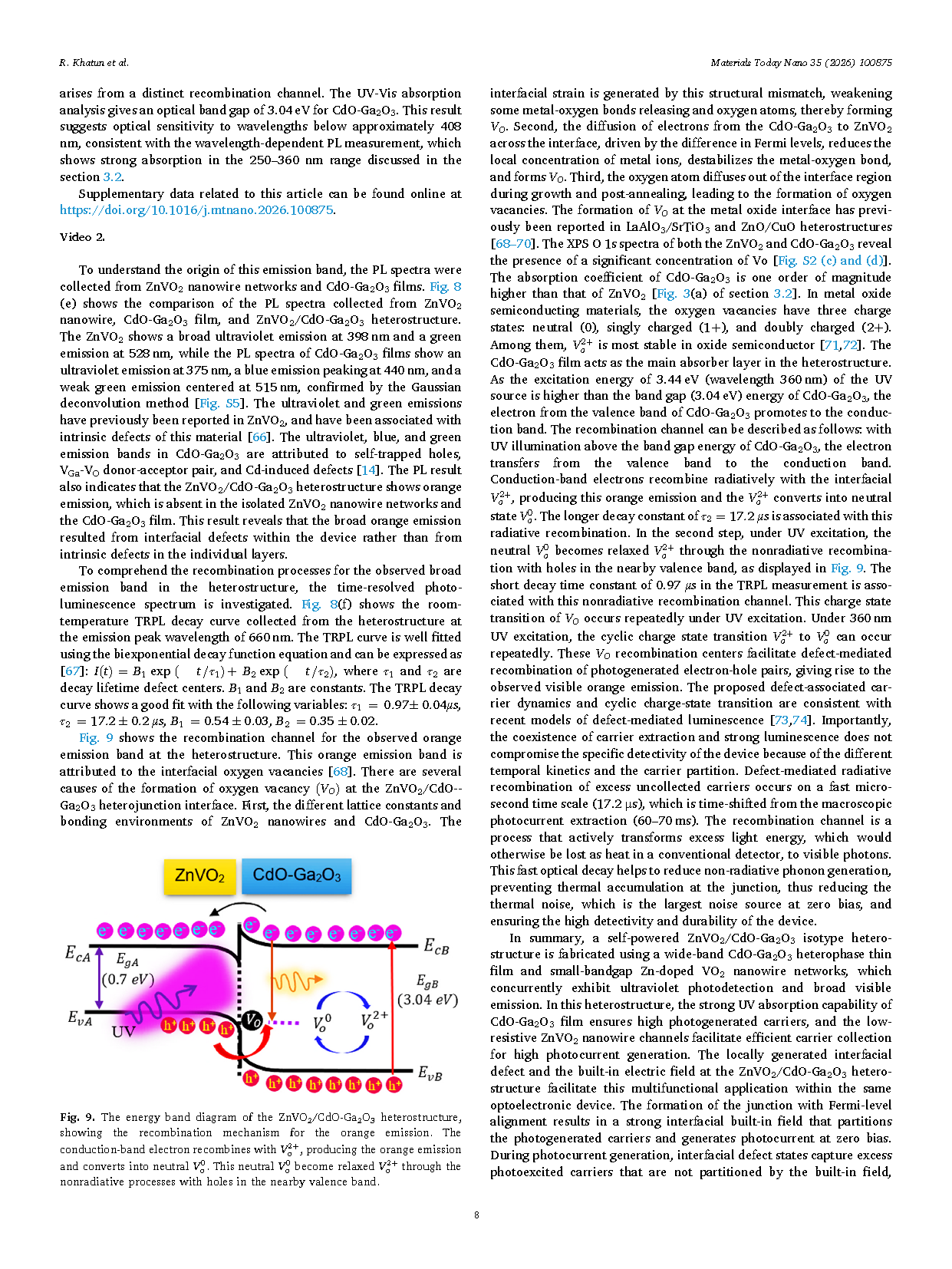
Traditional optoelectronic devices are limited in functionality and performance to discrete applications, and integrating various functionalities in a single device remains challenging. Here, self-assembled Zn-doped VO₂ (ZnVO₂) nanowire networks are interfaced with crystalline CdO-Ga₂O₃ heterophase film to fabricate a semitransparent self-powered ZnVO₂/CdO-Ga₂O₃ isotype heterostructure, in which the junction-interface engineering enables the light transmission, detection, and emission functionalities simultaneously under a single excitation source. The CdO-Ga₂O₃ heterophase film exhibits a high absorption coefficient of 1.6 ×10⁵ cm⁻¹, which enables the charge-carrier generation and recombination. ZnVO₂ nanowire networks facilitate a highly transparent (85%) low-resistance path for carrier collection, resulting in a high photocurrent generation. The heterostructure exhibits an optical transparency of 62%, enabling clear vision through its architecture. This semitransparent ZnVO₂/CdO-Ga₂O₃ heterostructure exhibits rectifying behaviour and operates as a self-powered detector with a fast response time of 60 ms and a high detectivity of 6.2 ×10¹¹ Jones. Simultaneously, this integrated device shows an intense orange emission observed by the naked eye during its self-powered detection, and this orange emission is attributed to the interfacial oxygen vacancy exhibiting a slow decay time constant of 17.2 μs, as confirmed by transient photoluminescence measurements. Mott-Schottky and X-ray photoemission experiments show that the formation of a high valence-band offset of 2.1 eV and a built-in electric field of 5.1 ×10⁶ V/m at the junction interface effectively separates the photogenerated carriers for self-powered operation. This metal-oxide-based nanostructured heterojunction can serve as a versatile optoelectronic platform for integrated UV sensing with visible readout, anticounterfeiting, and integrated photonics.
Highlights
Low-cost spray pyrolysis is adopted to fabricate ZnVO₂nanowire/CdO-Ga₂O₃ isotype heterojunction without vacuum epitaxy, the whole device is semitransparent with transmittance of 62%;
A single UV source simultaneously realizes three functions: light transmission, zero-bias self-powered UV detection and naked-eye orange luminescence, converting wasted optical energy into visible readout signals;
A large valence band offset of 2.1 eV and strong built-in electric field of 5.1×10⁶V/m are formed at interface, the device achieves high detectivity of 6.2×10¹¹ Jones with 60 ms rise time under zero bias;
Interfacial oxygen vacancies are verified as orange luminescence centers with decay lifetime of 17.2 μs, and the kinetics of detection and luminescence are independent without mutual interference;
All-metal-oxide nanostructure integrates UV sensing and anti-counterfeiting luminescence, applicable to smart windows, perovskite solar cells and other optoelectronic devices.
Conclusion
We report a multifunctional metal oxide-based ZnVO₂ nanowire/CdO-Ga₂O₃ heterophase junction that shows simultaneous self-powered UV photodetection and interface-defect-mediated orange emission. Structural and chemical analyses show the coexistence of the cubic CdO and monoclinic β-Ga₂O₃ phases, confirming the formation of a crystalline CdO-Ga₂O₃ heterophase, while the Zn-doped VO₂ shows the monoclinic structure. Individually, the CdO-Ga₂O₃ film provides charge carriers and recombination via strong UV photon absorption. ZnVO₂ nanowire networks facilitate low-resistance channels for carrier extraction. The device shows 62% optical transparency. This heterostructure shows rectifying behaviour and operates as a self-powered detector with a responsivity of 500 mA/W and a detectivity of 6.2 ×10¹¹ Jones. In light-detection mode, the heterojunction also emits an intense orange glow observed by the unaided eye. X-ray photoemission and Mott-Schottky analyses reveal that the formation of an interfacial built-in potential of 0.28 eV and a high valence-band offset of 2.1 eV at this heterostructure effectively separates charge carriers, leading to high photocurrent generation at zero bias. Photoluminescence measurements reveal that the interfacial oxygen vacancy is responsible for a bright orange luminescence with a long decay lifetime of 17.2 μs. The multifunctional properties of this heterostructure would be useful in designing sensors, anti-counterfeiting systems, smart photovoltaic windows, and integrated photonic devices.
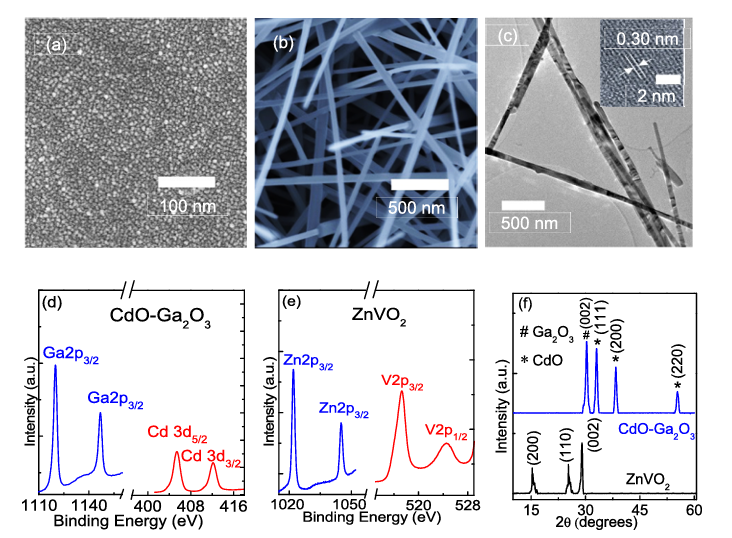
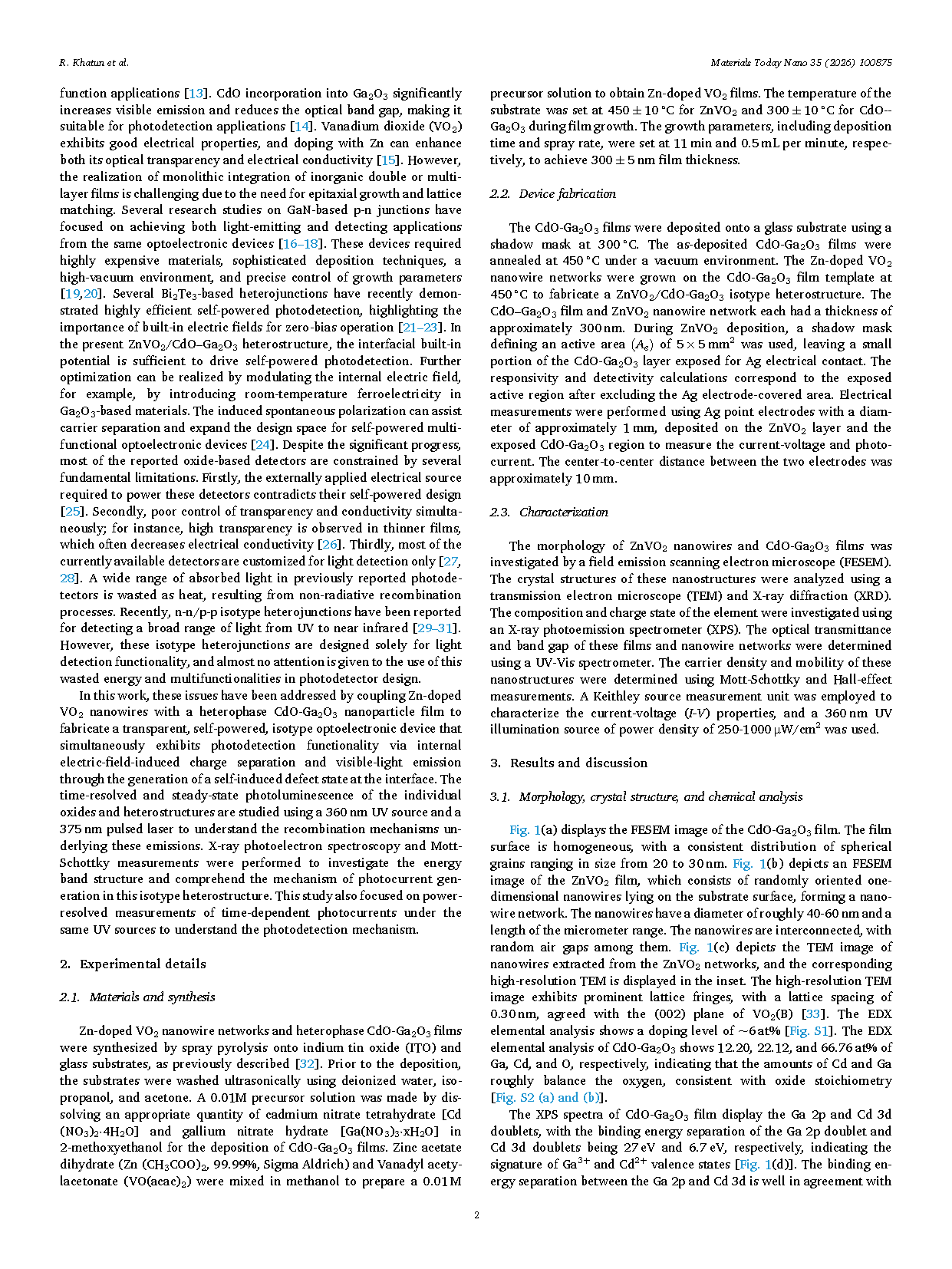
Figure 1 Morphology and crystal structure of ZnVO₂ and CdO-Ga₂O₃ films. (a) SEM images of the CdO-Ga₂O₃ films showing the homogeneous distribution of spherical grains. (b) SEM image of ZnVO₂ film displays spatially distributed nanowires forming networks. (c) TEM image of ZnVO₂ nanowires extracted from the network. The inset of (c) is a high-resolution TEM image of a ZnVO₂ nanowire, displaying an obvious lattice fringe. (d) The Ga 2p and Cd 3d spin-orbit splitting, demonstrating the presence of Ga³⁺ and Cd²⁺ in the CdO-Ga₂O₃ host. (e) XPS spectra of ZnVO₂ show Zn 2p and V 2p spin-orbit splitting, indicating the presence of Zn²⁺ and V⁴⁺. (f) XRD patterns of ZnVO₂ and CdO-Ga₂O₃ films confirm the monoclinic crystal structure of these materials.
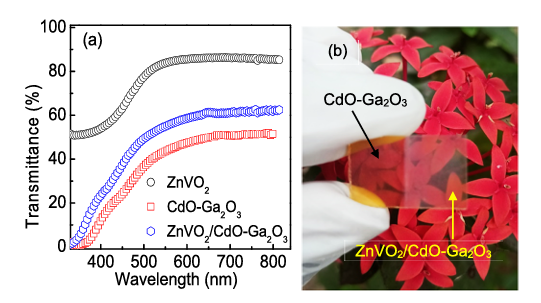
Figure 2 (a) UV-Vis transmittance of ZnVO₂ nanowire networks, CdO-Ga₂O₃ films, and ZnVO₂/CdO-Ga₂O₃ heterostructure. The nanowire, film, and device show optical transparencies of 85%, 52%, and 62%, respectively. (b) A photograph of the heterostructure shows a transparent view of the flower through the film and heterostructure.
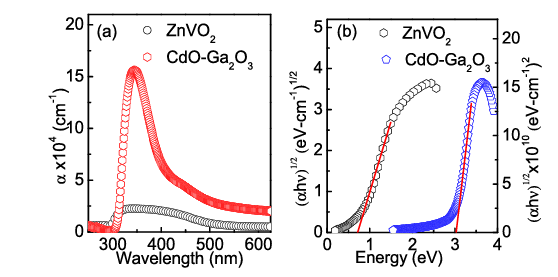
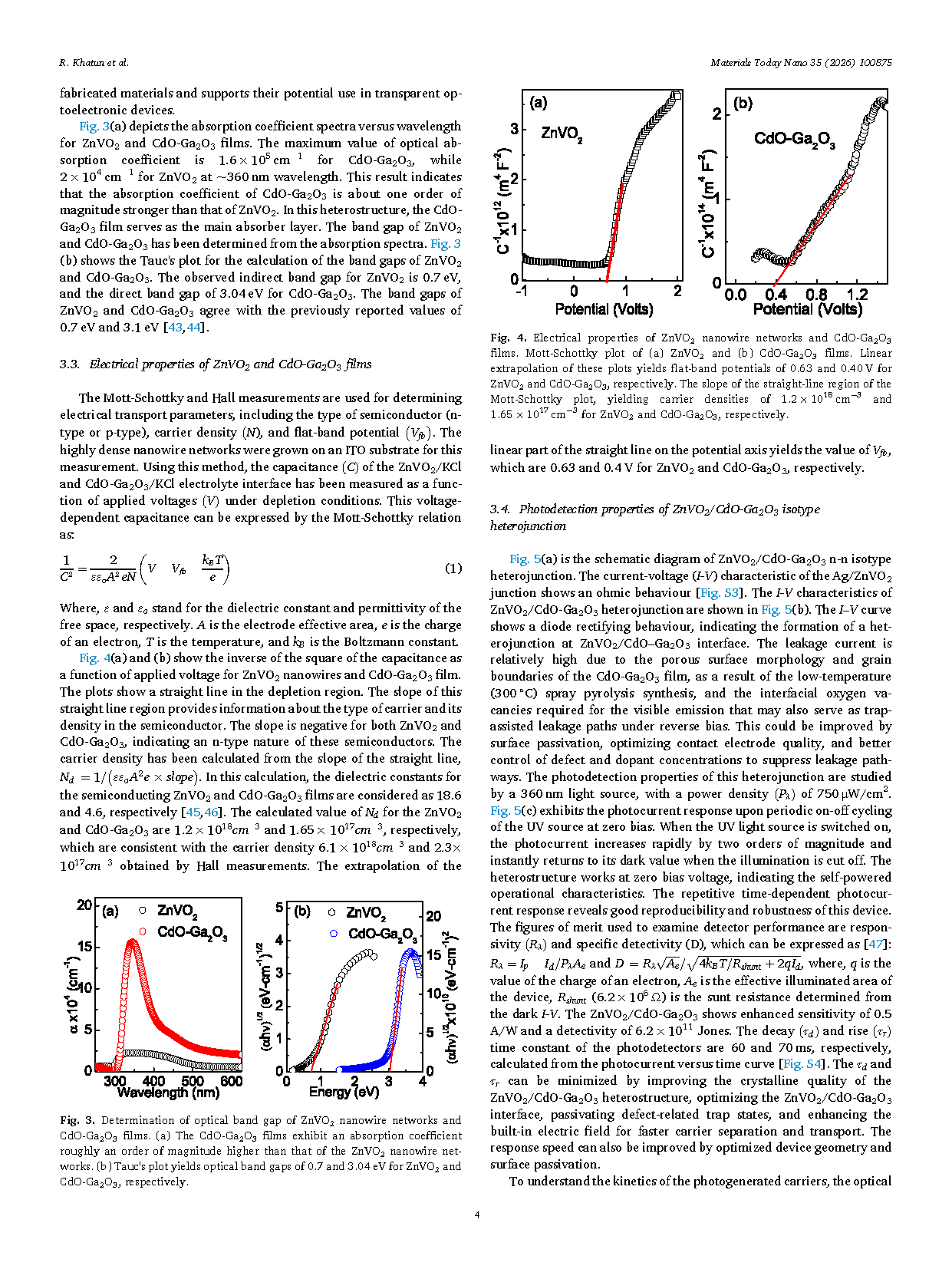
Figure 3 Determination of optical band gap of ZnVO₂ nanowire networks and CdO-Ga₂O₃ films. (a) The CdO-Ga₂O₃ films exhibit an absorption coefficient roughly an order of magnitude higher than that of the ZnVO₂ nanowire networks. (b) Tauc's plot yields optical band gaps of 0.7 and 3.04 eV for ZnVO₂ and CdO-Ga₂O₃ respectively.
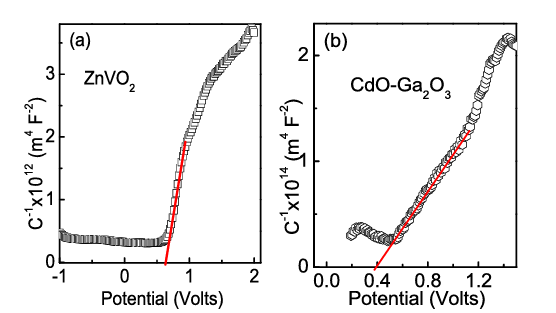
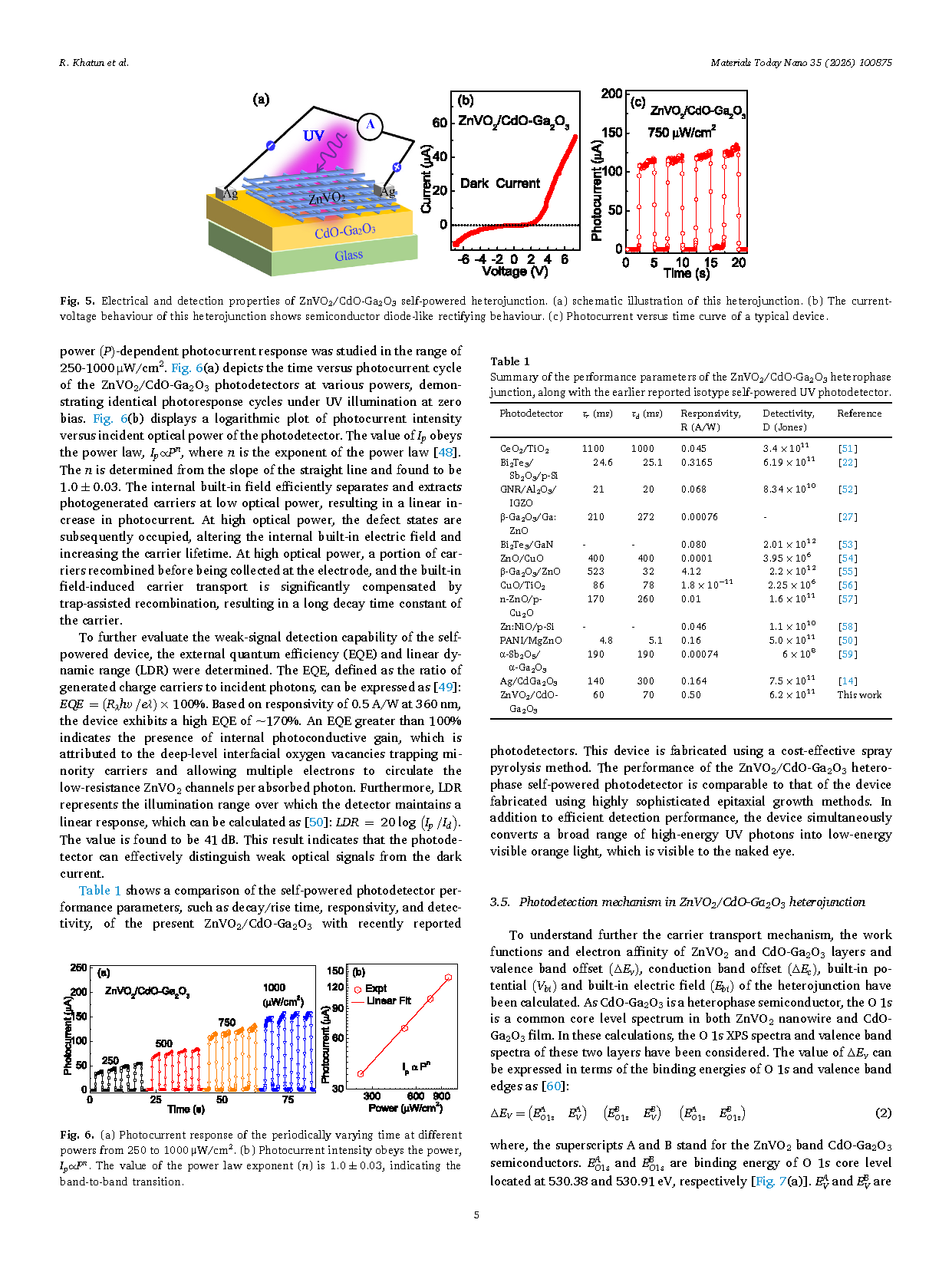
Figure 4 Electrical properties of ZnVO₂ nanowire networks and CdO-Ga₂O₃ films. Mott-Schottky plot of (a) ZnVO₂ and (b) CdO-Ga₂O₃ films. Linear extrapolation of these plots yields flat-band potentials of 0.63 and 0.40 V for ZnVO₂ and CdO-Ga₂O₃, respectively. The slope of the straight-line region of the Mott-Schottky plot, yielding carrier densities of 1.2 ×10¹⁸ cm⁻³ and 1.65 ×10¹⁷ cm⁻³ for ZnVO₂ and CdO-Ga₂O₃, respectively.
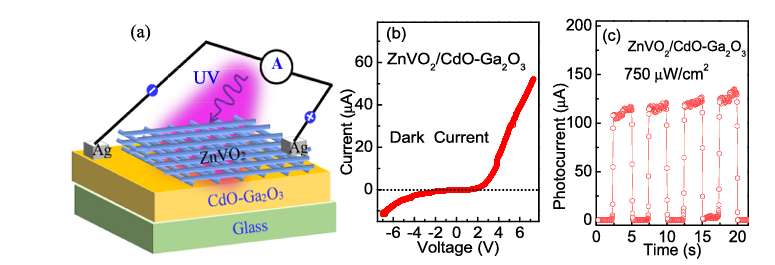
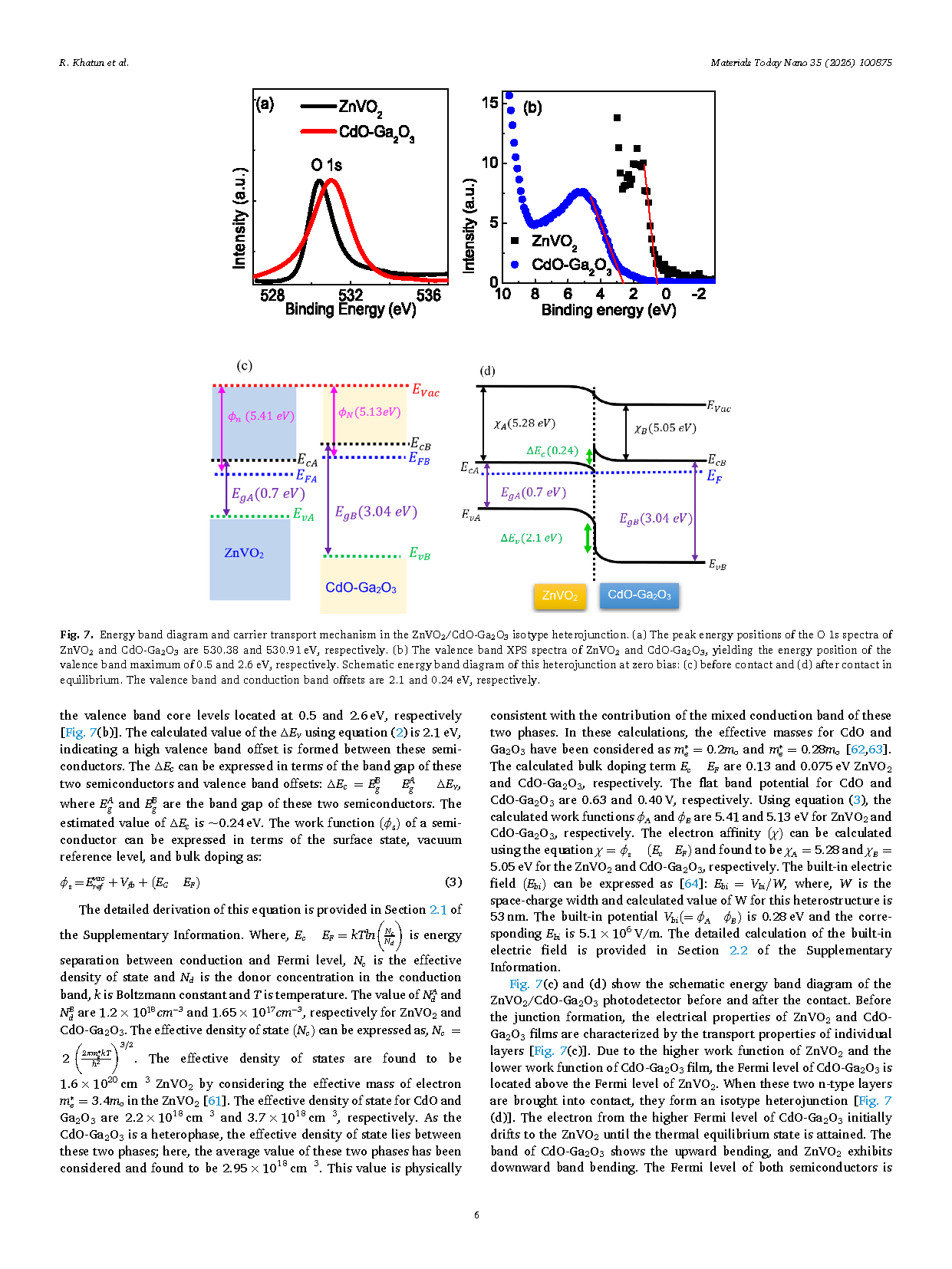
Figure 5 Electrical and detection properties of ZnVO₂/CdO-Ga₂O₃ self-powered heterojunction. (a) schematic illustration of this heterojunction. (b) The current-voltage behaviour of this heterojunction shows semiconductor diode-like rectifying behaviour. (c) Photocurrent versus time curve of a typical device.
DOI:
doi.org/10.1016/j.mtnano.2026.100875

Instruction
Official Account

Cooperation
Top