


Researchers from Xidian University and Fudan University have published a dissertation titled " Combined Degradation Mechanism of Leakage Temperature of Highly Doped Epitaxial β-Ga₂O₃ SBDs during 5 MeV Proton Irradiation " in 2026 IEEE 38th International Symposium on Power Semiconductor Devices and ICs (ISPSD).
Background
Gallium oxide (Ga₂O₃) has emerged as a promising next generation material in the field of power devices in recent years, owing to its ultrawide bandgap (4.8 eV) and high breakdown electric field strength (8 MV/cm). Among various crystal structures, the orthorhombic β-phase (β-Ga₂O₃) is the most stable, thus attracting the most attention. Benefiting from the high displacement energy of gallium and oxygen atoms, β-Ga₂O₃ devices exhibit better stability in space compared to traditional Si and GaAs devices.
Abstract
This study investigates firstly the leakage-temperature correlation degradation mechanism of highly doped epitaxial β-Ga₂O₃ Schottky Barrier Diode (SBD) after 5 MeV proton irradiation. Experimental results show that post-irradiation, the carrier concentration decreases by 52.1% from 1.4×1016 cm-3 to 0.68×1016 cm-3, the Schottky barrier height rises from 0.81 eV to 0.93 eV, the ideality factor increases from 1.076 to 1.601, the specific on-resistance increases by over 17 mΩ • cm2, and the reverse leakage current increases by two orders of magnitude while reducing temperature sensitivity. On the other hand, pre-irradiation reverse leakage of the device—measured at 300-350K with reverse bias from -20 V to -200 V—is dominated by Poole-Frenkel Emission (PFE) with a deep trap state ΦT = 0.49 eV. For post-irradiation device, Trap-Assisted Tunneling (TAT) becomes dominant instead of PFE. TAT related to 0.22 eV and 0.43 eV two shallow trap states prevail two regions respectively at 300-350K from -130V to -200V, and at 300-330 K from -80V to -130V. PFE with the 0.52 eV trap state merely remains in a narrowed region spanning temperatures from 330K to 350K from -60 V to -130 V. This transition of mechanism is attributed to the synergistic effect of irradiation-induced shallow trap states with ΦT values of 0.22 eV and 0.43 eV coupling with anode-edge surface electric field concentration, which differs from the PFE-dominated failure in our low-doped β-Ga₂O₃ SBD. Thus, irradiation-introduced shallow trap states are the primary cause of reverse characteristic degradation and reduced temperature sensitivity in highly doped epitaxial β-Ga₂O₃ SBDs.
Conclusion
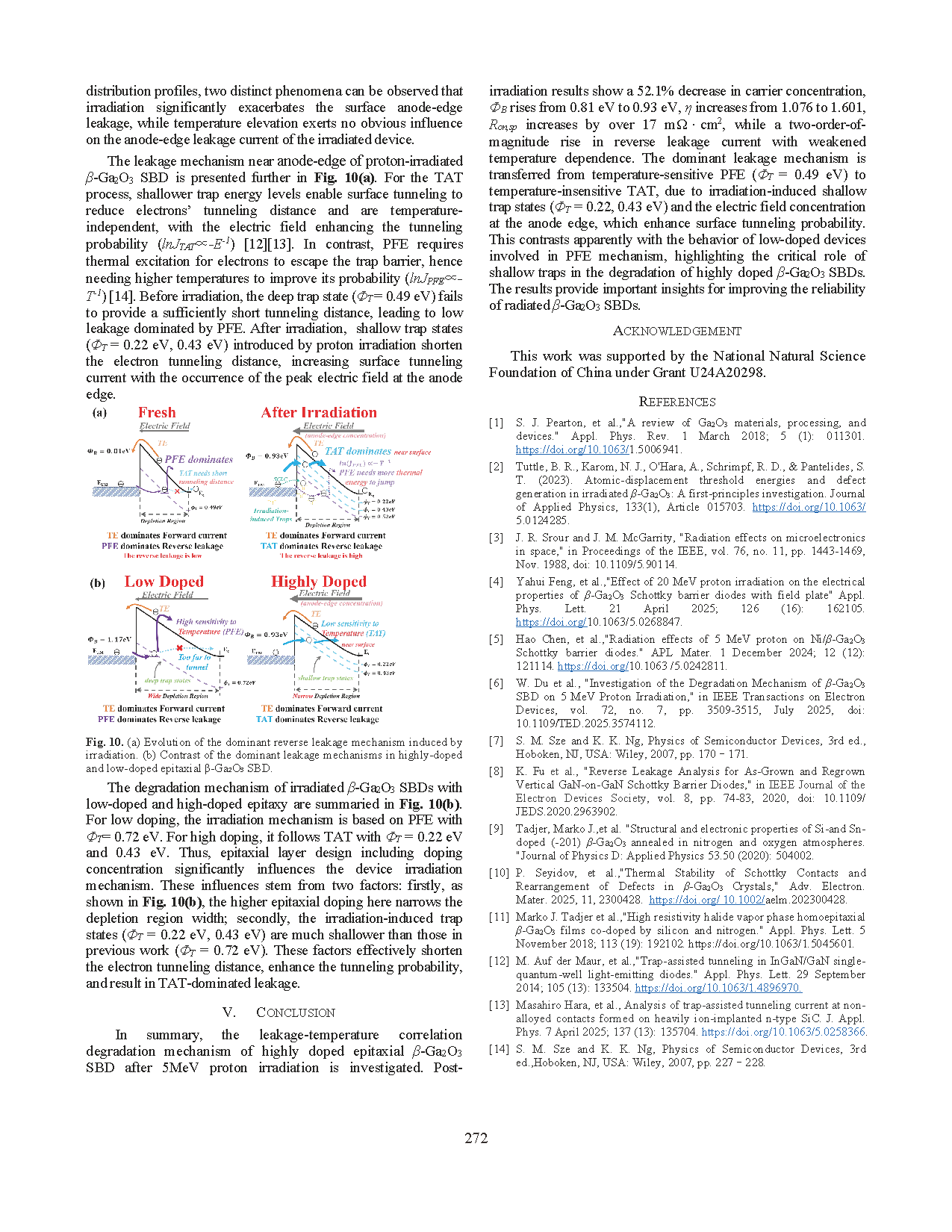
In summary, the leakage-temperature correlation degradation mechanism of highly doped epitaxial β-Ga₂O₃ SBD after 5MeV proton irradiation is investigated. Postirradiation results show a 52.1% decrease in carrier concentration, ΦB from 0.81 eV to 0.93 eV, η increases from 1.076 to 1.601, Ron,sp increases by over 17 mΩ · cm2, while a two-order-of magnitude rise in reverse leakage current with weakened temperature dependence. The dominant leakage mechanism is transferred from temperature-sensitive PFE (ΦT = 0.49 eV) to temperature-insensitive TAT, due to irradiation-induced shallow trap states (ΦT = 0.22, 0.43 eV) and the electric field concentration at the anode edge, which enhance surface tunneling probability. This contrasts apparently with the behavior of low-doped devices involved in PFE mechanism, highlighting the critical role of shallow traps in the degradation of highly doped β-Ga₂O₃ SBDs. The results provide important insights for improving the reliability of radiated β-Ga₂O₃ SBDs.
Project Support
This work was supported by the National Natural Science Foundation of China under Grant U24A20298.
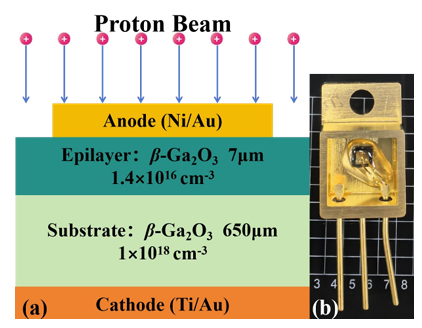
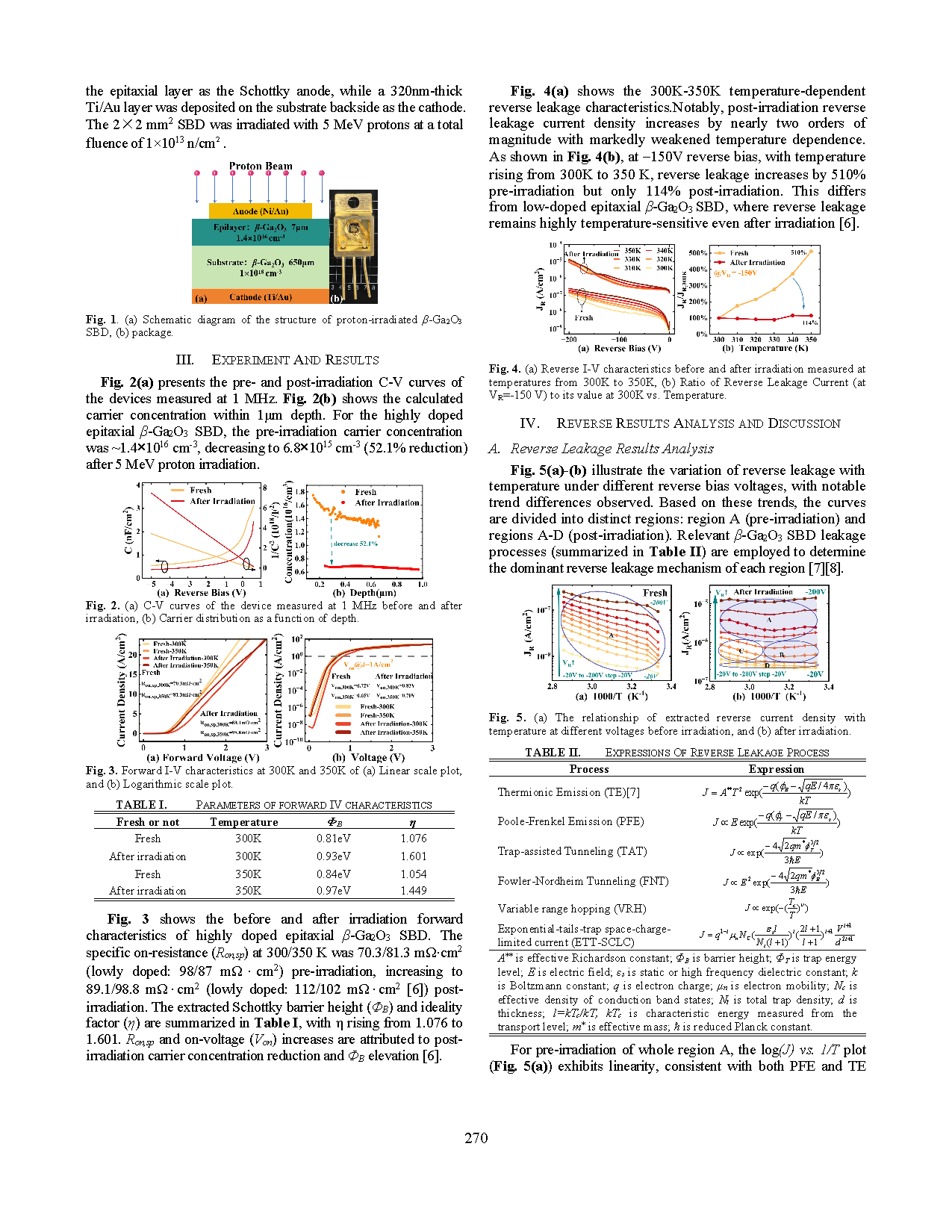
Fig. 1. (a)Schematic diagram of the structure of proton-irradiated β-Ga₂O₃ SBD, (b)package.
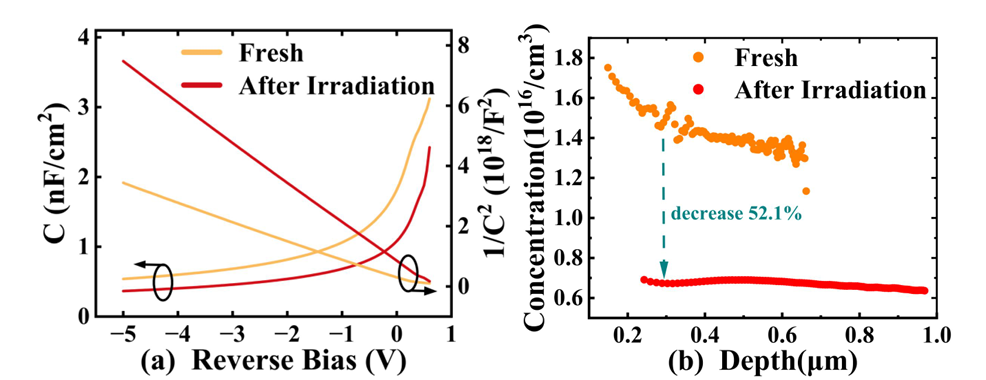
Fig. 2. (a)C-V curves of the device measured at 1 MHz before and after irradiation, (b)Carrier distribution as a function of depth.
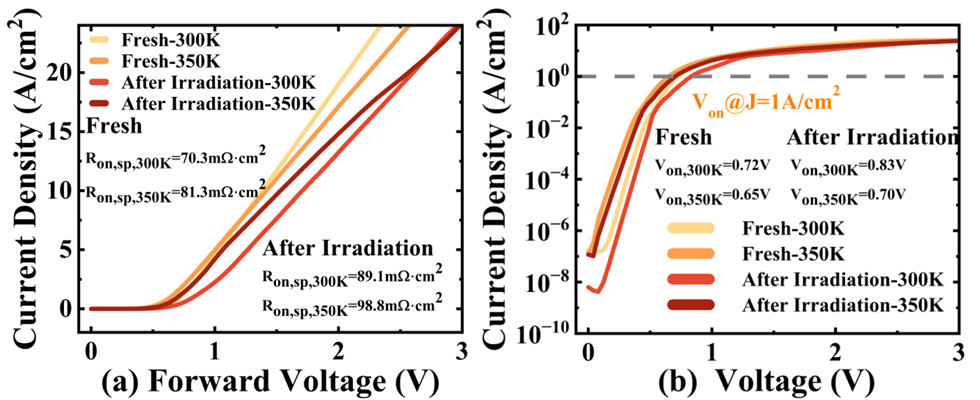
Fig.3.Forward I-V characteristics at 300K and 350K of (a) Linear scale plot, and (b) Logarithmic scale plot.
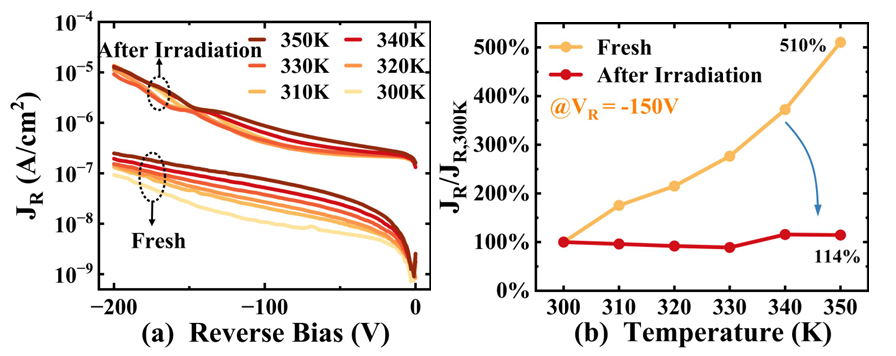
Fig.4. (a)Reverse I-V characteristics before and after irradiation measured at temperatures from 300K to 350K, (b)Ratio of Reverse Leakage Current (at VR=-150V) to its value at 300K vs. Temperature.
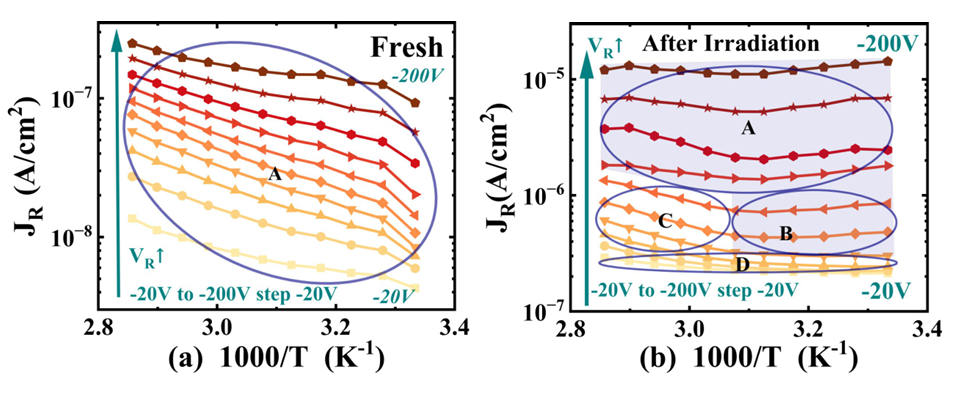
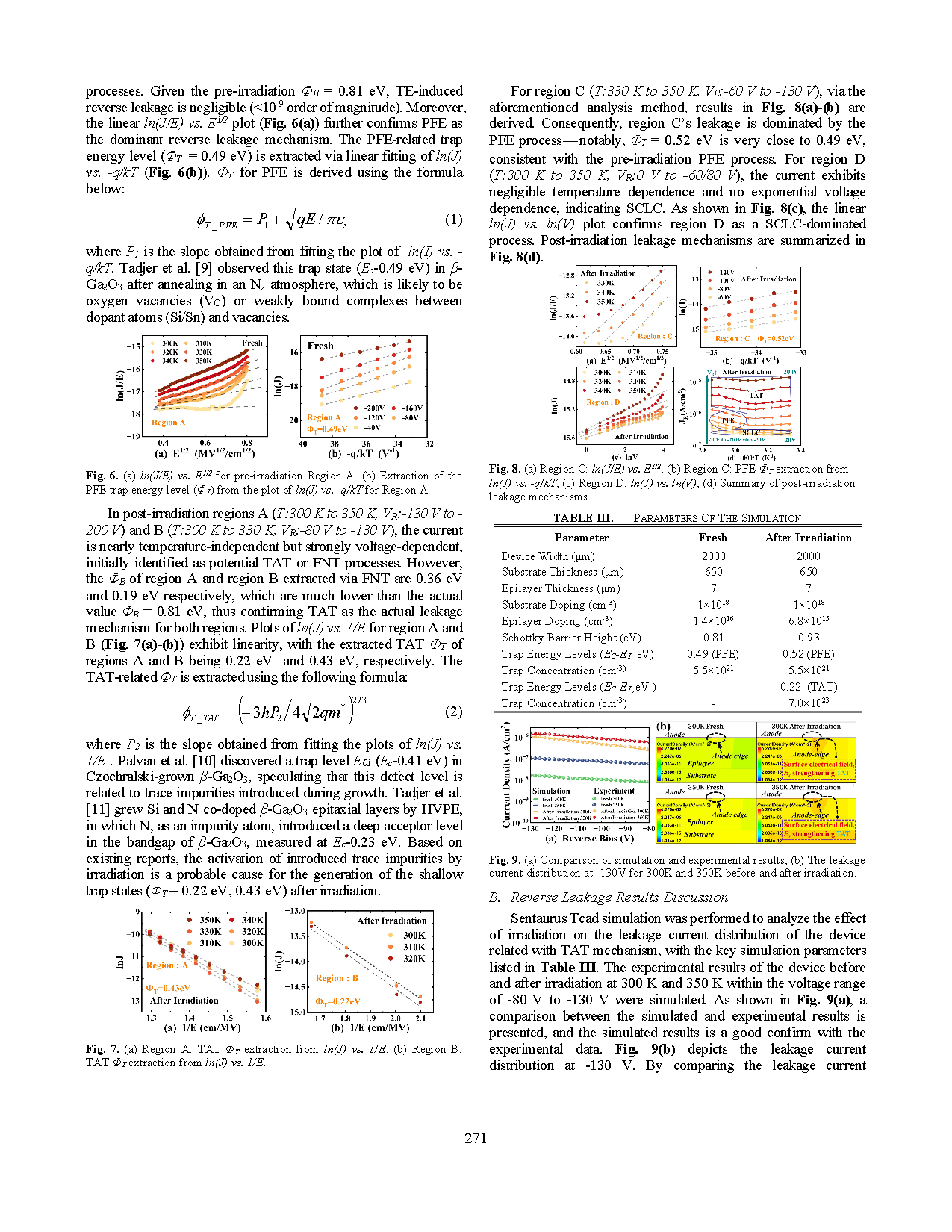
Fig. 5. (a) The relationship of extracted reverse current density with temperature at different voltages before irradiation, and (b) after irradiation.
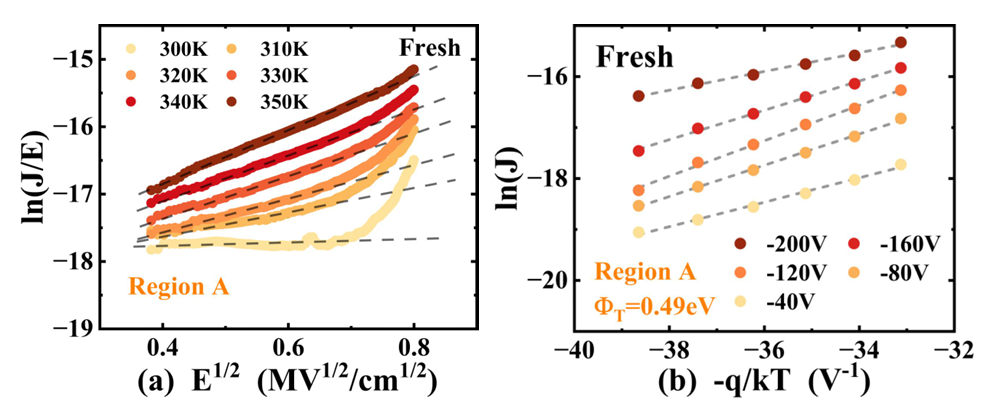
Fig. 6. (a) ln(J/E) vs. E1/2 for pre-irradiation Region A. (b) Extraction of the PFE trap energy level (ΦT) from the plot of ln(J) vs.-q/kT for Region A.
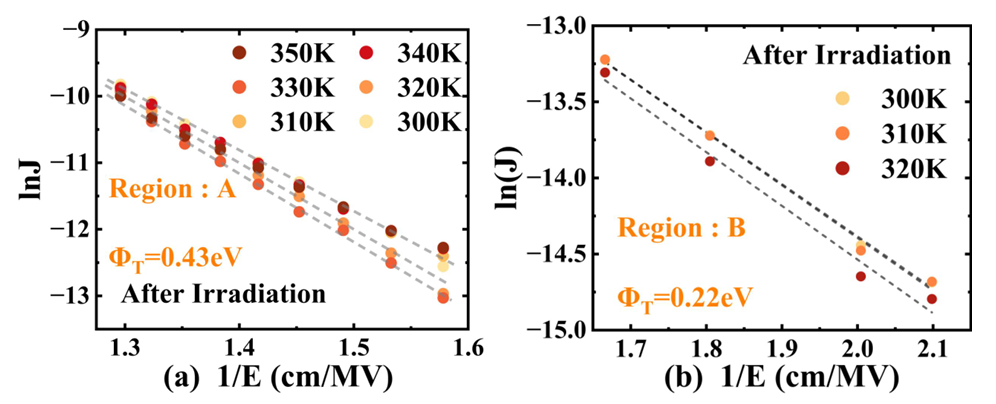
Fig. 7. (a) Region A: TAT ΦT extraction from ln(J) vs. 1/E, (b) Region B: TAT ΦT extraction from ln(J) vs. 1/E.
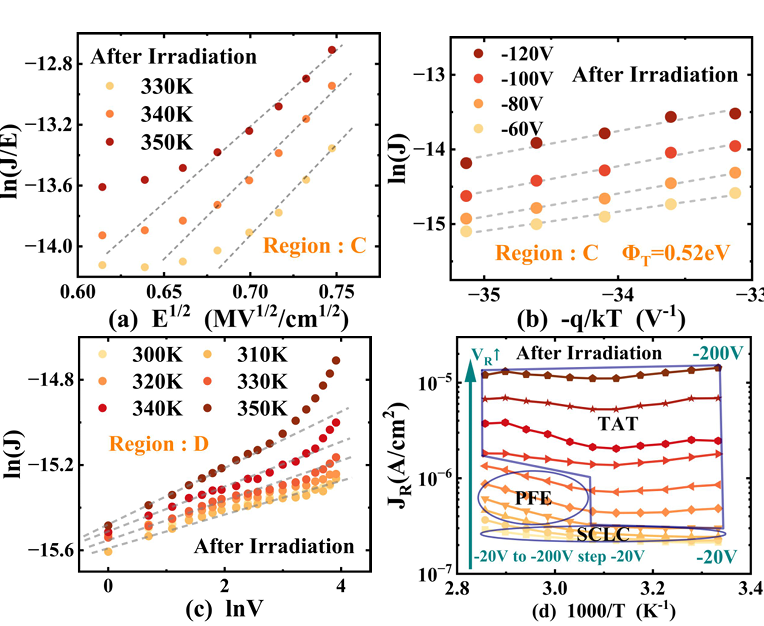
Fig. 8. (a) Region C: ln(J/E) vs. E1/2, (b) Region C: PFE ΦT extraction from ln(J) vs.-q/kT, (c) Region D: ln(J) vs. ln(V), (d) Summary of post-irradiation leakage mechanisms.
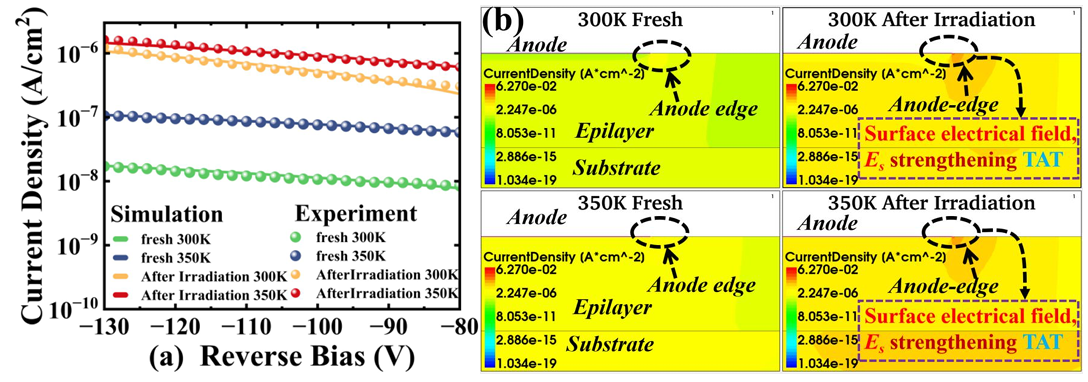
Fig. 9. (a) Comparison of simulation and experimental results, (b) The leakage current distribution at-130V for 300K and 350K before and after irradiation.
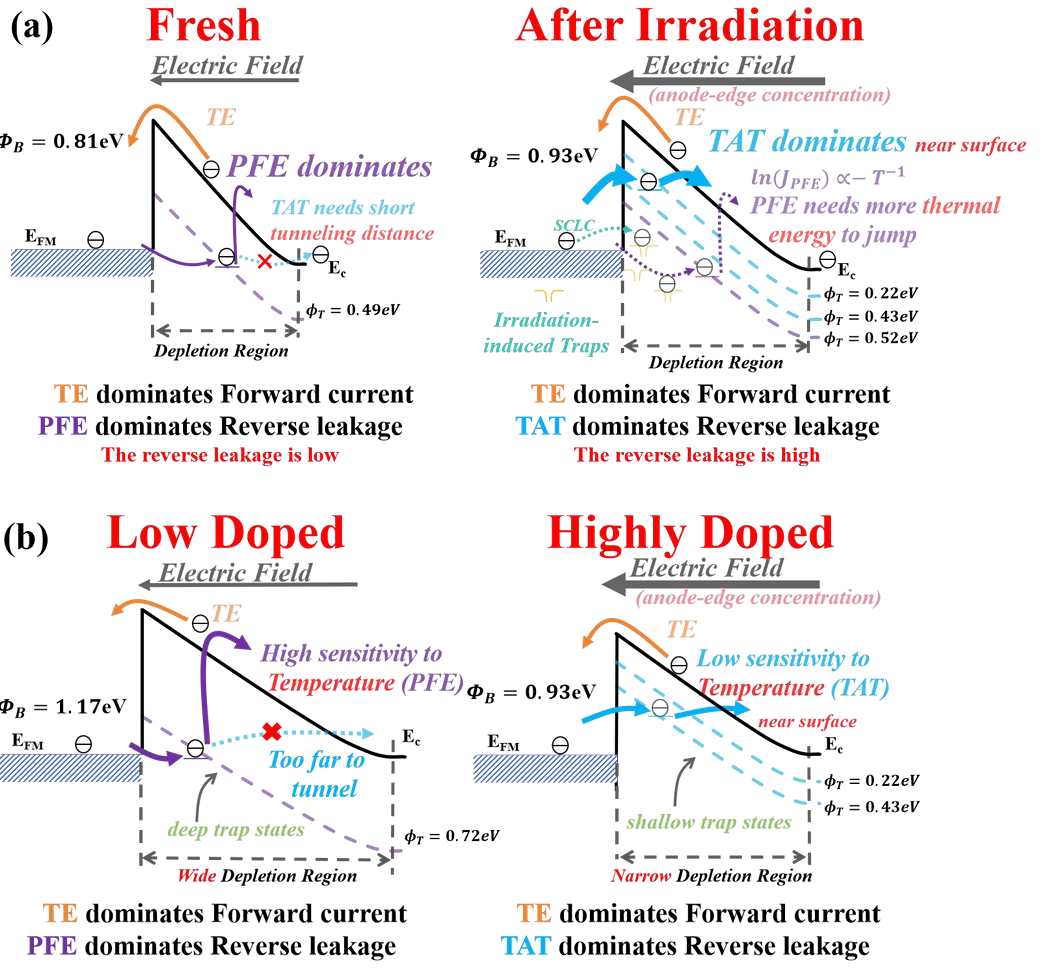
Fig. 10. (a) Evolution of the dominant reverse leakage mechanism induced by irradiation. (b) Contrast of the dominant leakage mechanisms in highly-doped and low-doped epitaxial β-Ga₂O₃ SBD.
DOI:
10.1109/ISPSD64561.2026.11553786
Instruction
Official Account

Cooperation
Top