

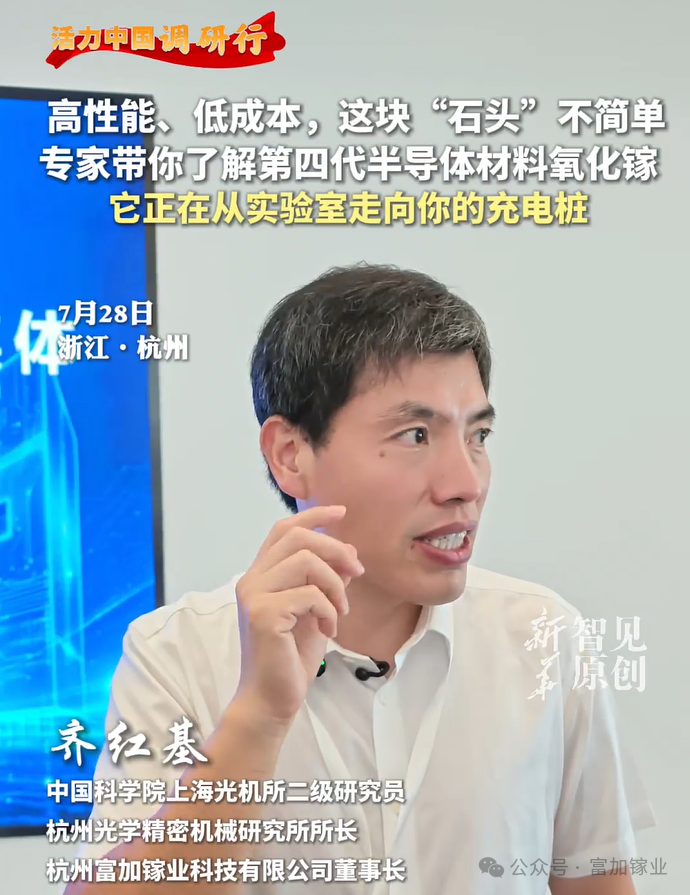
On July 28, Xinhua interviewed Qi Hongji, Chairman of Hangzhou Fujia Gallium Technology Co., Ltd., to gain deeper insights into the latest breakthroughs in the ultra-wide-bandgap semiconductor material gallium oxide and his forward-looking assessment of the industry’s development.
Being included in Xinhua’s research coverage not only reflects the attention from a major state media outlet to Fujia Gallium’s technological progress, but also highlights the growing attention being paid to gallium oxide as an emerging advanced material and to its ongoing industrialization.
In March this year, Fujia Gallium successfully produced a 12-inch gallium oxide single crystal, setting a new global record for gallium oxide crystal size. From continuously pushing the boundaries of single-crystal size to advancing the industrialization of the material, Fujia Gallium is exploring how to bring this “high-performance material” from the laboratory into real-world industrial applications.
Why Gallium Oxide?
In Qi Hongji’s view, the growing industry interest in gallium oxide stems first and foremost from the material’s inherent performance advantages.
“Gallium oxide’s biggest advantage is its high performance. It can withstand higher voltages than third-generation semiconductor materials such as silicon carbide and gallium nitride,” Qi Hongji said.
As an ultra-wide-bandgap semiconductor material, gallium oxide offers a high theoretical breakdown electric field and unique potential for high-voltage and high-power applications. As demand for high-voltage and high-power devices continues to grow in fields such as new energy vehicles, rail transportation, high-voltage power grids, and data centers, the application value of gallium oxide is becoming increasingly apparent.
Take new energy vehicles as an example. With 800-volt high-voltage platforms becoming increasingly widespread, onboard power devices face higher requirements for voltage withstand capability and energy-efficiency management. Qi Hongji believes that, with its characteristics of “high voltage withstand capability and low power loss,” gallium oxide could play a role in applications such as high-voltage fast charging, providing a new material option for reducing losses and improving efficiency in new energy vehicle power-control systems.
However, in Qi Hongji’s view, what makes gallium oxide truly worth looking forward to is not merely its “high performance.”
Beyond High Performance, Gallium Oxide Must Also Be “Affordable”
“Among all wide-bandgap and ultra-wide-bandgap semiconductor materials, gallium oxide is the only one that grows through a crystallization process similar to ‘water freezing into ice,’” Qi Hongji explained.
This unique crystal growth mechanism gives gallium oxide potential advantages in material production efficiency and cost control. For any emerging material technology, performance determines whether it is usable, while cost directly determines whether it can be used on a large scale. This is precisely why Fujia Gallium has continued to advance the development of large-size gallium oxide single crystals.
From continuously breaking through larger single-crystal sizes to successfully producing 12-inch gallium oxide single crystals, Fujia Gallium is steadily enhancing its material production capabilities and building a stronger material foundation for subsequent large-scale applications. In Qi Hongji’s view, the industrialization of gallium oxide cannot be judged by individual technical metrics alone; the real test is whether the material can successfully cross the critical threshold from the laboratory to the market.
From “Can We Make It?” to “Do We Want to Use It?”—How Far Is Gallium Oxide from Commercialization?
Regarding the current stage of China’s domestic gallium oxide industry, Qi Hongji offered a clear assessment: “From the perspective of materials, the industrialization process can be divided into four stages: ‘availability, usefulness, usability, and desirability.’”
The first stage, “availability,” addresses whether the material can be produced at all. The second, “usefulness,” asks whether its performance meets application requirements. The third, “usability,” focuses on industrialization challenges such as stability and consistency. Ultimately, the goal is to reach the stage of “desirability,” where downstream customers genuinely want to adopt the material. Together, these stages represent the complete path from technological breakthroughs to industrial maturity.
“At present, China’s domestic gallium oxide industry has overcome the challenge of moving from zero to one, and is accelerating toward large-scale applications—from ‘having it’ to ‘making it better,’” Qi Hongji said.
This is also the direction in which Fujia Gallium is currently focusing its efforts—not merely producing gallium oxide single crystals, but making them larger, more stable, and more competitive for industrial applications.
2026 marks the first year of China’s 15th Five-Year Plan. The Outline of the 15th Five-Year Plan explicitly calls for accelerating the upgrading of the wide-bandgap semiconductor industry and promoting the industrialization of ultra-wide-bandgap semiconductors such as gallium oxide and diamond. Against a backdrop of stronger policy support, continued technological iteration, and growing collaboration across the industrial chain, the gallium oxide industry is entering a new window of opportunity.
Looking ahead, Qi Hongji is confident: “Over the next two years, we expect to be able to use this high-quality material.”
From laboratory development of 2-inch single crystals to setting a new global size record with 12-inch single crystals; from overcoming the challenge of producing gallium oxide “from nothing” to advancing toward the goal of making it “better and more industrially competitive,” Fujia Gallium is using breakthroughs in large-size single-crystal materials as a key driver to continuously explore the path toward taking gallium oxide from technological achievement to large-scale industrial application.
Instruction
Official Account

Cooperation
Top