


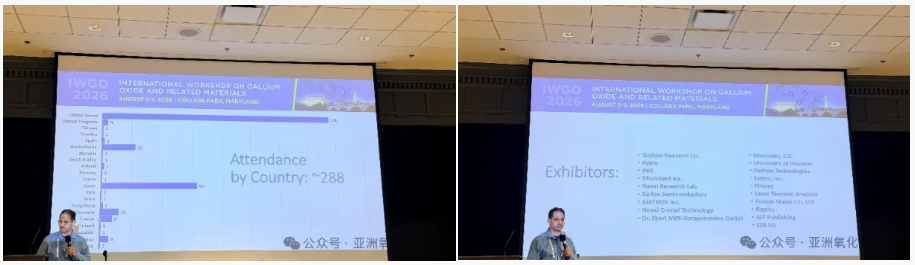
In August 2026, the 6th International Workshop on Gallium Oxide and Related Materials (IWGO 2026) successfully concluded in Maryland, USA. As an important global platform for academic and industry exchange in the Ga₂O₃ field, this year’s event reached a new high in both scale and participation. The conference attracted 288 registered participants, more than three times the 86 attendees at the inaugural IWGO in Kyoto. Notably, this scale was achieved despite the absence of a large number of Chinese researchers due to travel restrictions.
Industry participation was equally active, with 19 companies from different regions around the world attending and exhibiting. The participating companies covered multiple segments of the Ga₂O₃ value chain, including materials, epitaxy, devices, equipment, and applications. While U.S. companies accounted for a relatively large share, companies from Japan, Europe, South Korea, and China also took part.
The growing number of companies and broader coverage across the value chain have given what was once primarily an academic conference a much more pronounced industrial character. Over the five-day event, the latest developments from crystal growth and epitaxy to device development and industrialization were brought together from around the world. More importantly, the discussions both inside and outside the conference offered an opportunity to consider a broader question: How far has Ga₂O₃ actually progressed toward industrialization today?
During the conference, the Alliance also spoke with and interviewed leaders from several member organizations, as well as researchers and experts from the field, engaging in in-depth discussions on materials, devices, pathways to industrialization, and the future of the industry. We will be releasing these interviews in the coming weeks, sharing perspectives from researchers and industry practitioners at the forefront of global Ga₂O₃ development and offering further insights into the evolution of the industry.
01 From “Technical Feasibility” to “Industrial Economics”
One of the clearest signals from this year’s conference was that Ga₂O₃ is moving from “technical feasibility” toward “industrial economics.”
In the past, the industry focused more on whether crystals could be grown, devices could be fabricated, and higher voltage ratings could be achieved. After years of development, extensive technical validation has now been carried out across both materials and devices, bringing the industry to a critical stage ahead of large-scale commercialization. At this point, the questions that really matter are no longer simply “Can we make it larger, withstand higher voltages, or push the technology further?” but rather: Can we produce it consistently? At what cost? And can we ultimately turn it into a reliable, commercially viable product?
Accordingly, discussions at this year’s conference increasingly centered on yield, cost, reliability, and manufacturing capability. Substrate technology routes are gradually moving from a phase of “many competing approaches” toward greater consolidation, while the exploration of new crystal orientations is increasingly being evaluated in terms of defects, processing difficulty, and cost. On the device side, the focus is also shifting from simply demonstrating high-voltage performance toward reliability and practical application validation. Ultimately, all of these discussions point to the same question: How can Ga₂O₃’s theoretical breakdown-field advantage of around 8 MV/cm be translated into a genuine product advantage with economic value?
This also means that the industry needs to take a closer look at the relationship between larger sizes and lower costs. If yield, defect control, processing costs, and equipment capabilities cannot improve together, simply pursuing larger substrates will have diminishing significance. Rather than continuing to chase size alone, it may be more valuable at this stage to focus on improving stable production yields at existing sizes, reducing unit manufacturing costs, enhancing device reliability, and establishing repeatable manufacturing processes.
From this perspective, Ga₂O₃ may be only “one final step” away from true industrialization, but that step is no longer about a single technological breakthrough. It will test the capabilities of the entire value chain. Materials, epitaxy, devices, and equipment need to work more closely around real product requirements, while gaps in application expertise, dedicated equipment, standards, and demonstration applications also need to be addressed. For the domestic industry, the materials side has already established a solid foundation. The next stage will require stronger coordination between materials and equipment, as well as epitaxy and devices, so that existing materials advantages can be translated into stable manufacturing capabilities.
And precisely because the industry is reaching this stage, the importance of international exchange is becoming even more apparent.
02 Industrialization Requires Not Only Technology, but Also the Flow of Information
Looking back at IWGO 2026, one phenomenon deserves the industry’s attention: only six colleagues from mainland China attended the conference in person, reflecting relatively limited participation from China’s broader academic and industrial community. At the same time, experts and company representatives from around the world used this international platform to exchange the latest technological developments face to face, assess industry trends, and discuss potential paths forward. International conferences serve as important windows into the technological frontier and provide opportunities for two-way technical dialogue. We hope that more researchers and industry representatives from China will actively participate in such high-level international exchanges in the future. Through closer communication and interaction, they can stay abreast of global technological developments, learn from different approaches, while also bringing the voice of China’s Ga₂O₃ industry to the international community and promoting mutual learning and collaborative progress.
Different regions around the world are now developing along distinctive paths. Europe and the United States continue to advance fundamental research and novel device technologies; Japan has built deep expertise in crystal growth, large-size substrates, and process development; while China is showing strong potential in materials manufacturing and cost control. Each region has its own strengths, and these differences are themselves an important resource for industry development.
For an industry still in the early stages of industrialization, the flow of information is itself a productive force. The value of international conferences is no longer limited to learning about the latest papers. More importantly, they provide insight into what problems different regions are working to solve, which technology routes are gradually converging, and where the value chain is heading. For Chinese research institutions and companies, this can help reduce duplicated efforts and enable more accurate assessments of their own position and next steps. At the same time, it allows international peers to gain a more accurate understanding of the progress already being made by China’s Ga₂O₃ industry.
This is also the role the Alliance hopes to play. As an industry organization focused on Ga₂O₃, the Alliance will continue to follow global technological and industrial developments, promote broader information exchange across regions, and connect research institutions, companies, and industry professionals. This will enable different regions to understand one another’s progress, perspectives, and needs in a more timely manner. During IWGO 2026, we also had the opportunity to engage with peers from different countries and regions, and one thing became increasingly clear: as Ga₂O₃ moves closer to industrialization, the industry’s need for cross-regional information exchange and resource connectivity is growing.
The industrialization of Ga₂O₃ requires not only breakthroughs in materials, equipment, and device technologies, but also an open and efficient global network for communication and collaboration. Only when information, talent, technology, and industrial resources continue to move across borders can technological progress be translated more quickly into industrial progress.
03 See you at IWGO 2028 in Okayama, Japan.
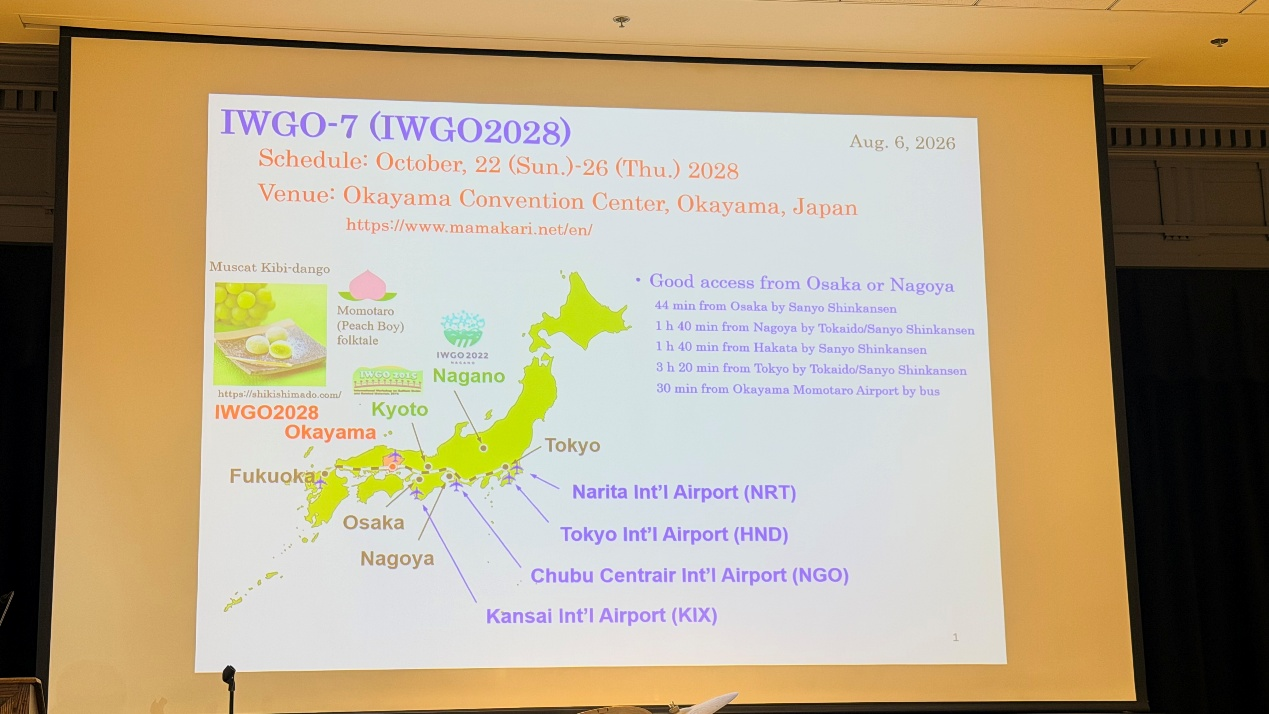
In 2028, the next IWGO will be held in Okayama, Japan. We look forward to seeing the Ga₂O₃ community come together again with more mature material platforms, more reliable device products, and clearer paths toward commercialization. By then, we hope to see products that can truly translate the advantages of Ga₂O₃ into practical value and demonstrate the material’s potential to the market.
At the same time, the Alliance looks forward to continuing its open exchange and collaboration with colleagues around the world, working together to advance the Ga₂O₃ industry toward greater maturity.
Instruction
Official Account

Cooperation
Top
