


A team of researchers from Tomsk State University, the Institute for Physics of Microstructures of the Russian Academy of Sciences, and St. Petersburg State University, led by Dr. Aleksei Almaev, has developed a method to improve the stability of high-temperature gas sensors based on Ga2O3 thin films.
Modern automobile engines and various power generation systems require reliable sensors to monitor exhaust gas composition. The operating conditions of such sensors correspond to high temperatures (600–1000 °C). β-Ga2O3 is known for its high thermal and chemical stability, making it an attractive material for sensors capable of functioning at high temperatures. To enhance the surface contribution as the sensing element of sensors, it is necessary to use thin films. From the standpoint of ease of implementation and compatibility with other microelectronics methods, it is advisable to deposit Ga2O3 thin films using magnetron sputtering, and to use commercially available sapphire, which is stable at high temperatures and in gaseous environments, as the substrate. Our preliminary studies have shown that at high temperatures, both during annealing and in the operating mode, Al atoms from the sapphire substrate diffuse into the sensitive layer. This causes an undesirable increase in the baseline resistance of the sensors and leads to a drift in their characteristics. It is worth noting that the annealing temperature was higher than the operating temperature. To solve this problem, the researchers proposed depositing an additional SiO2 barrier layer between the sapphire substrate and the Ga2O3 thin film.
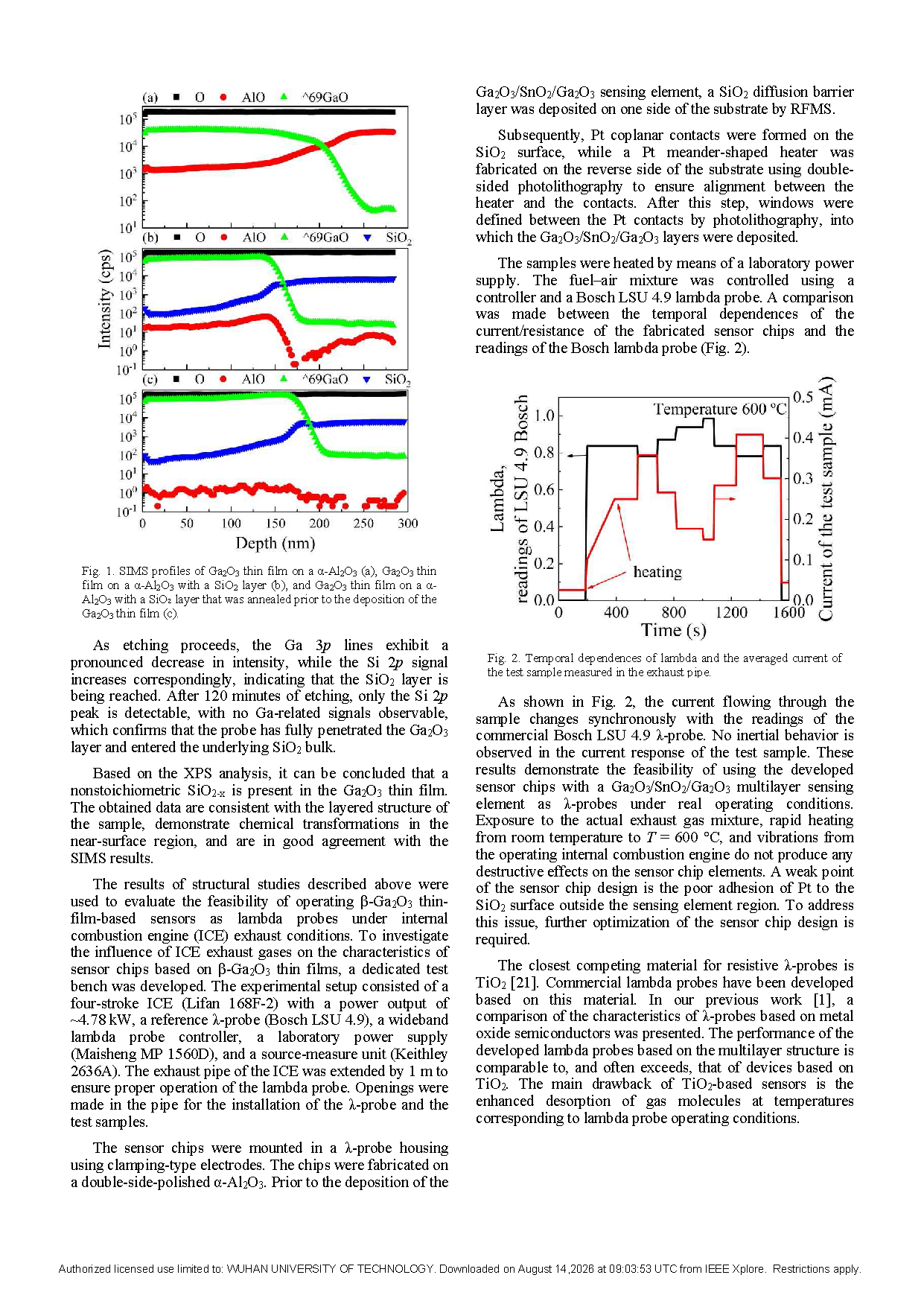
The oxide films were deposited onto a sapphire substrate using magnetron sputtering. Three series of samples were fabricated: without a SiO2 barrier layer; with a SiO2 barrier layer; and with the same layer pre-annealed at 1100 °C. All samples were annealed at 1000 °C after Ga2O3 deposition. Studies of the structural properties of the samples showed that a 300 nm thick SiO2 layer significantly reduces Al diffusion, and its pre-annealing almost completely blocks it, the Al concentration in the film drops to the detection limit of the instruments.
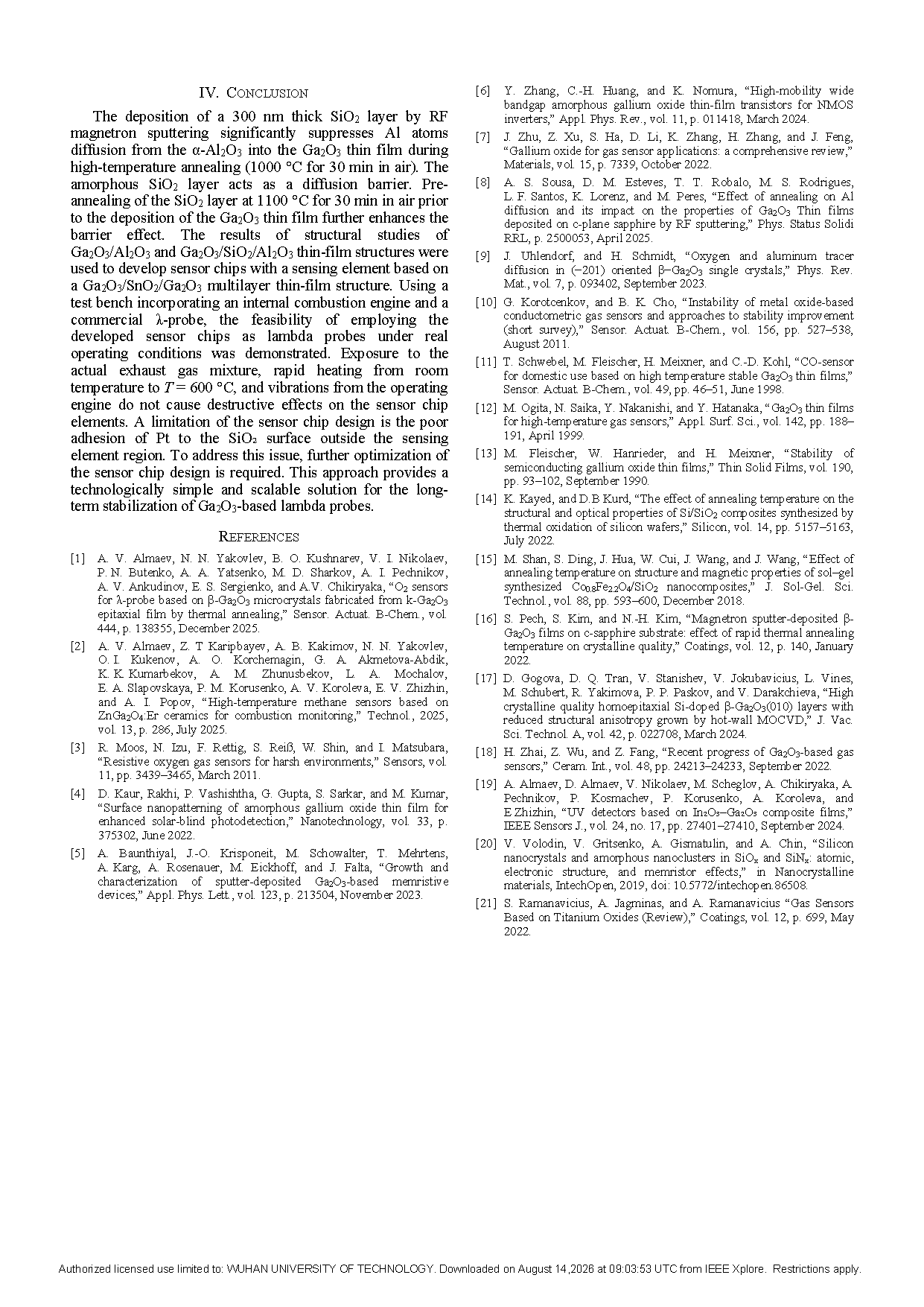
Based on these results, prototype sensors with a multilayer Ga2O3/SnO2/Ga2O3 structure and Pt contacts and a heater were fabricated. Tests on a real internal combustion engine showed that the signal of the developed sensor synchronously follows the readings of a reference commercial lambda probe, withstands vibrations and rapid heating to 600 °C, and does not exhibit characteristic drift.
These results were presented at the 2026 IEEE 27th International Conference of Young Professionals in Electron Devices and Materials (EDM) https://edm.ieeesiberia.org/.
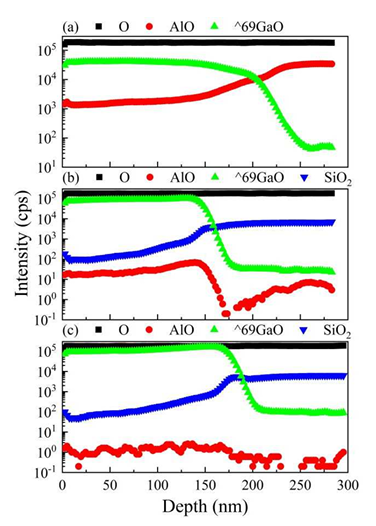
Fig. 1. SIMS profiles of Ga₂O₃ thin film on a α-Al₂O₃ (a), Ga₂O₃ thin film on a α-Al₂O₃ with a SiO₂ layer (b), and Ga₂O₃ thin film on a α Al₂O₃ with a SiO₂ layer that was annealed prior to the deposition of the Ga₂O₃ thin film (c).
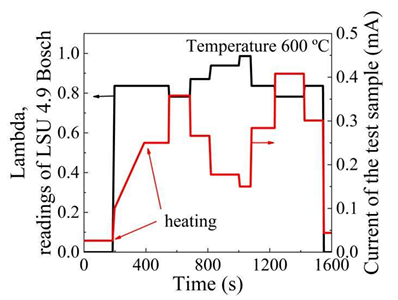
Fig. 2. Temporal dependences of lambda and the averaged current of the test sample measured in the exhaust pipe.
DOI:
doi.org/10.1109/EDM69524.2026.11631909
Instruction
Official Account

Cooperation
Top