


Researchers from the Ritsumeikan University and Toray Research Center Inc. have published a paper titled "Nondestructive estimation of defect-depth distribution in processed β-Ga₂O₃ using plan-view cathodoluminescence" in Japanese Journal of Applied Physics.
Background
Gallium oxide (Ga₂O₃) is an ultra-wide-bandgap semiconductor suitable for power electronics and optoelectronics. The monoclinic β phase is thermally stable, and its bandgap is approximately 4.7-4.9 eV. Ion implantation and subsequent activation annealing are key processes for realizing ideal device characteristics; however, it is difficult to completely remove the implantation-induced damage even by high-temperature annealing. Moreover, activation annealing drives the point defects to diffuse deeper into the device. The depth profiles of the point defects strongly influence the performance of vertical power devices, and dry etching can also generate unintended point defects. Cathodoluminescence (CL) is particularly suitable for characterizing ultra-wide-bandgap semiconductors, and depth-resolved information can be obtained by varying the beam energy; however, most previous studies used this technique qualitatively. Cross-sectional CL is effective for obtaining defect depth profiles but is destructive. In this work, plan-view CL is applied to processed β-Ga₂O₃, and a model describing the beam-energy dependence of the CL intensity is developed by incorporating a depth-dose function, surface recombination, and the CL-intensity retention function, enabling non-destructive estimation of the depth distribution of nonradiative recombination centers.
Abstract
We propose a nondestructive method for estimating damage depth in processed β-Ga₂O₃ using plan-view cathodoluminescence (CL). To estimate the depth distribution of nonradiative recombination centers, a model describing the beam-energy dependence of the CL intensity was developed by incorporating a depth-dose function and surface recombination. When applied to silicon (Si)-ion implanted β-Ga₂O₃, the estimated defect distributions reasonably agreed with those derived from the cross-sectional CL measurements. In dry-etched samples, defects were concentrated at shallower depths than those in the ion-implanted samples. This method enables nondestructive estimation of the defect-depth distributions and is applicable to device-process optimization and device-failure analysis.
Highlights
① A non-destructive method is proposed to estimate damage depth in processed β-Ga₂O₃ using plan-view cathodoluminescence (CL), avoiding destructive cross-sectional sample preparation.
② An analytical model describing the beam-energy dependence of the CL intensity is established by incorporating the depth-dose function, surface recombination, and the CL-intensity retention function.
③ Validation on silicon (Si)-ion implanted β-Ga₂O₃ samples shows that the estimated defect distributions agree reasonably with cross-sectional CL measurements.
④ In dry-etched samples, defects are concentrated at shallower depths, consistent with the shallower penetration of the Ar ions used in dry etching.
⑤ The method is applicable to device-process optimization and device-failure analysis, meeting the demand for non-destructive characterization in mass production.
Conclusion
In summary, we developed a model describing the plan-view CL intensity of processed β-Ga₂O₃ by considering the depth-dose function, surface recombination, and the CL-intensity retention function. The beam-energy dependence of the CL intensity was reproduced reasonably well by the model. The estimated CL-intensity retention functions for the Si-ion implanted samples were reasonably consistent with the cross-sectional CL-intensity profiles obtained in our previous work. The proposed plan-view CL procedure can be used for nondestructive estimation of the damage depth in processed β-Ga₂O₃.
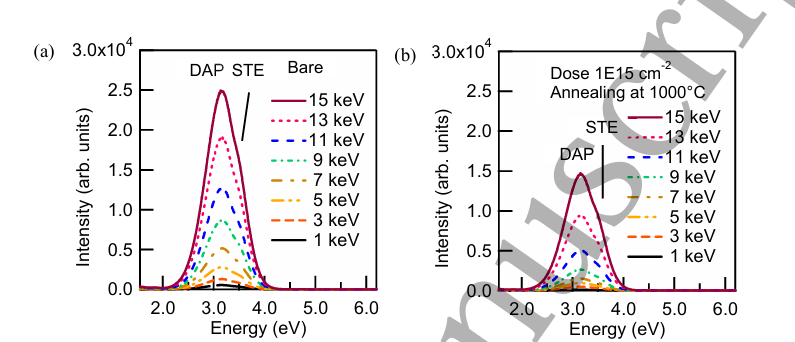
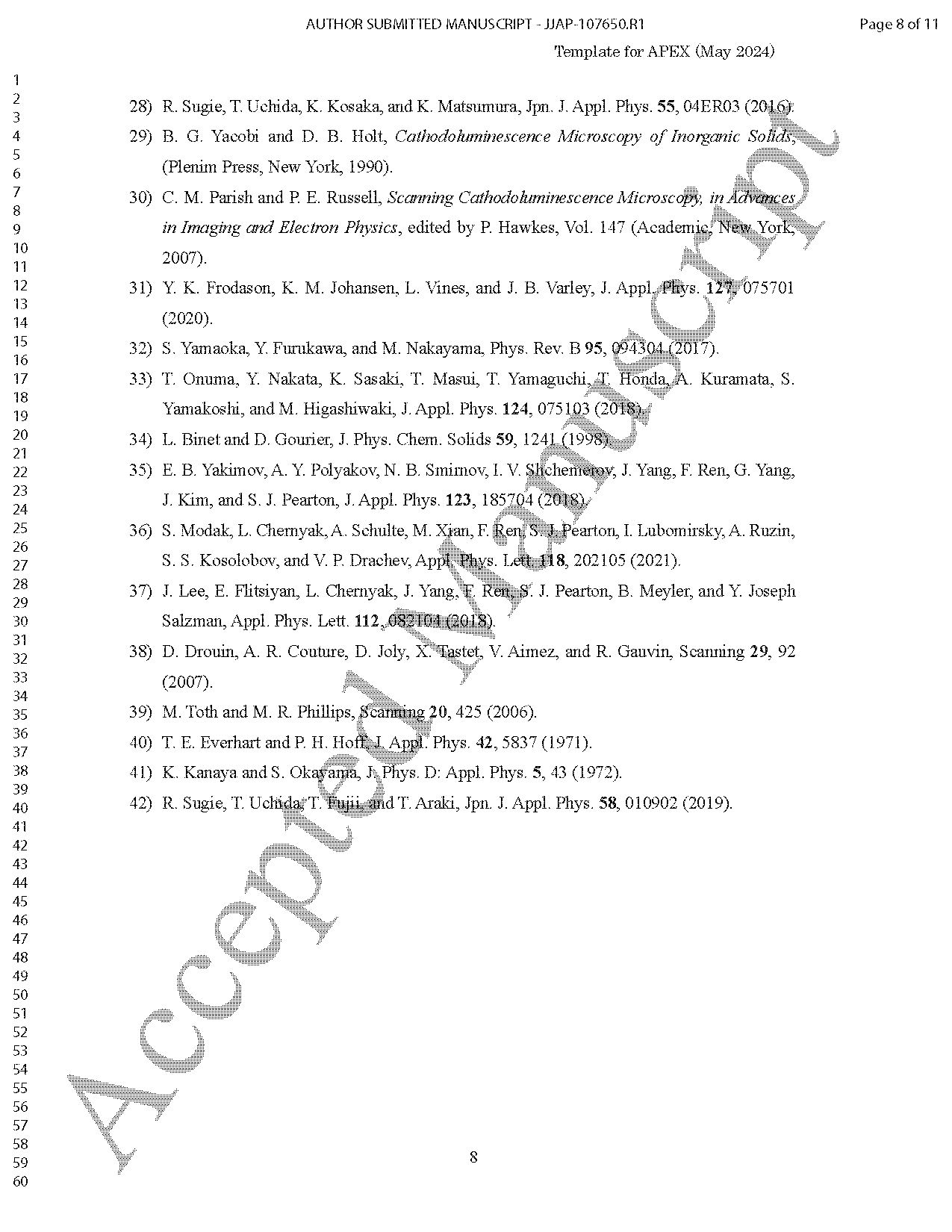
Figure 1. Plan-view CL spectra of (a) the bare sample and (b) the sample implanted at a dose of 1 × 10¹⁵ cm⁻² and annealed at 1000°C, measured at various beam energies.
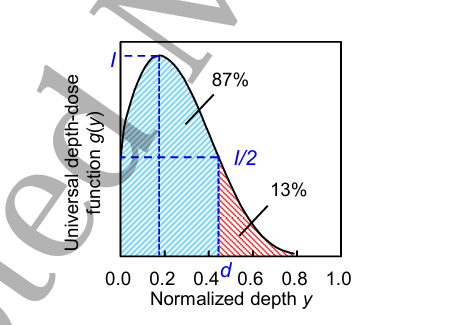
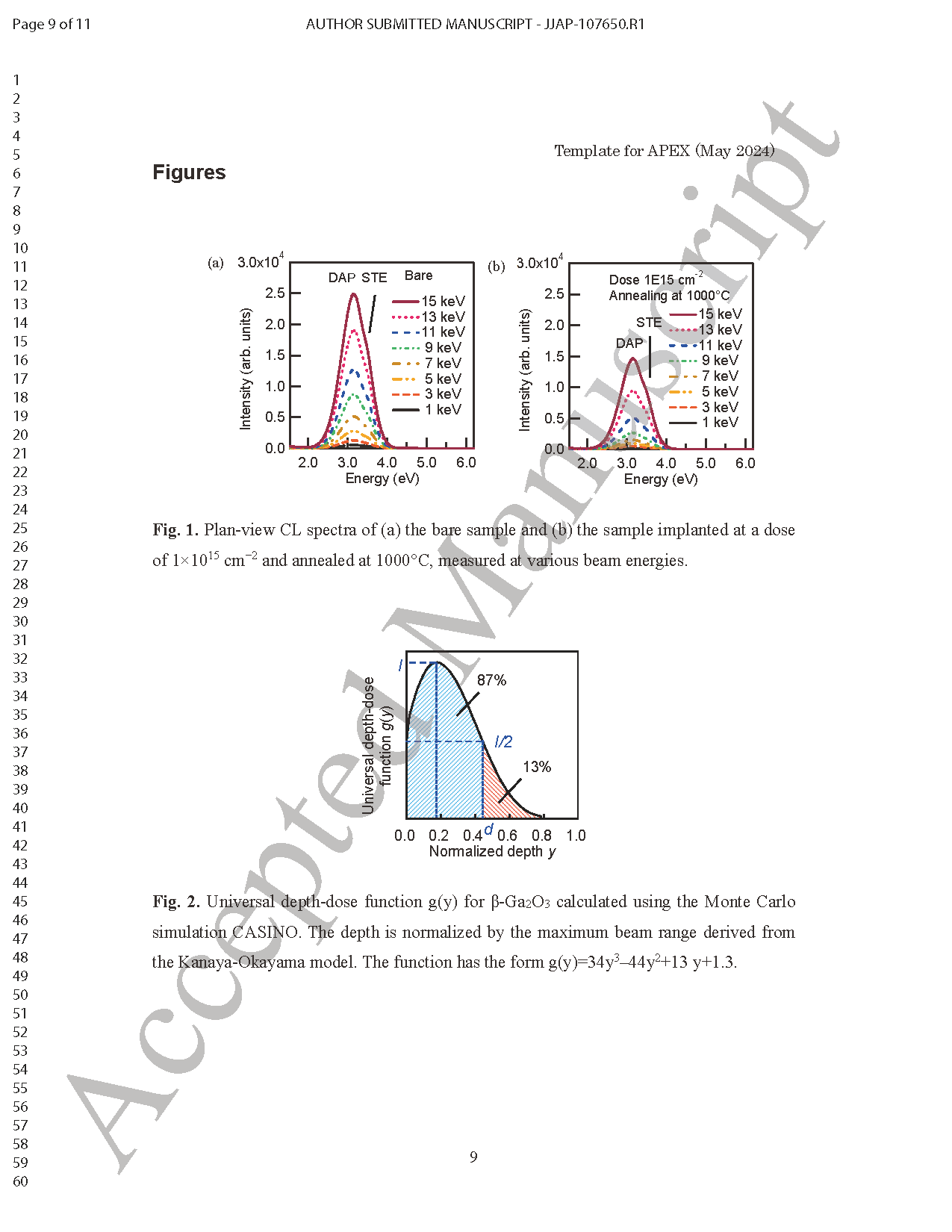
Figure 2. Universal depth-dose function g(y) for β-Ga₂O₃ calculated using the Monte Carlo simulation CASINO. The depth is normalized by the maximum beam range derived from the Kanaya-Okayama model. The function has the form g(y)=34y³-44y²+13 y+1.3.
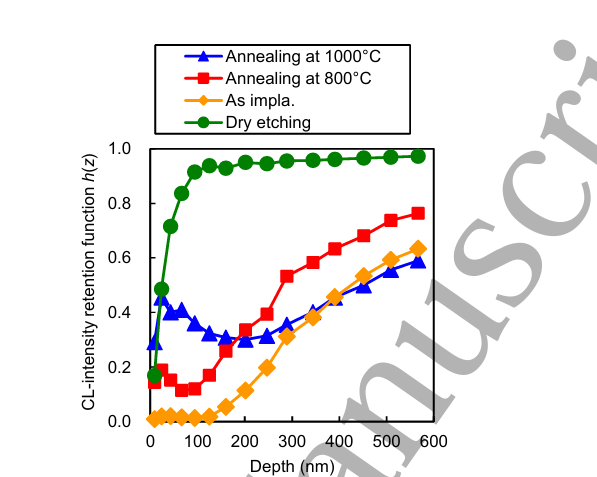
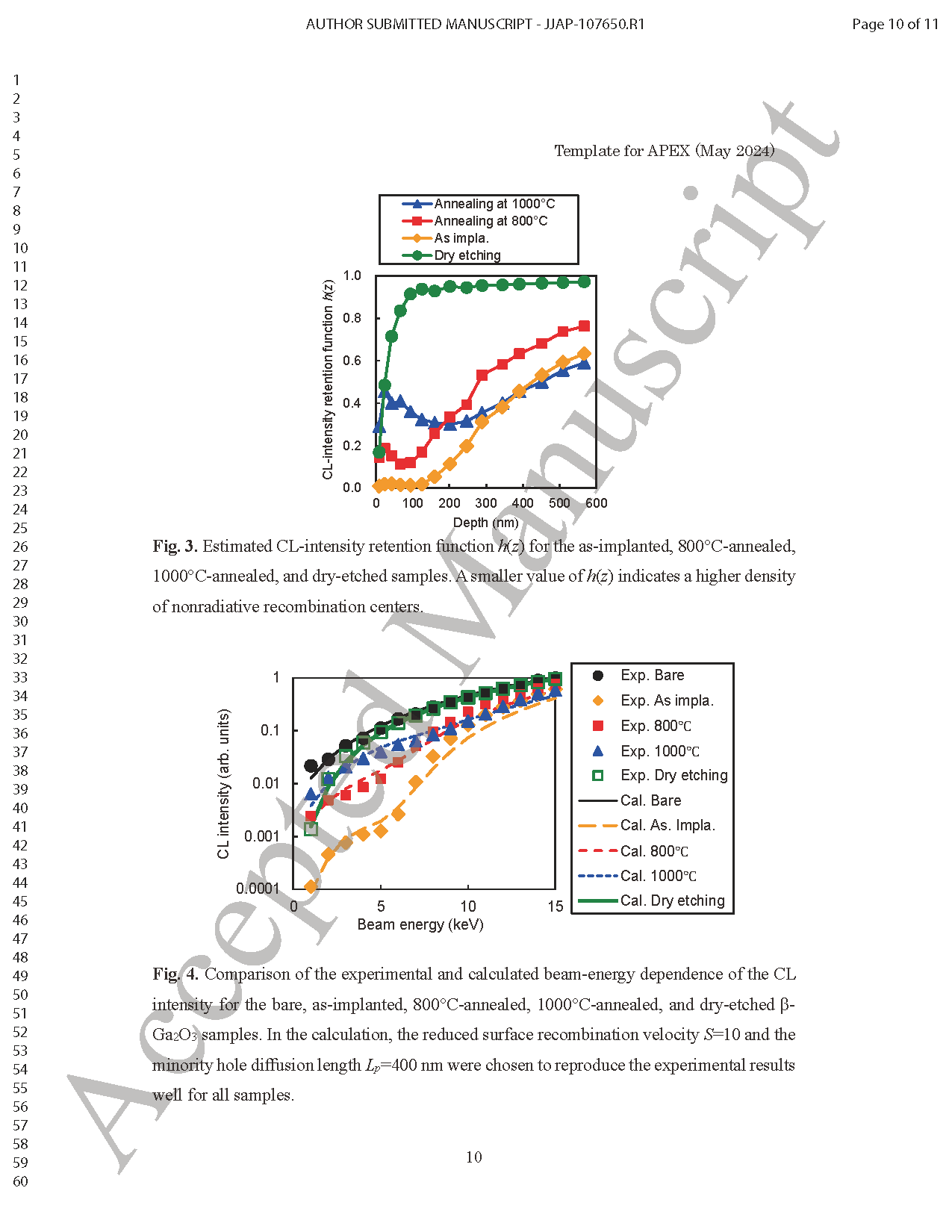
Figure 3. Estimated CL-intensity retention function h(z) for the as-implanted, 800°C-annealed, 1000°C-annealed, and dry-etched samples. A smaller value of h(z) indicates a higher density of nonradiative recombination centers.
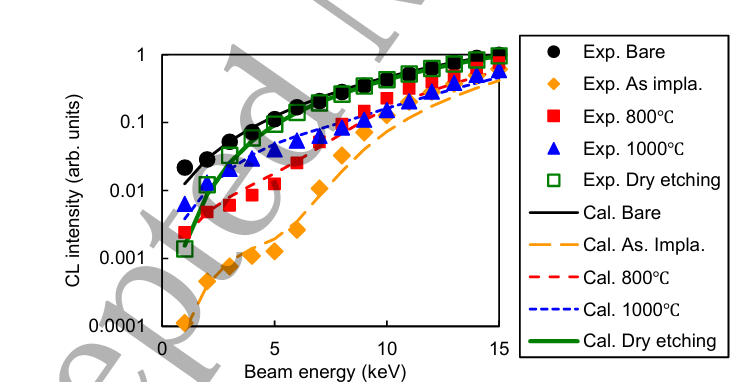
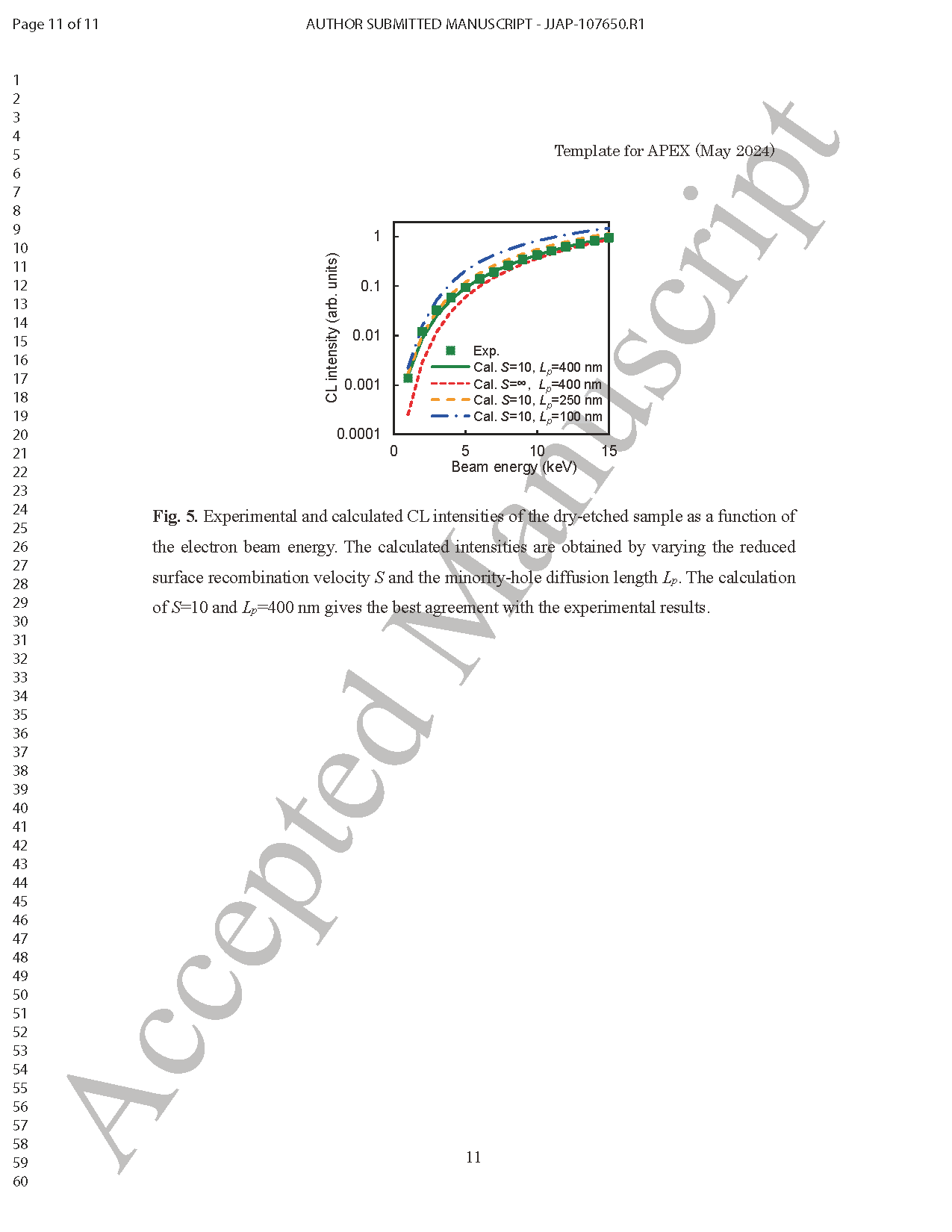
Figure 4. Comparison of the experimental and calculated beam-energy dependence of the CL intensity for the bare, as-implanted, 800°C-annealed, 1000°C-annealed, and dry-etched β-Ga₂O₃ samples. In the calculation, the reduced surface recombination velocity S=10 and the minority hole diffusion length Lₚ=400 nm were chosen to reproduce the experimental results well for all samples.
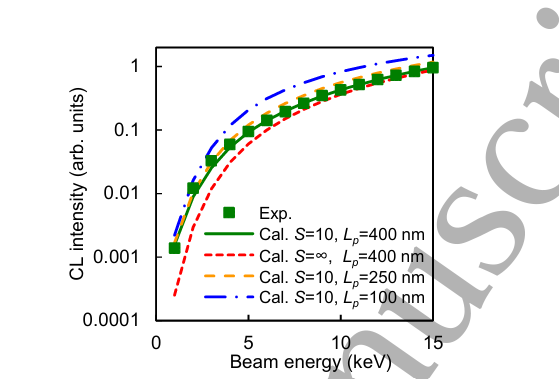
Figure 5. Experimental and calculated CL intensities of the dry-etched sample as a function of the electron beam energy. The calculated intensities are obtained by varying the reduced surface recombination velocity S and the minority-hole diffusion length Lₚ. The calculation of S=10 and Lₚ=400 nm gives the best agreement with the experimental results.
DOI:
10.35848/1347-4065/aea7eb
Instruction
Official Account

Cooperation
Top