


A research team comprising researchers from Hangzhou Garen Semiconductor Company Limited, the Central Research Institute of China Resource Microelectronics Limited, and Zhejiang University’s State Key Laboratory of Silicon and Advanced Semiconductor Materials published a research article in Materials Science in Semiconductor Processing. The article, “Neuroevolution potential enabled accurate prediction of thermophysical properties for high-temperature Ga₂O₃ melt,” reports a neuroevolution potential trained on density functional theory data and used with molecular dynamics simulations to evaluate multiple thermophysical properties of high-temperature gallium oxide melt. The results provide data to inform numerical simulations of Ga₂O₃ melt growth.
Background
β-Ga₂O₃ has an ultrawide bandgap of approximately 4.8 eV and a high critical breakdown field, making it a promising candidate for high-voltage power electronic devices. Device development depends on high-quality, large-diameter single-crystal substrates, which are primarily produced using melt-growth techniques such as casting, edge-defined film-fed growth (EFG), and vertical Bridgman growth. The process optimization of these crystal growth methods relies on numerical simulation for coupled analysis of heat transfer, melt flow, and solid–liquid interface stability in the growth furnace, and its reliability depends to a large extent on the accuracy of the thermophysical properties of the melt. However, Ga₂O₃ melts at approximately 2066 K, making experimental measurements of its melt properties challenging. Data on thermal conductivity and the temperature dependence of surface tension are particularly limited. Therefore, atomic-scale simulation has become an important approach for obtaining these key parameters. Although first-principles molecular dynamics (AIMD) has high accuracy, it is limited by computational scale and time and is difficult to apply directly to large-scale, long-time simulations of high-temperature melts. In this study, we trained a neuroevolution potential on density functional theory data to extend atomistic simulations to larger systems and longer timescales. We used this approach to estimate key properties of the high-temperature melt and compare the predictions with available experimental data.
Abstract
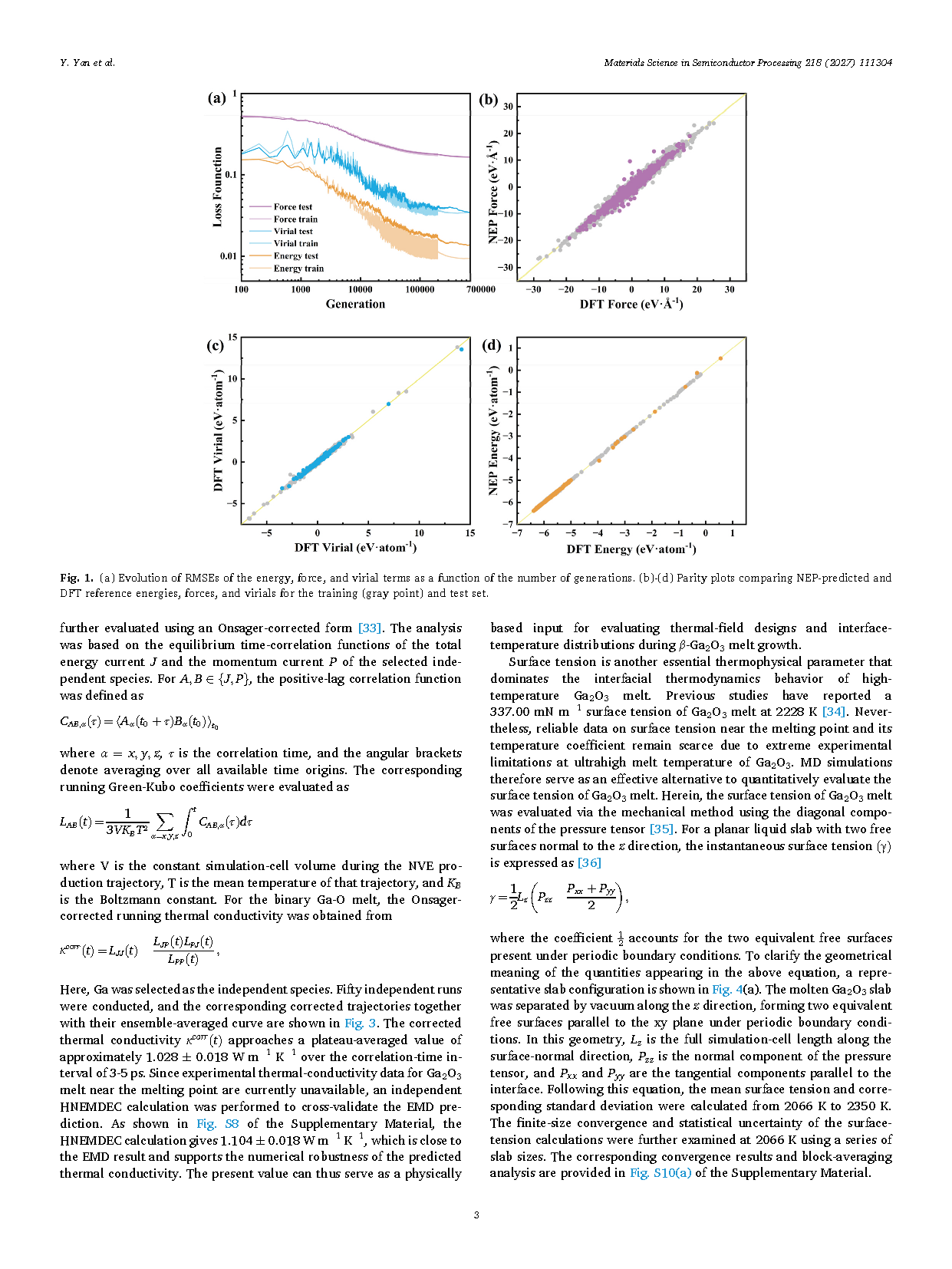
The research developed a neuroevolution potential (NEP) based on density functional theory (DFT) calculations and expanded the training set through active learning to a total of 3,876 structures. The model’s prediction errors for energy and stress were evaluated on both the training and test sets. The team then compared the radial distribution functions (RDFs) and angular distribution functions (ADFs) from NEP-based molecular dynamics (MD) simulations with those from ab initio molecular dynamics (AIMD) to assess how well the model reproduced the melt’s local atomic structure. On this basis, the team systematically calculated the melt’s thermal conductivity, surface tension and its temperature coefficient, density, isobaric thermal expansion coefficient, and shear and longitudinal viscosities. These results provide important input parameters for melt-growth simulations and indicate that transport properties such as viscosity require further validation and refinement.
Highlights
Applying a neuroevolution potential to large-scale atomistic simulations of high-temperature Ga₂O₃ melt: The model was trained on density functional theory data and expanded through active learning. Its performance was assessed using energy, force, and stress errors and by comparing melt structures with ab initio molecular dynamics.
Providing initial simulation estimates for melt properties that are difficult to measure: The paper reports the first calculated estimates of the thermal conductivity and surface-tension temperature coefficient of Ga₂O₃ melt, offering input values for growth simulations.
Evaluating multiple thermophysical properties within one framework: The study covers thermal conductivity, surface tension, density, isobaric thermal expansion, and shear and longitudinal viscosities, comparing properties with available experimental data where possible.
Independently cross-checking a key calculated property: Thermal conductivity was evaluated using both Green–Kubo equilibrium molecular dynamics and HNEMD, which produced close estimates. The paper also reports the remaining difference between calculated viscosity and available experimental data.
Conclusion
This study developed and validated a neuroevolution potential for simulating high-temperature Ga₂O₃ melt. It reported the first simulation estimates of thermal conductivity and the surface-tension temperature coefficient, and systematically evaluated density, isobaric thermal expansion, and viscosity. These data can inform simulations of heat transfer, melt flow, and growth kinetics in β- Ga₂O₃ melt growth. Because some transport properties still differ from available experimental data, further work combining improved potentials, additional high-temperature measurements, and validation against growth processes will be needed to improve the reliability of the input parameters.
Project Support
This work was supported by the ‘Pioneer’ and ‘Leading Goose’ R&D Program of Zhejiang (2023C01193), the National Natural Science Foundation of China (52202150, 22205203, 62574179), Fundamental Research Funds for the Central Universities (226-2022-00200 and 226-2022-00250), the Foundation for Innovative Research Groups of the National Natural Science Foundation of China (61721005), the National Postdoctoral Program for Innovative Talents (BX20220264), the National Program for Support of Topnotch Young Professionals, Zhejiang Provincial Natural Science Foundation of China (LJXSZ26A040002), and the Open Fund of State Key Laboratory of Silicon and Advanced Semiconductor Materials, Zhejiang University (SKL2026-07).
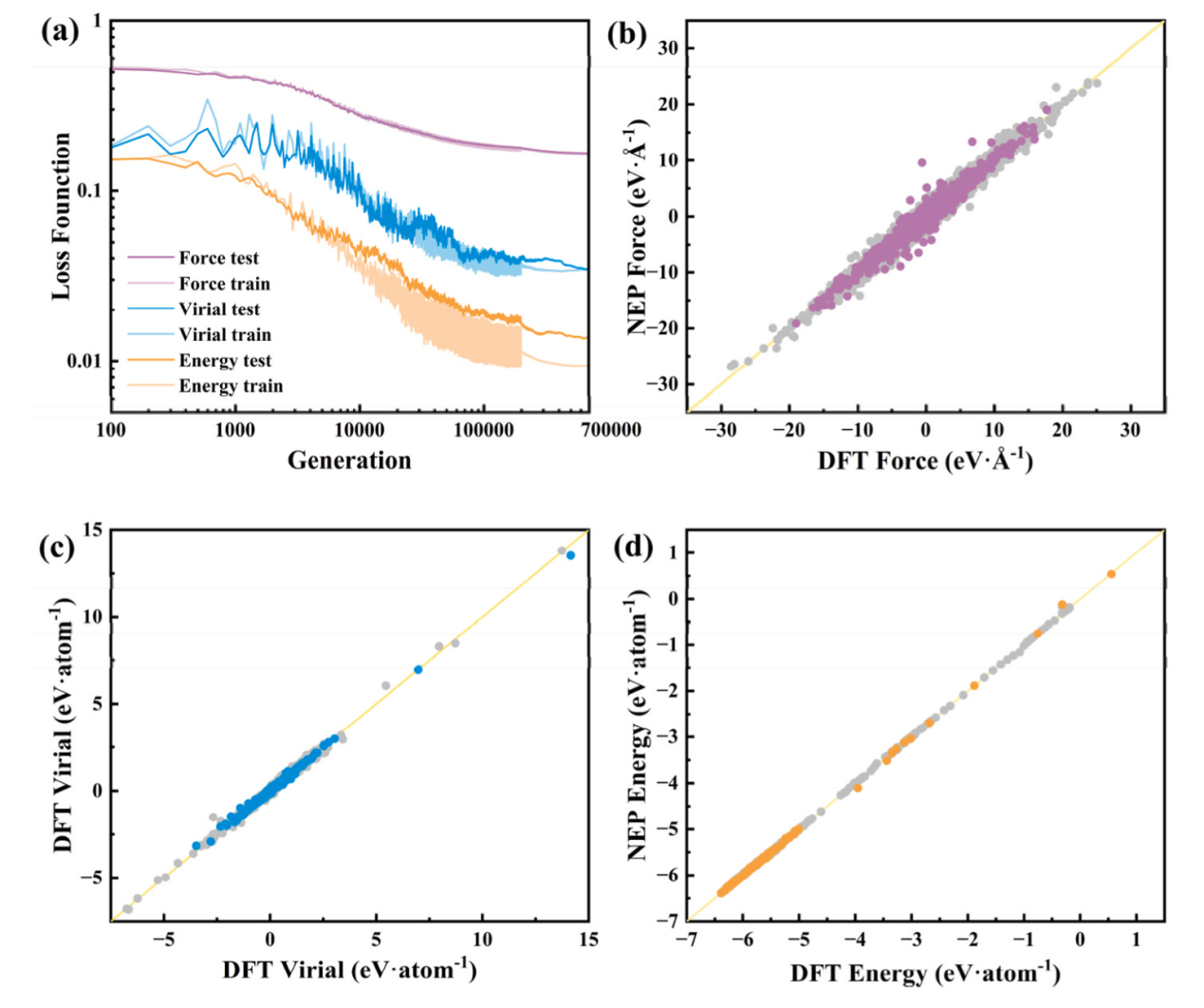
Figure 1. Training and test results for the neuroevolution potential (NEP). (a) Evolution of the root-mean-square errors (RMSEs) for energy, atomic forces, and virial stress with training generation. (b–d) Parity plots comparing NEP predictions with density functional theory (DFT) reference values for energy, atomic forces, and virial stress, respectively, for the training and test sets.
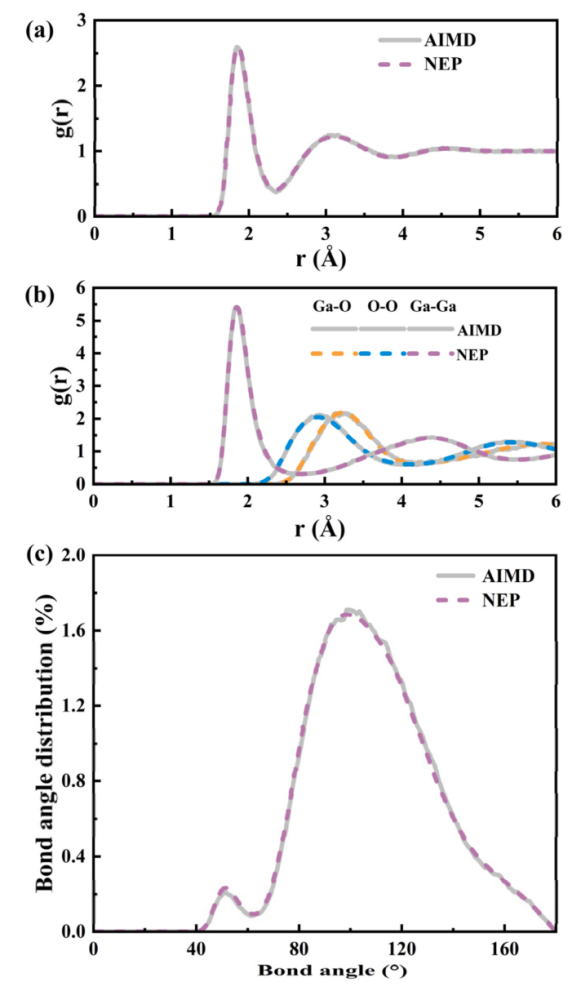
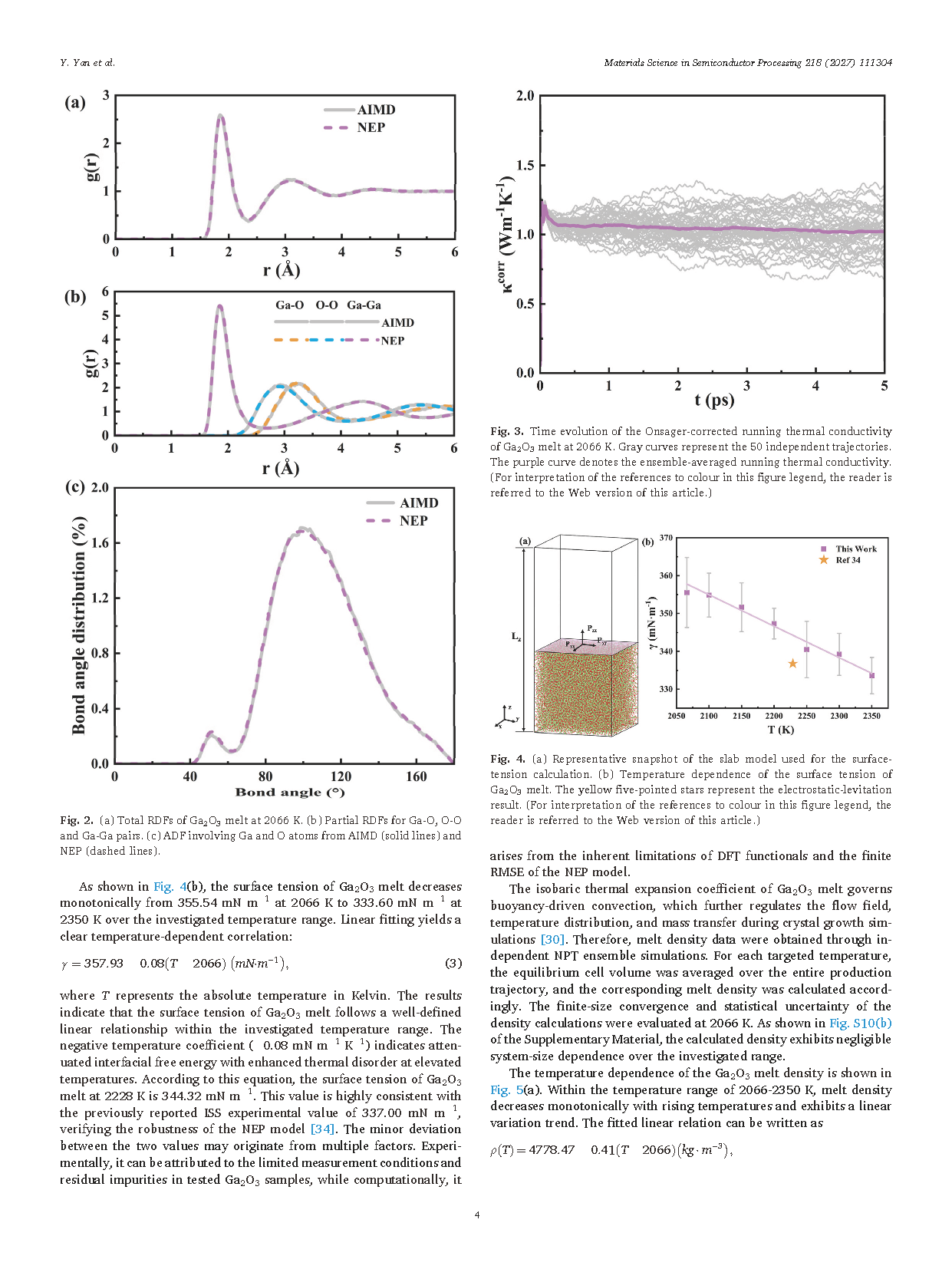
Fig. 2. (a) Total RDFs of Ga₂O₃ melt at 2066 K. (b) Partial RDFs for Ga-O, O-Oand Ga-Ga pairs. (c) ADF involving Ga and O atoms from AIMD (solid lines) andNEP (dashed lines).
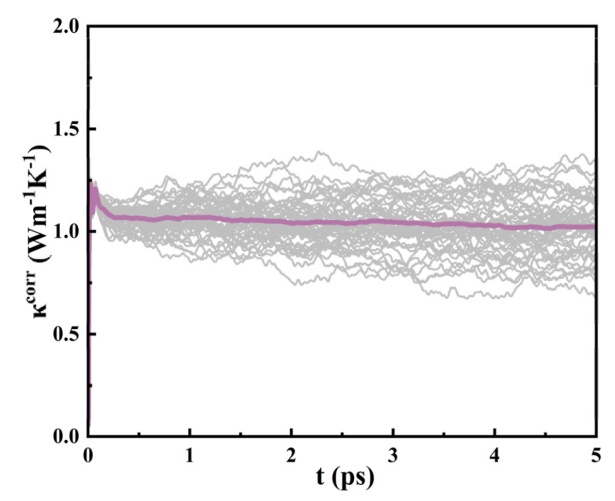
Fig. 3. Time evolution of the Onsager-corrected running thermal conductivity of Ga₂O₃ melt at 2066 K. Gray curves represent 50 independent trajectories, and the colored curve shows their ensemble average.
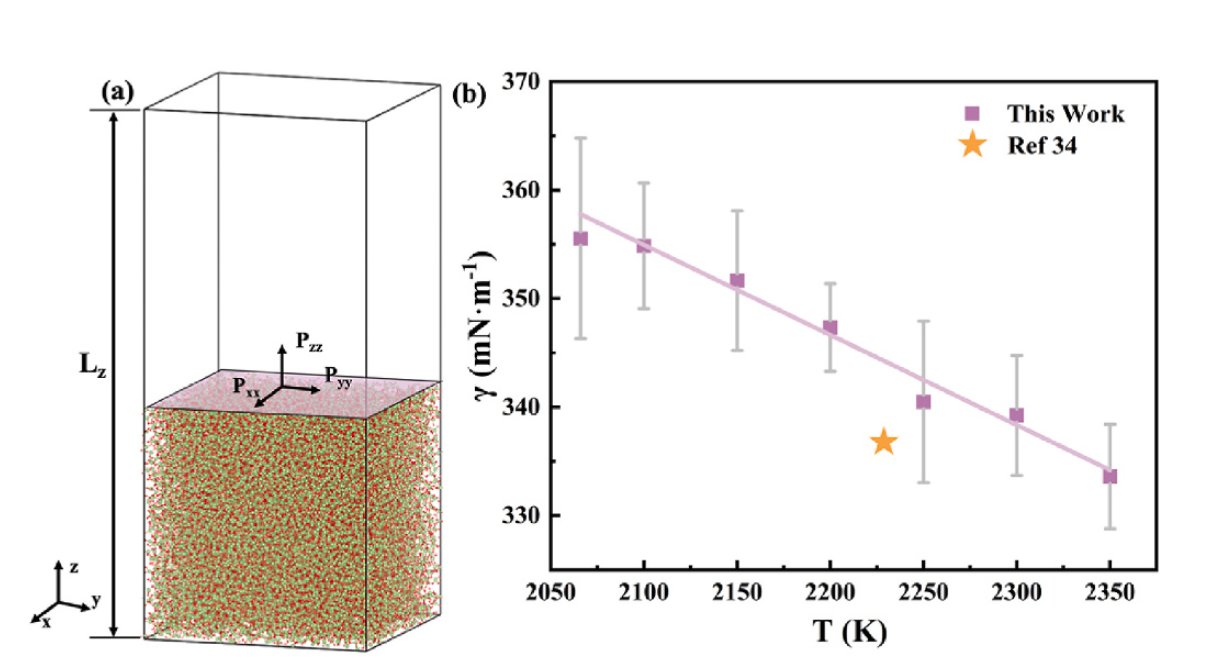
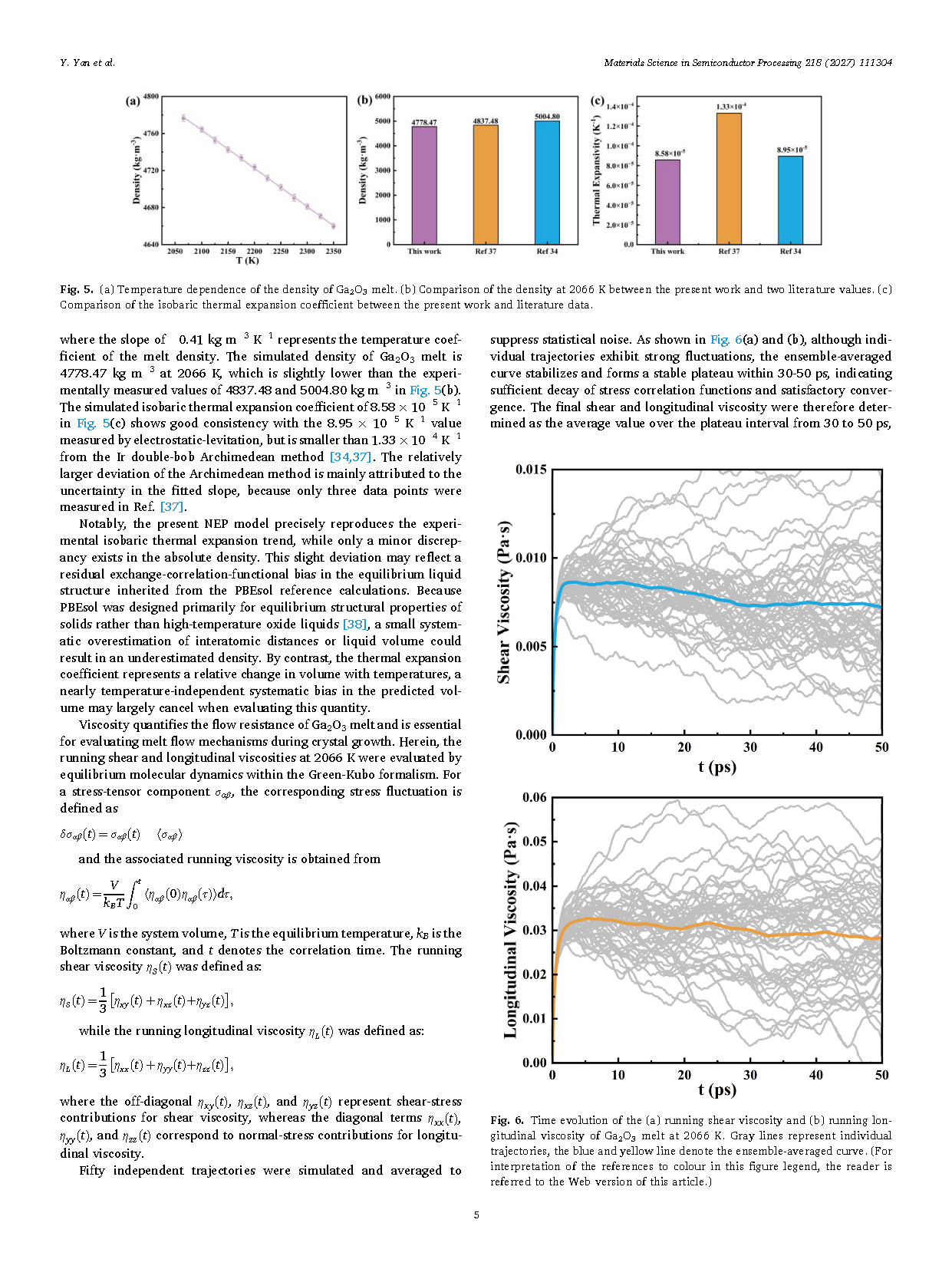
Fig. 4. Surface-tension calculations for Ga₂O₃ melt. (a) Representative liquid-slab model used in the calculation. (b) Temperature dependence of surface tension. Yellow stars denote electrostatic-levitation experimental data.
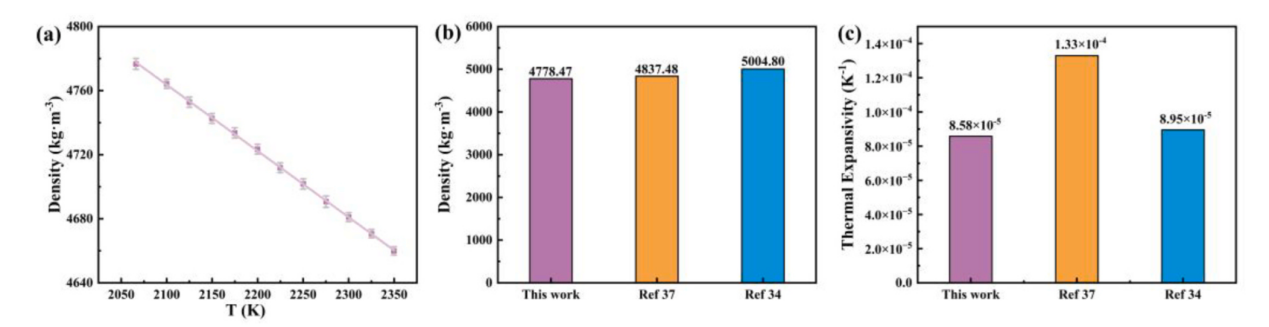
Fig. 5. Density and isobaric thermal-expansion coefficient of Ga₂O₃ melt. (a) Temperature dependence of density. (b) Comparison of the calculated density at 2066 K with literature experimental values. (c) Comparison of the calculated isobaric thermal-expansion coefficient with literature data.
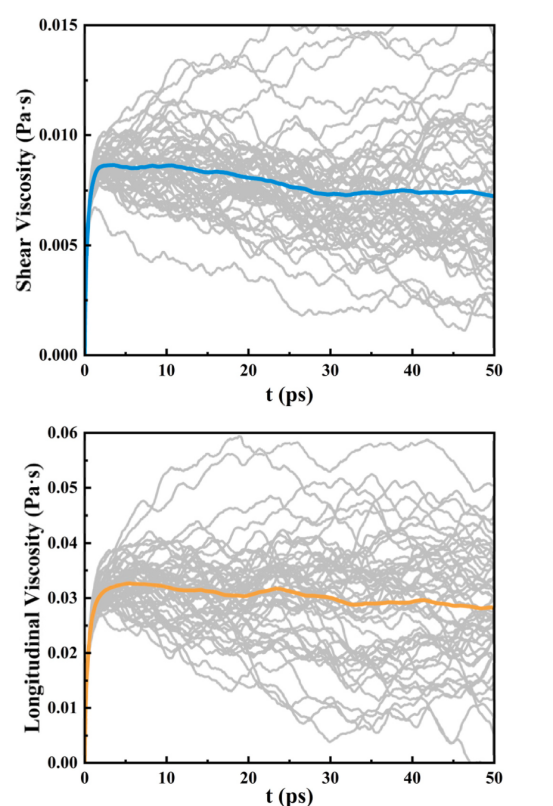
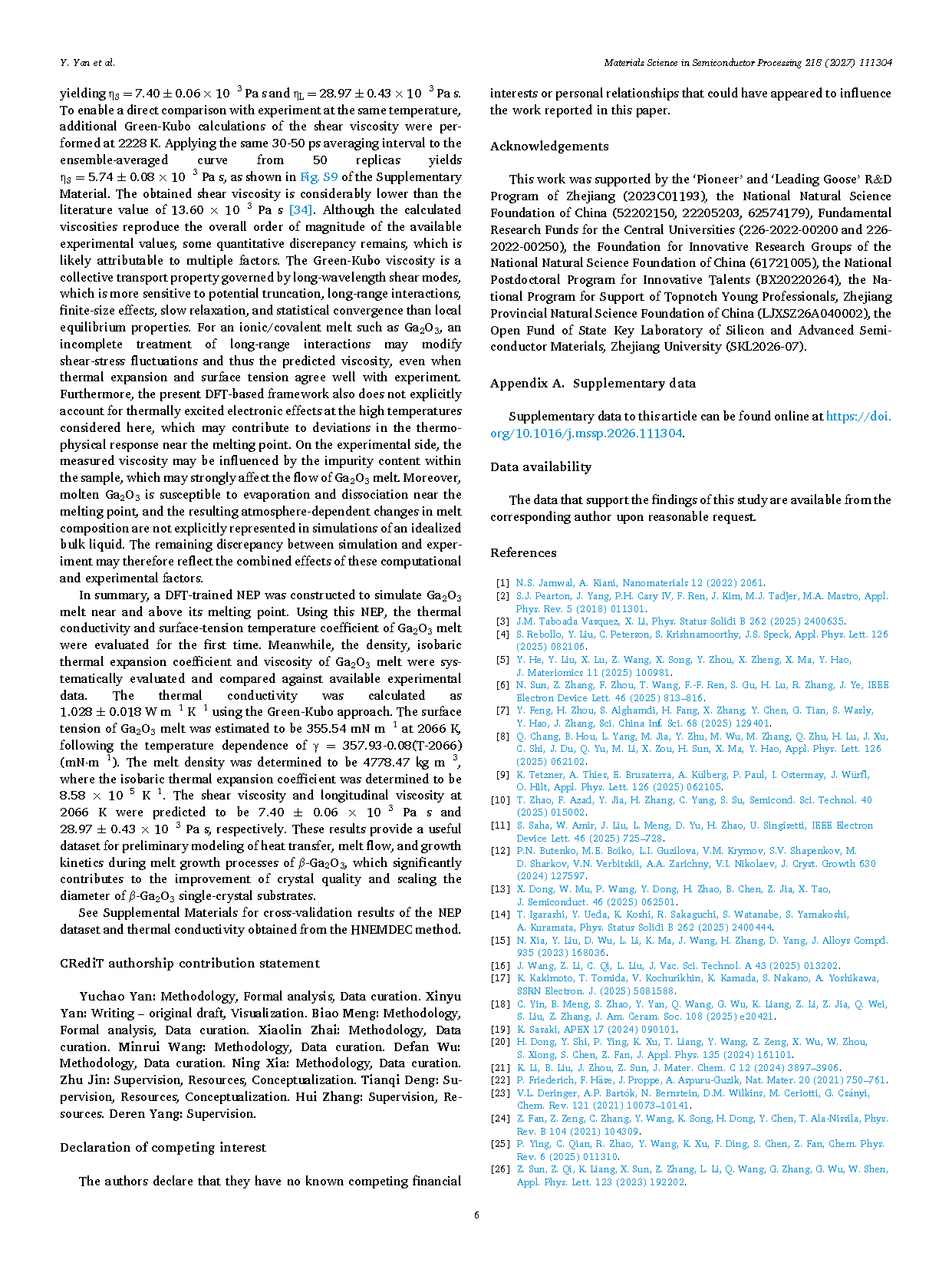
Fig. 6. Time evolution of the running viscosities of Ga₂O₃ melt at 2066 K. (a) Shear viscosity. (b) Longitudinal viscosity. Gray curves represent individual trajectories, and colored curves denote the ensemble averages.
DOI:
10.1016/j.mssp.2026.111304

Instruction
Official Account

Cooperation
Top