

Researchers from the Ocean University of China have published a dissertation titled "Harnessing non-reducible Ga₂O₃ hydroxyls to modulate proton delivery for highly selective electrochemical CO₂ methanation" in Chemical Engineering Journal.
Background
Electrochemical CO₂ reduction reaction (CO₂RR) driven by renewable electricity offers a promising strategy to convert CO₂ into value-added chemicals and fuels and achieve carbon neutrality. Among the products of CO₂RR, methane (CH4) has attracted considerable attention owing to its high energy density (55.5 MJ kg−1) and compatibility with existing natural gas infrastructure. Nevertheless, achieving high CH4 selectivity remains a major challenge due to intrinsic kinetic barriers, complicated proton-coupled electron transfer (PCET) processes and the competing hydrogen evolution reaction (HER). It is well acknowledged that the efficient conversion of CO₂ into CH4 relies on the preferential protonation of *CO to the *CHO intermediate, which must outcompete both CO desorption and CC coupling toward C2+ products. Because this rate-determining *CO hydrogenation is fundamentally restricted by the instantaneous availability of active hydrogen (*H) at the catalyst-electrolyte interface, engineering the localized proton flux and optimizing interfacial proton transfer kinetics are paramount to unlocking efficient CO₂-to-CH4 conversion.
Abstract
Electrochemical reduction of CO₂ (CO₂RR) to methane (CH4) provides a sustainable pathway for the green and efficient CO₂ conversion, yet it is hindered by the competing hydrogen evolution reaction and poorly regulated interfacial proton microenvironments. This work establishes hydroxyl-content modulation on gallium oxide (Ga₂O₃) supports as a robust strategy for CuO/Ga₂O₃ catalyst fabrication and CO₂RR to CH4 optimization. Notably, the CuO/Ga₂O₃–550 catalyst with a moderate hydroxyl content exhibits excellent performance, achieving a Faradaic efficiency of 72.1% at −1.5 V vs. RHE for CH4 production. The kinetic isotope effect (KIE) result reveals that surface hydroxyl groups significantly accelerate *H transfer dynamics. In situ spectroscopy and DFT calculations clarify that surface hydroxyl groups on Ga₂O₃ not only promote the CO₂ reduction pathway by lowering the energy barrier for CO₂-to-*COOH conversion, but also optimize *CO adsorption on Cu sites and stabilize *CHO intermediates. Moreover, hydroxyl-mediated water molecular activation reduces the energy barriers for H2O dissociation, generates abundant active hydrogen groups, thereby promotes proton-coupled electron transfer toward deep methanation. This study underscores the great potential of support hydroxyl engineering to regulate local proton environments for the selective electroreduction of CO₂ to CH4.
Highlights
The CuO/Ga₂O₃–550 catalyst achieves a high CH4Faradaic efficiency of 72.1%.
Hydroxyl-rich Ga₂O₃support modulates interfacial proton delivery.
Surface hydroxyls accelerate H2O dissociation and lower the *CO₂−to *COOH energy barrier.
Hydroxyl-mediated water activation and *CO stabilization contribute to deep methanation.
Conclusions
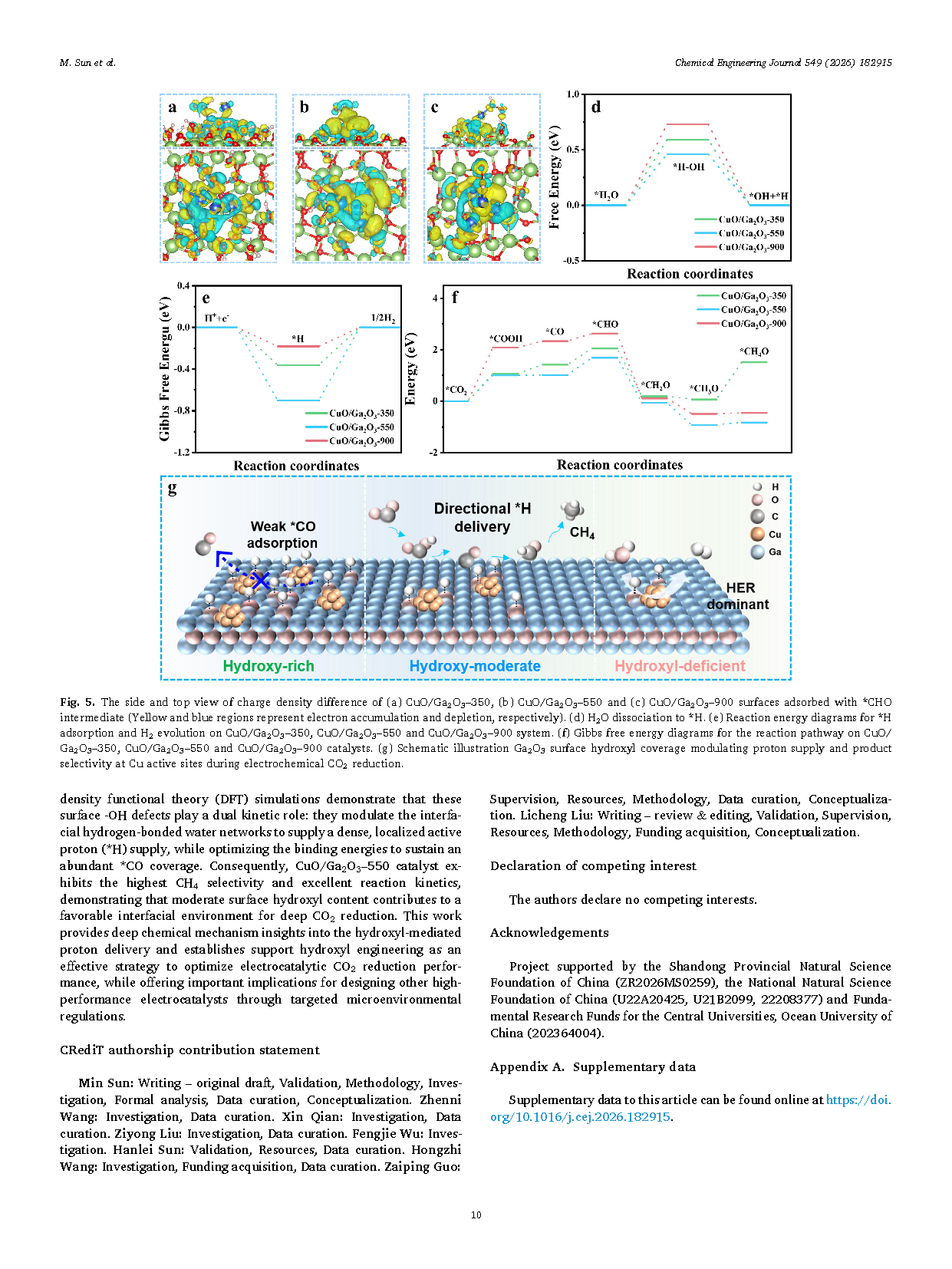
In summary, this work establishes the surface hydroxyl content of an inert, non-reducible gallium oxide (Ga₂O₃) support as an effective interfacial regulator of the proton microenvironment at neighboring active sites, thereby revealing its significant role in regulating the reaction pathways of electrochemical CO₂ reduction. Comprehensive structural characterizations combined with in situ ATR-SEIRAS and density functional theory (DFT) simulations demonstrate that these surface -OH defects play a dual kinetic role: they modulate the interfacial hydrogen-bonded water networks to supply a dense, localized active proton (*H) supply, while optimizing the binding energies to sustain an abundant *CO coverage. Consequently, CuO/Ga₂O₃–550 catalyst exhibits the highest CH4 selectivity and excellent reaction kinetics, demonstrating that moderate surface hydroxyl content contributes to a favorable interfacial environment for deep CO₂ reduction. This work provides deep chemical mechanism insights into the hydroxyl-mediated proton delivery and establishes support hydroxyl engineering as an effective strategy to optimize electrocatalytic CO₂ reduction performance, while offering important implications for designing other high-performance electrocatalysts through targeted microenvironmental regulations.
Project Support
Project supported by the Shandong Provincial Natural Science Foundation of China (ZR2026MS0259), the National Natural Science Foundation of China (U22A20425, U21B2099, 22208377) and Fundamental Research Funds for the Central Universities, Ocean University of China (202364004).
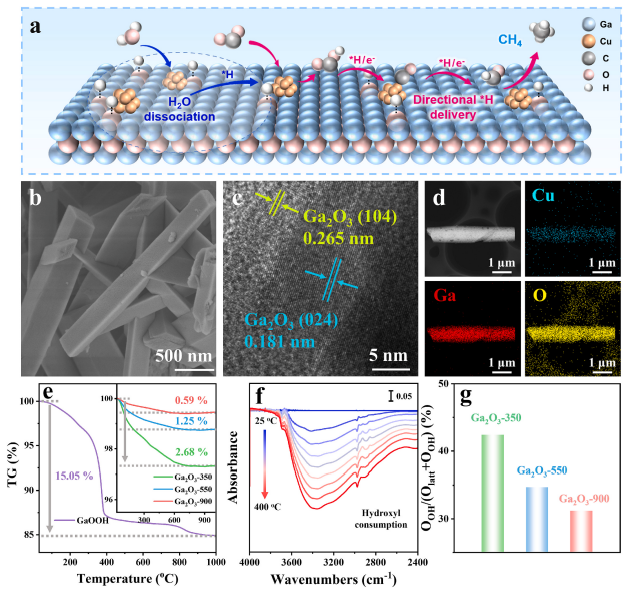
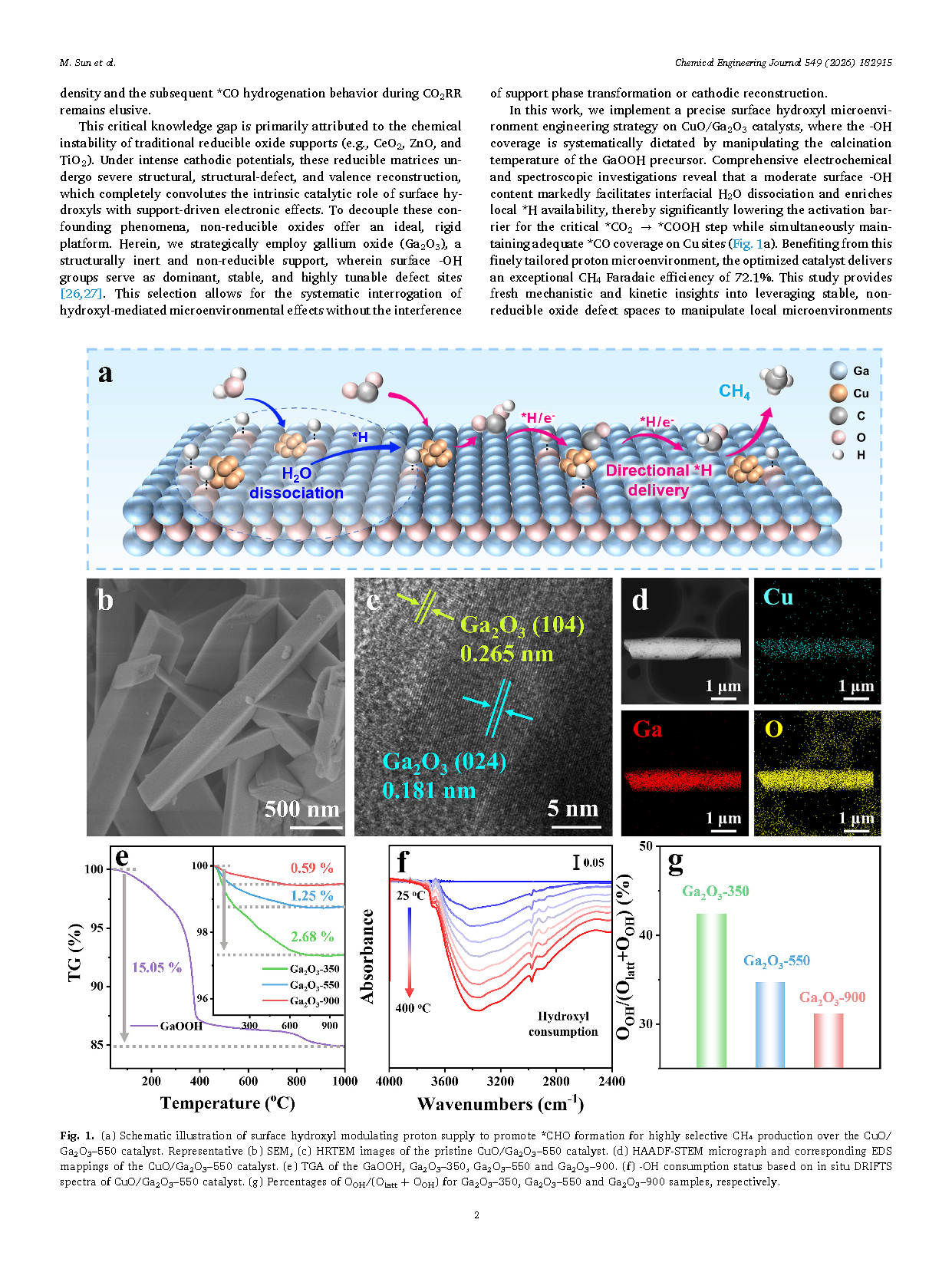
Fig. 1. (a) Schematic illustration of surface hydroxyl modulating proton supply to promote *CHO formation for highly selective CH₄ production over the CuO/ Ga₂O₃–550 catalyst. Representative (b) SEM, (c) HRTEM images of the pristine CuO/Ga₂O₃–550 catalyst. (d) HAADF-STEM micrograph and corresponding EDS mappings of the CuO/Ga₂O₃–550 catalyst. (e) TGA of the GaOOH, Ga₂O₃–350, Ga₂O₃–550 and Ga₂O₃–900. (f) -OH consumption status based on in situ DRIFTS spectra of CuO/Ga₂O₃–550 catalyst. (g) Percentages of OOH/(Olatt + OOH) for Ga₂O₃–350, Ga₂O₃–550 and Ga₂O₃–900 samples, respectively.
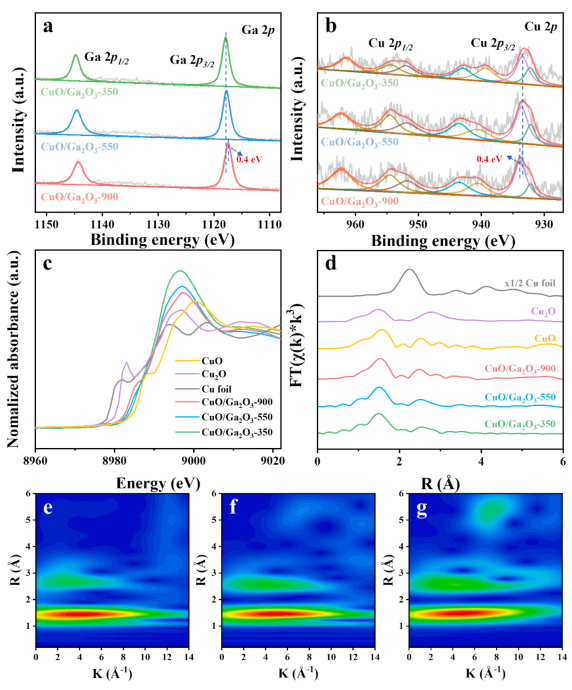
Fig. 2. XPS spectra of (a) Ga 2p, (b) Cu 2p of different catalysts. (c, d) Normalized Cu K-edge XANES spectra and FT-EXAFS spectra of the CuO/Ga₂O₃ and reference samples. Cu K-edge WT-EXAFS contour plots of the (e) CuO/Ga₂O₃–350, (f) CuO/Ga₂O₃–550 and (g) CuO/Ga₂O₃–900, respectively.
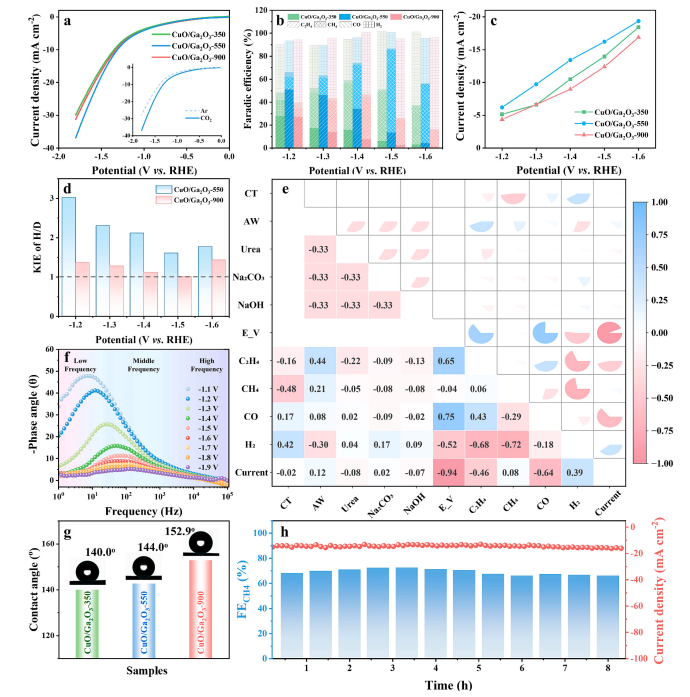
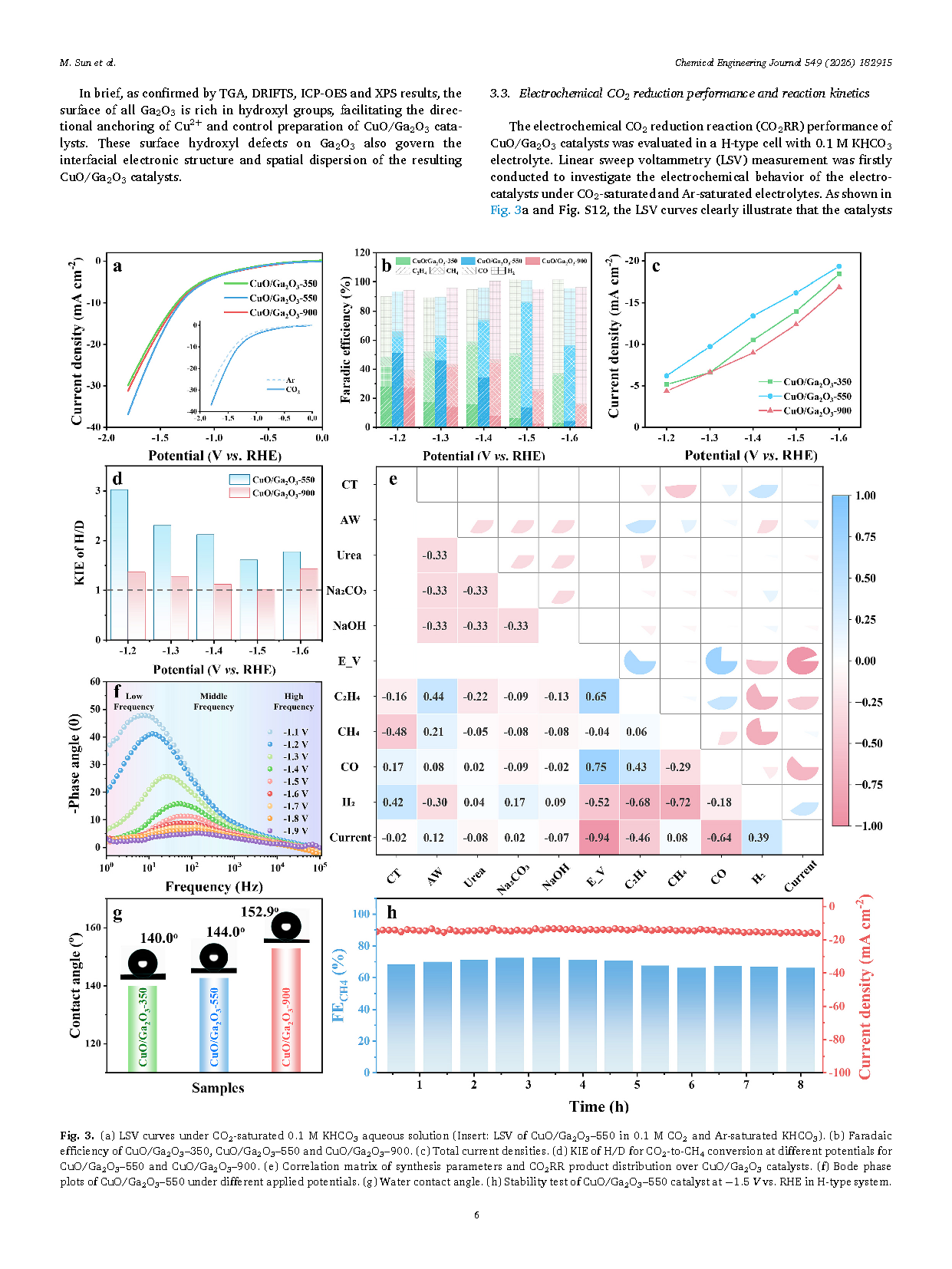
Fig. 3. (a) LSV curves under CO₂-saturated 0.1 M KHCO3 aqueous solution (Insert: LSV of CuO/Ga₂O₃–550 in 0.1 M CO₂ and Ar-saturated KHCO3). (b) Faradaic efficiency of CuO/Ga₂O₃–350, CuO/Ga₂O₃–550 and CuO/Ga₂O₃–900. (c) Total current densities. (d) KIE of H/D for CO₂-to-CH4 conversion at different potentials for CuO/Ga₂O₃–550 and CuO/Ga₂O₃–900. (e) Correlation matrix of synthesis parameters and CO₂RR product distribution over CuO/Ga₂O₃ catalysts. (f) Bode phase plots of CuO/Ga₂O₃–550 under different applied potentials. (g) Water contact angle. (h) Stability test of CuO/Ga₂O₃–550 catalyst at − 1.5 V vs. RHE in H-type system.
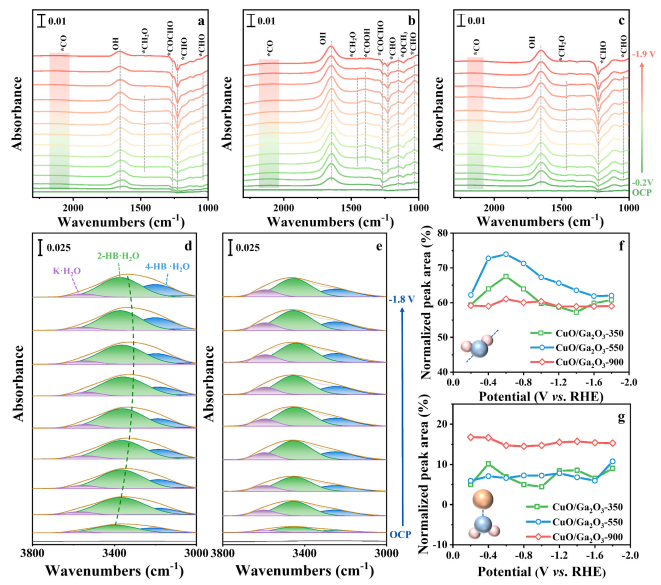
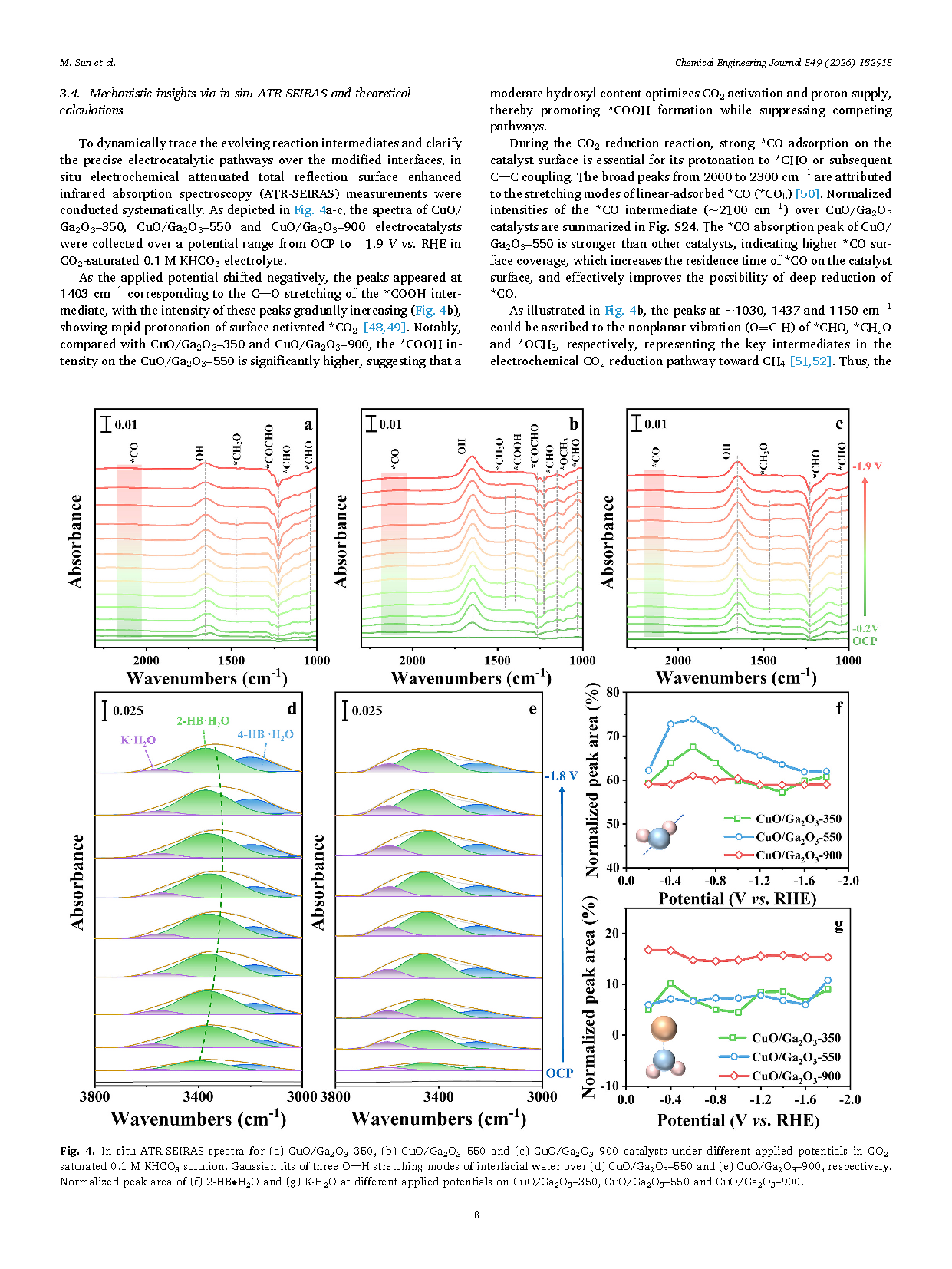
Fig. 4. In situ ATR-SEIRAS spectra for (a) CuO/Ga₂O₃–350, (b) CuO/Ga₂O₃–550 and (c) CuO/Ga₂O₃–900 catalysts under different applied potentials in CO₂- saturated 0.1 M KHCO3 solution. Gaussian fits of three O–H stretching modes of interfacial water over (d) CuO/Ga₂O₃–550 and (e) CuO/Ga₂O₃–900, respectively. Normalized peak area of (f) 2-HB•H2O and (g) K⋅H2O at different applied potentials on CuO/Ga₂O₃–350, CuO/Ga₂O₃–550 and CuO/Ga₂O₃–900.
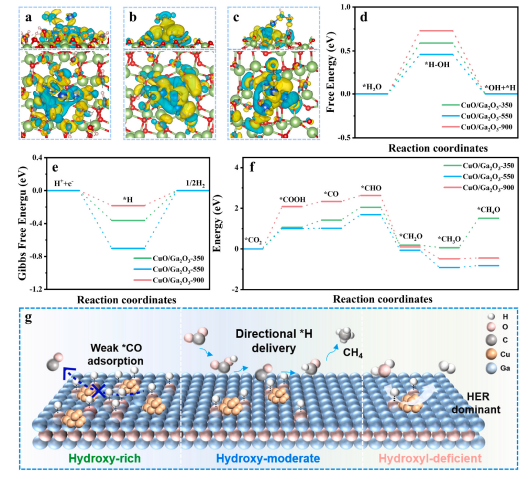
Fig. 5. The side and top view of charge density difference of (a) CuO/Ga₂O₃–350, (b) CuO/Ga₂O₃–550 and (c) CuO/Ga₂O₃–900 surfaces adsorbed with *CHO intermediate (Yellow and blue regions represent electron accumulation and depletion, respectively). (d) H2O dissociation to *H. (e) Reaction energy diagrams for *H adsorption and H2 evolution on CuO/Ga₂O₃–350, CuO/Ga₂O₃–550 and CuO/Ga₂O₃–900 system. (f) Gibbs free energy diagrams for the reaction pathway on CuO/Ga₂O₃–350, CuO/Ga₂O₃–550 and CuO/Ga₂O₃–900 catalysts. (g) Schematic illustration Ga₂O₃ surface hydroxyl coverage modulating proton supply and product selectivity at Cu active sites during electrochemical CO₂ reduction.
DOI:
doi.org/10.1016/j.cej.2026.182915
Instruction
Official Account

Cooperation
Top