


An electron effective mass of 0.40 m₀ and a thermal conductivity of 19 W/(m·K) provide important parameters for next-generation power semiconductor device design.
On November 9, 2026, Hokkaido University and Kyoto University jointly announced that their research teams had successfully measured the electron effective mass and thermal conductivity of α-phase gallium oxide (α-Ga₂O₃) thin films, obtaining values of 0.40 m₀ and 19 W/(m·K), respectively. This achievement provides important physical parameters for the design of α-Ga₂O₃-based power semiconductor devices and lays the groundwork for further exploration of their applications in high-voltage power devices.
01 Research Background: The Need to Establish Fundamental Physical Properties of α-Ga₂O₃
Gallium oxide is an ultra-wide-bandgap semiconductor material. Among its polymorphs, α-phase gallium oxide (α-Ga₂O₃), with an optical bandgap of 5.3 eV, has significant potential for high-voltage power semiconductor applications.
For power device design, electron effective mass and thermal conductivity are two essential fundamental parameters. The former influences carrier transport properties, while the latter is closely related to heat conduction and thermal management during device operation.
However, experimental data on the fundamental physical properties of α-Ga₂O₃ have remained limited, with previous studies relying primarily on theoretical calculations for predictions. This has posed challenges for material characterization and device design.
02 Key Findings: Experimental Measurement of Two Fundamental Physical Properties
The study was jointly conducted by the research team led by Professor Hiromichi Ohta from the Research Institute for Electronic Science at Hokkaido University and the team led by Professor Katsuhisa Tanaka from the Graduate School of Engineering at Kyoto University.
The researchers prepared high-quality α-Ga₂O₃ epitaxial films using the Mist Chemical Vapor Deposition (Mist CVD) method and characterized their fundamental physical properties through two experimental techniques:
Electron effective mass:Measured using thermopower measurements, the room-temperature carrier electron effective mass was determined to be 0.40 m₀, where m₀ represents the free-electron rest mass.
Thermal conductivity:Measured using the time-domain thermoreflectance (TDTR) method, the room-temperature cross-plane thermal conductivity was determined to be 19 W/(m·K).
These experimental results provide a basis for understanding the carrier transport and thermal properties of α-Ga₂O₃, supplementing fundamental physical property data that had previously relied largely on theoretical calculations.
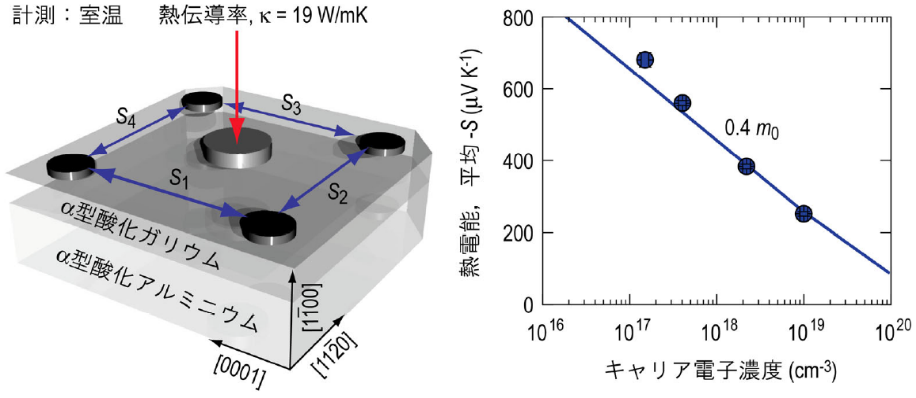
Figure: Thermopower and thermal conductivity of high-quality α-Ga₂O₃ thin films prepared by Mist CVD. Analysis of the dependence of thermopower on carrier concentration revealed an electron effective mass of 0.40 m₀, while the measured thermal conductivity was 19 W/(m·K).
03 Research Significance: Supporting the Design of High-Voltage Power Devices
Electron effective mass and thermal conductivity are important parameters influencing the performance of power semiconductor devices. By experimentally determining these two key physical properties of α-Ga₂O₃ thin films, this study provides valuable data for further material characterization, device structure design, and thermal management research.
As research into gallium oxide materials and devices continues to advance, the growing body of fundamental physical property data will help facilitate the exploration of α-Ga₂O₃ for high-voltage power semiconductor applications and support the development of next-generation high-efficiency power devices.
Publication Information
Title: Experimental Determination of Carrier Effective Mass and Cross-Plane Thermal Conductivity in Mist-CVD-Grown Ge-Doped α-Ga₂O₃ Epitaxial Films
Journal: ACS Applied Electronic Materials
Online Publication Date: November 5, 2026
DOI: https://doi.org/10.1021/acsaelm.6c01639
Instruction
Official Account

Cooperation
Top