


Researchers from the Chongqing Normal University have published a dissertation titled "Geometry-Engineered Bipolar Photodetectors for Multivalued Logic-Gate Encrypted Optical Communication" in Advanced Materials.
Project Support
The authors gratefully acknowledge support from the National Natural Science Foundation of China (Grant Nos. 62574029 and 12304102), the Natural Science Foundation of Chongqing (Grant No. CSTB2023NSCQMSX0479) and the Science and Technology Research Project of Chongqing Municipal Education Commission (Grant No. KJQN202400558).
Background
Information encryption is a cornerstone of secure infrastructure in the digital era. The rising demand for both communication bandwidth and data confidentiality is driving the advancement of low-power, high-security optical encryption technologies. Within these systems, photodetectors play a pivotal role in maintaining the integrity of transmitted data. In parallel, optoelectronic logic gates (OLGs) leverage multiple dimensions of light, such as wavelength and polarization, to enable photonic information processing. They have evolved into highly valuable core components for advanced optical communication scenarios including high-speed optical signal processing, optical computing, and optical-domain encryption, thereby providing a critical technical pathway for enhancing system processing speed and security. Bipolar photodetectors are capable of generating both positive and negative photocurrent responses, providing a physical basis for implementing binary and ternary logic operations in encrypted optical communications. However, when bipolar devices are applied in multi-wavelength parallel transmission systems, the asymmetry of photocurrent directly leads to signal recognition errors and hinders accurate data transmission. Existing research has mostly focused on constructing bipolar devices or improving performance metrics such as responsivity through band alignment modulation or light intensity tuning, while systematic strategies specifically addressing the issue of bipolar photoresponse balance remain unexplored.
Abstract
Bipolar photodetectors, with positive-negative photocurrent responses and coupling-enabled multifunctionality, show great promise for logic-gate-encrypted optical communication, where precise photocurrent balancing is essential to minimize polarity-induced logic errors and ensure transmission accuracy. Here, a parallel-structured, self-powered photoelectrochemical photodetector (PEC-PD) based on fully amorphous p-NiOX and n-GaOX thin films is developed, exhibiting dual-band (254 nm/365 nm) bipolar photoresponses. To address the intrinsic photocurrent asymmetry, we first employ thermal annealing to mitigate the imbalance. More significantly, leveraging the unique parallel architecture, we propose a universal geometry-engineered strategy to accurately balance positive and negative photocurrents by simply adjusting the area ratio of the two photoactive materials. This approach enables robust photocurrent symmetry across diverse wavelength combinations, ensuring broad adaptability to complex optical environments. Based on this tunability, reconfigurable binary and ternary exclusive OR (XOR and TXOR) logic gates are demonstrated as encryption frameworks in optical communication systems. The ternary encryption scheme enhances information throughput by ∼1.585 × and expands the key space by 89% compared to binary systems. This work presents a universal strategy for implementing balanced bipolar photodetectors, facilitating their application in secure, high-throughput underwater optical communication.
Conclusion
Fully amorphous p-NiOX and n-GaOX thin films were successfully fabricated via magnetron sputtering, and parallel-structured bipolar PEC-PDs were constructed. To address the initial photocurrent imbalance, annealing treatments were applied to improve device performance, yet the inherent material limitations necessitate a more universal solution. By leveraging the structural flexibility of the parallel configuration, we developed a geometry-engineered strategy that achieves precise positive-negative photocurrent balance through simple area ratio adjustment, independent of material properties or optical conditions. This approach enables robust operation across multi-wavelength environments, overcoming a critical barrier for practical deployment.
Benefiting from this dynamic tunability, the device demonstrates reconfigurable binary and ternary logic operations. Furthermore, we constructed the first underwater optical encryption system based on a ternary exclusive OR logic architecture. Compared with its binary counterpart, the system achieves an approximately 1.58-fold increase in information throughput (log23 vs. log22) and an 89% expansion of the key space (35 = 243 vs. 27 = 128), thereby theoretically enhancing encryption robustness against brute-force attacks. These findings establish geometry-engineered bipolar photodetectors as a universal platform for secure, high-throughput optical communication, particularly in challenging environments such as underwater networks where power efficiency and environmental adaptability are paramount.
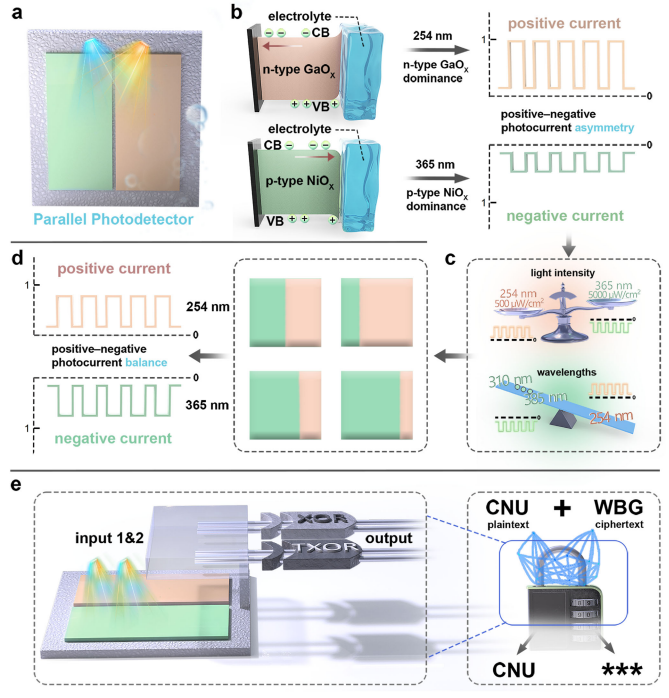
FIGURE 1 Concept of bipolar current balancing and logic-gate-encrypted optical communication in parallel PEC-PDs. (a) Schematic illustration of the parallel p-NiOX-n-GaOX PEC-PDs. (b) Energy band diagrams and photocurrent asymmetry under 254 nm (n-GaOX-dominant) and 365 nm (pNiOX-dominant) illumination. (c) The device exhibits a positive–negative photocurrent imbalance under 254 and 365 nm illumination, along with a relatively large intensity ratio. Similar imbalances also occur under fixed intensity ratios with other wavelength combinations. (d) Universal geometric tuning strategy for achieving balanced bipolar photocurrent by adjusting the relative photoactive areas. (e) Reconfigurable logic operations (XOR and TXOR) enabled by wavelength-multiplexed input and output polarity states in the parallel PEC-PD, used as encryption structures for secure optical communication.
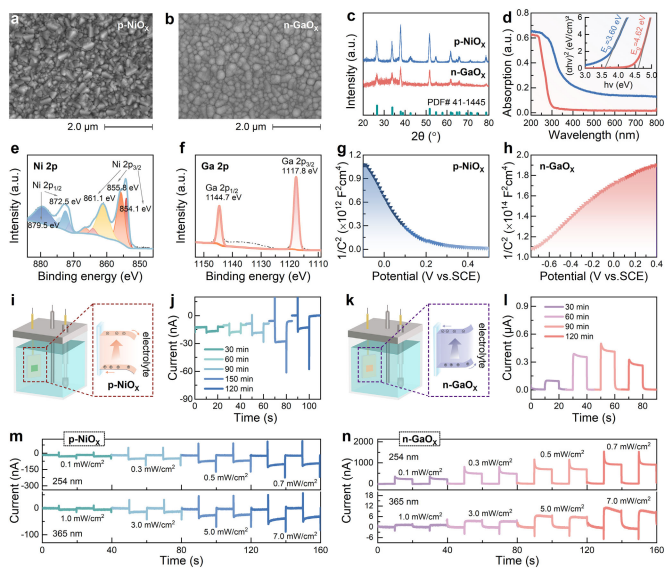
FIGURE 2 Structural and photoelectrochemical characterization of p-NiOX and n-GaOX PEC-PDs. (a,b) Top-view SEM images of p-NiOX and n-GaOX thin films. (c) Grazing-incidence X-ray diffraction (GI-XRD) patterns showing only diffraction peaks from the FTO substrate, indicating the amorphous nature of both films. (d) UV–vis absorption spectra and corresponding Tauc plots ((αhν)2 vs. hν), used to estimate optical bandgaps. (e,f) XPS spectra of Ni 2p and Ga 2p regions, confirming the presence of mixed-valence Ni2+/Ni3+ and typical Ga oxidation states. (g,h) Mott–Schottky plots revealing p-type conductivity for NiOX and n-type behavior for GaOX. (i,k) Schematic illustration of the PEC measurement setup for p-NiOX and nGaOX devices. (j,l) Time-resolved photocurrent (I–t) curves of p-NiOX and n-GaOX PEC-PDs under 254 and 365 nm illumination with varying sputtering durations. (m,n) Zero-bias photocurrent responses of p-NiOX and n-GaOX PEC-PDs under different illumination intensities at 254 and 365 nm.

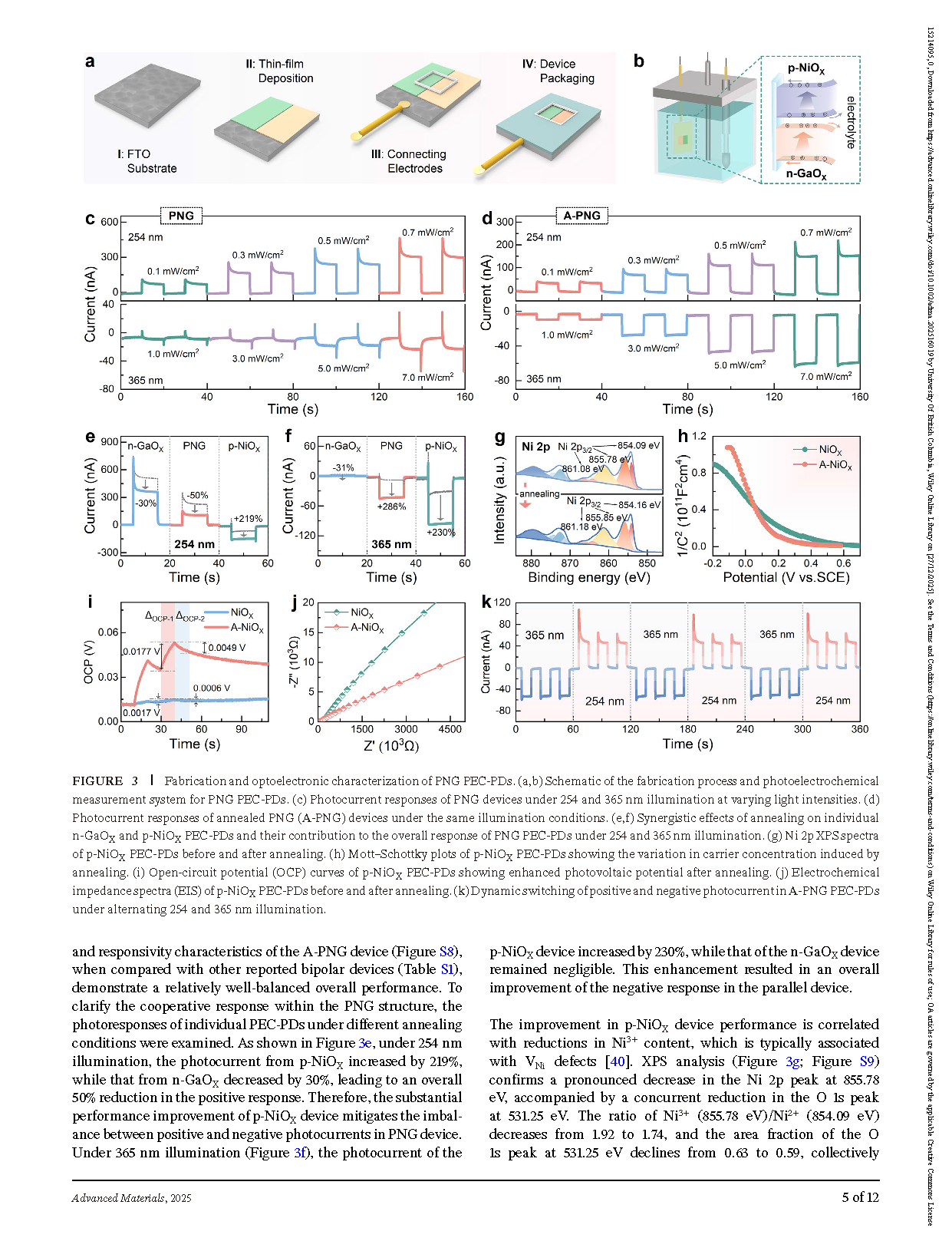
FIGURE 3 Fabrication and optoelectronic characterization of PNG PEC-PDs. (a,b) Schematic of the fabrication process and photoelectrochemical measurement system for PNG PEC-PDs. (c) Photocurrent responses of PNG devices under 254 and 365 nm illumination at varying light intensities. (d) Photocurrent responses of annealed PNG (A-PNG) devices under the same illumination conditions. (e,f) Synergistic effects of annealing on individual n-GaOX and p-NiOX PEC-PDs and their contribution to the overall response of PNG PEC-PDs under 254 and 365 nm illumination. (g) Ni 2p XPS spectra of p-NiOX PEC-PDs before and after annealing. (h) Mott–Schottky plots of p-NiOX PEC-PDs showing the variation in carrier concentration induced by annealing. (i) Open-circuit potential (OCP) curves of p-NiOX PEC-PDs showing enhanced photovoltaic potential after annealing. (j) Electrochemical impedance spectra (EIS) of p-NiOX PEC-PDs before and after annealing. (k) Dynamic switching of positive and negative photocurrent in A-PNG PEC-PDs under alternating 254 and 365 nm illumination.
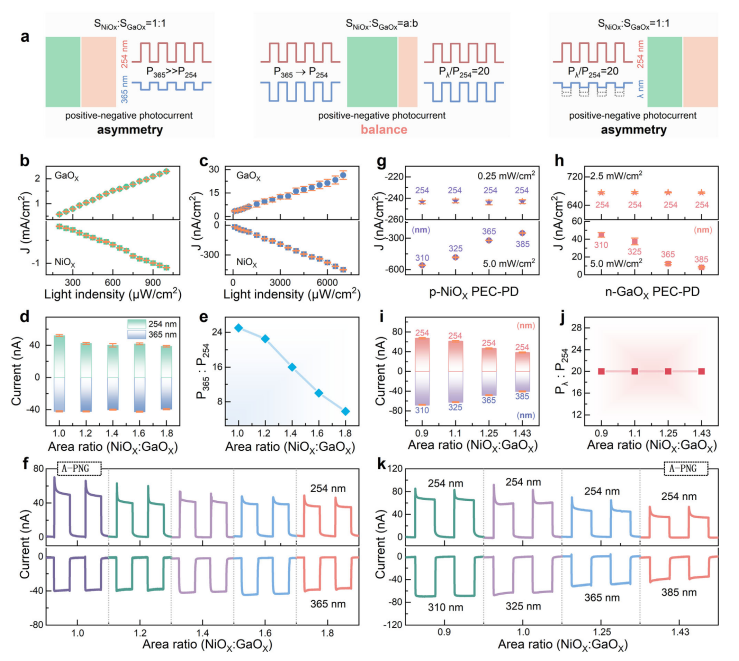
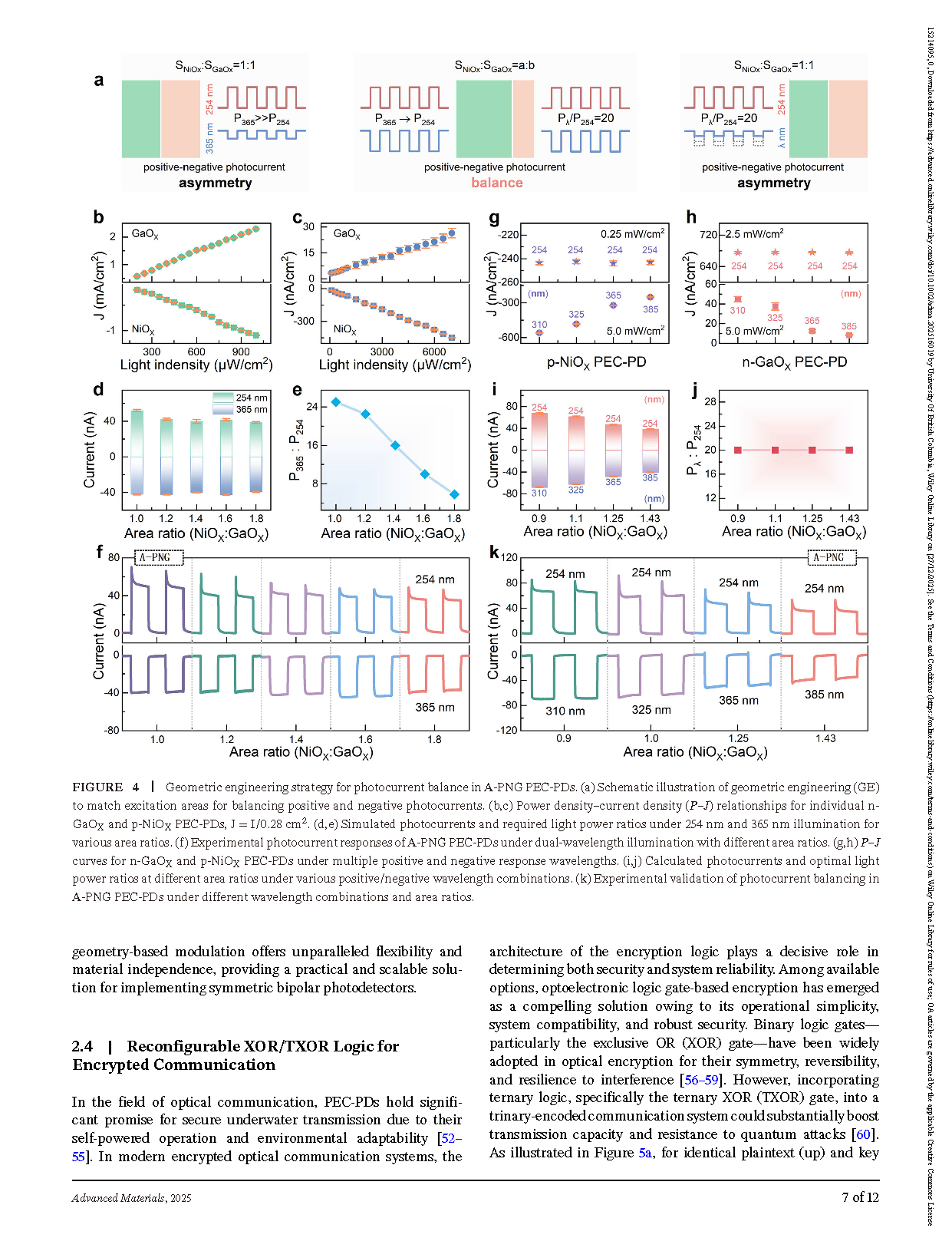
FIGURE 4 Geometric engineering strategy for photocurrent balance in A-PNG PEC-PDs. (a) Schematic illustration of geometric engineering (GE) to match excitation areas for balancing positive and negative photocurrents. (b,c) Power density–current density (P–J) relationships for individual nGaOX and p-NiOX PEC-PDs, J = I/0.28 cm2. (d,e) Simulated photocurrents and required light power ratios under 254 nm and 365 nm illumination for various area ratios. (f) Experimental photocurrent responses of A-PNG PEC-PDs under dual-wavelength illumination with different area ratios. (g,h) P–J curves for n-GaOX and p-NiOX PEC-PDs under multiple positive and negative response wavelengths. (i,j) Calculated photocurrents and optimal light power ratios at different area ratios under various positive/negative wavelength combinations. (k) Experimental validation of photocurrent balancing in A-PNG PEC-PDs under different wavelength combinations and area ratios.
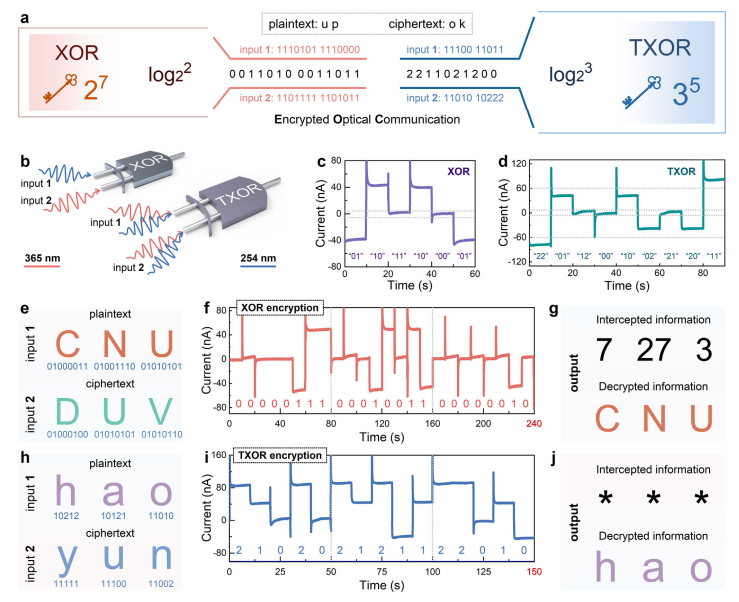
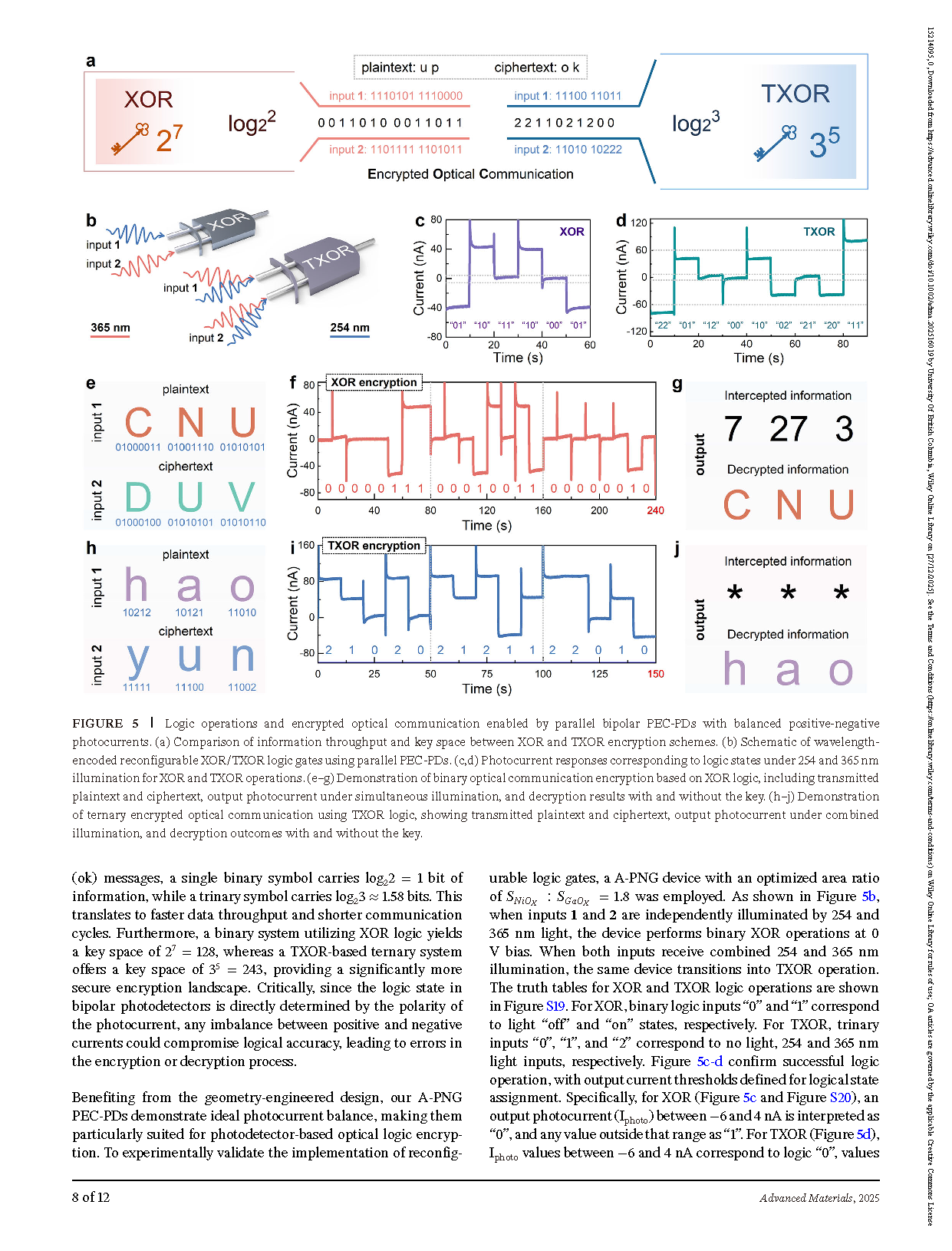
FIGURE 5 Logic operations and encrypted optical communication enabled by parallel bipolar PEC-PDs with balanced positive-negative photocurrents. (a) Comparison of information throughput and key space between XOR and TXOR encryption schemes. (b) Schematic of wavelengthencoded reconfigurable XOR/TXOR logic gates using parallel PEC-PDs. (c,d) Photocurrent responses corresponding to logic states under 254 and 365 nm illumination for XOR and TXOR operations. (e–g) Demonstration of binary optical communication encryption based on XOR logic, including transmitted plaintext and ciphertext, output photocurrent under simultaneous illumination, and decryption results with and without the key. (h–j) Demonstration of ternary encrypted optical communication using TXOR logic, showing transmitted plaintext and ciphertext, output photocurrent under combined illumination, and decryption outcomes with and without the key.
DOI:
doi.org/10.1002/adma.202516019

Instruction
Official Account

Cooperation
Top