


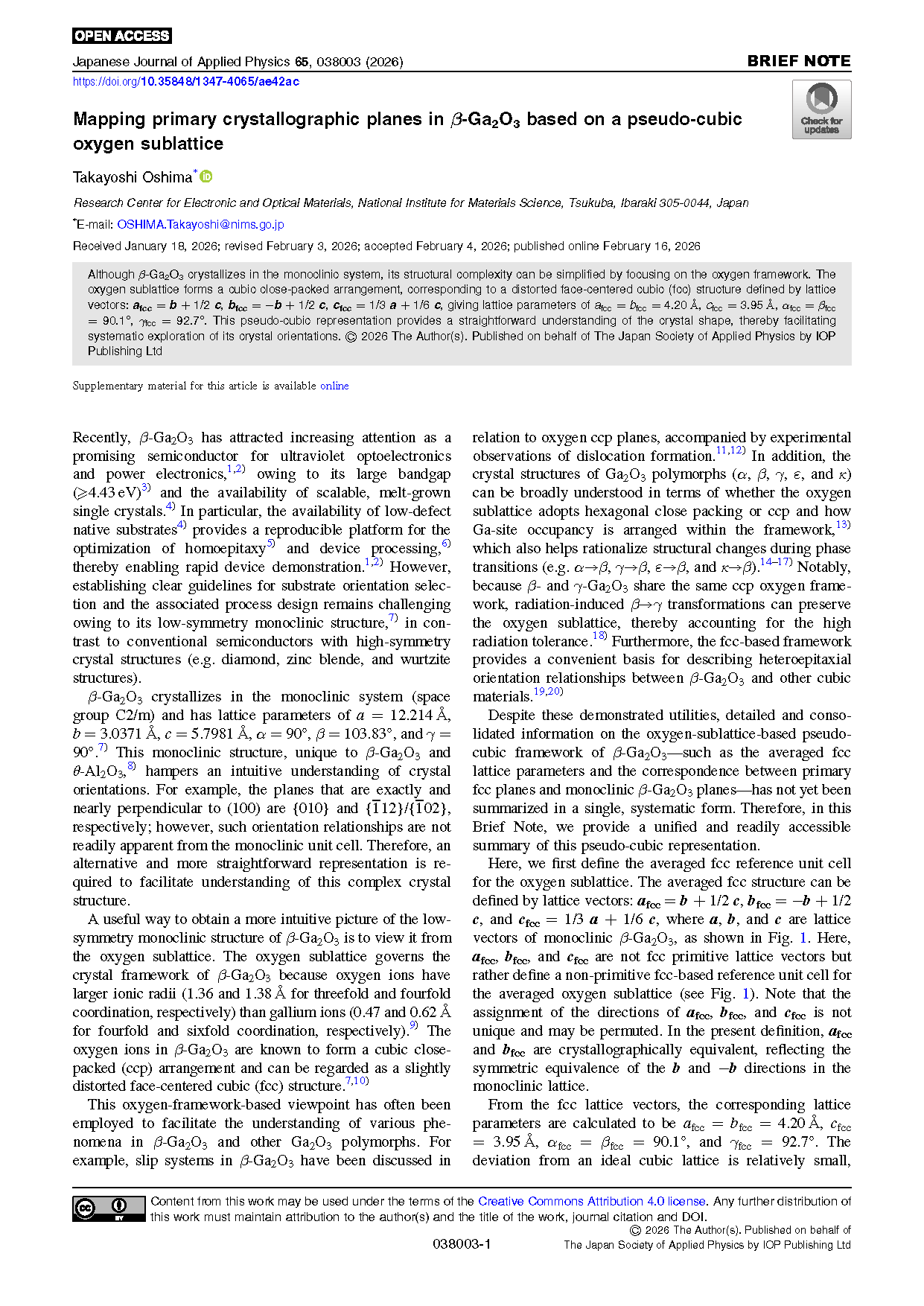
Researchers from the National Institute for Materials Science have published a dissertation titled "Mapping primary crystallographic planes in β-Ga2O3 based on a pseudo-cubic oxygen sublattice" in Japanese Journal of Applied Physics.
Background
Recently, β-Ga2O3 has attracted increasing attention as a promising semiconductor for ultraviolet optoelectronics and power electronics, owing to its large bandgap (≥4.43 eV) and the availability of scalable, melt-grown single crystals. In particular, the availability of low-defect native substrates provides a reproducible platform for the optimization of homoepitaxy and device processing, thereby enabling rapid device demonstration. However, establishing clear guidelines for substrate orientation selection and the associated process design remains challenging owing to its low-symmetry monoclinic structure, in contrast to conventional semiconductors with high-symmetry crystal structures (e.g. diamond, zinc blende, and wurtzite structures).
β-Ga2O3 crystallizes in the monoclinic system (space group C2/m) and has lattice parameters of a = 12.214 Å, b = 3.0371 Å, c = 5.7981 Å, α = 90°, β = 103.83°, and γ = 90°. This monoclinic structure, unique to β-Ga2O3 and θ-Al2O3, hampers an intuitive understanding of crystal orientations. For example, the planes that are exactly and nearly perpendicular to (100) are {010} and {-112}/{-102}, respectively; however, such orientation relationships are not readily apparent from the monoclinic unit cell. Therefore, an alternative and more straightforward representation is required to facilitate understanding of this complex crystal structure.
Abstract
Although β-Ga2O3 crystallizes in the monoclinic system, its structural complexity can be simplified by focusing on the oxygen framework. The oxygen sublattice forms a cubic close-packed arrangement, corresponding to a distorted face-centered cubic (fcc) structure defined by lattice vectors: afcc = b + 1/2 c, bfcc = −b + 1/2 c, cfcc = 1/3 a + 1/6 c, giving lattice parameters of afcc = bfcc = 4.20 Å, cfcc = 3.95 Å, αfcc = βfcc = 90.1°, γfcc = 92.7°. This pseudo-cubic representation provides a straightforward understanding of the crystal shape, thereby facilitating systematic exploration of its crystal orientations.
Conclusion
In summary, we systematically investigated a pseudo-cubic description of monoclinic β-Ga2O3 based on its distorted fcc oxygen sublattice. By defining an averaged fcc unit cell and establishing the correspondence between fcc and monoclinic planes, the complex orientation relationships of β-Ga2O3 can be understood in an intuitive and straightforward manner. This approach identifies the primary planes constituting the oxygen sublattice, clarifies the orthogonal relationships among these planes, enables reasonable selection of substrate orientations suitable for vertical etching, and allows estimation of epitaxial relationships with cubic oxides such as NiO. The pseudo-cubic representation therefore provides a practical crystallographic basis for β-Ga2O3 and is useful for screening unexplored substrate orientations.
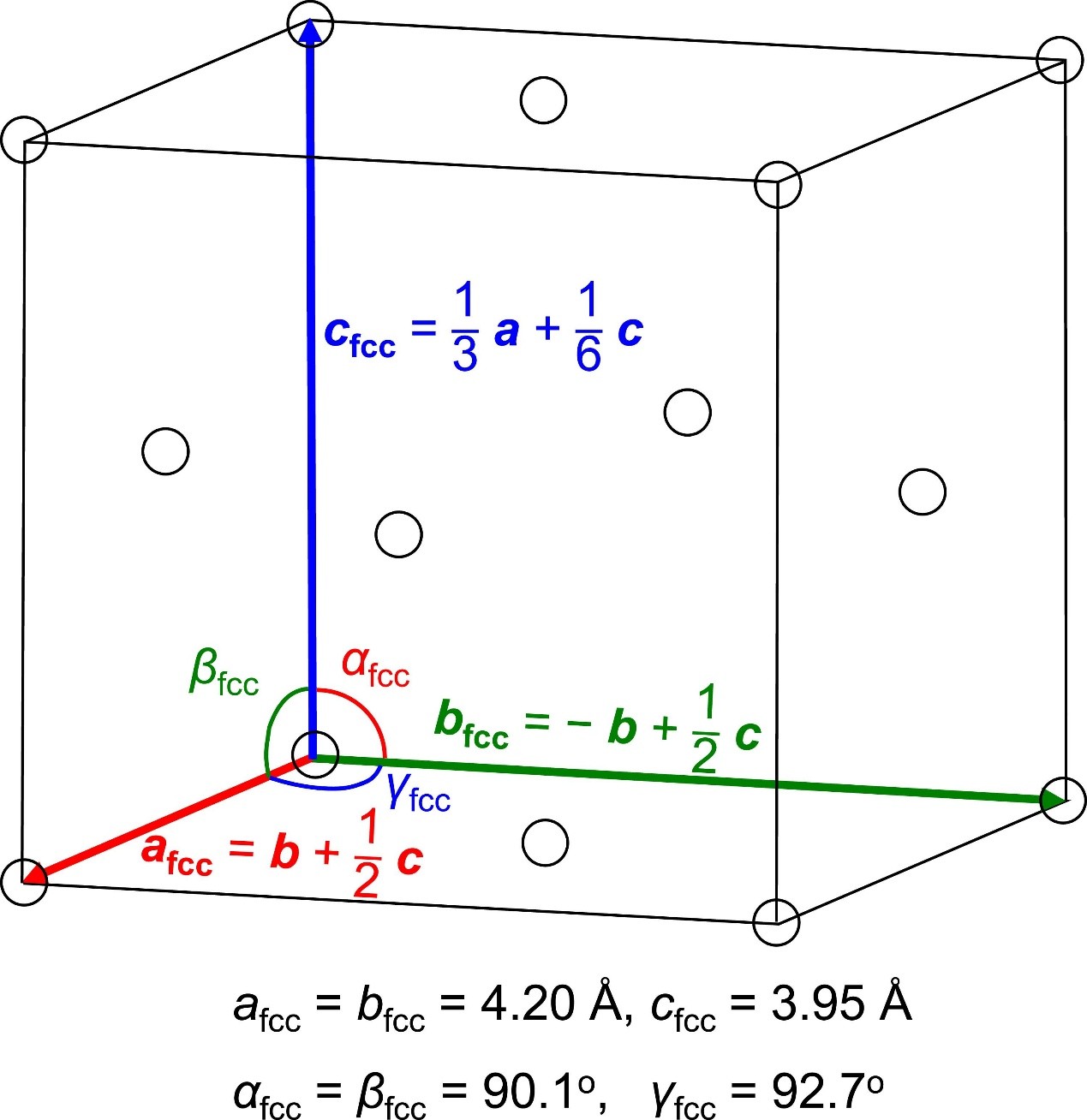
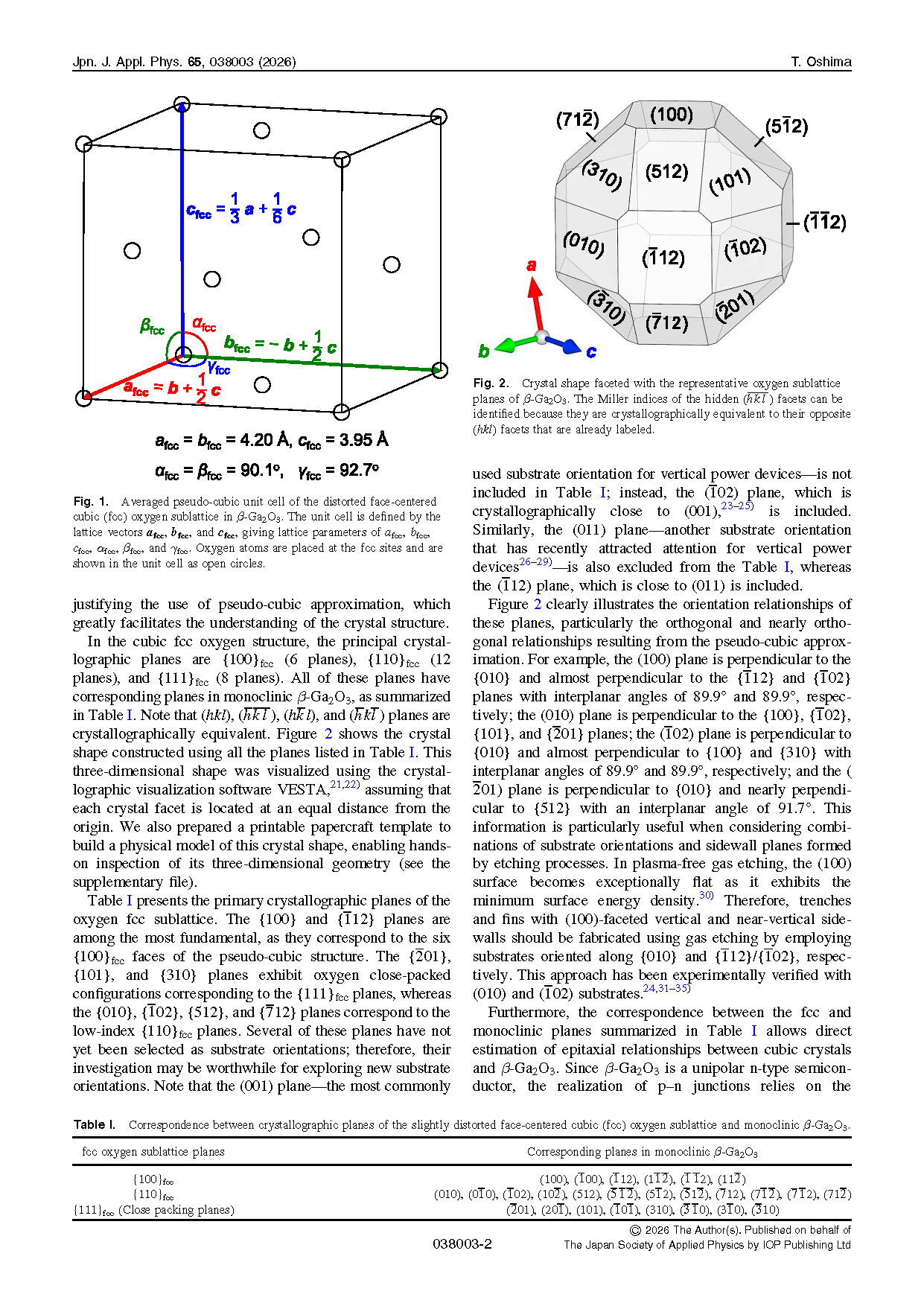
Fig. 1. Averaged pseudo-cubic unit cell of the distorted face-centered cubic (fcc) oxygen sublattice in β-Ga2O3. The unit cell is defined by the lattice vectors afcc, bfcc, and cfcc, giving lattice parameters of afcc, bfcc, cfcc, αfcc, βfcc, and γfcc. Oxygen atoms are placed at the fcc sites and are shown in the unit cell as open circles.
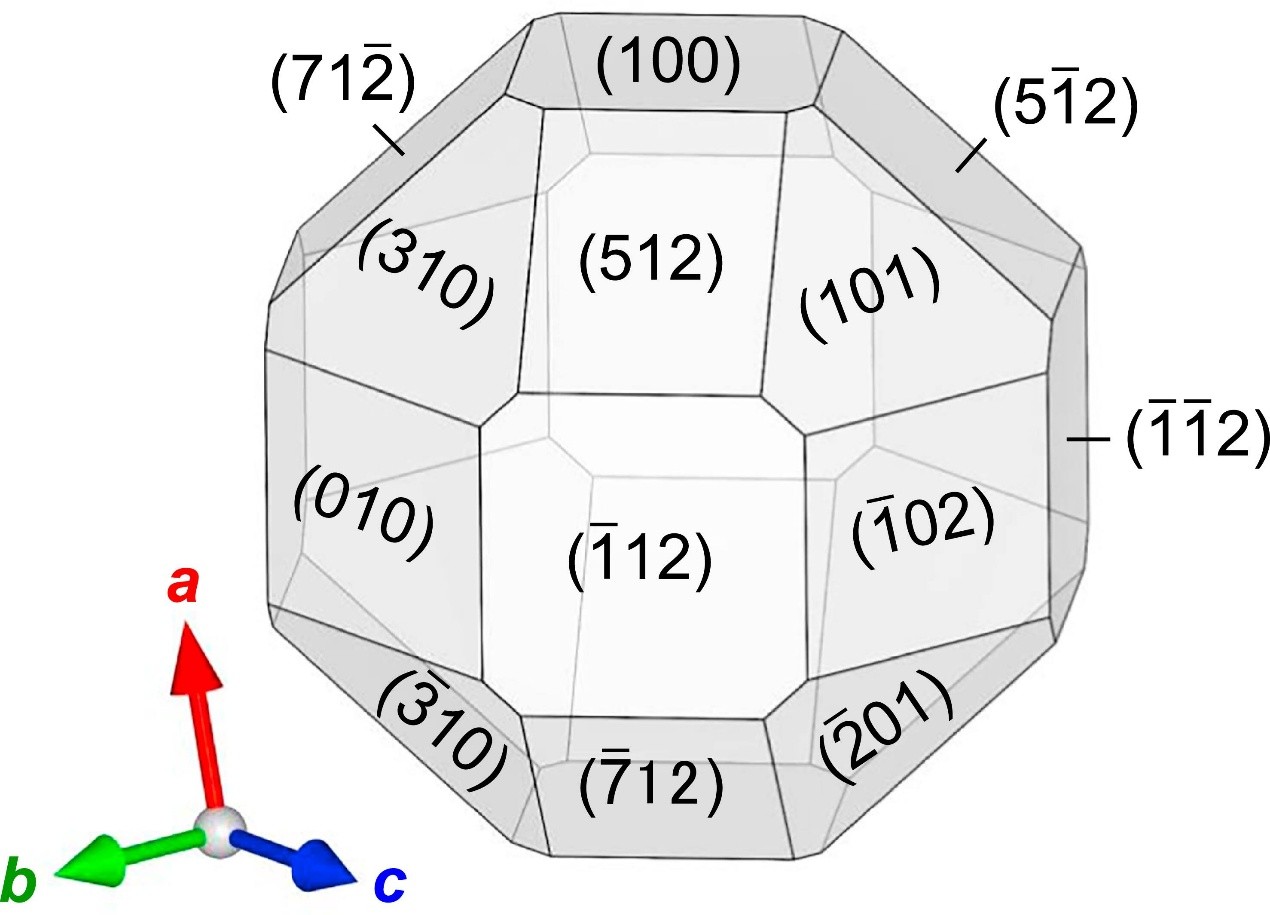
Fig. 2. Crystal shape faceted with the representative oxygen sublattice planes of β-Ga2O3. The Miller indices of the hidden (hkl) facets can be identified because they are crystallographically equivalent to their opposite (hkl) facets that are already labeled.
DOI:
doi.org/10.35848/1347-4065/ae42ac
Instruction
Official Account

Cooperation
Top