


Researchers from the Xi’an Shiyou University have published a dissertation titled "Surface activated bonding of (100)-β-Ga2O3 and Si: Annealing-induced evolution of interfacial microstructure and its effects on thermal transport" in Applied Surface Science.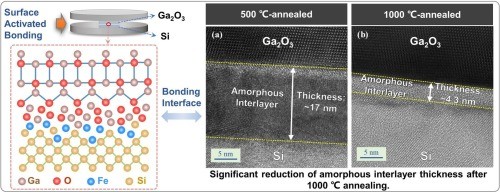
Abstract
High‑performance β-Ga2O3/Si heterointerfaces are crucial for next‑generation power and optoelectronic devices, yet their thermal stability and interfacial thermal transport remain challenging due to lattice mismatch and thermal expansion mismatch. Herein, we fabricated β-Ga2O3(1 0 0)/Si heterointerface by surface-activated bonding and investigated the annealing-induced evolution of interfacial microstructures and their regulatory effects on interfacial thermal transport properties. A 16.2 nm-thick interlayer consisting of amorphous Si and Fe forms at the as-bonded heterointerface, while annealing at 1000 °C reduces its thickness to 4.3 nm and eliminates the characteristic signal of concentrated Fe. Molecular dynamics simulations indicate that these amorphous interlayers degrade interfacial thermal transport properties, with interfacial thermal conductance (ITC) decreasing as amorphous Si layer thickness and Fe atomic fraction increase. Amorphous Si reduces the ITC by 24% relative to the ideal interface, while Fe doping can further decrease the value by 29.5%. This work reveals the critical role of interfacial microstructures and elemental distributions in regulating interfacial thermal properties, and provides a theoretical basis for optimizing bonding processes and thermal management strategies.
DOI:
https://doi.org/10.1016/j.apsusc.2026.166258
Instruction
Official Account

Cooperation
Top