


Researchers from the Ningbo Institute of Materials Technology and Engineering, Chinese Academy of Sciences have published a dissertation titled "Ultrawide-Bandgap Diamond/ε-Ga2O3 pn Heterojunction for Self-Powered Solar-Blind Photodetection and High-Temperature Operation" in Carbon.
Project Support
This research was supported by National Natural Science Foundation of China (Grant Nos. 62204244, 62304227, and 62474165), Fund of National Key Laboratory of Plasma Physics (Grant No. 6142A04240204), Zhejiang Provincial Natural Science Foundation of China (Grant nos. LQ23F040003 and LQ23F040005), and Ningbo Yongjiang Talent Introduction Programme (2021A-046-C).
Background
The photodetectors operating in solar-blind ultraviolet (SBUV) spectral region (200 – 280 nm) hold immense technological importance due to its applications in secure non-line-of-sight communication, ozone layer monitoring, and flame sensors. A critical challenge in this field is the development of high-sensitivity photodetectors that can operate efficiently without an external power source, which is essential for portable, remote, and large-scale distributed sensor networks. Ultrawide bandgap (UWBG) semiconductors, with their inherent cutoff wavelengths within the SBUV region, are ideal candidates for such detectors, eliminating the need for complex and costly external optical filters required by narrow-bandgap semiconductors like silicon. Among UWBG materials, gallium oxide (Ga2O3), particularly with a bandgap around 4.9 – 5.0 eV, has emerged as a frontrunner due to its mature crystal growth technology and excellent deep-UV absorption. However, the realization of efficient Ga2O3 homojunction photodiodes is severely hindered by the formidable challenge of achieving stable and controllable p-type doping, a consequence of its very flat valence band maximum and low hole mobility. While metal-semiconductor-metal (MSM) and Schottky diode photodetectors feature simpler structures and fabrication processes, they often suffer from high dark currents and persistent photoconductivity, limiting their signal-to-noise ratio and response speed.
Abstract
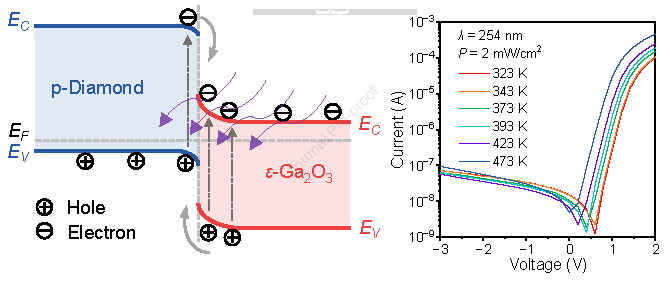
Solar-blind photodetectors (SBPDs) operating without external power are highly desirable for applications in communication, sensing, and imaging, yet their performance is often limited by high dark current and poor detectivity. Here, we demonstrate a self-powered SBPD based on a p-type diamond/n-type ε-Ga2O3 heterojunction diode. The detector exhibits remarkable comprehensive performance under self-powered operation, including an ultra-low dark current of 23 fA, an ultrahigh photo-to-dark current ratio (PDCR) exceeding 106, a responsivity of 384 mA/W, and robust high-temperature stability with a PDCR of 102 at 473 K. Moreover, it shows excellent spectral selectivity at the solar-blind wavelength regime, as well as outstanding spatial uniformity and stable operation over time. The high performance originates from the synergistic combination of exclusive ultrawide bandgap semiconductors and a deliberately engineered pn junction. This design ensures efficient light absorption and carrier collection within the ε-Ga2O3 layer while the diamond counterpart maintains excellent rectification and thermal management. The detector is further successfully applied in rapid UV communication taking advantage of its microsecond-level response time. This work establishes an ultrawide-bandgap pn heterojunction design for self-powered solar-blind photodetectors for advanced optoelectronics.
Conclusions
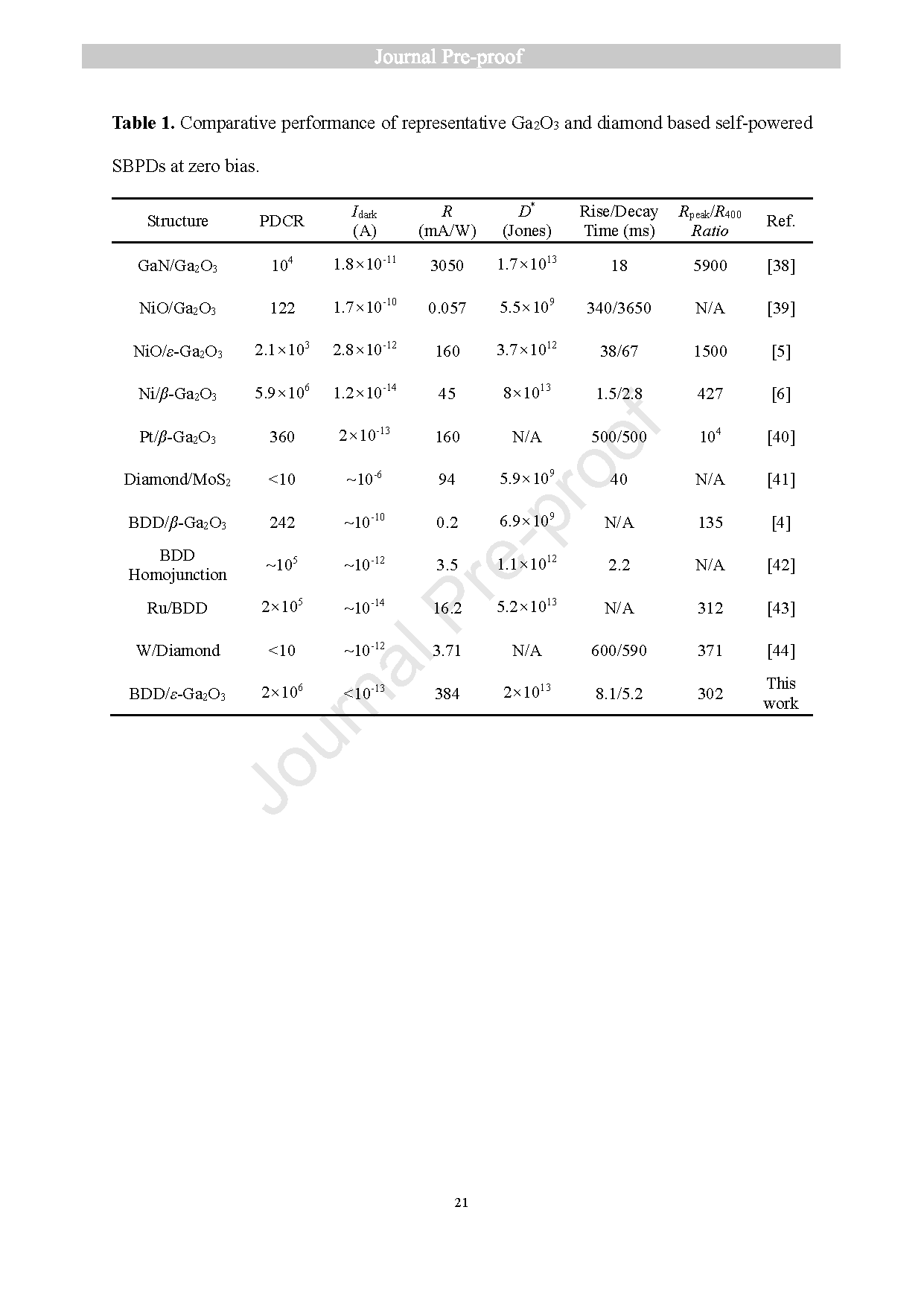
In summary, we have successfully fabricated and characterized a high-performance self-powered solar-blind photodetector based on a p-diamond/n-ε-Ga2O3 heterojunction diode. The device demonstrates well-balanced and exceptional performance, featuring an ultra-low dark current of 23 fA, an ultrahigh photo-to-dark current ratio exceeding 106, a responsivity of 384 mA/W, an excellent detectivity over 1013 Jones, fast response times of 8.1/5.2 ms (rise/decay) and robust high-temperature stability, all achieved at zero bias. The detector also exhibits outstanding operational stability and spatial uniformity, enabling its successful implementation in UV communication systems. The key to the performance lies in the deliberate design of the heterojunction, with efficient light absorption secured by the ε-Ga2O3 depletion region and rectification maintained by the diamond counterpart. This work provides a viable strategy for developing high-performance self-powered SBPDs of UWBG semiconductor heterojunctions for future optoelectronic application.
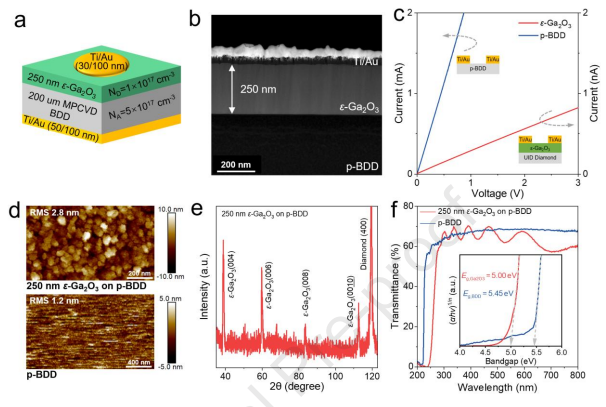
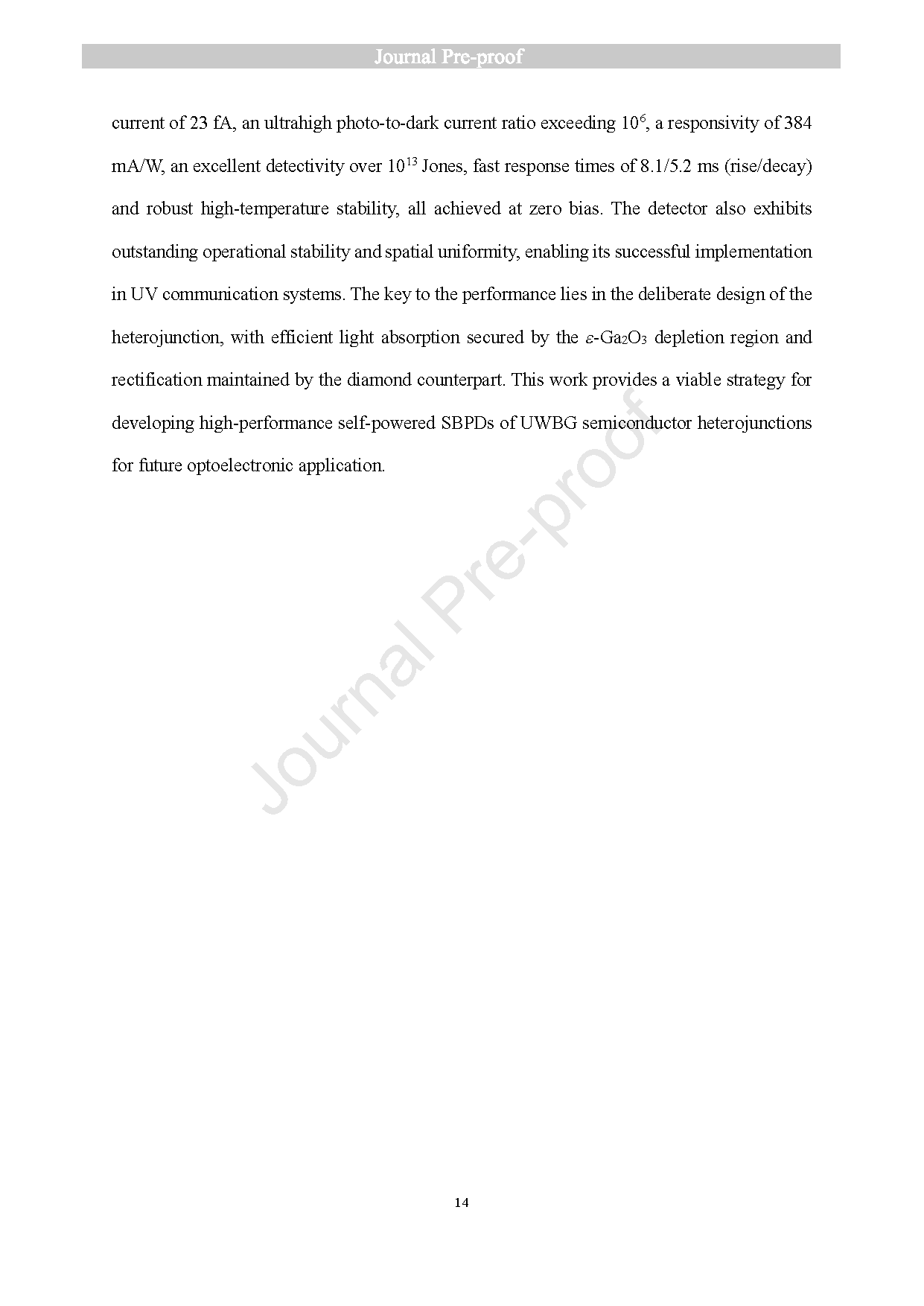
Figure 1. (a) Schematic diagram of the BDD/ε-Ga2O3 heterojunction photodetector. (b) SEM image of cross-sectional heterointerface of the photodetector. (c) Lateral current-voltage behavior of the Ti/Au ohmic contact on BDD and the ε-Ga2O3 film. (d) AFM images of the ε-Ga2O3 film on BDD and the bare BDD substrate. (e) XRD pattern of the ε-Ga2O3 film grown on BDD. (f) Optical transmittance characteristics of the ε-Ga2O3 film on BDD and the bare BDD substrate with the corresponding Tauc plots and bandgap values as the inset.
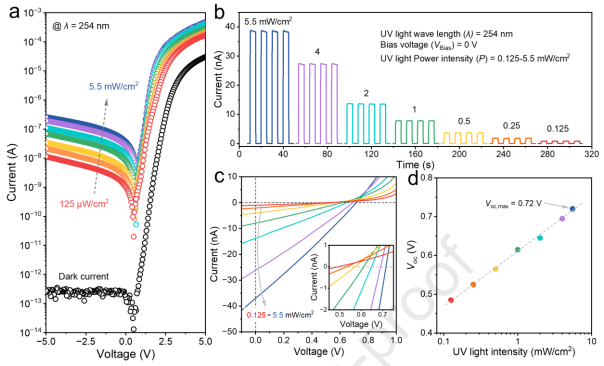
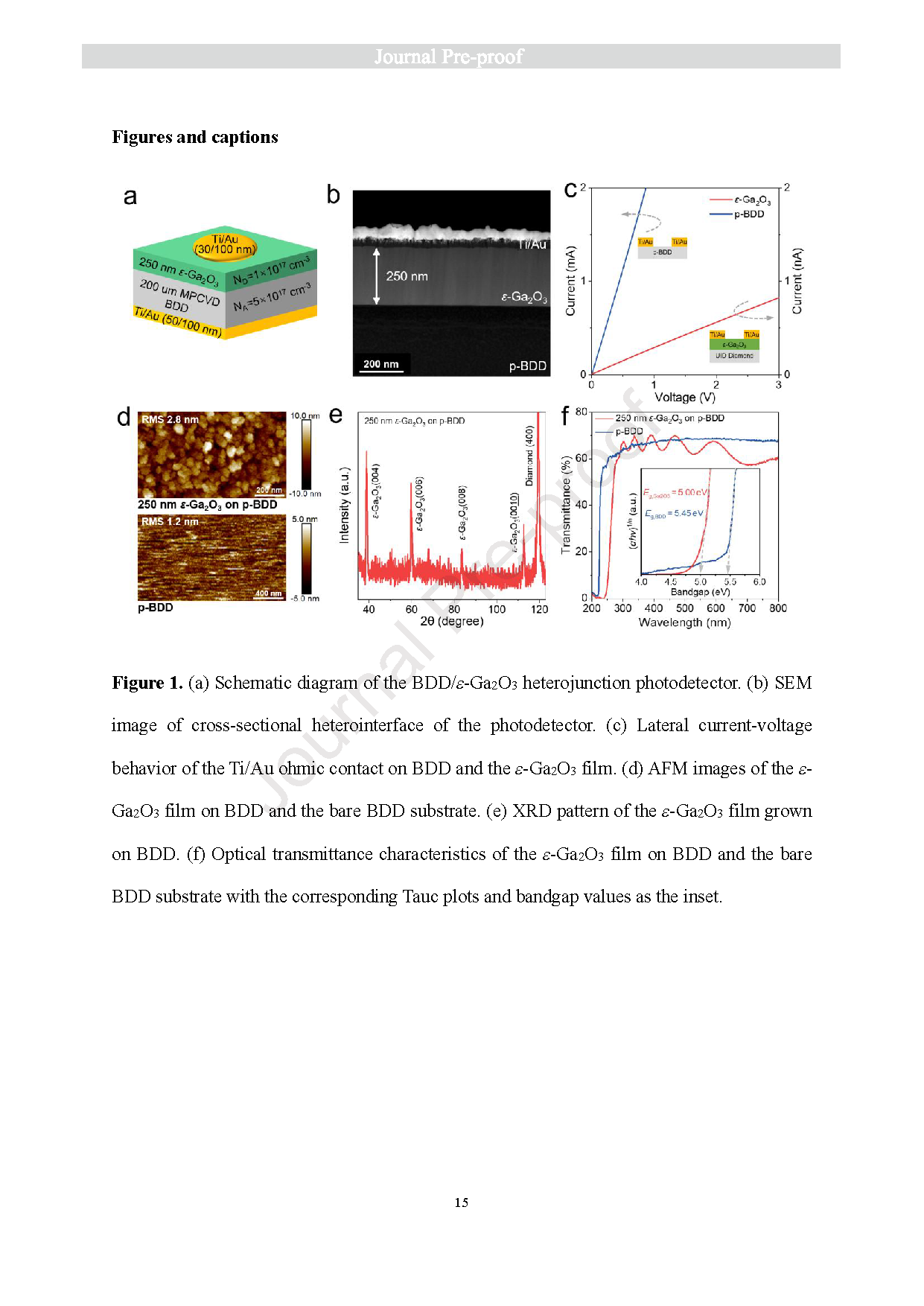
Figure 2. (a) Logarithmic I–V characteristics of the BDD/ε-Ga2O3 SBPD in the dark and under 254 nm light with various intensities. (b) Linear I–t characteristics of the BDD/ε-Ga2O3 SBPD at zero bias under different 254 nm light intensities. (c) Linear I–V characteristics extracted from (a) with inset of enlarged figure of the x-axis intercept. (d) VOC as a directly proportional function of light power intensities.
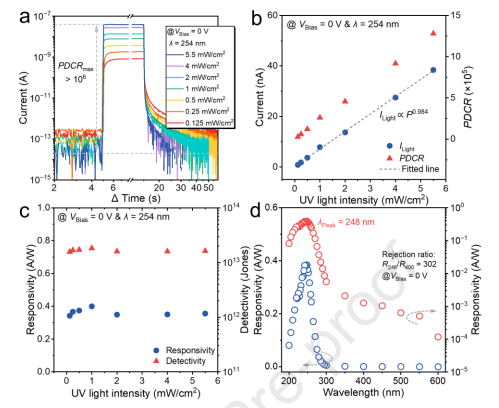
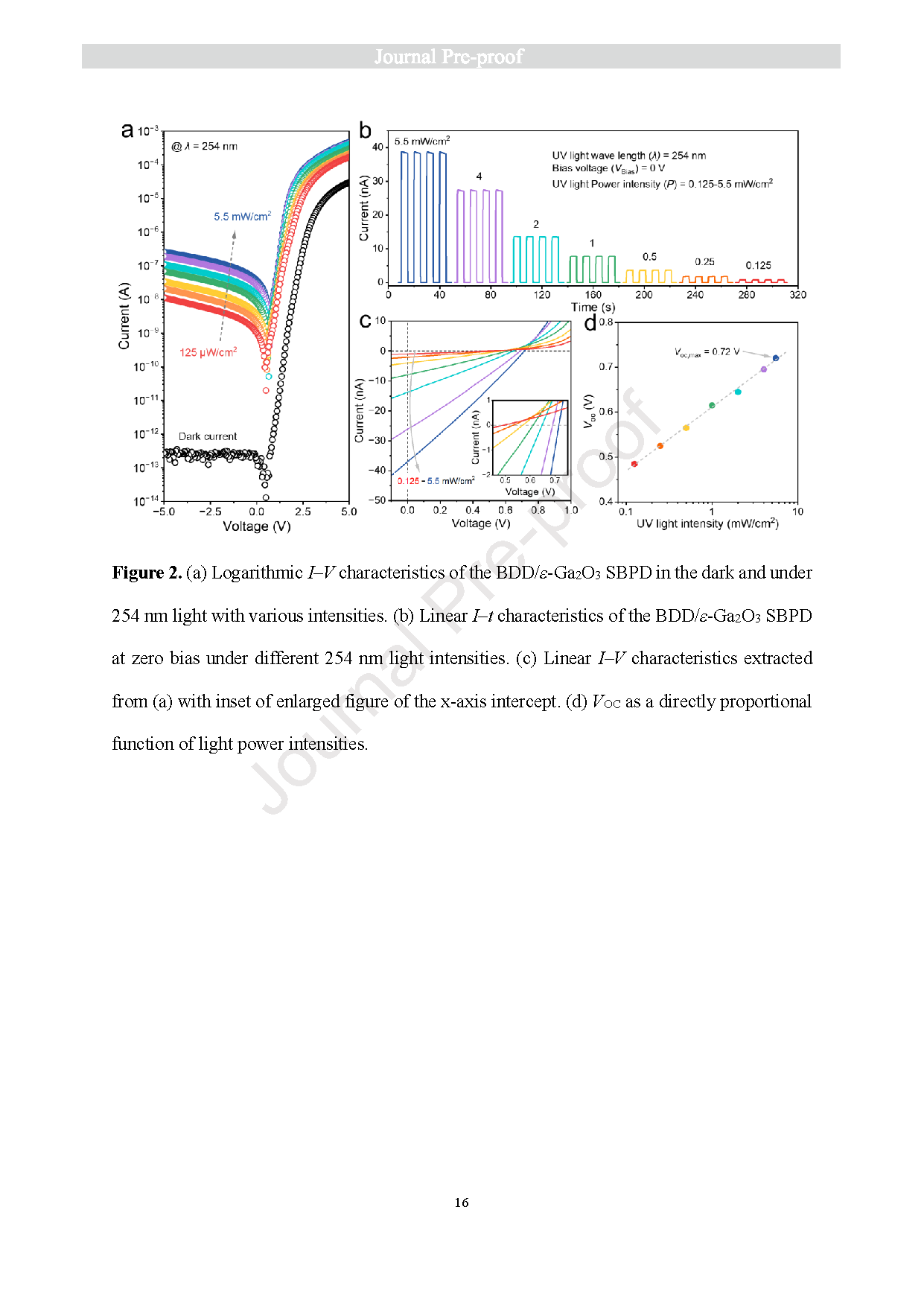
Figure 3. (a) Logarithmic I–t characteristics of the BDD/ε-Ga2O3 SBPD at zero bias under different 254 nm light intensities. Extracted values of (b) Iph, PDCR, (c) R and D* at zero bias under different 254 nm light intensities, respectively. (d) Spectral response of the SBPD at zero bias.
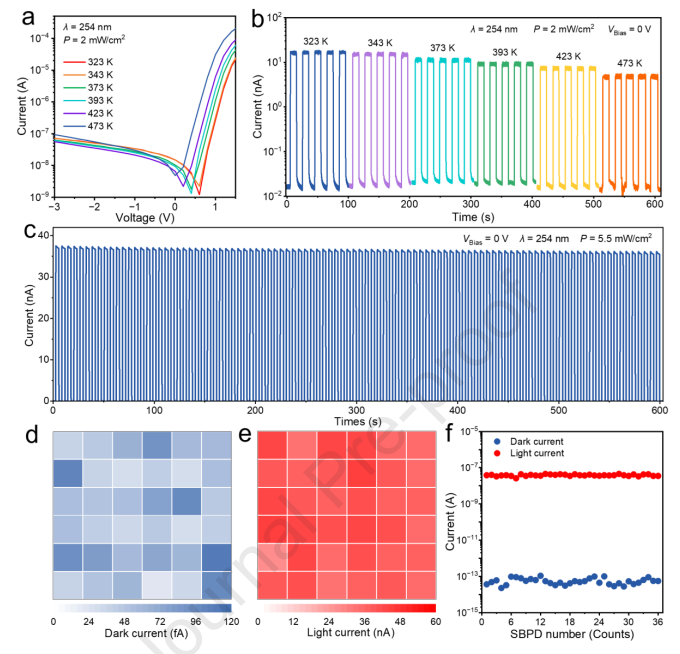
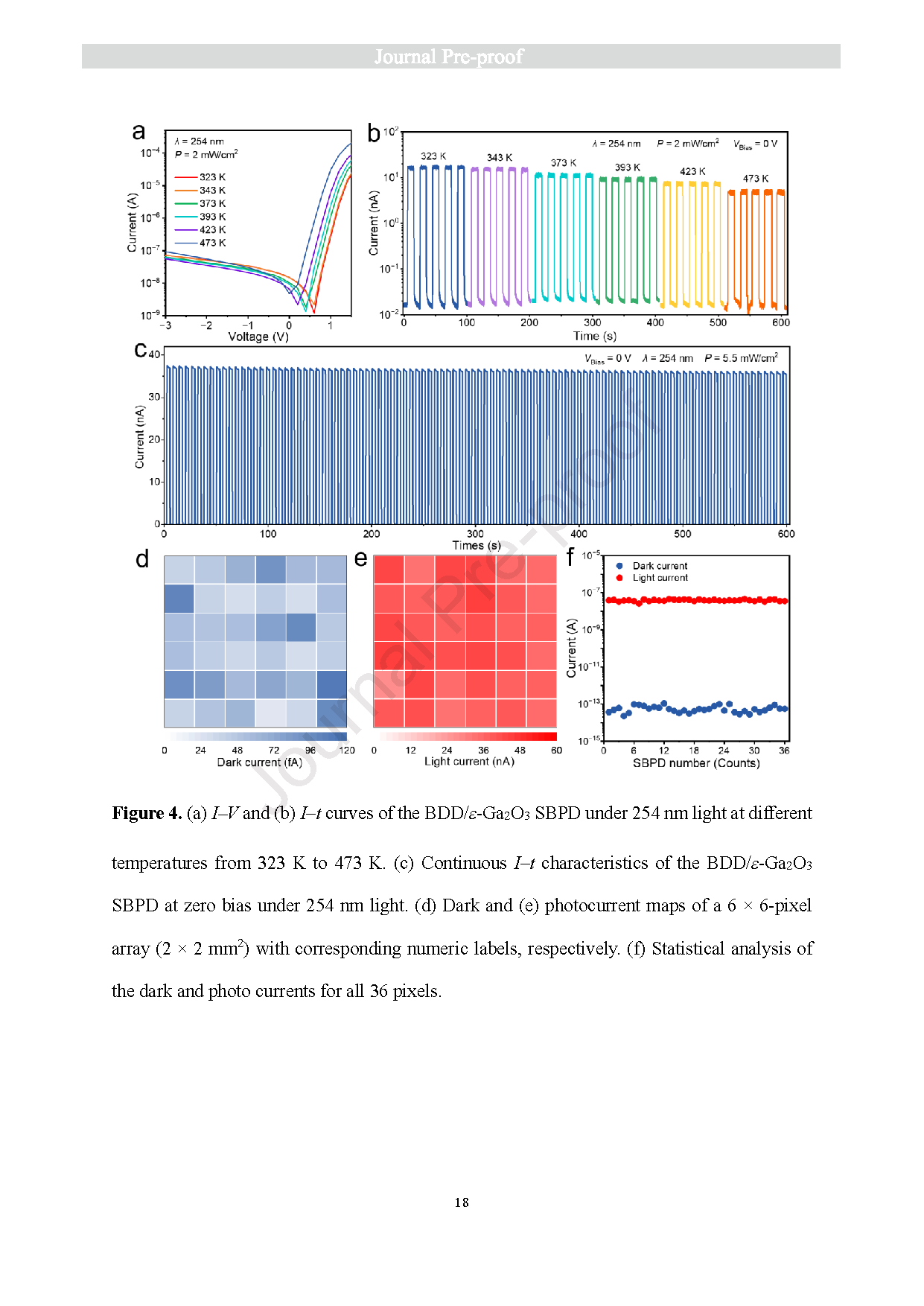
Figure 4. (a) I–V and (b) I–t curves of the BDD/ε-Ga2O3 SBPD under 254 nm light at different temperatures from 323 K to 473 K. (c) Continuous I–t characteristics of the BDD/ε-Ga2O3 SBPD at zero bias under 254 nm light. (d) Dark and (e) photocurrent maps of a 6 × 6-pixel array (2 × 2 mm2) with corresponding numeric labels, respectively. (f) Statistical analysis of the dark and photo currents for all 36 pixels.
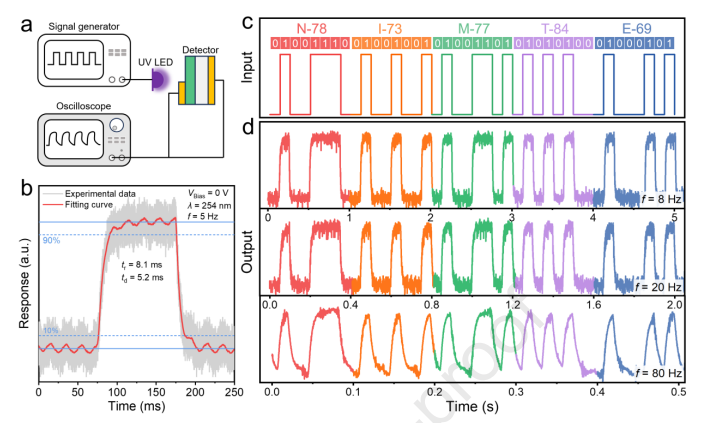
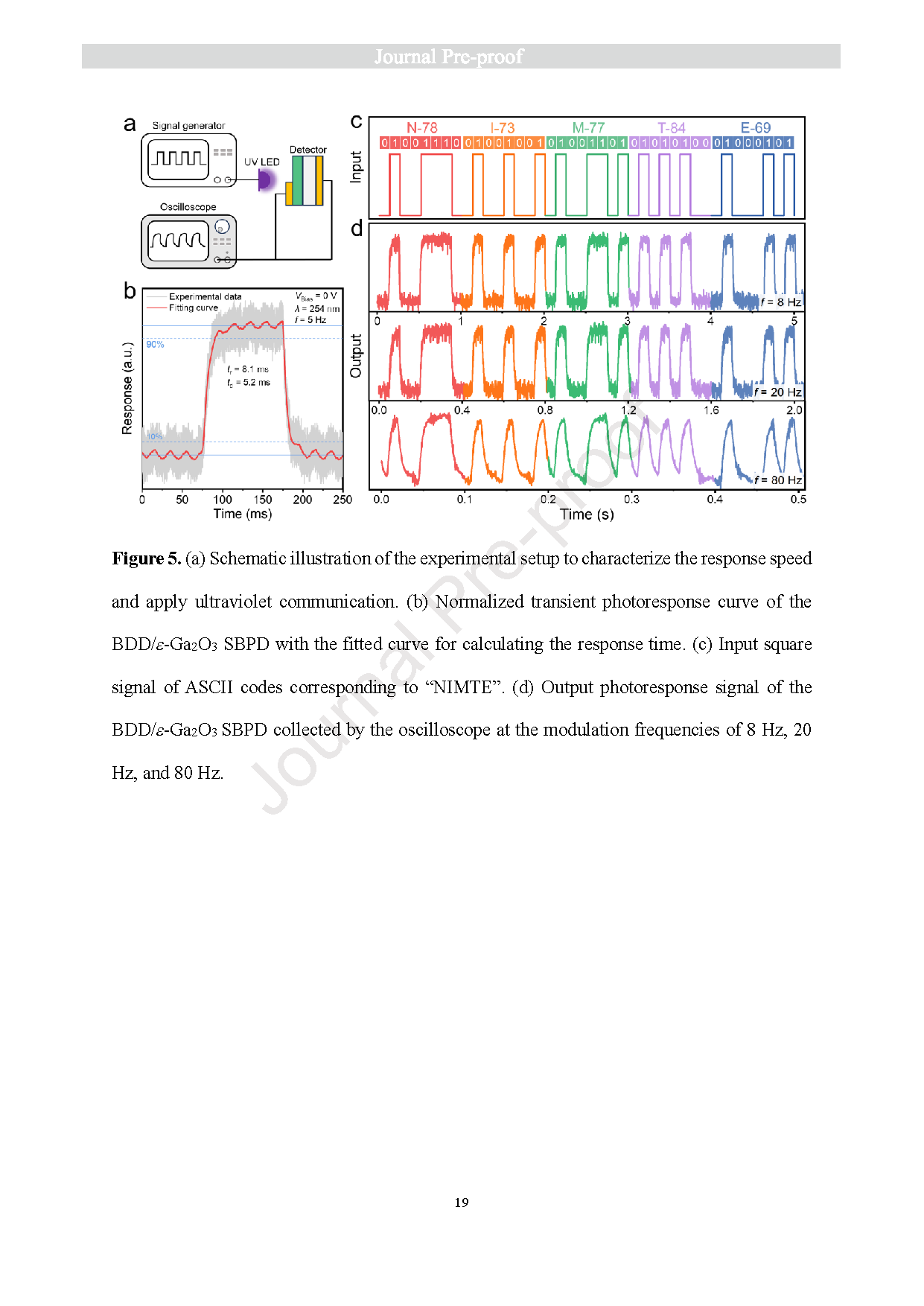
Figure 5. (a) Schematic illustration of the experimental setup to characterize the response speed and apply ultraviolet communication. (b) Normalized transient photoresponse curve of the BDD/ε-Ga2O3 SBPD with the fitted curve for calculating the response time. (c) Input square signal of ASCII codes corresponding to “NIMTE”. (d) Output photoresponse signal of the BDD/ε-Ga2O3 SBPD collected by the oscilloscope at the modulation frequencies of 8 Hz, 20 Hz, and 80 Hz.
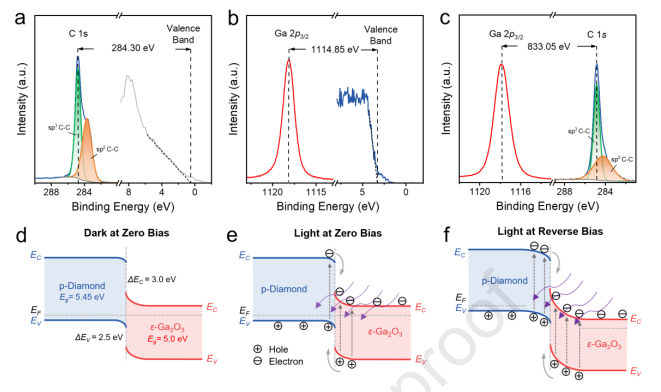
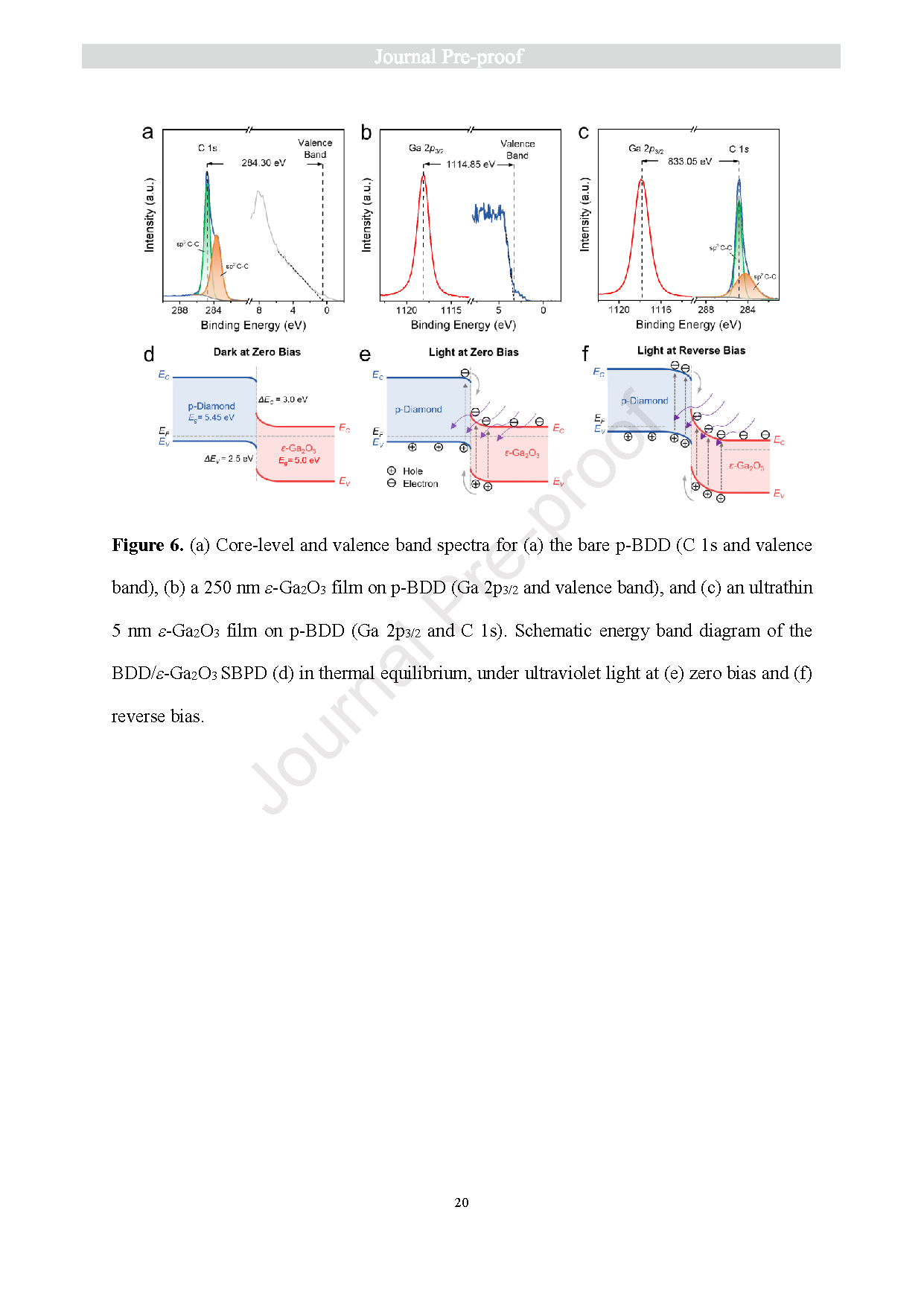
Figure 6. (a) Core-level and valence band spectra for (a) the bare p-BDD (C 1s and valence band), (b) a 250 nm ε-Ga2O3 film on p-BDD (Ga 2p3/2 and valence band), and (c) an ultrathin 5 nm ε-Ga2O3 film on p-BDD (Ga 2p3/2 and C 1s). Schematic energy band diagram of the BDD/ε-Ga2O3 SBPD (d) in thermal equilibrium, under ultraviolet light at (e) zero bias and (f) reverse bias.
DOI:
doi.org/10.1016/j.carbon.2026.121335

Instruction
Official Account

Cooperation
Top