

During this year’s National Two Sessions, Hao Yue, a deputy to the National People’s Congress and an academician of the Chinese Academy of Sciences, put forward proposals related to the development of the integrated circuit industry.
In an interview with China Science Daily, Hao Yue noted that China should not only focus on addressing critical “chokepoint” challenges and overcoming fundamental technological bottlenecks in semiconductor chip development, but also pay attention to fields where the country is already running in parallel with, or even partially leading, the international frontier. By strengthening these advantages, China can move toward the front ranks of the global semiconductor industry.
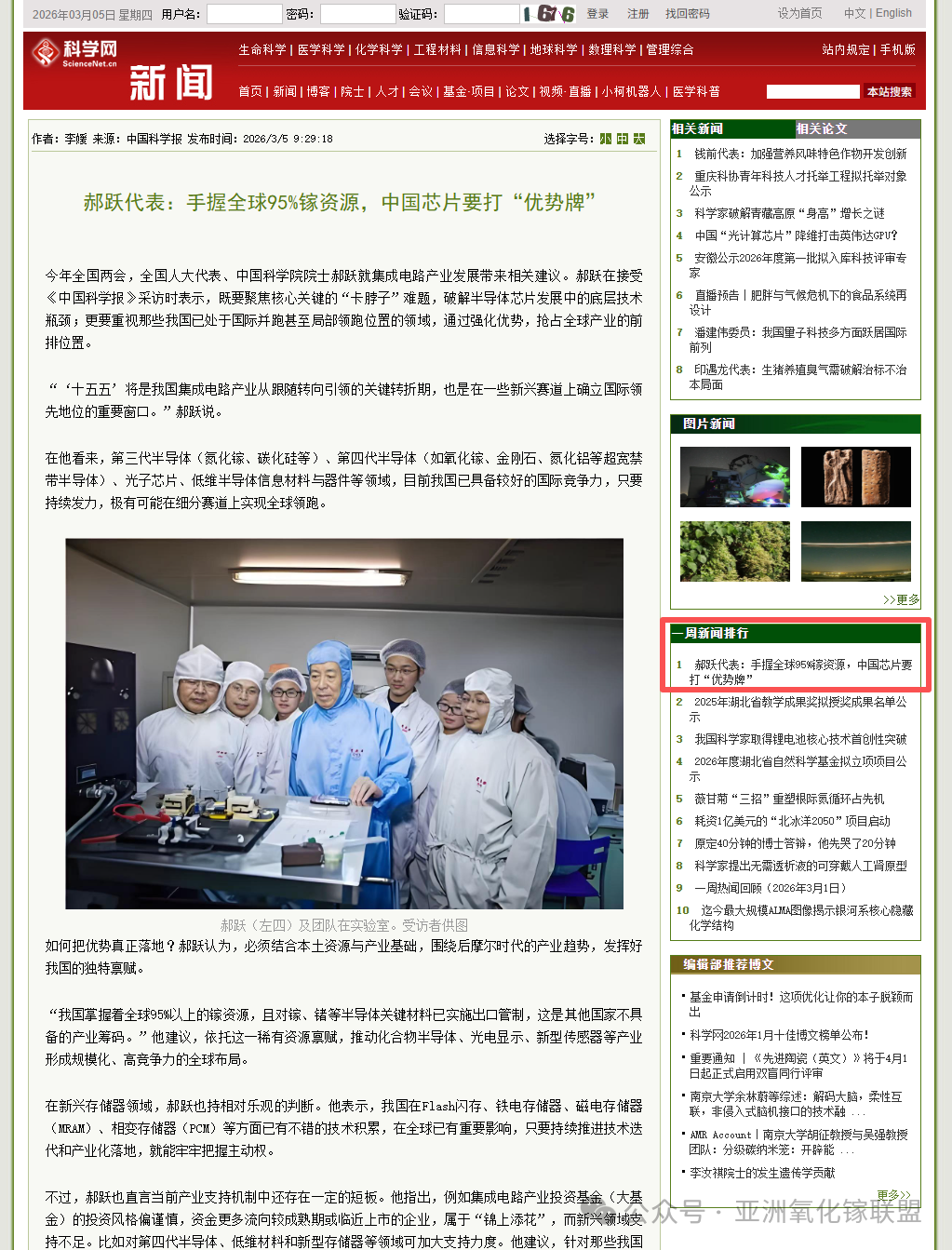
Report by Scientific Net titled “Representative Hao Yue: With 95% of the World’s Gallium Resources in Hand, China’s Chip Industry Should Play Its ‘Advantage Card’”
“The 15th Five-Year Plan period will be a critical turning point for China’s integrated circuit industry, shifting from following to leading, and also an important window for establishing international leadership in several emerging technology tracks,” said Hao Yue.
In his view, China already possesses relatively strong international competitiveness in several frontier areas, including third-generation semiconductors (such as gallium nitride and silicon carbide), fourth-generation semiconductors (such as ultra-wide bandgap materials including Gallium Oxide, diamond, and aluminum nitride), photonic chips, and low-dimensional semiconductor information materials and devices. With sustained efforts, China has strong potential to achieve global leadership in certain niche segments.
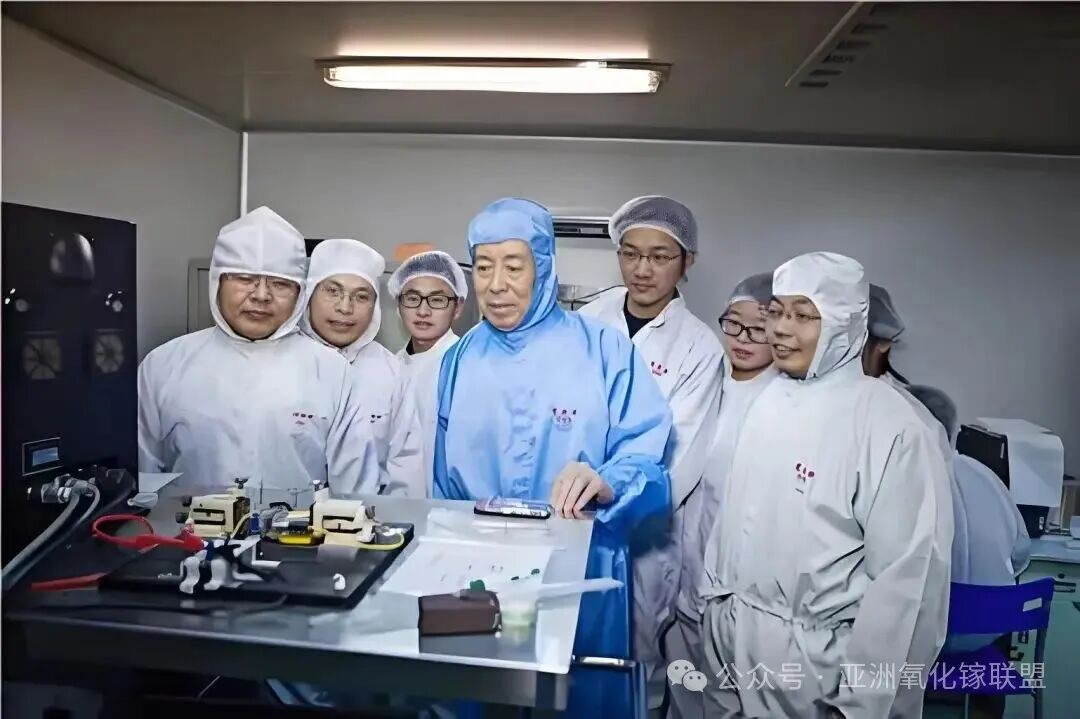
Hao Yue (fourth from the left) and his team in the laboratory
How can these advantages be translated into real industrial progress? Hao Yue believes this must be achieved by leveraging China’s domestic resources and industrial foundation while aligning with the broader technological trends of the post-Moore era.
“China holds more than 95% of the world’s gallium resources, and export controls have already been implemented on key semiconductor materials such as gallium and germanium. This provides an industrial leverage that other countries do not possess,” he noted. He suggested that China should capitalize on this rare resource advantage to promote the large-scale and globally competitive development of industries such as compound semiconductors, optoelectronic displays, and next-generation sensors.
Regarding emerging memory technologies, Hao Yue also expressed a relatively optimistic outlook. He pointed out that China has already built solid technical foundations in areas such as flash memory, ferroelectric memory, magnetoresistive random-access memory (MRAM), and phase-change memory (PCM), and has gained considerable global influence in these fields. With continued technological iteration and industrial implementation, China could maintain strong strategic initiative in the future.
However, Hao Yue also acknowledged certain shortcomings in the current industrial support mechanisms. For example, he noted that the investment style of the Integrated Circuit Industry Investment Fund (“Big Fund”) tends to be relatively cautious, with capital flowing more often to companies that are already mature or approaching public listing—essentially “adding flowers to brocade,” while support for emerging fields remains limited. He suggested increasing support for areas such as fourth-generation semiconductors, low-dimensional materials, and novel memory technologies. “For directions where China already possesses technological advantages, greater investment and faster commercialization are needed. We should not only ‘add flowers to brocade,’ but also provide ‘timely help in the snow.’”
Industrial development ultimately depends on talent, especially looking ahead to the “15th Five-Year Plan” period and beyond. Cultivating innovative talent aligned with industry needs has become an urgent priority. Hao Yue noted that, with supportive policies from national authorities aimed at addressing talent shortages in the electronic information field—such as establishing dedicated training quotas, expanding training channels, and optimizing education mechanisms in integrated circuits and microelectronics—the talent situation in the IC industry has already improved significantly.
“Going forward, universities should further strengthen the integration of science and education, industry and education, as well as international collaboration,” he said. “It is important to cultivate students’ sense of responsibility, innovative thinking, critical thinking, and teamwork skills. Students should be encouraged to focus on real industrial challenges in their research, combining practical capability with innovation, in order to ultimately train truly interdisciplinary talents who meet the needs of the industry.”
Instruction
Official Account

Cooperation
Top