


Researchers from Hubei University and Wuhan Textile University have published a dissertation titled “Flexible solar-blind photodetector based on individual gallium oxide microwire with high responsivity and detectivity” in Physica B: Condensed Matter.
Background
Solar-blind ultraviolet (SBUV) photodetectors are critical for strategic defense and civilian applications, including missile warning and deep-space exploration. Current research focuses on enhancing sensitivity while advancing device miniaturization and flexible integration. Among wide-bandgap semiconductors, β‑Ga₂O₃ has gained significant attention due to its intrinsic bandgap (~4.8 eV) that aligns naturally with the solar-blind region, along with excellent thermal stability and radiation hardness. Compared to bulk or thin-film counterparts, one-dimensional (1D) nano/micro-structures offer superior crystalline perfection, lower defect densities, and better flexibility. However, conventional synthesis of 1D Ga₂O₃ often relies on noble metal catalysts, which increases costs and introduces metallic impurities. Consequently, developing a catalyst-free, cost-effective growth method for high-performance flexible SBUV detectors is of great importance.
Abstract
Solar-blind ultraviolet (SBUV) photodetectors based on one-dimensional (1D) β‑Ga₂O₃ have recently attracted significant interest for their superior photodetection performance, yet conventional methods for synthesizing 1D Ga₂O₃ nanomaterials often rely on noble metal catalysts (e.g., Au, Pt, Sn), which increase production costs and may introduce metallic impurities. This study presents a catalyst-free suboxide chemical vapor transport (SOCVT) method to fabricate high-quality β‑Ga₂O₃ microtubes. The device was achieved by integrating a single β‑Ga₂O₃ microtube between two gold electrodes with a 50 µm channel spacing. It achieves a responsivity of 592 A/W, a detectivity of 3.3 ×10¹⁴ Jones, and fast response times of 0.19 s (rise) and 0.04 s (decay) under 255 nm illumination at 20 V bias. Furthermore, it retains 93% of its initial photocurrent after 1000 bending cycles at a 0.5 cm radius, demonstrating excellent mechanical durability. These results highlight the potential of SOCVT-grown β‑Ga₂O₃ microtubes for high-performance, flexible, and wearable SBUV sensing systems.
Highlights
Catalyst-free SOCVT method for growing high-quality β‑Ga₂O₃ microtubes.
Flexible MSM photodetector based on a single β‑Ga₂O₃ microtube with 50 µm channel.
Ultrahigh responsivity of 592 A/W and detectivity of 3.3 ×10¹⁴ Jones.
Fast response speed with rise time of 0.19 s and decay time of 0.04 s.
Excellent mechanical flexibility with 93% photocurrent retention after 1000 bending cycles.
Conclusion
In summary, high-quality β‑Ga₂O₃ microtubes were successfully synthesized via a catalyst-free sub-oxide chemical vapor transport (SOCVT) method. A MSM structured SBUV photodetector was fabricated by integrating a single β‑Ga₂O₃ microtube between two gold electrodes with a 50 µm channel spacing. The device exhibits outstanding optoelectronic performance, achieving a responsivity of 592 A/W, a D* of 3.3 ×10¹⁴ Jones, and fast response times of 0.19 s (rise) and 0.04 s (decay) under a 20 V bias. Furthermore, it demonstrates excellent mechanical flexibility and operational stability, with both photocurrent and dark current showing negligible degradation after 1000 bending cycles at a 0.5 cm bending radius. The overall performance compares favorably with reported state-of-the-art devices, highlighting the superior photodetection performance and mechanical robustness of this flexible architecture. These results present a viable and scalable pathway toward high-performance, flexible, and wearable SBUV detection systems.
Project Support
This work was supported by the National Natural Science Foundation of China (Grant Nos. 62274057, 52202132, and 11975093), the Hubei International Science and Technology Cooperation Project (Grant No. 2025EHA006), and Wuhan Municipal Bureau of Science and Technology Innovation (Grant Nos. 2024040801020306, and 2025011202030396), and the Program for Science and Technology Innovation Team in Colleges of Hubei Province (Grant No. T201901).
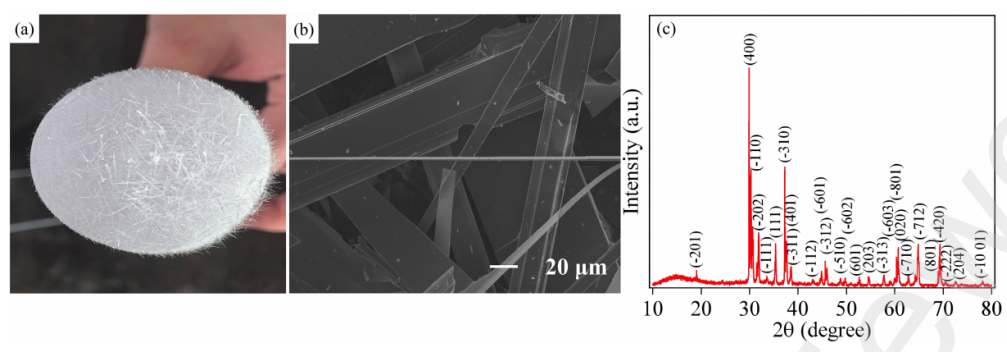
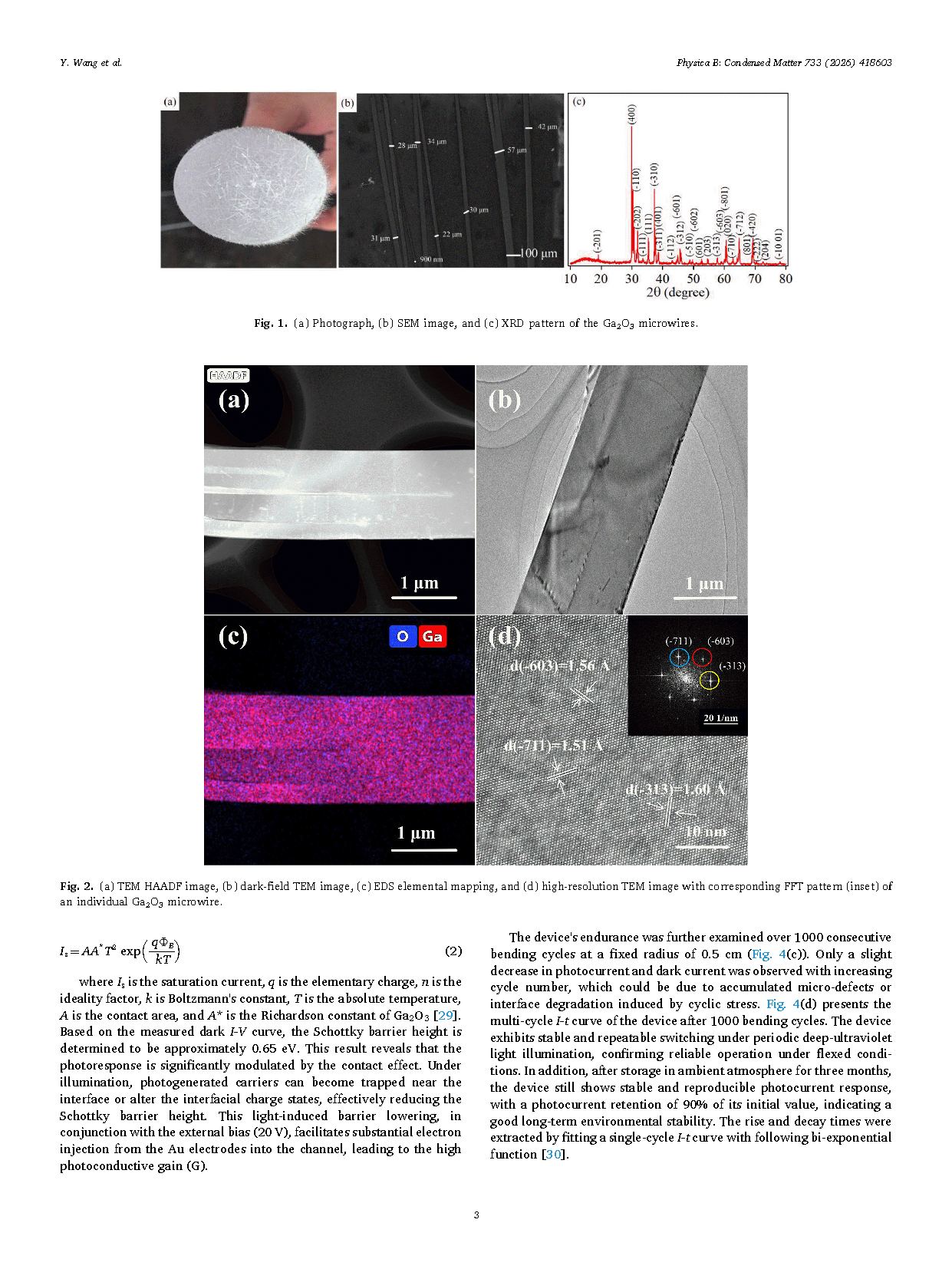
Figure 1. (a) Photograph, (b) SEM image, and (c) XRD pattern of the Ga₂O₃ microtubes.
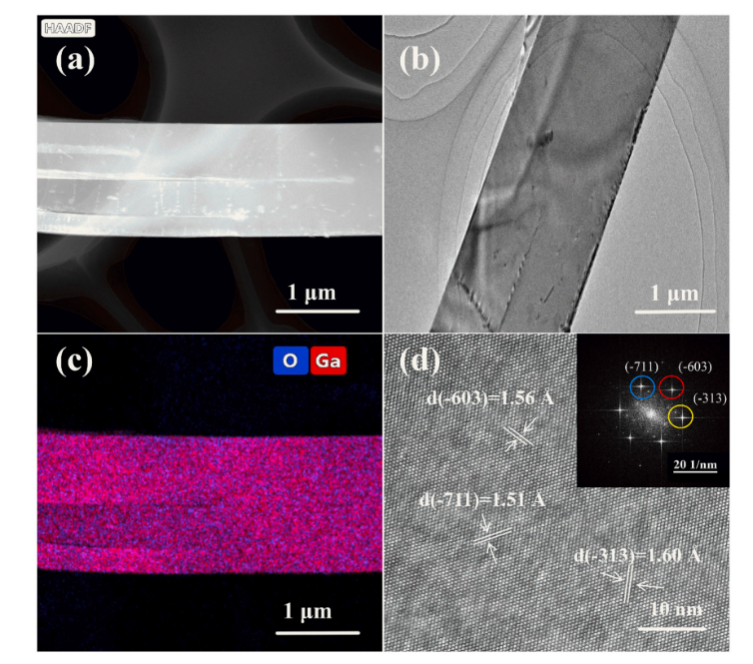
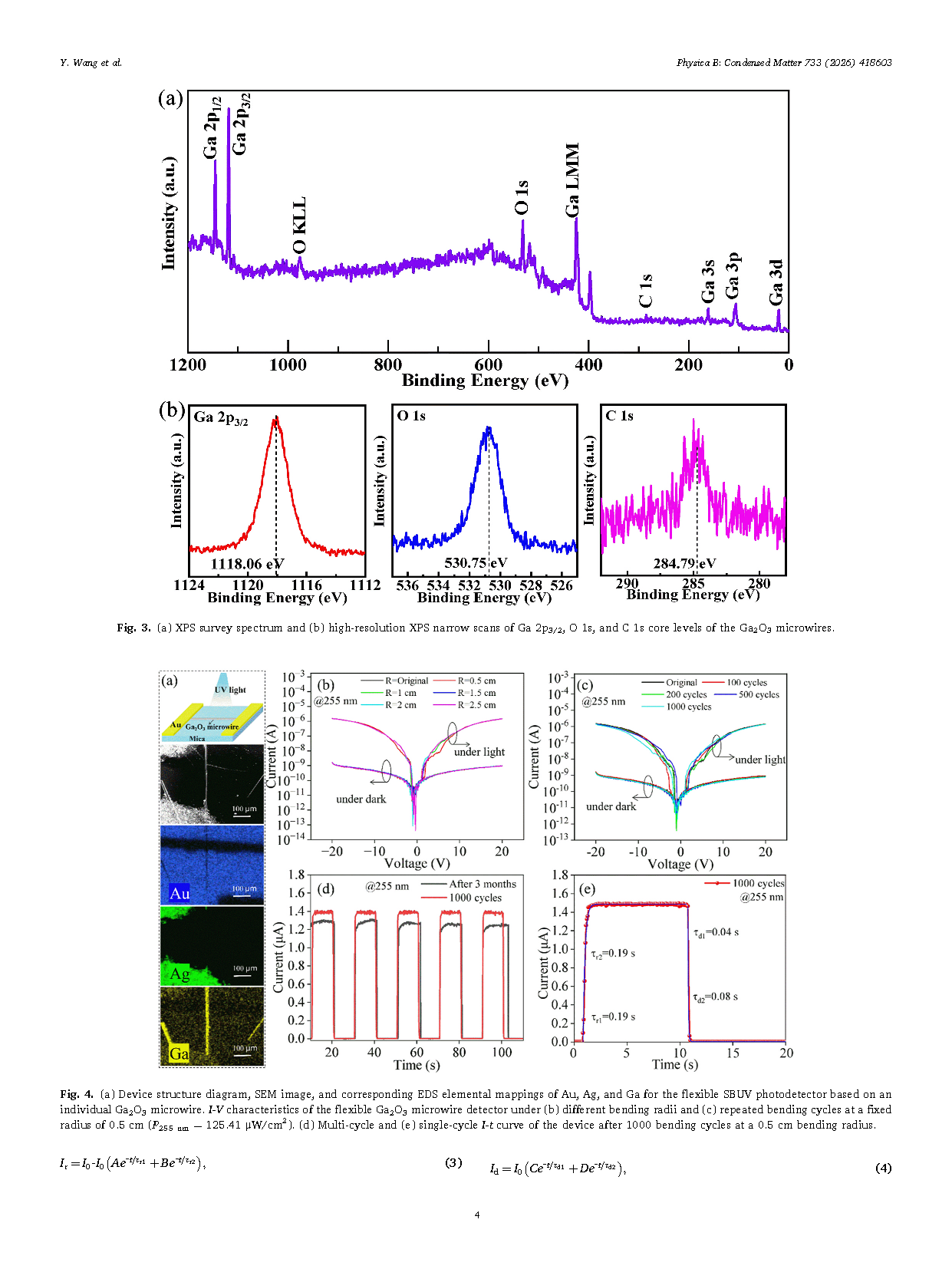
Figure 2. (a) TEM HAADF image, (b) EDS elemental mapping, (c) high-resolution TEM image, and (d) SAED pattern of an individual Ga₂O₃ microtube.
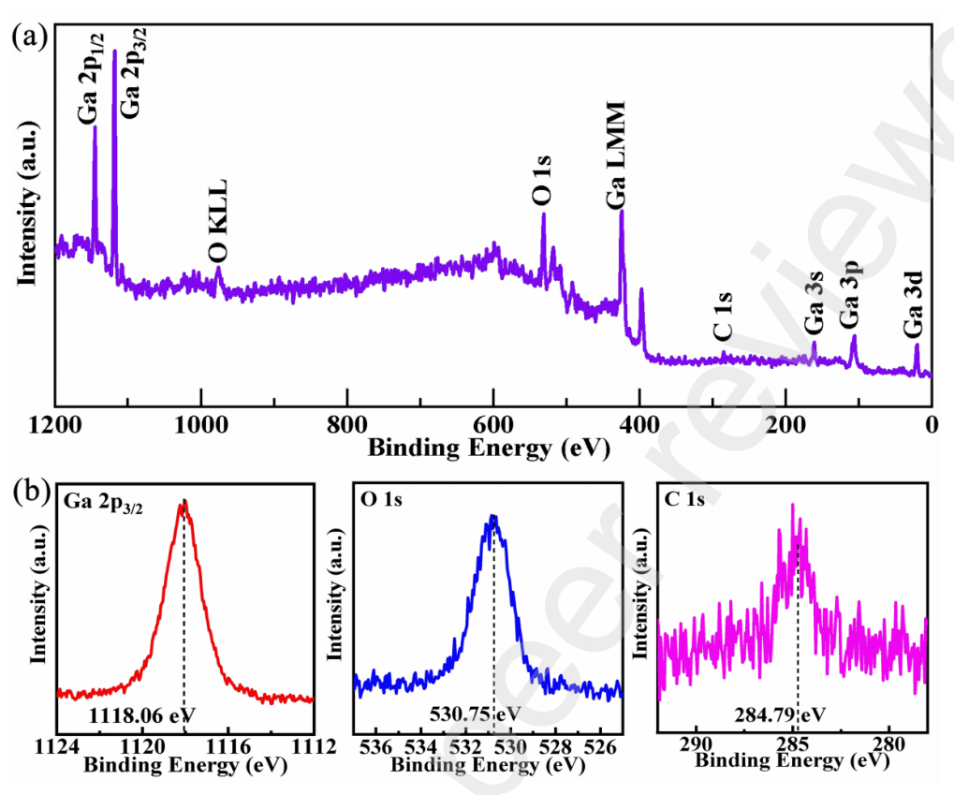
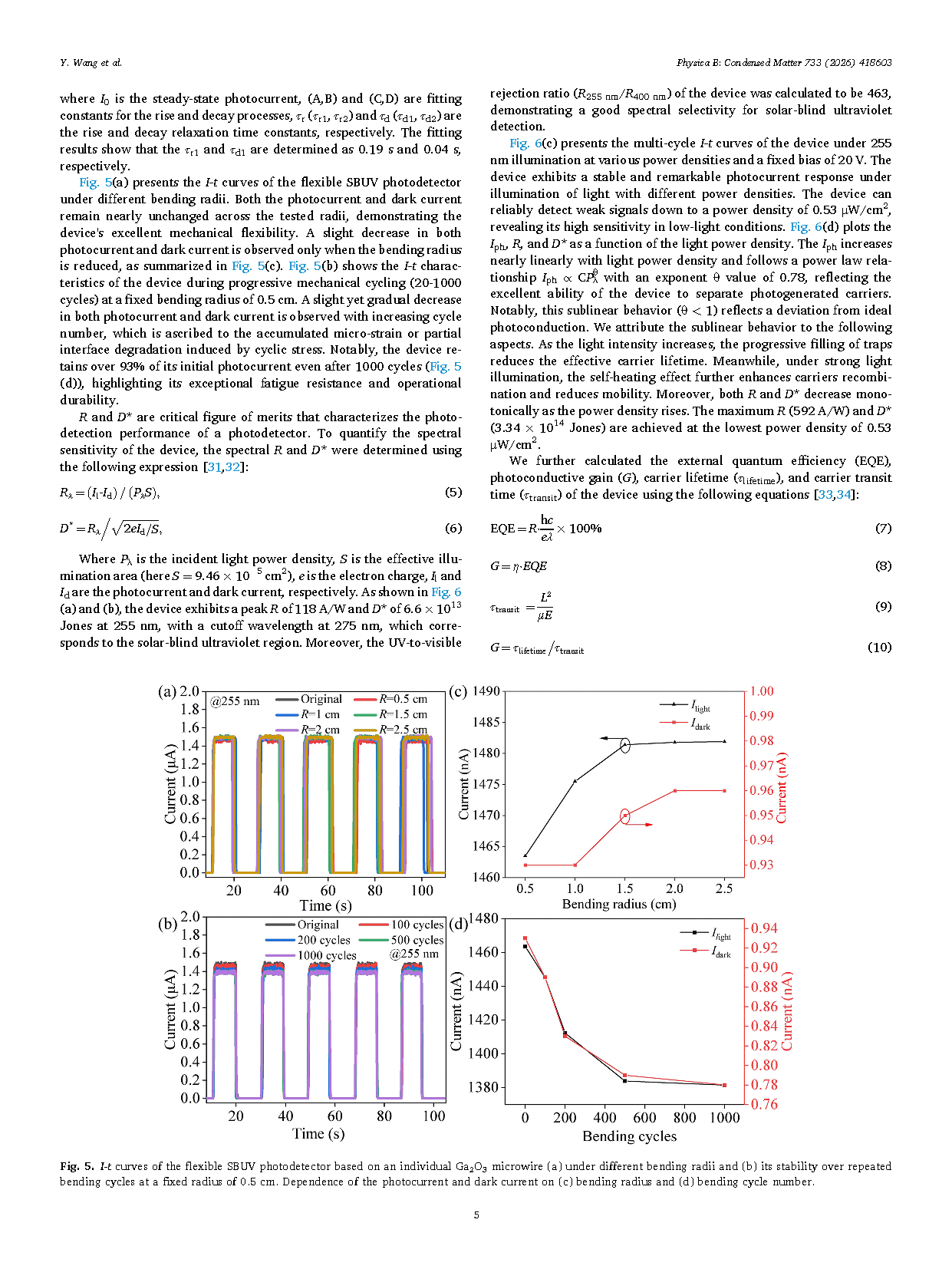
Figure 3. (a) XPS survey spectrum and (b) high-resolution XPS narrow scans of Ga 2p3/2, O 1s, and C 1s core levels of the Ga₂O₃ microtubes.
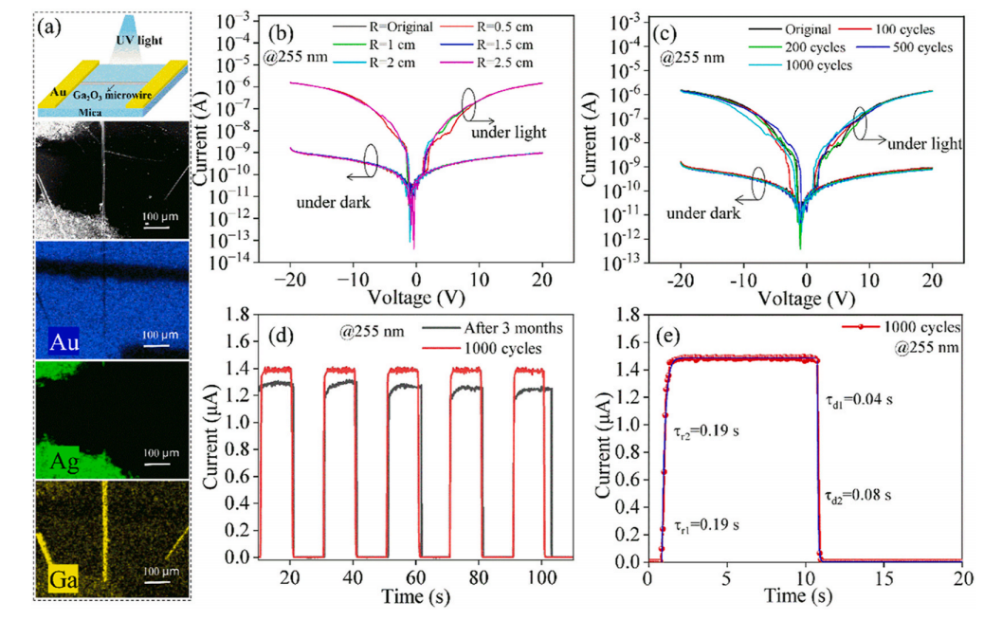
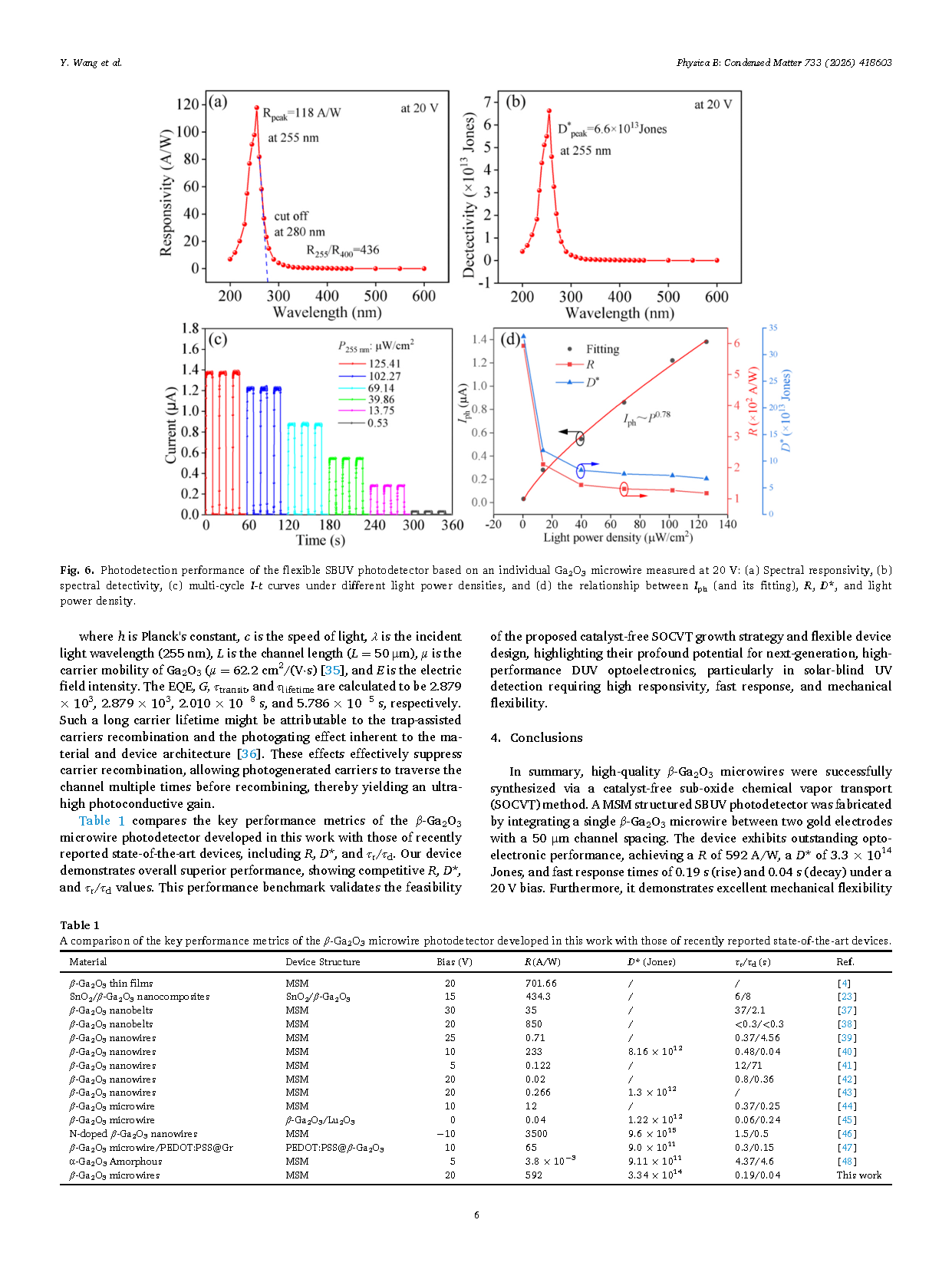
Figure 4. (a) Device structure diagram, SEM image, and corresponding EDS elemental mappings of Au, Ag, and Ga for the flexible SBUV photodetector based on an individual Ga₂O₃ microtube. I–V characteristics of the flexible Ga₂O₃ microtube detector under (b) different bending radii and (c) repeated bending cycles at a fixed radius of 0.5 cm. (d) Multi-cycle and (e) single-cycle I–t curves of the device after 1000 bending cycles at a 0.5 cm bending radius.
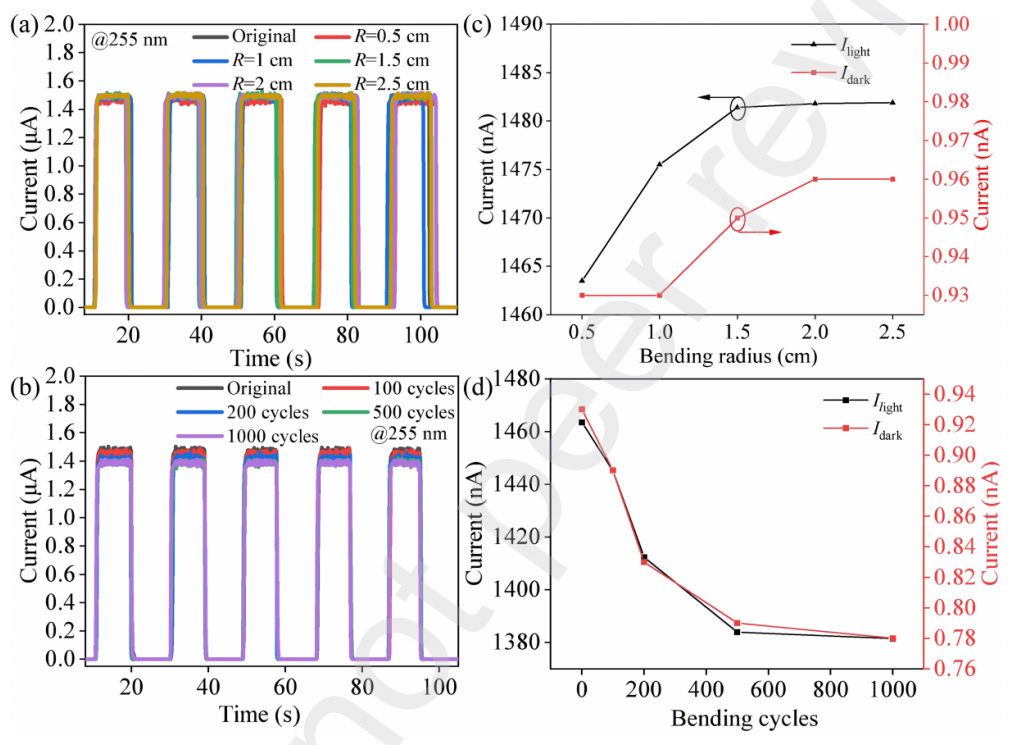
Figure 5. I–t curves of the flexible SBUV photodetector based on an individual Ga₂O₃ microtube (a) under different bending radii and (b) its stability over repeated bending cycles at a fixed radius of 0.5 cm. Dependence of the photocurrent and dark current on (c) bending radius and (d) bending cycle number.
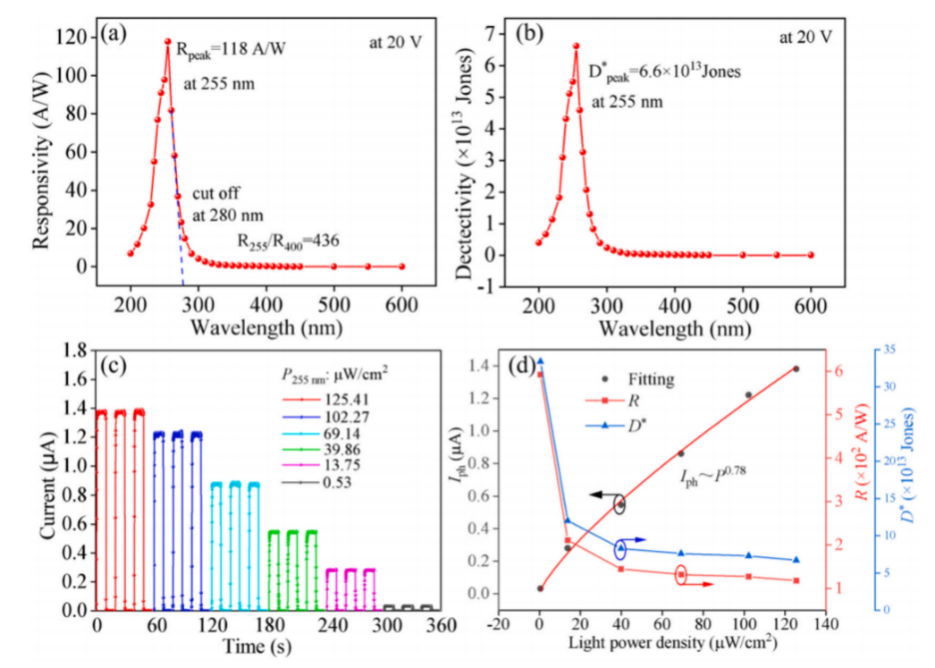
Fig. 6 Photodetection performance of the flexible SBUV photodetector based on an individual Ga₂O₃ microwire measured at 20 V: (a) Spectral responsivity, (b) spectral detectivity, (c) multi-cycle I-t curves under different light power densities, and (d) the relationship between Iph (and its fitting), R, D*, and light power density.
DOI:
doi.org/10.1016/j.physb.2026.418603
Instruction
Official Account

Cooperation
Top