


Researchers from Zhejiang Sci-Tech University have published a dissertation titled “Fabrication of a Self-Powered β‑Ga₂O₃/PEDOT:PSS Heterojunction for Polarization-Sensitive Ultraviolet Imaging Sensing” in ACS Applied Electronic Materials.
Background
Polarization-sensitive deep-ultraviolet photodetectors are crucial for advanced imaging, secure communication, and intelligent sensing, but their applications are limited by complex device architectures and high power consumption. β‑Ga₂O₃ features intrinsic anisotropy and an ultrawide bandgap, enabling polarization response without external polarizers. The team constructed a β‑Ga₂O₃/PEDOT:PSS heterojunction and achieved self-powered operation by utilizing the built-in electric field at the interface, providing a simple and efficient strategy for low-power, highly integrated polarization UV detection.
Abstract
Polarization-sensitive deep-ultraviolet (DUV) photodetectors are of great interest for advanced imaging, secure communication, and intelligent sensing, yet their practical application is often hindered by complex device architectures and high power consumption. Here, we report the fabrication of a self-powered polarization-sensitive DUV photodetector based on a β‑Ga₂O₃/PEDOT:PSS heterojunction. Benefiting from the intrinsic anisotropic optical absorption of monoclinic β‑Ga₂O₃ and the built-in electric field at the heterointerface, the device exhibits high polarization-dependent photoresponse without the need for external polarization lens. Under 254 nm ultraviolet illumination, the β‑Ga₂O₃ photodetector exhibits an ultrahigh dichroic ratio of 136, demonstrating its exceptional intrinsic polarization sensitivity. In contrast, the β‑Ga₂O₃/PEDOT:PSS heterojunction photodetector maintains a dichroic ratio of approximately 5 under zero-bias conditions. Using this polarization sensitivity photodetector, a polarization-encrypted ultraviolet image sensor is successfully demonstrated, in which encrypted images are transmitted under one polarization state and accurately decrypted by switching to the orthogonal polarization. This work provides a simple effective strategy for realizing low-power, polarization-sensitive ultraviolet photodetectors and highlights the potential of β‑Ga₂O₃/PEDOT:PSS heterojunctions for secure imaging sensing and advanced optoelectronic applications.
Highlights
Realizing self-powered polarization-sensitive DUV detection based on β‑Ga₂O₃/PEDOT:PSS heterojunction.
Ultrahigh dichroic ratio of 136 for bare β‑Ga₂O₃ photodetector without polarizers.
Self-powered polarization response with a dichroic ratio of ~5 at zero bias.
Demonstration of polarization-encrypted ultraviolet imaging sensing.
Simplified device structure without external polarizing components.
Conclusion
In summary, a self-powered polarization-sensitive ultraviolet photodetector based on a β‑Ga₂O₃/PEDOT:PSS heterojunction has been demonstrated by integrating the intrinsic anisotropic optical absorption of monoclinic β‑Ga₂O₃ with heterojunction-induced built-in electric fields. The device exhibits a clear polarization-dependent photoresponse with a characteristic 180° periodicity and maintains effective polarization discrimination under zero-bias operation, as further quantified by a high DOLP. Although the dichroic ratio of the heterojunction device is lower than that of the bare β‑Ga₂O₃ photodetector, the preserved polarization sensitivity under self-powered conditions enables reliable polarization information extraction without external power consumption. Leveraging this capability, a polarization-encrypted ultraviolet image transmission scheme is successfully demonstrated, in which encrypted images are transmitted under one polarization state and accurately decrypted by switching to the orthogonal polarization. These results highlight a simple yet effective strategy for realizing low-power, polarization-sensitive ultraviolet photodetectors and underscore the potential of β‑Ga₂O₃/PEDOT:PSS heterojunctions for secure imaging sensing and advanced optoelectronic applications.
Project Support
This work was supported by the National Natural Science Foundation of China (Nos. 62304205, 52300145, 62274148, 62374147, and U23A20349), the Zhejiang Provincial Natural Science Foundation of China (LQ24F040002 and ZCLQN26F0403), the Science Foundation of Zhejiang Sci-Tech University (25062169-Y), and the Natural Science Foundation of Hangzhou (No. 2024SZRZDF040001).
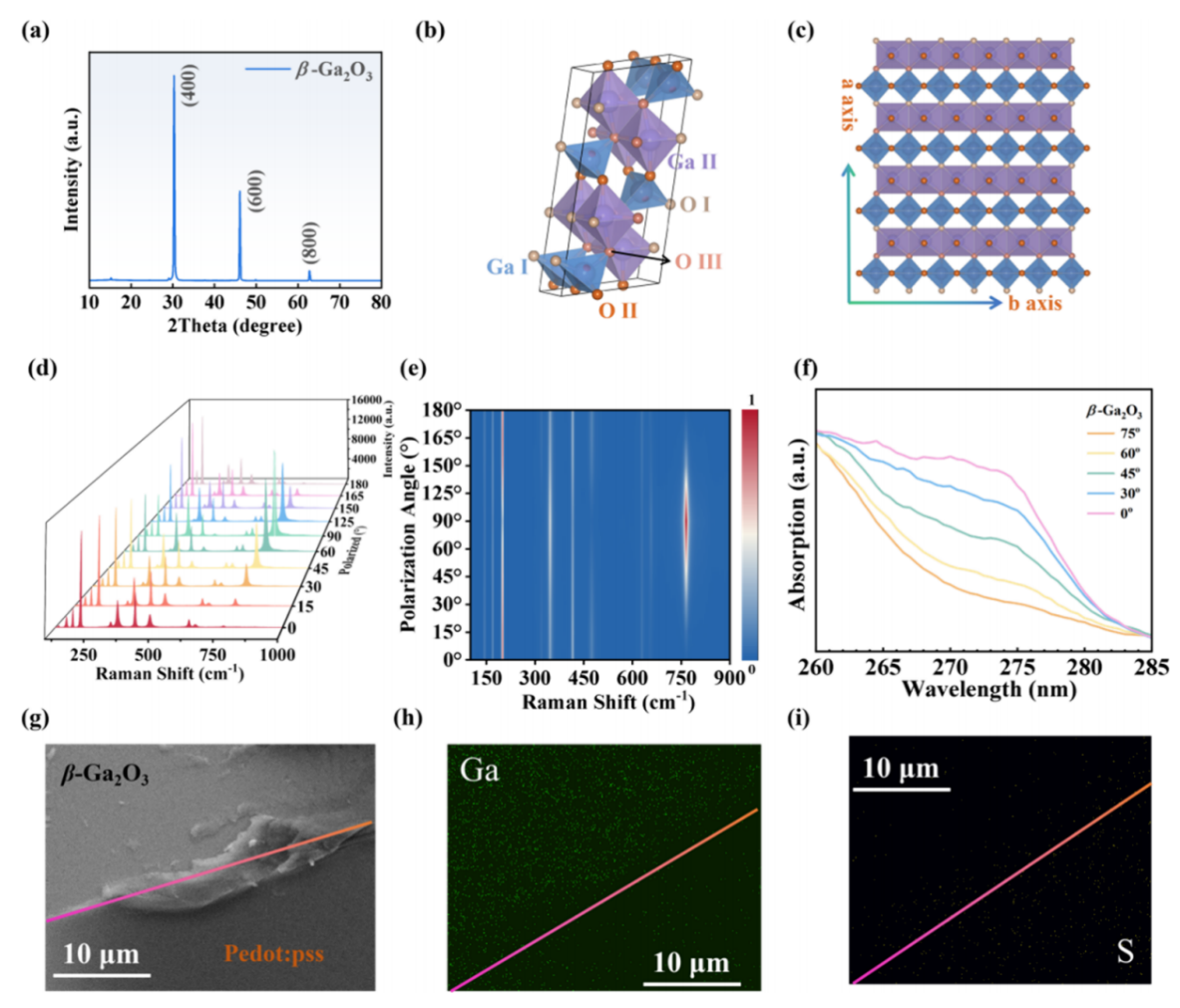
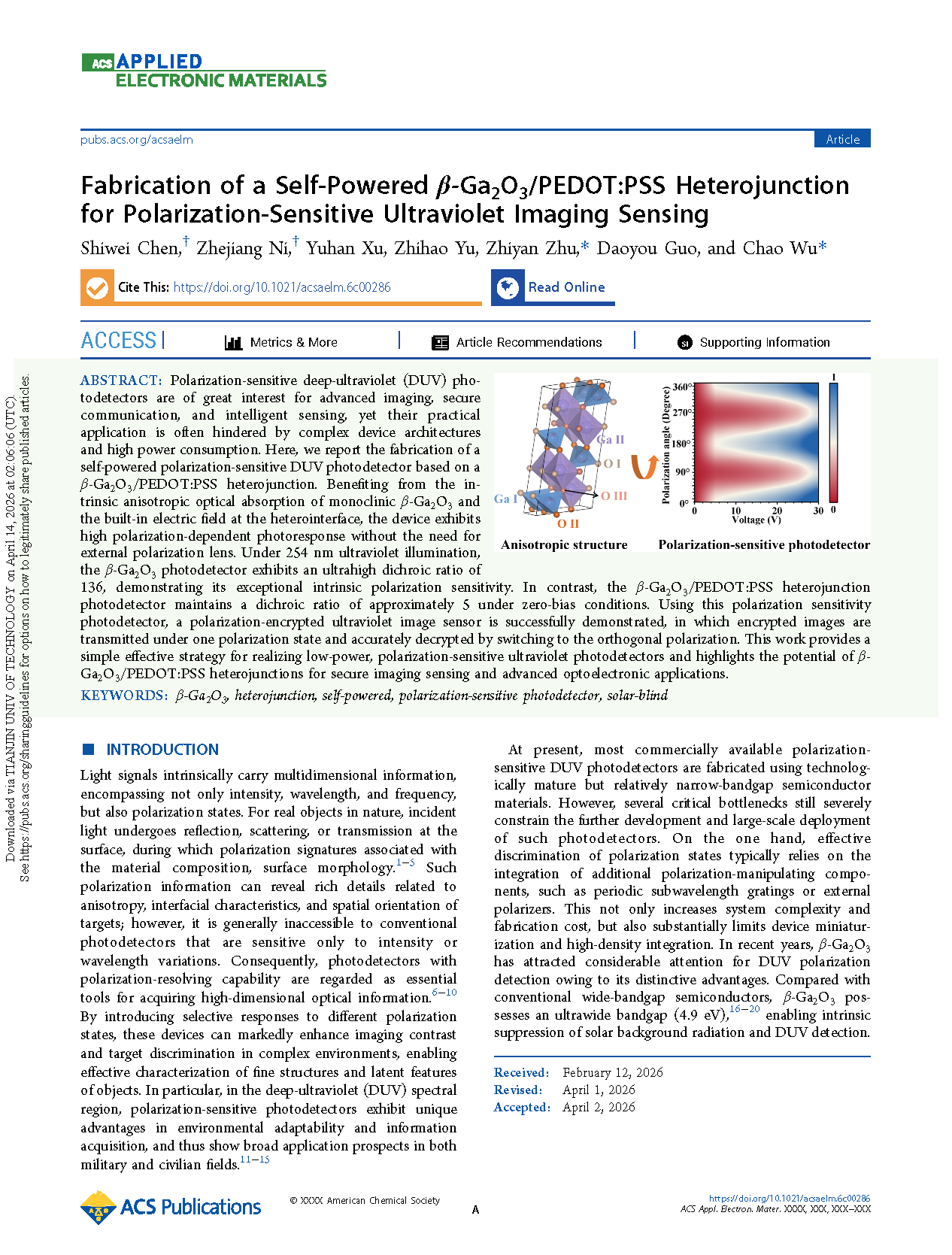
Figure 1. (a) XRD pattern of the β‑Ga₂O₃ single crystal. (b) Schematic illustration of the monoclinic crystal structure of β‑Ga₂O₃. (c) Atomic arrangement of the (100) plane β‑Ga₂O₃. (d) ARPRS spectra of the β‑Ga₂O₃ single crystal. (e) Mapping image of the angle-resolved polarized Raman intensity. (f) Polarization-dependent absorption spectra of the β‑Ga₂O₃ single crystal under linearly polarized light. (g–i) SEM image of the β‑Ga₂O₃/PEDOT:PSS heterojunction and the corresponding EDS elemental mappings of Ga and S.
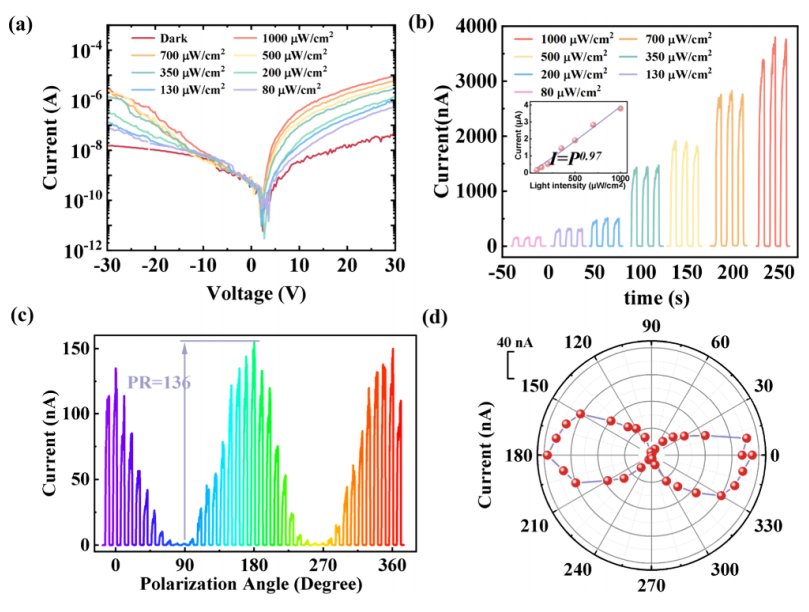
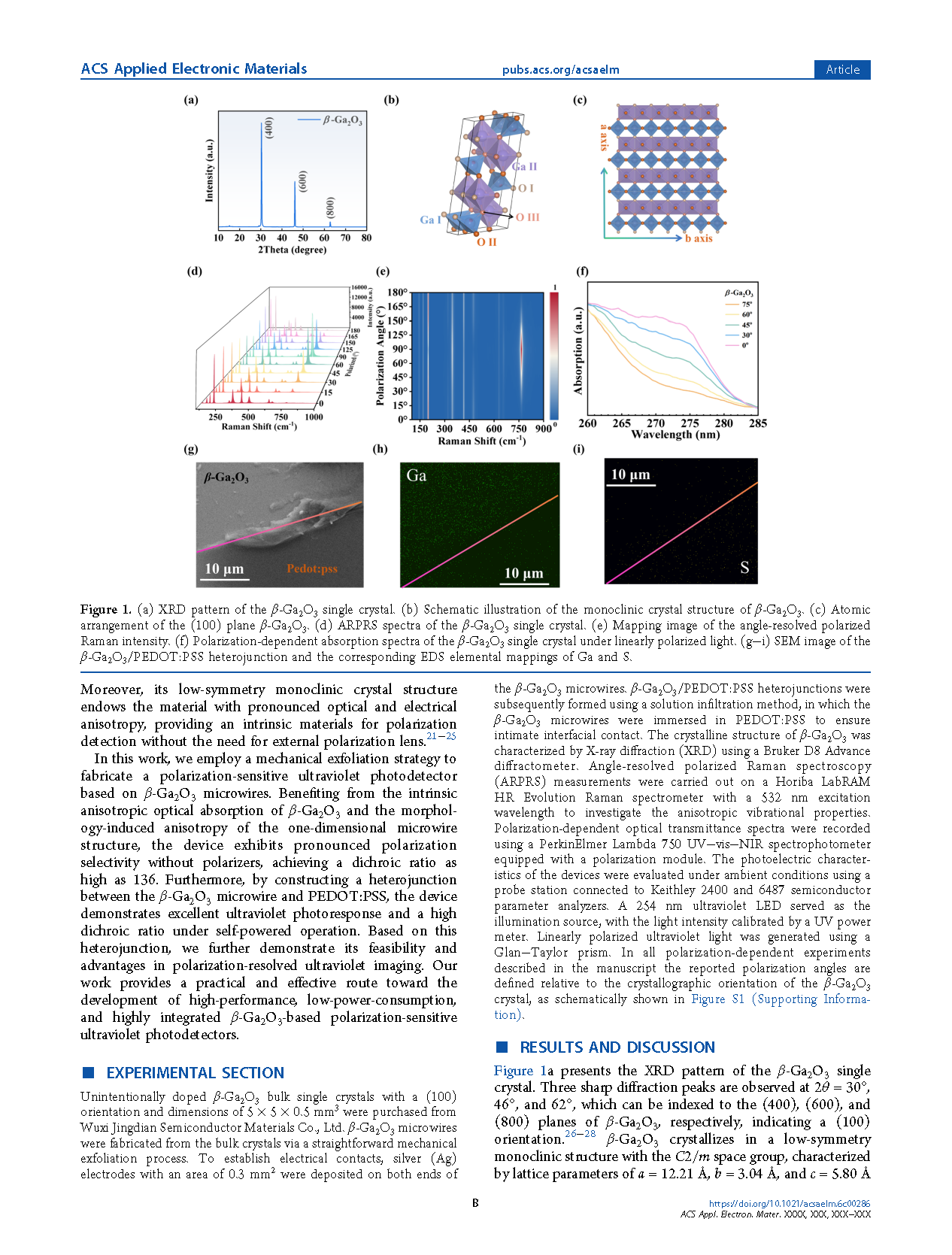
Figure 2. (a) I–V characteristics of the β‑Ga₂O₃ microwire photodetector measured under 254 nm ultraviolet illumination with different light intensities. (b) I–t curves of the β‑Ga₂O₃ microwire photodetector under various incident light intensities. (c) I–t curves of the β‑Ga₂O₃ microwire photodetector recorded under linearly polarized ultraviolet illumination with different polarization angles. (d) Polar plot of the photocurrent as a function of polarization angle.
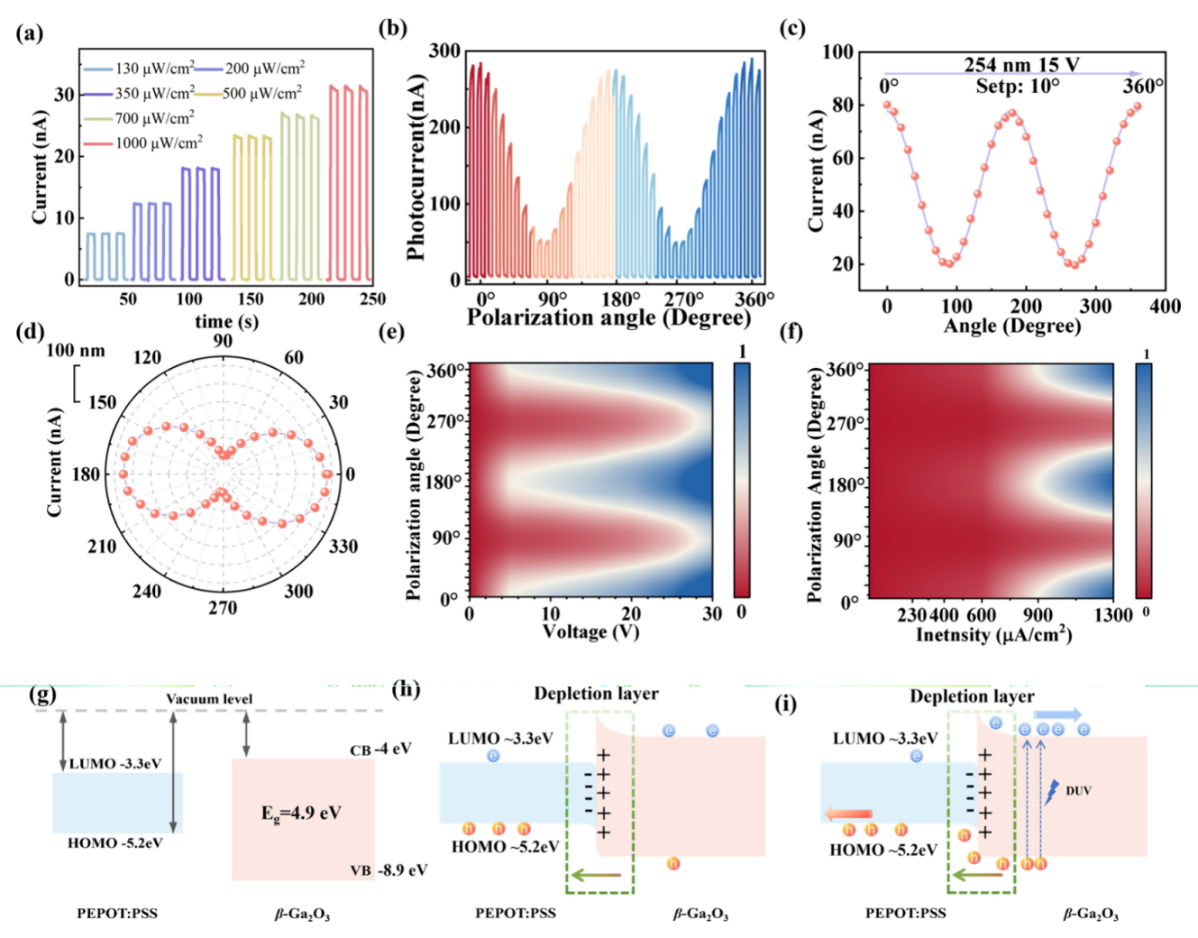
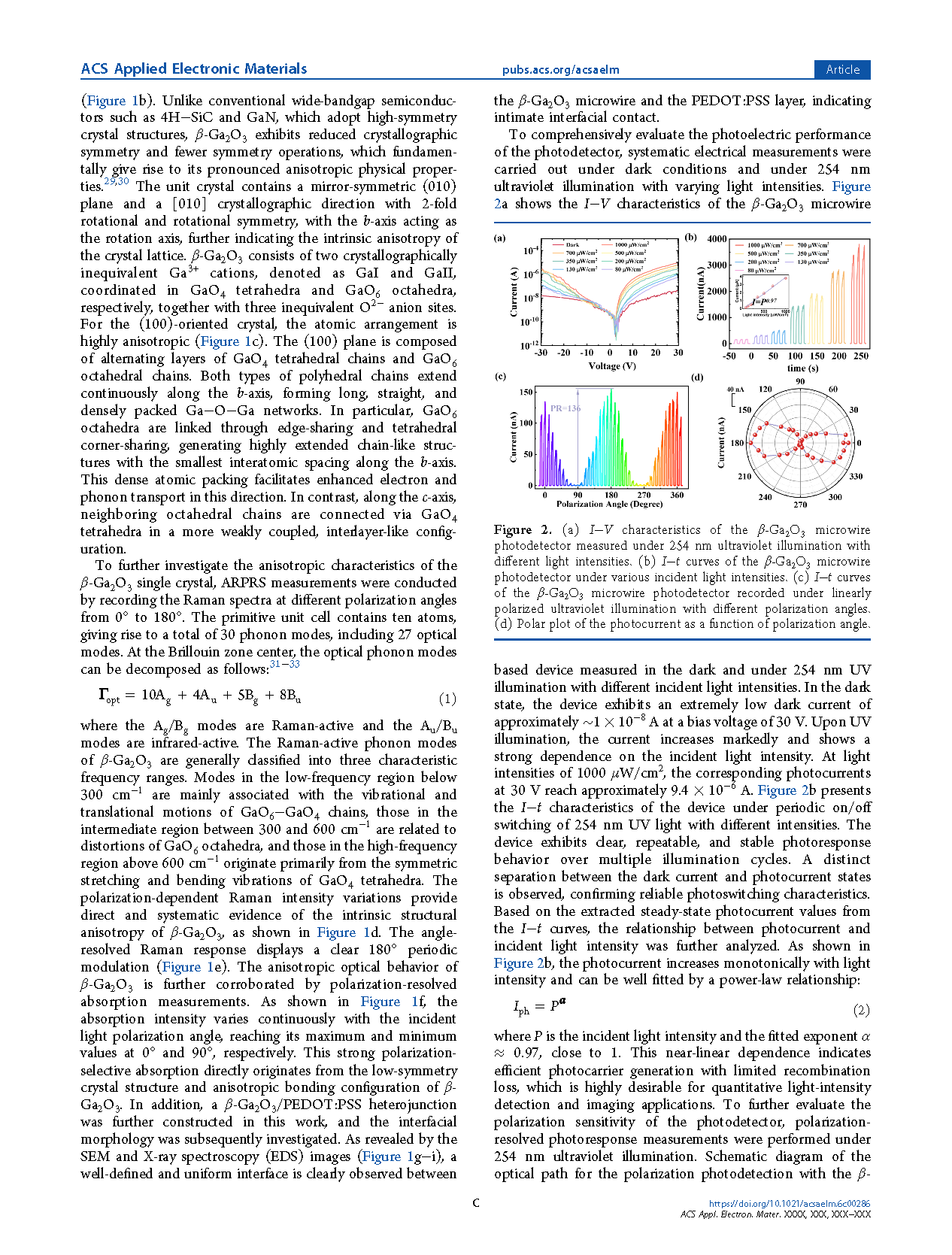
Figure 3. (a) I–t curves of the β‑Ga₂O₃/PEDOT:PSS heterojunction photodetector measured at 0 V under 254 nm ultraviolet illumination with different light intensities. (b) I–t curves recorded under linearly polarized ultraviolet illumination at 0 V. (c) Polar-angle-dependent photocurrent extracted from the polarization-resolved measurements. (d) Polar plot of the photocurrent as a function of polarization angle. (e) Mapping of the photocurrent at different bias voltages. (f) Photocurrent spatial mapping of the device under different illumination conditions. (g–i) Schematic energy band diagrams of the β‑Ga₂O₃/PEDOT:PSS heterojunction before contact, under dark conditions and illumination.
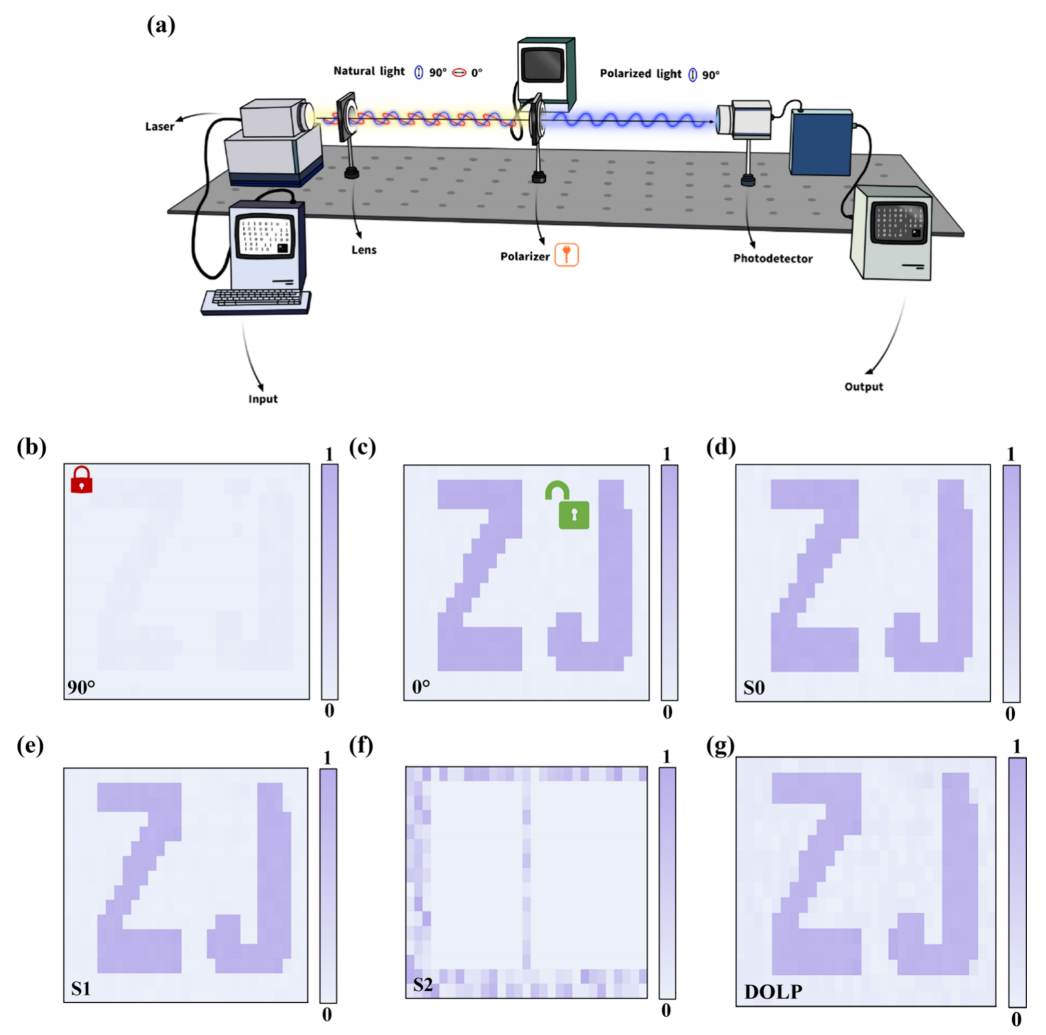
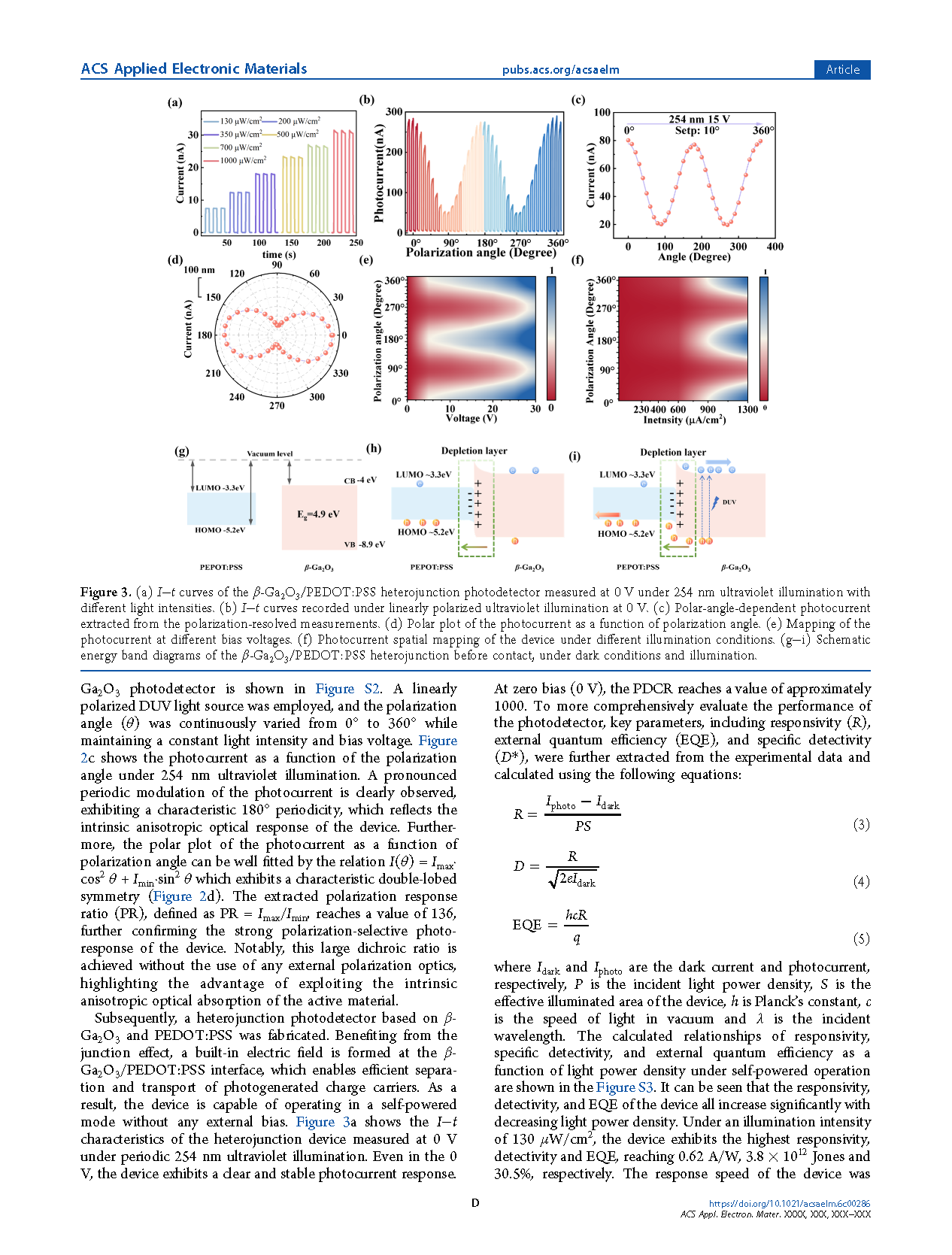
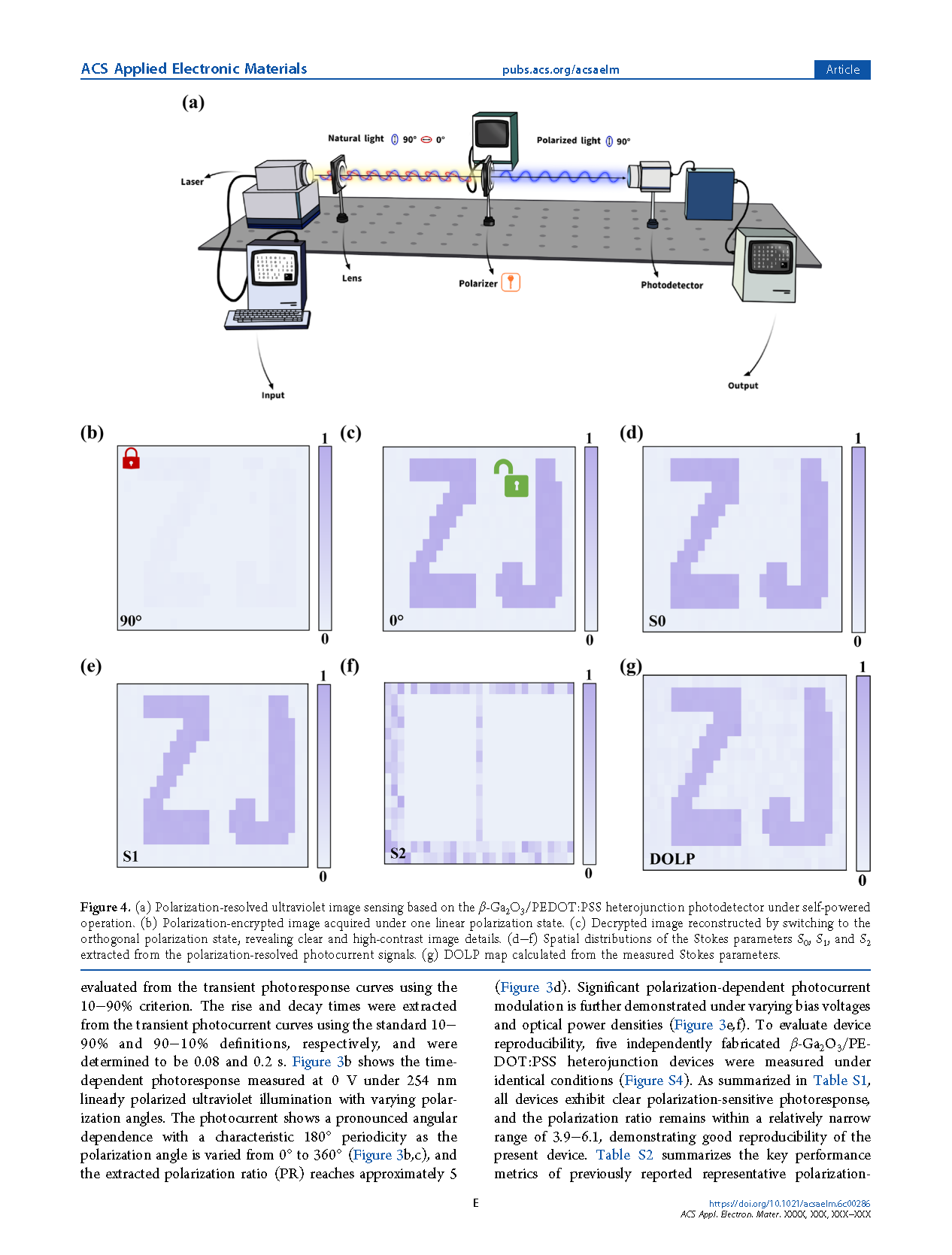
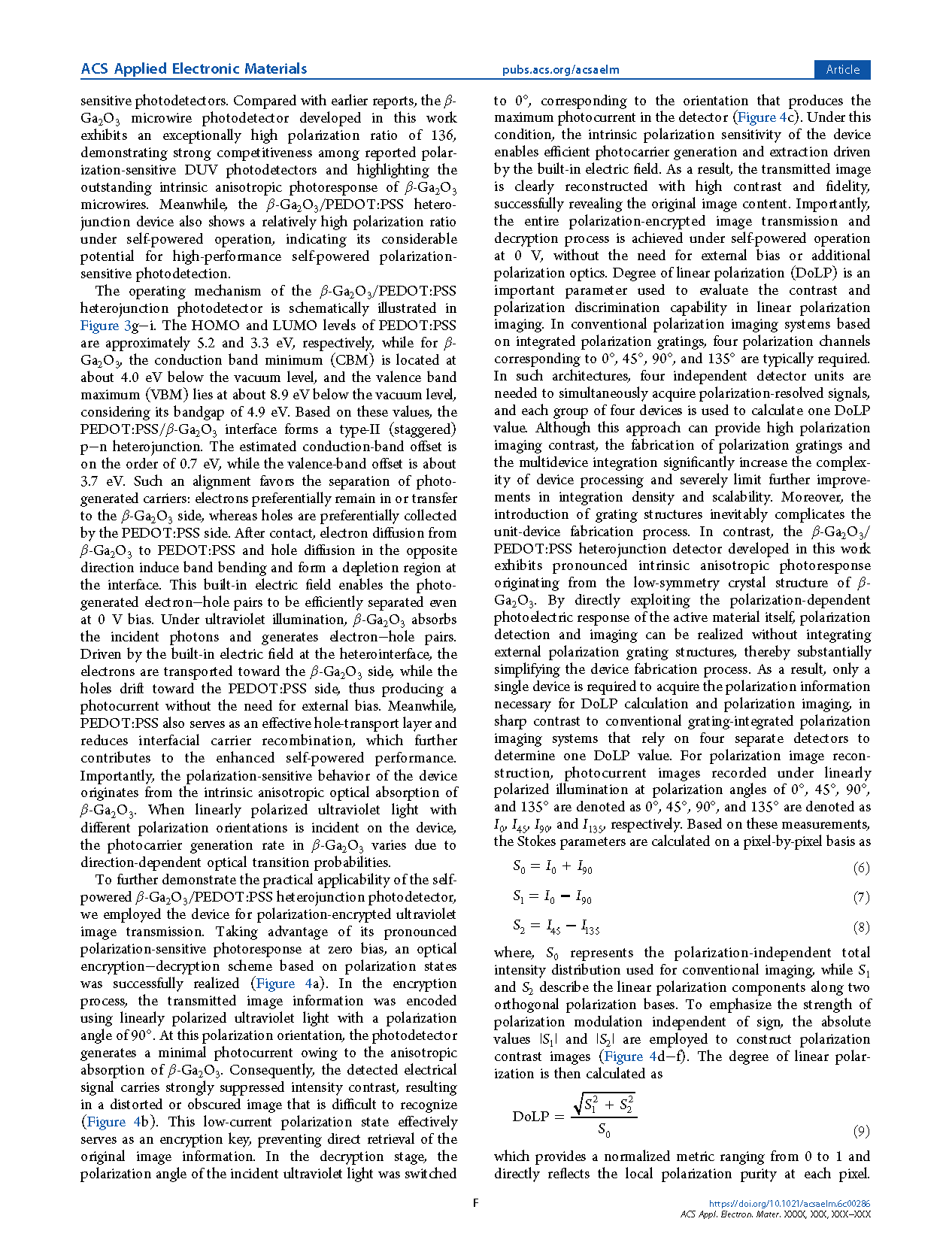
Figure 4. (a) Polarization-resolved ultraviolet image sensing based on the β‑Ga₂O₃/PEDOT:PSS heterojunction photodetector under self-powered operation. (b) Polarization-encrypted image acquired under one linear polarization state. (c) Decrypted image reconstructed by switching to the orthogonal polarization state, revealing clear and high-contrast image details. (d–f) Spatial distributions of the Stokes parameters S₀, S₁, and S₂ extracted from the polarization-resolved photocurrent signals. (g) DOLP map calculated from the measured Stokes parameters.
DOI:
doi.org/10.1021/acsaelm.6c00286

Instruction
Official Account

Cooperation
Top