


Researchers from the research group led by Professor Weihua Tang and Professor Yufeng Guo at Nanjing University of Posts and Telecommunications have published a dissertation titled “Demonstration of Ga₂O₃ Lateral MOSFET With Integrated Freewheeling Diode for Low-Loss Reverse Conduction “in IEEE TRANSACTIONS ON ELECTRON DEVICES.
Background
The ultra-wide bandgap semiconductor gallium oxide (Ga₂O₃) is a promising candidate for next-generation high-voltage power electronics owing to its wide bandgap (~4.8 eV), high critical electric field (~8 MV/cm), and excellent figures of merit. However, conventional Ga₂O₃ lateral MOSFETs suffer from high reverse turn-on voltage and large reverse conduction loss due to the lack of a body diode caused by the difficulty in p-type doping, which limits practical applications. Most previous studies on integrated freewheeling diodes were based on simulations, with few experimental demonstrations.
Abstract
The ultra wide bandgap semiconductor gallium oxide (Ga₂O₃) has emerged as a promising platform for next-generation high-voltage power electronics due to its wide bandgap (∼4.8 eV), high critical electric field (∼8 MV/cm), and favorable figures of merit. However, conventional Ga₂O₃ lateral metal-oxide-semiconductor field-effect transistors (MOSFETs) lack a body diode, resulting in a high reverse turn-on voltage and significant reverse conduction loss, which limits practical applications. In this work, we report the experimental realization of a Ga₂O₃ lateral MOSFET with an integrated freewheeling diode (IFD). The proposed structure enables low-voltage reverse conduction without compromising forward performance or breakdown characteristics. The IFD MOSFET demonstrates a marked reduction in reverse turn-on voltage (−0.89 V), representing a 90%–94% decrease compared with conventional devices. Forward transfer and output characteristics remain comparable. Breakdown measurements yield a voltage of 2.5 kV with a 20-μm drift region. These results demonstrate the feasibility of integrating freewheeling diodes in Ga₂O₃ MOSFETs, providing a practical pathway to low-loss and high-voltage power switching devices.
Highlights
First experimental demonstration of Ga₂O₃ lateral MOSFET with integrated freewheeling diode (IFD), solving the core problem of lacking body diode in conventional devices.
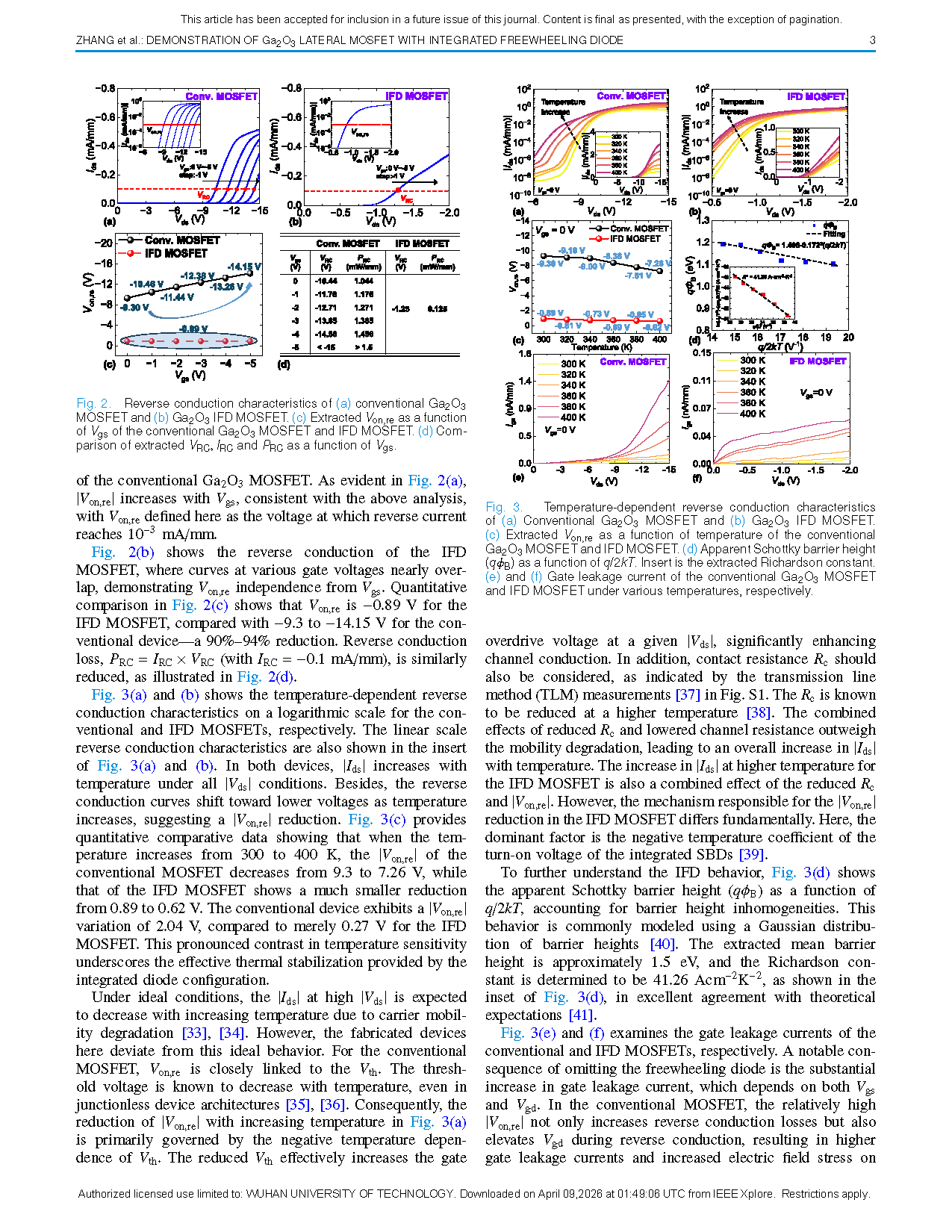
Reverse turn-on voltage reduced to -0.89 V, 90%–94% lower than conventional devices, greatly cutting reverse conduction loss.
Integrated diode does not degrade forward conduction performance; threshold voltage and switching behavior are almost identical to conventional MOSFETs.
Common drift region design ensures simultaneous breakdown of MOSFET and diode, with 2.5 kV breakdown voltage at 20 μm drift region length.
Excellent thermal stability, significantly reduced gate leakage current, and greatly improved device reliability.
Conclusion
In summary, this work presents the experimental demonstration of a Ga₂O₃ lateral MOSFET with an IFD, addressing the high reverse conduction voltage inherent to conventional junctionless Ga₂O₃ devices. The IFD MOSFET exhibits a 90%–94% reduction in reverse turn-on voltage. Forward conduction characteristics remain nearly identical to conventional MOSFETs, confirming that the integration of the diode does not degrade channel performance. Breakdown measurements indicate that the common drift region design successfully ensures simultaneous breakdown of the MOSFET and diode, achieving 2.5 kV for a 20 μm drift length. Temperature-dependent studies and TCAD-based double-pulse simulations demonstrate that the IFD structure maintains stable reverse recovery behavior with minimal sensitivity to temperature. Overall, the proposed IFD architecture provides a practical solution for low-loss reverse conduction in Ga₂O₃ lateral MOSFETs, offering a promising pathway toward high-voltage, high-efficiency power electronic devices.
Project Support
This work was supported by the National Natural Science Foundation of China under Grant 62304113, Grant 62204126, Grant 62334003, and Grant U23B2042.
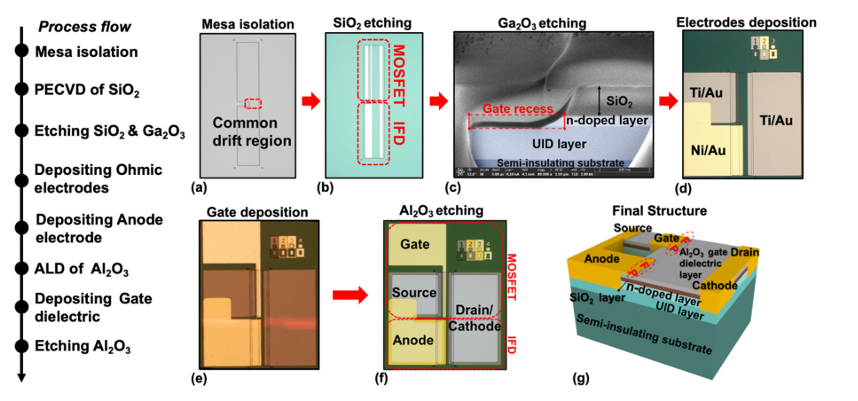
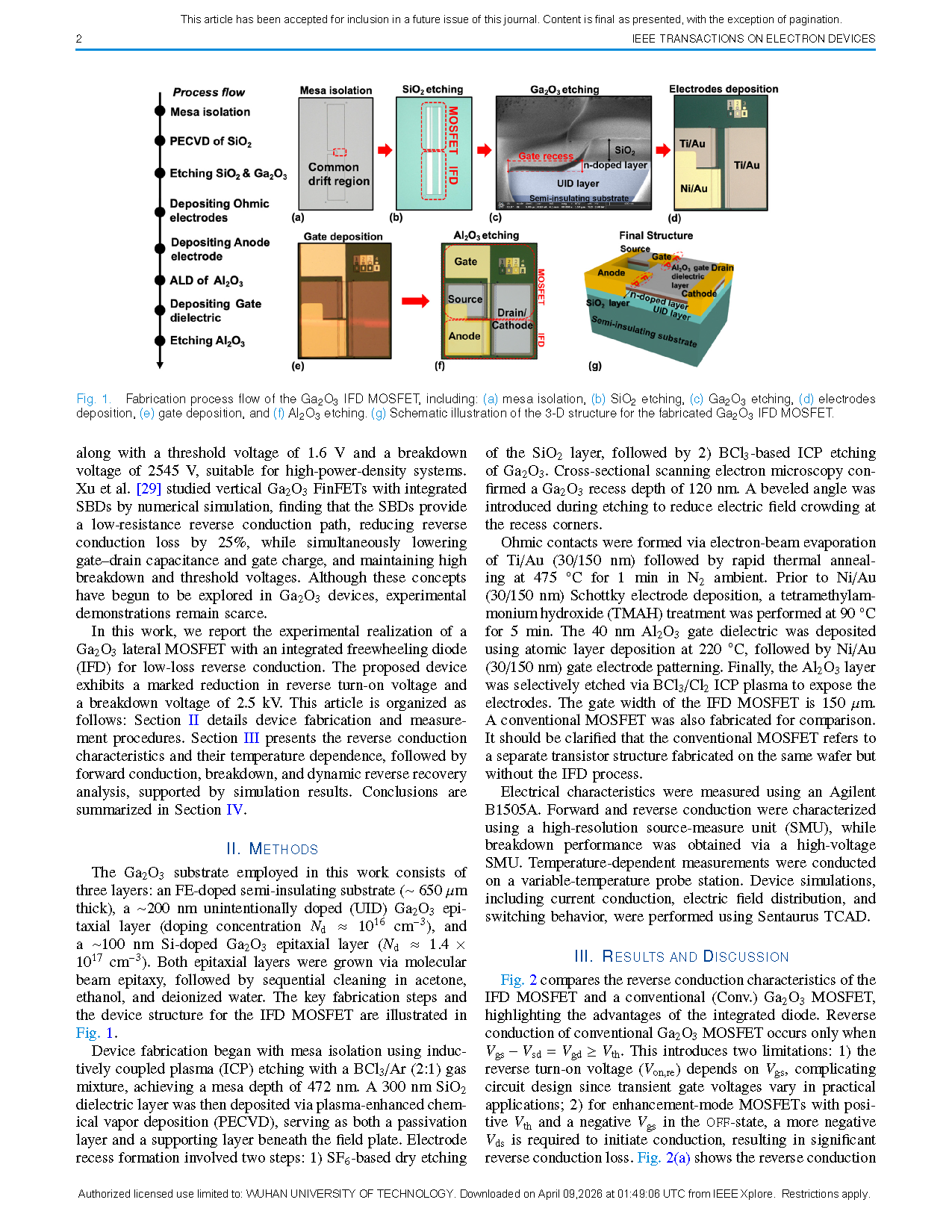
Figure 1 Fabrication process flow of the Ga₂O₃ IFD MOSFET, including: (a) mesa isolation, (b) SiO₂ etching, (c) Ga₂O₃ etching, (d) electrodes deposition, (e) gate deposition, and (f) Al₂O₃ etching. (g) Schematic illustration of the 3-D structure for the fabricated Ga₂O₃ IFD MOSFET.
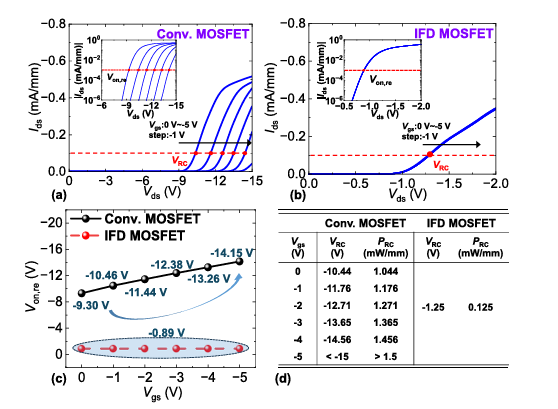
Figure 2 Reverse conduction characteristics of (a) conventional MOSFET and (b) IFD MOSFET. (c) Extracted as a function of of the conventional MOSFET and IFD MOSFET. (d) Comparison of extracted VRC, IRC and PRC as a function of Vgs.
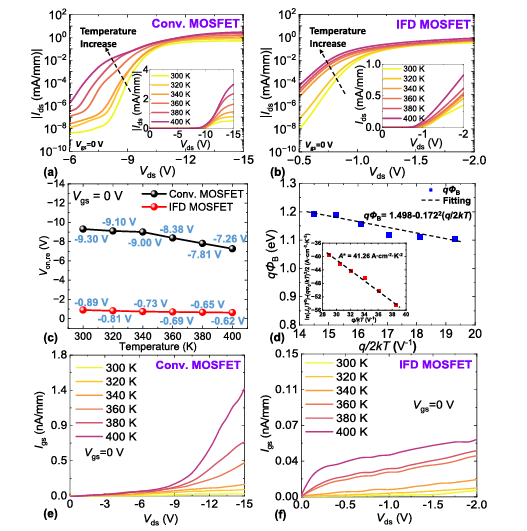
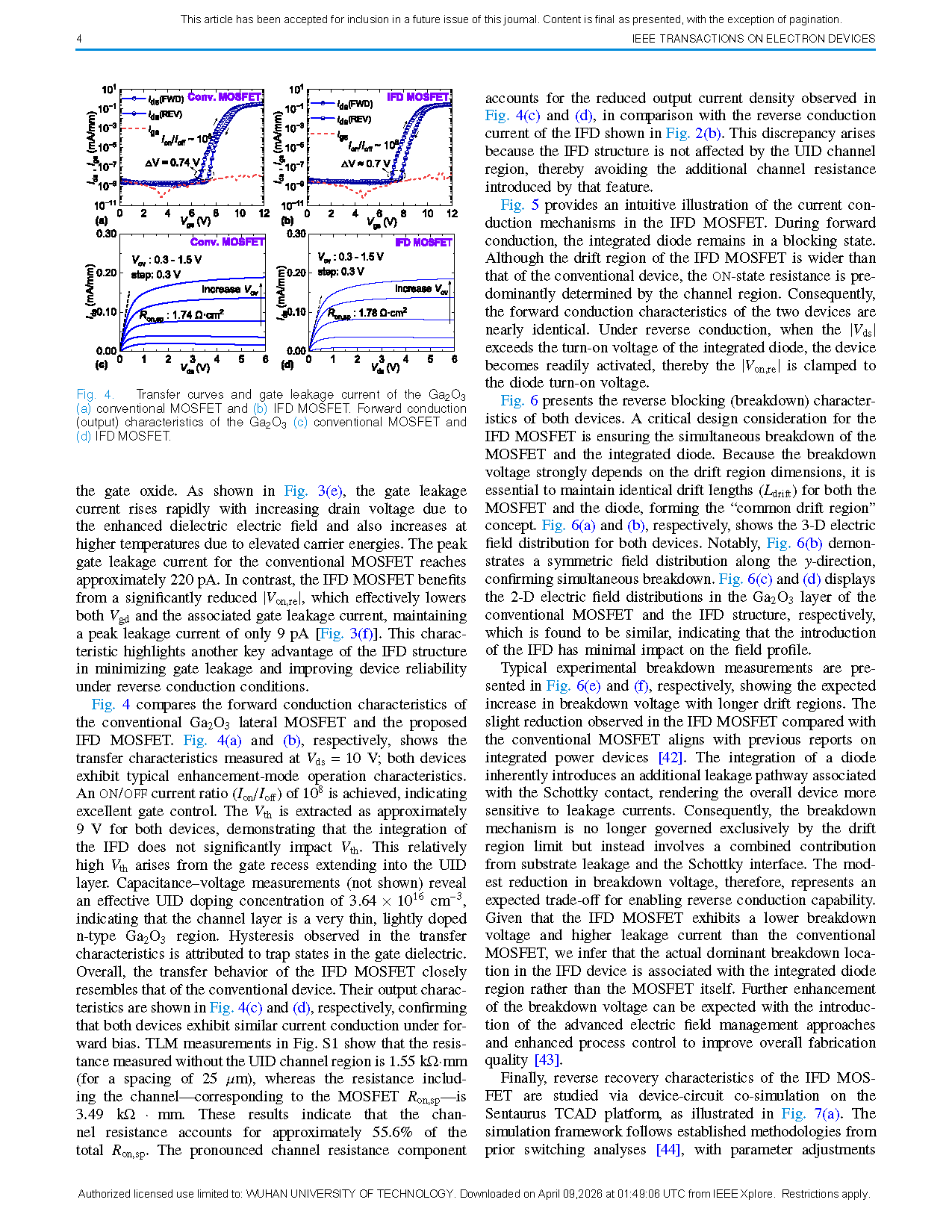
Figure 3 Temperature-dependent reverse conduction characteristics of (a) Conventional Ga₂O₃ MOSFET and (b) Ga₂O₃ IFD MOSFET. Extracted Vₒₙ,ᵣₑ as a function of temperature of the conventional (c) Ga₂O₃ MOSFET and IFD MOSFET. (d) Apparent Schottky barrier height (qϕB) as a function of q/2kT. Insert is the extracted Richardson constant. (e) and (f) Gate leakage current of the conventional Ga₂O₃ MOSFET and IFD MOSFET under various temperatures, respectively.
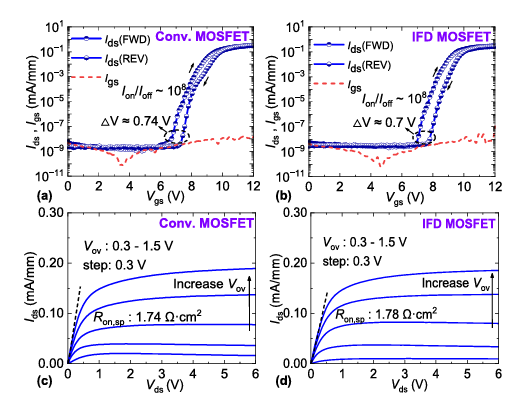
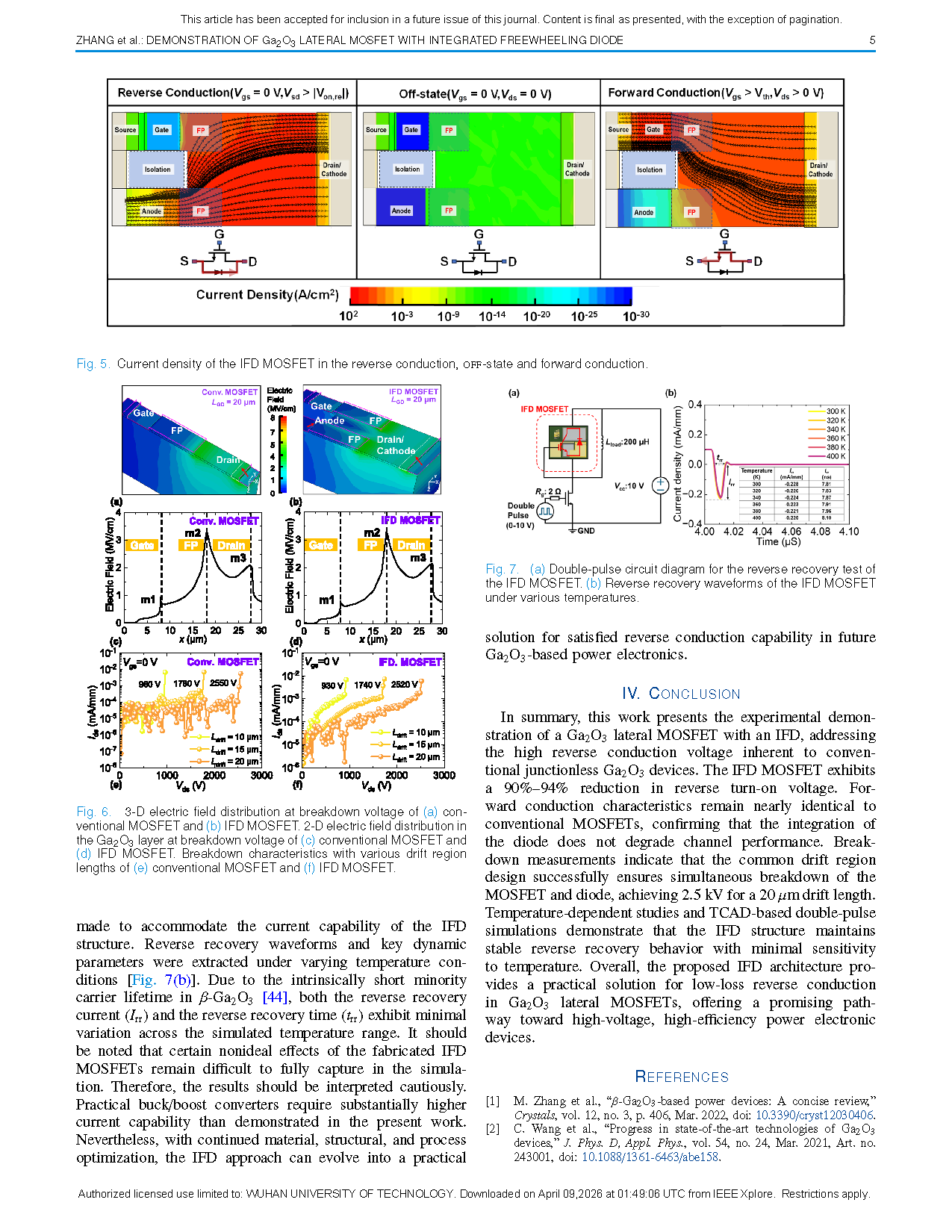
Figure 4 Transfer curves and gate leakage current of the Ga₂O₃ (a) conventional MOSFET and (b) IFD MOSFET. Forward conduction (output) characteristics of the Ga₂O₃ (c) conventional MOSFET and (d) IFD MOSFET.
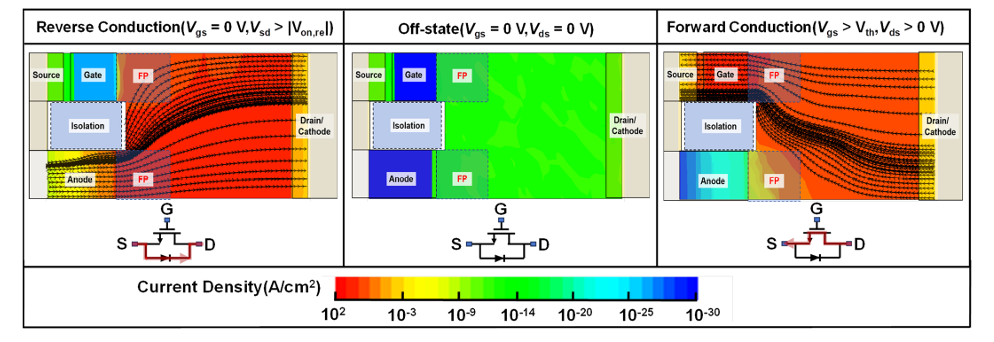
Figure 5 Current density of the IFD MOSFET in the reverse conduction, OFF-state and forward conduction.
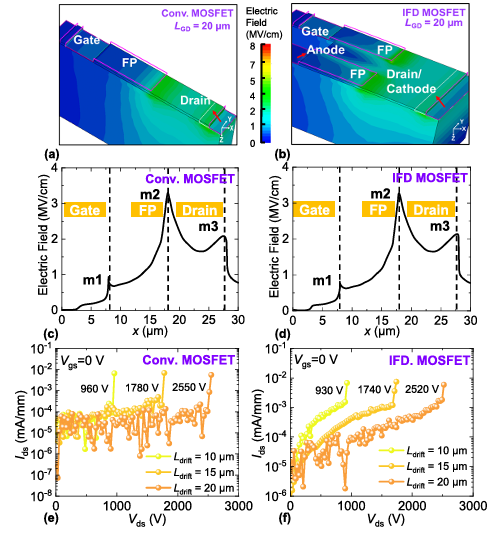
Figure 6 3-D electric field distribution at breakdown voltage of (a) conventional MOSFET and (b) IFD MOSFET. 2-D electric field distribution in the Ga₂O₃ layer at breakdown voltage of (c) conventional MOSFET and (d) IFD MOSFET. Breakdown characteristics with various drift region lengths of (e) conventional MOSFET and (f) IFD MOSFET.
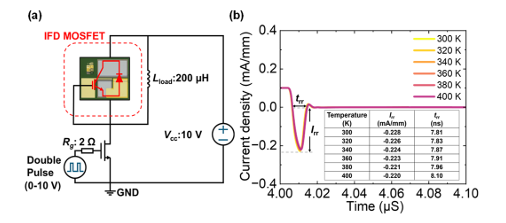
Figure 7 (a) Double-pulse circuit diagram for the reverse recovery test of the IFD MOSFET. (b) Reverse recovery waveforms of the IFD MOSFET under various temperatures.
DOI:
10.1109/TED.2026.3679310
Instruction
Official Account

Cooperation
Top