


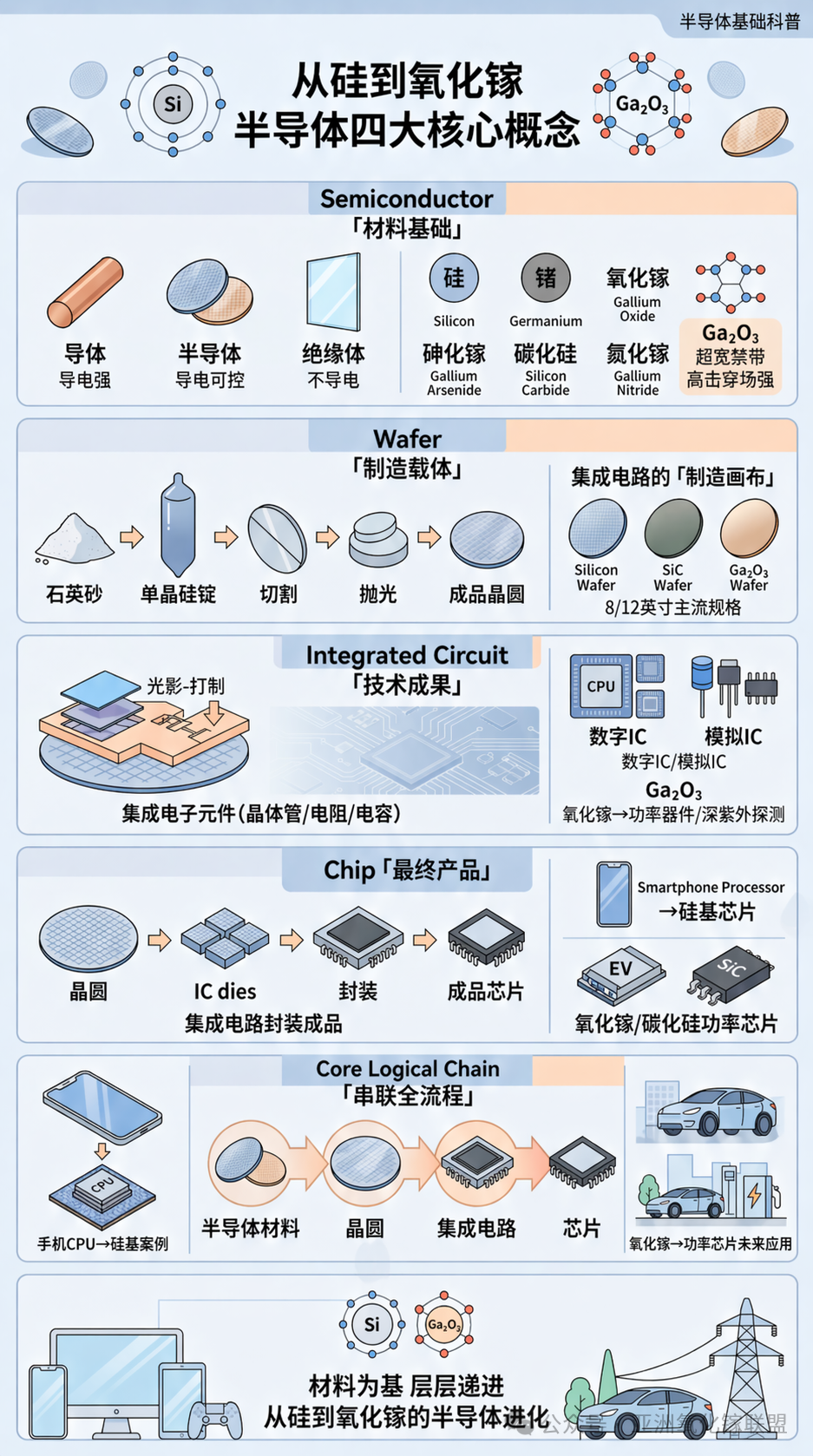
From silicon to gallium oxide, the evolution of semiconductors is essentially a materials-driven technological transition. Semiconductors are not a single point technology, but a complete system: upstream, material properties define the performance limits; midstream, wafer fabrication provides the engineering platform; downstream, integrated circuits enable complex functionalities, ultimately entering real-world applications in the form of chips.
At the materials level, the progression from traditional silicon and germanium to silicon carbide (SiC), gallium nitride (GaN), and now the increasingly prominent gallium oxide (Ga₂O₃) reflects a shift from “information processing optimization” toward “high-power and extreme-environment capability expansion.” Among these, Ga₂O₃, with its ultra-high breakdown electric field, is emerging as a key candidate for power devices and deep-ultraviolet detection.
On the manufacturing side, wafers serve as the critical bridge between materials and circuits. From quartz sand to single-crystal growth, followed by slicing and polishing, standardized wafers (such as 8-inch and 12-inch) form the foundational platform of the modern semiconductor industry.
What ultimately enables “intelligence” is the integrated circuit. Through processes such as photolithography, microscopic components—transistors, resistors, and capacitors—are densely integrated to form digital and analog ICs, completing the transformation from the physical world to information processing.
Finally, wafers are diced and packaged into chips, entering application scenarios such as smartphones, automobiles, and power systems: silicon underpins computing power, while silicon carbide and gallium oxide increasingly take on roles in power and energy applications.
In other words, this is not merely a substitution of materials, but a continuous expansion of capability boundaries—from “being able to compute” to “using energy more efficiently.”
Instruction
Official Account

Cooperation
Top