


Researchers from Wuhan Textile University, Huazhong University of Science & Technology, and China Special Equipment Inspection & Research Institute have published a dissertation titled “First-principles study on formation and action mechanism of intrinsic Ga and O vacancy in β‑Ga₂O₃” in Computational Materials Science.
Background
As an ultra-wide bandgap semiconductor, β‑Ga₂O₃ exhibits prominent properties including high breakdown voltage, deep-ultraviolet absorption capability and excellent Baliga figure of merit, showing great potential for next-generation high-power electronic devices, deep-ultraviolet detection and photocatalysis. However, intrinsic point defects such as gallium vacancy (VGa) and oxygen vacancy (VO) can act as deep-level centers, severely compensating carriers, reducing mobility and compromising material stability, which becomes a key factor limiting device performance. Most previous studies only focused on formation energy, density of states, or two-dimensional systems, lacking systematic investigation on formation energy, thermodynamic transition levels, charge distribution, band structure, phonon spectra and binding energy of VGa, VO and VGa‑VO complex defects in bulk β‑Ga₂O₃. Based on first-principles calculations, the team systematically revealed the formation mechanism, charge distribution, electronic structure effects and stability of intrinsic vacancy defects, providing a quantitative theoretical foundation for understanding and regulating defect properties of β‑Ga₂O₃.
Abstract
To gain an in-depth understanding of the formation and action mechanism of intrinsic vacancy defects in β‑Gallium Oxide (β‑Ga₂O₃), the first-principles methods are employed to systematically investigate gallium vacancy (VGa) and oxygen vacancy (VO) in β‑Ga₂O₃. By comparing the formation energies of β‑Ga₂O₃ with VGa and VO under different charge states and growth conditions, the most stable charge states and transition level properties of β‑Ga₂O₃ containing intrinsic vacancy defects are determined. The results reveal that VGa acts as deep acceptor defects and VO functions as deep donor defects. Additionally, the calculated vacancy complexes of VGa‑VO are all deep-level defects. Charge analysis further elucidates the charge redistribution during vacancy formation, showing that charge diffuses outward from the vacancy centers. Bader charge analysis indicates that Ga atoms in β‑Ga₂O₃ with intrinsic vacancy defects all lose electrons, while O atoms all gain electrons, with specific charge change values provided. Band structure calculations demonstrate that the introduction of VGa, VO and VGa‑VO induces the movement of the whole band towards lower energies with the emergence of impurity levels within the bandgap. Finally, stability analysis based on phonon spectra and binding energy calculations shows no dynamical stability for VGa, VO and VGa‑VO in β‑Ga₂O₃. This study provides a detailed quantitative description on formation and action mechanism of intrinsic vacancy defects in β‑Ga₂O₃, offering a solid foundation for understanding and regulating the defect properties of β‑Ga₂O₃.
Highlights
Systematically reveal the formation energies and thermodynamic transition levels of VGa1, VGa2, VO1~VO3 and various VGa‑VO complex defects in β‑Ga₂O₃
Confirm that all intrinsic vacancies are deep-level defects, and clarify the defect properties of VGa as deep acceptor and VO as deep donor
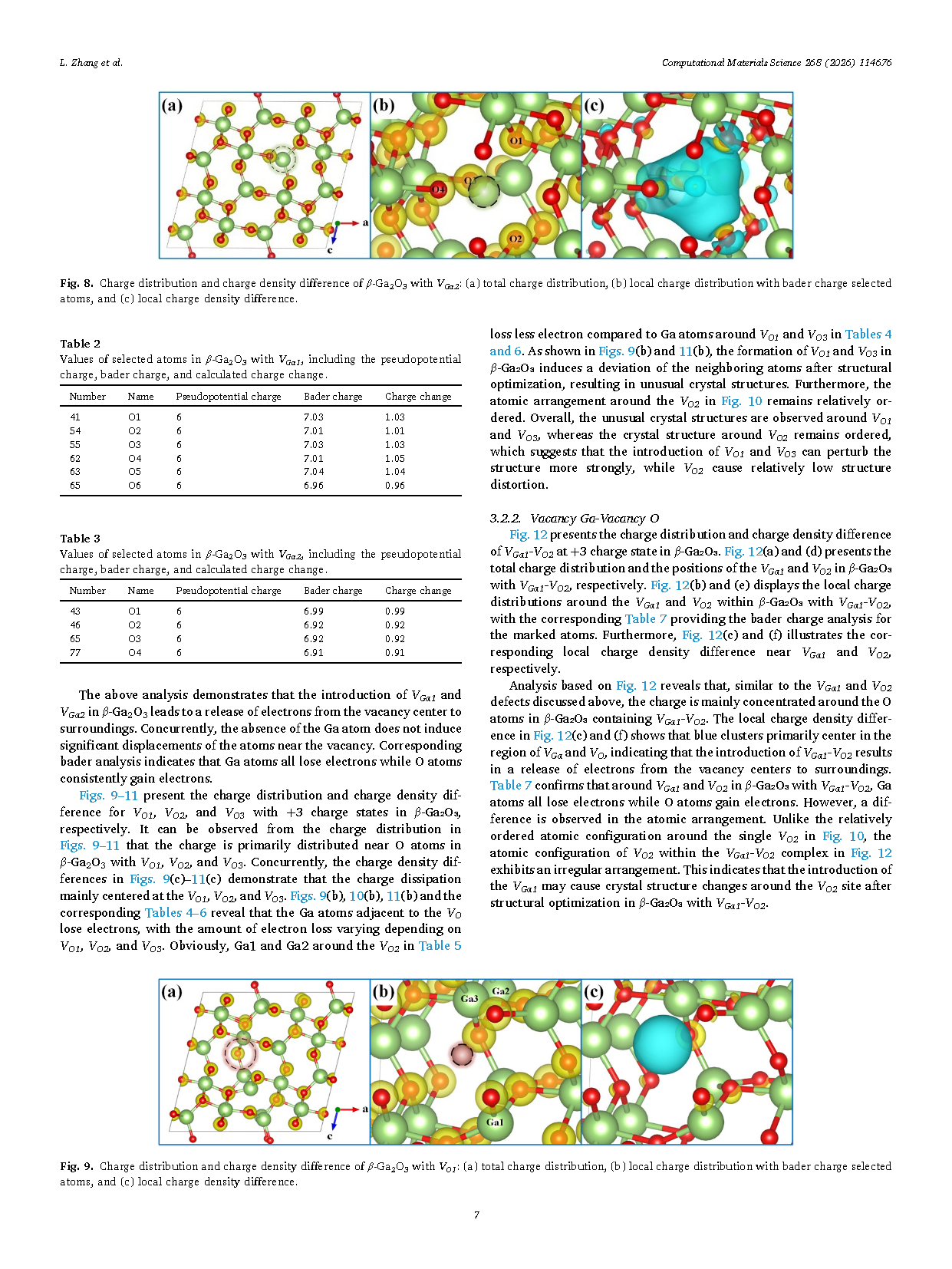
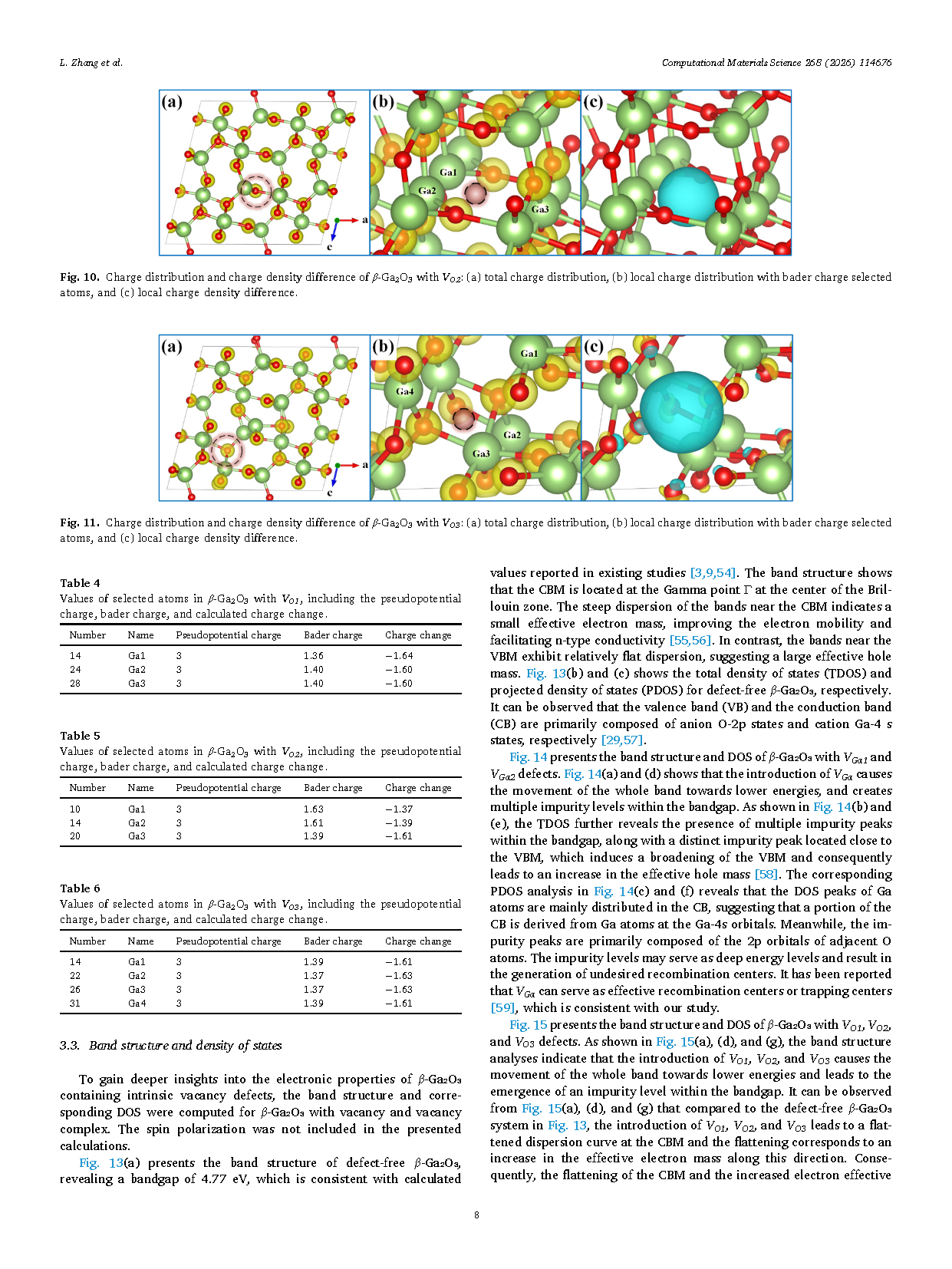
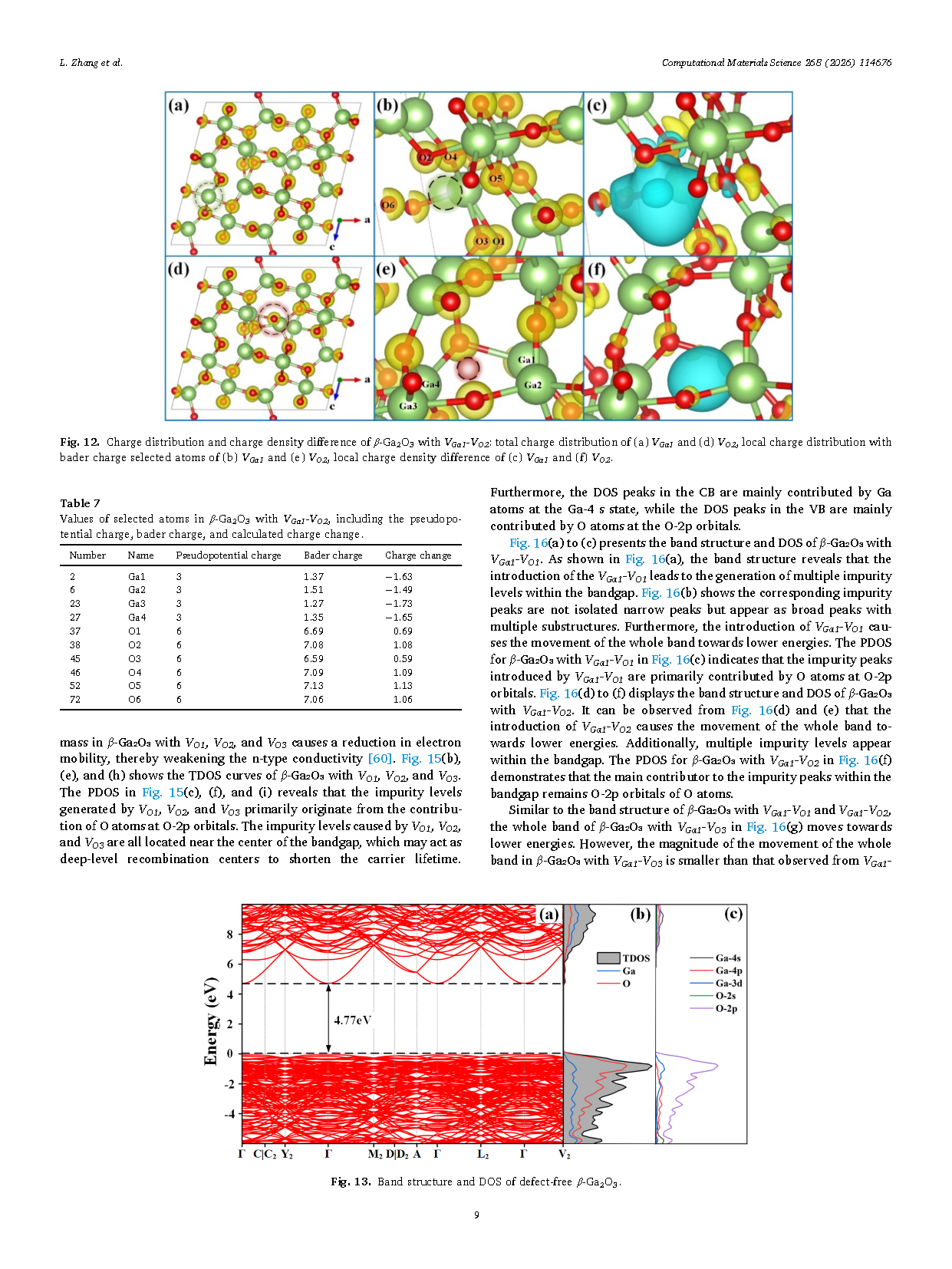
Quantitatively clarify the charge redistribution induced by vacancy formation: Ga loses electrons, O gains electrons, and charges diffuse outward from vacancy centers
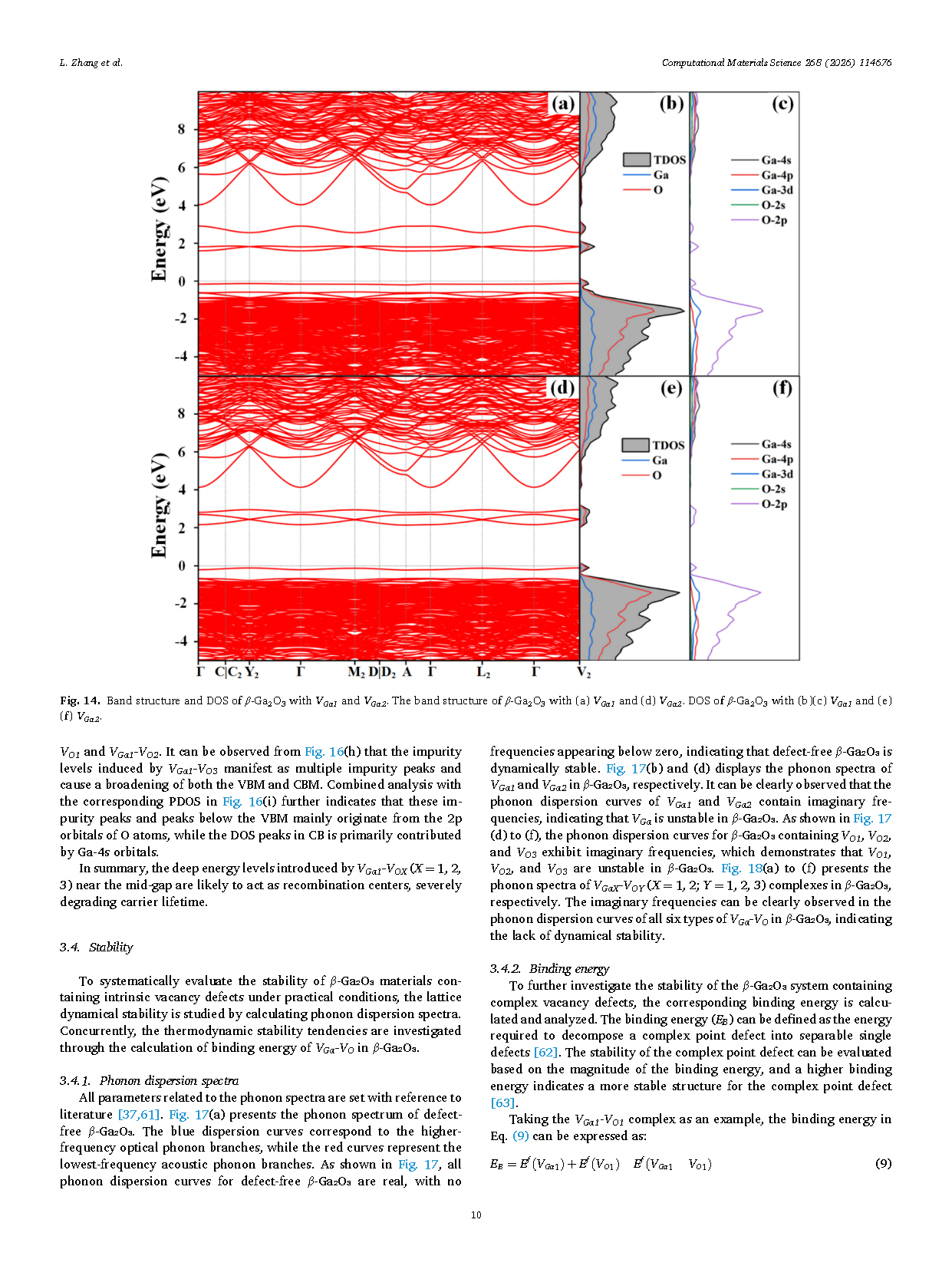
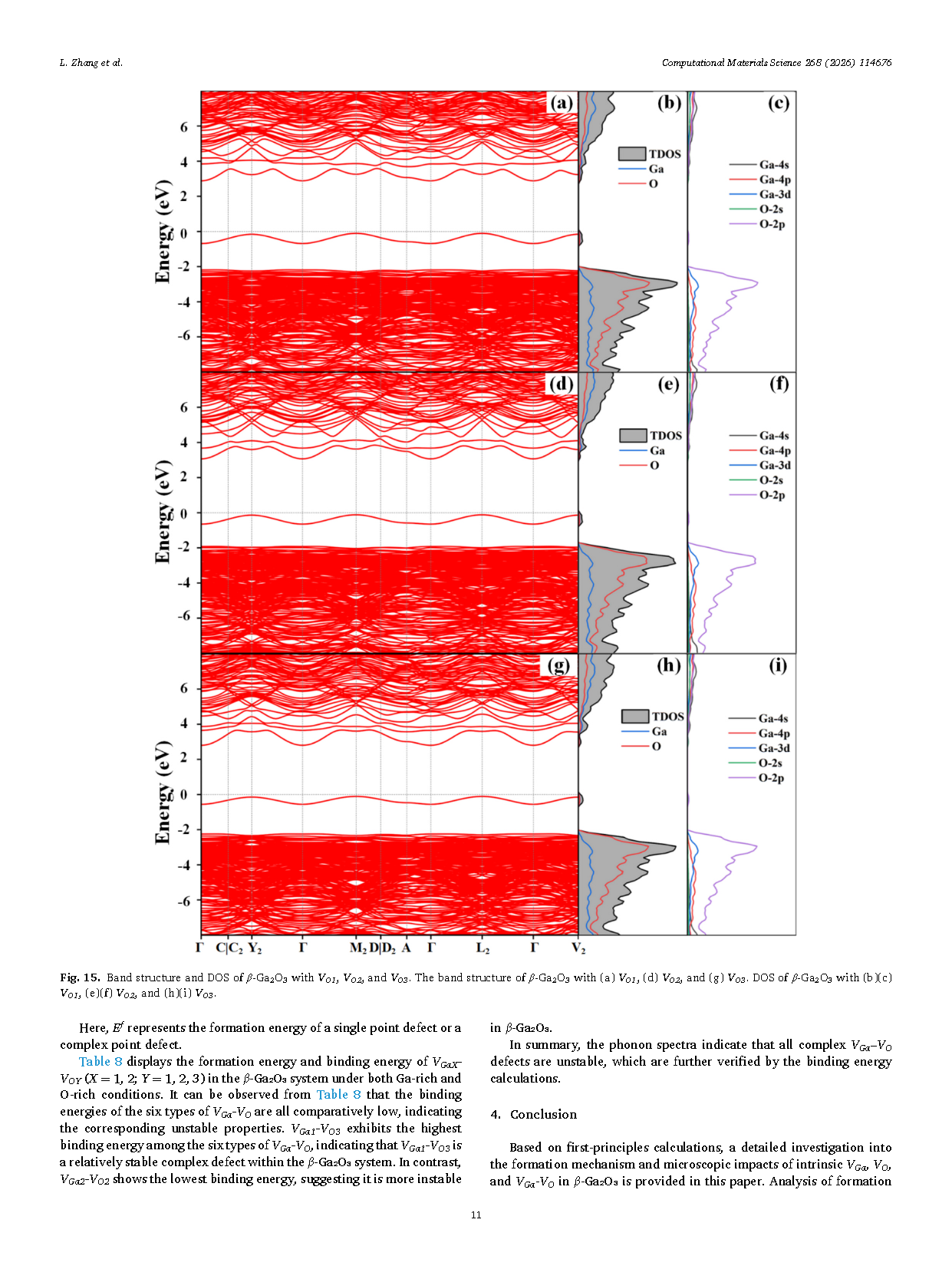
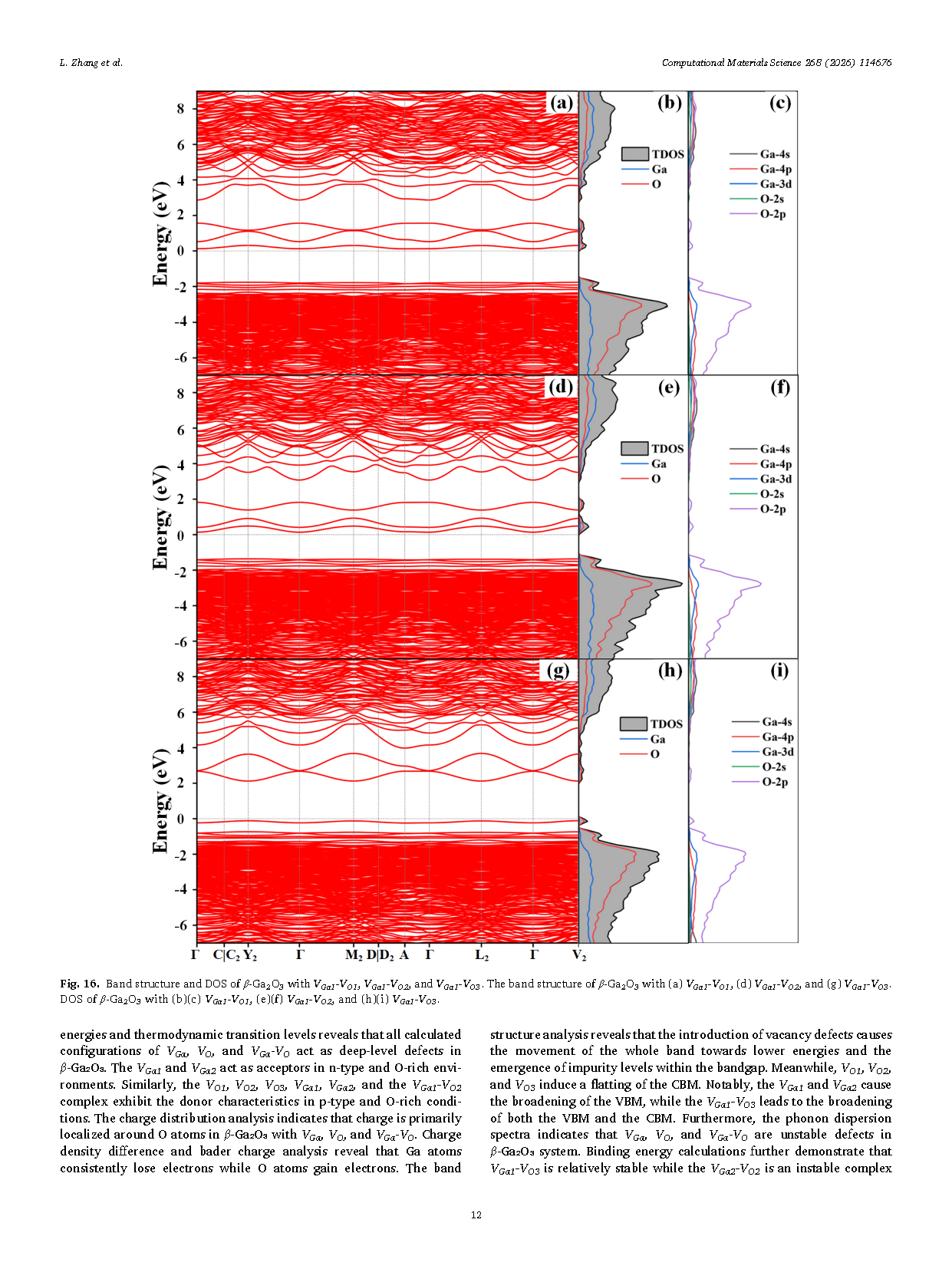
Reveal that vacancy defects cause the overall downward shift of energy bands, appearance of impurity levels in the bandgap, and change the dispersion characteristics of CBM/VBM
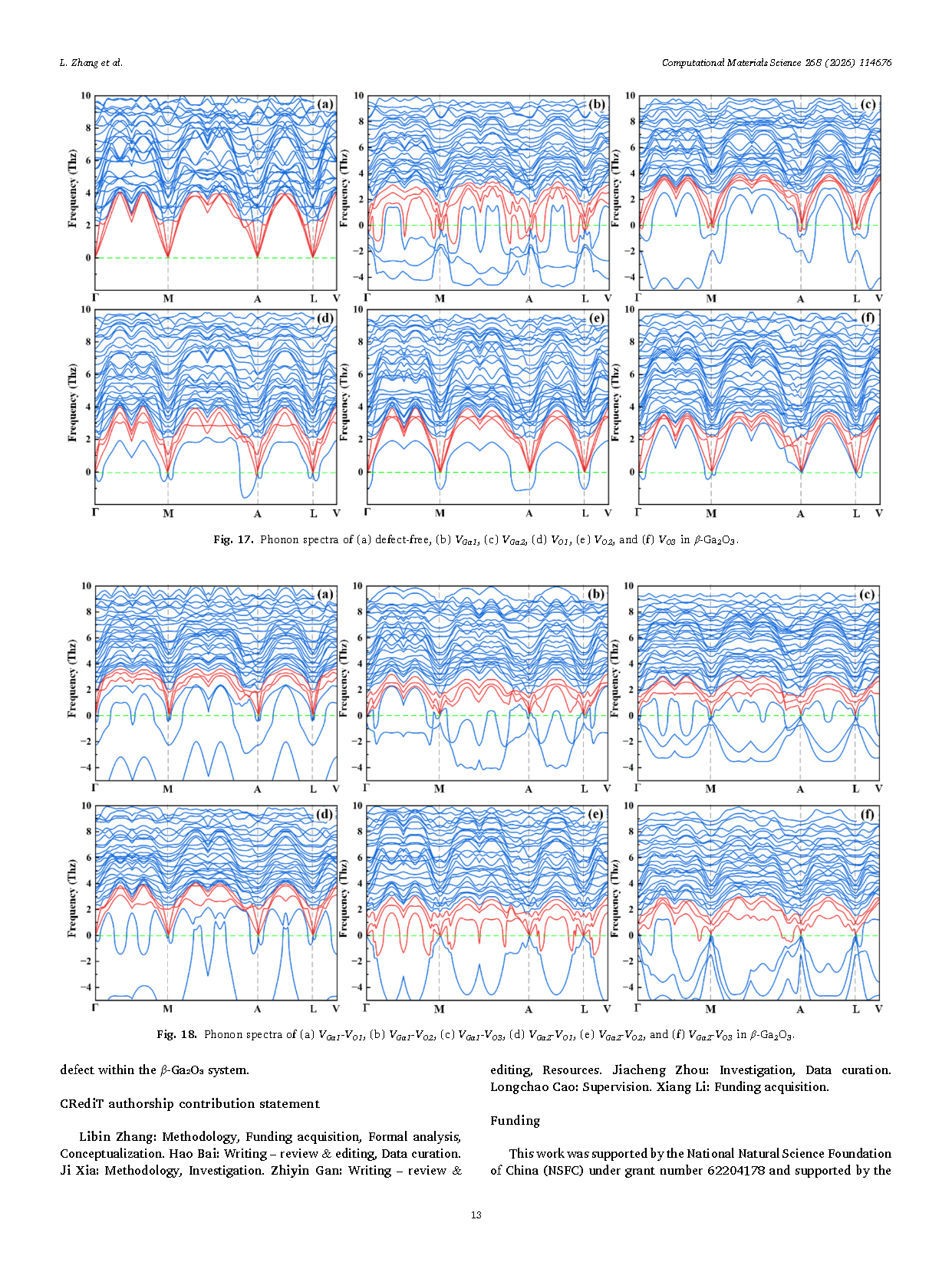
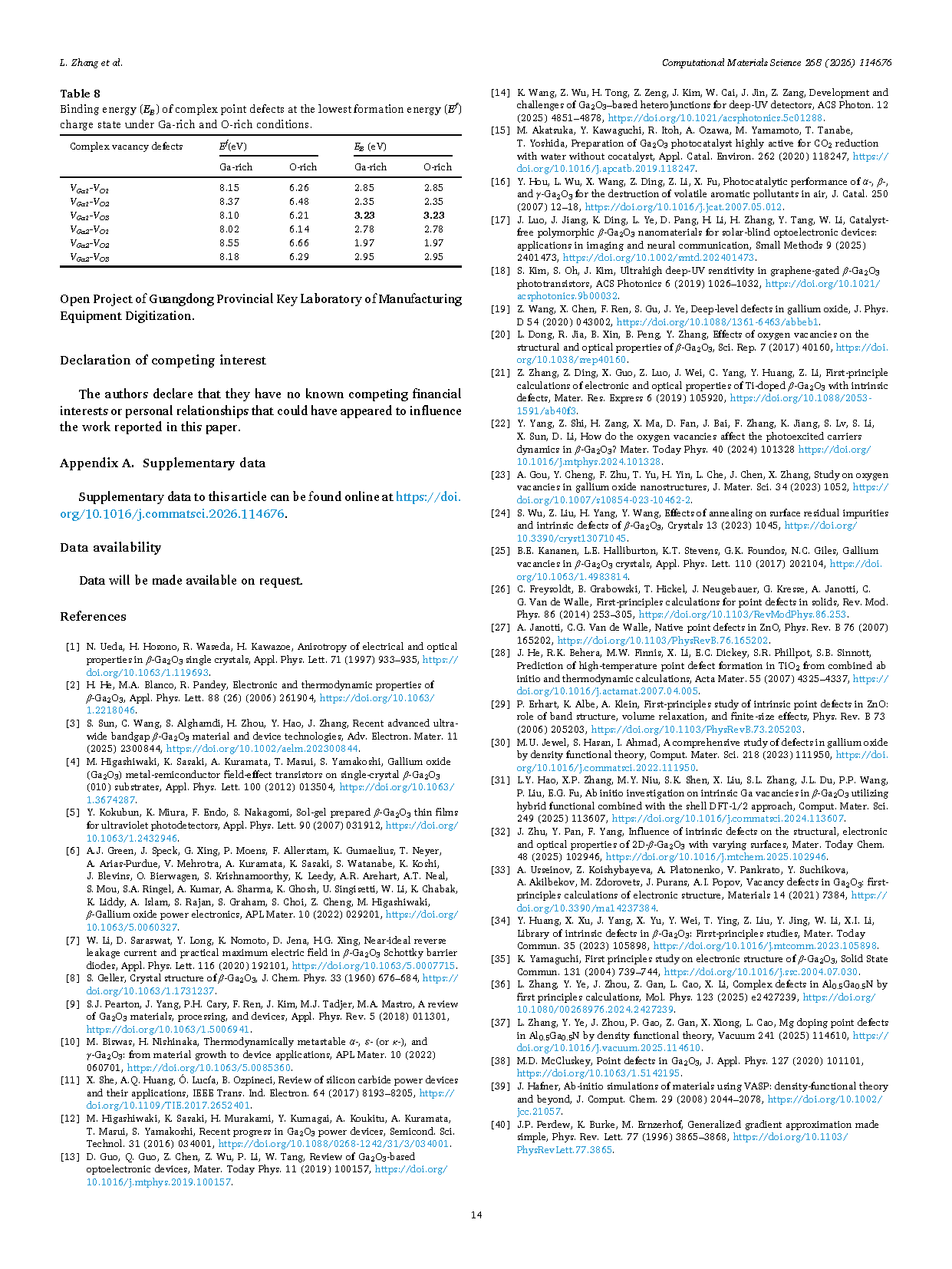
Prove for the first time that VGa, VO and VGa‑VO are all dynamically unstable by combining phonon spectra and binding energy, and clarify the relative stability of complex defects
Conclusion
Based on first-principles calculations, a detailed investigation into the formation mechanism and microscopic impacts of intrinsic VGa, VO and VGa‑VO in β‑Ga₂O₃ is provided in this paper. Analysis of formation energies and thermodynamic transition levels reveals that all calculated configurations of VGa, VO and VGa‑VO act as deep-level defects in β‑Ga₂O₃. The VGa1 and VGa2 act as acceptors in n-type and O-rich environments. Similarly, the VO1, VO2, VO3, VGa1, VGa2 and the VGa1‑VO2 complex exhibit the donor characteristics in p-type and O-rich conditions. The charge distribution analysis indicates that charge is primarily localized around O atoms in β‑Ga₂O₃ with VGa, VO, and VGa‑VO. Charge density difference and bader charge analysis reveal that Ga atoms consistently lose electrons while O atoms gain electrons. The band structure analysis reveals that the introduction of vacancy defects causes the movement of the whole band towards lower energies and the emergence of impurity levels within the bandgap. Meanwhile, VO1, VO2 and VO3 induce a flatting of the CBM. Notably, the VGa1 and VGa2 cause the broadening of the VBM, while the VGa1‑VO3 leads to the broadening of both the VBM and the CBM. Furthermore, the phonon dispersion spectra indicates that VGa, VO, and VGa‑VO are unstable defects in β‑Ga₂O₃ system. Binding energy calculations further demonstrate that VGa1‑VO3 is relatively stable while the VGa2‑VO2 is an instable complex defect within the β‑Ga₂O₃ system.
Project Support
This work was supported by the National Natural Science Foundation of China (NSFC) under grant number 62204178 and supported by the Open Project of Guangdong Provincial Key Laboratory of Manufacturing Equipment Digitization.
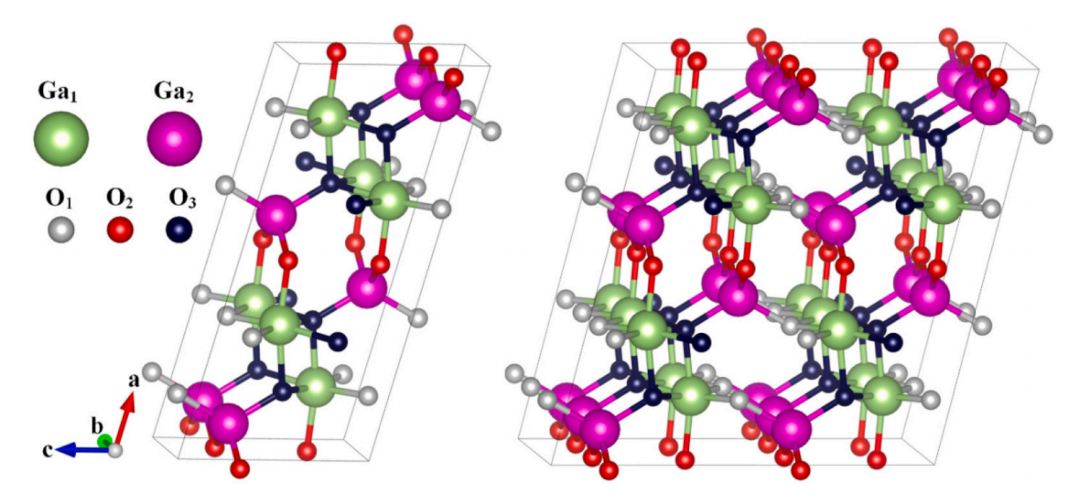
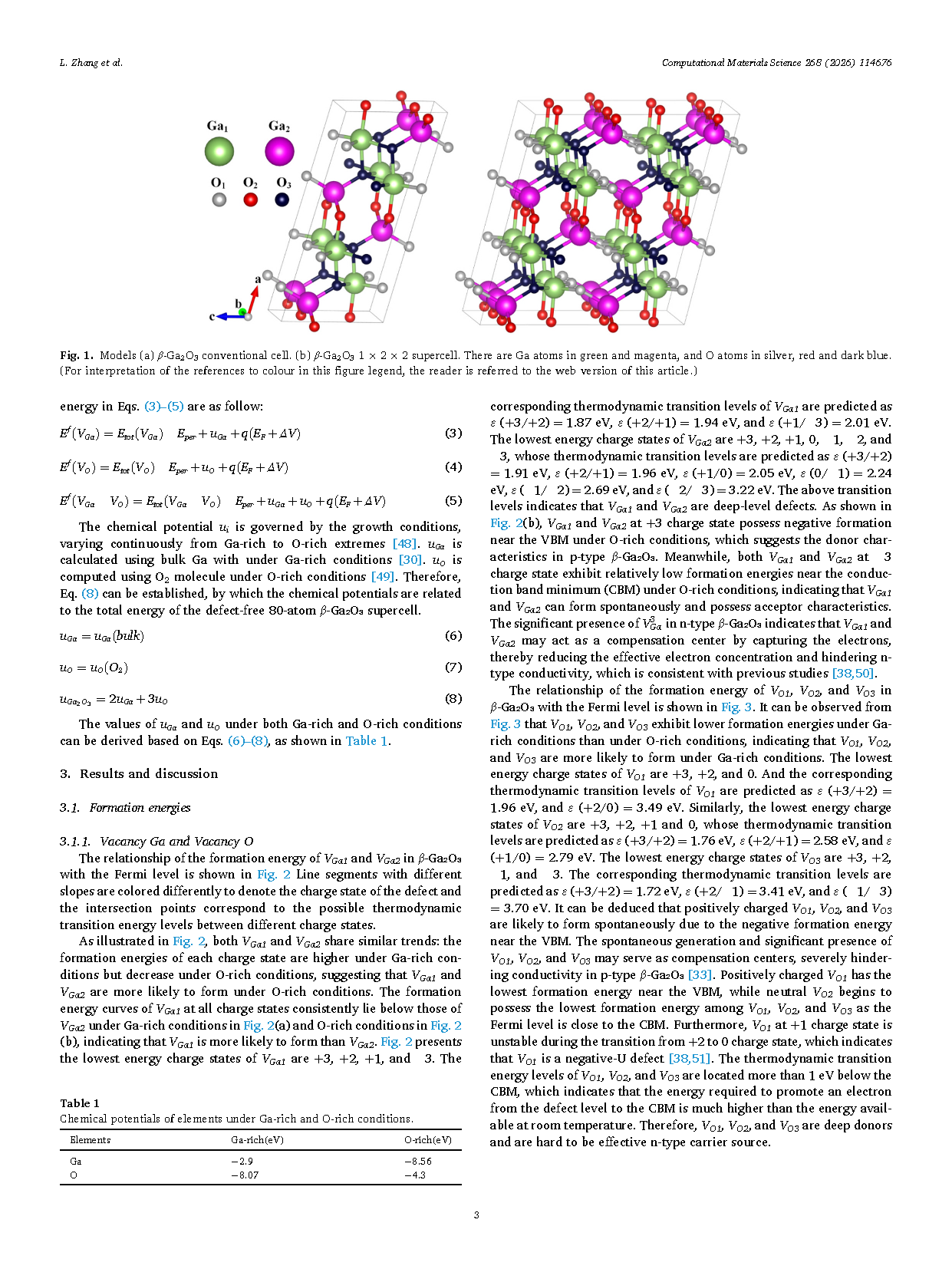
Fig. 1. Models (a) β‑Ga₂O₃ conventional cell. (b) β‑Ga₂O₃ 1 × 2 × 2 supercell. There are Ga atoms in green and magenta, and O atoms in silver, red and dark blue.
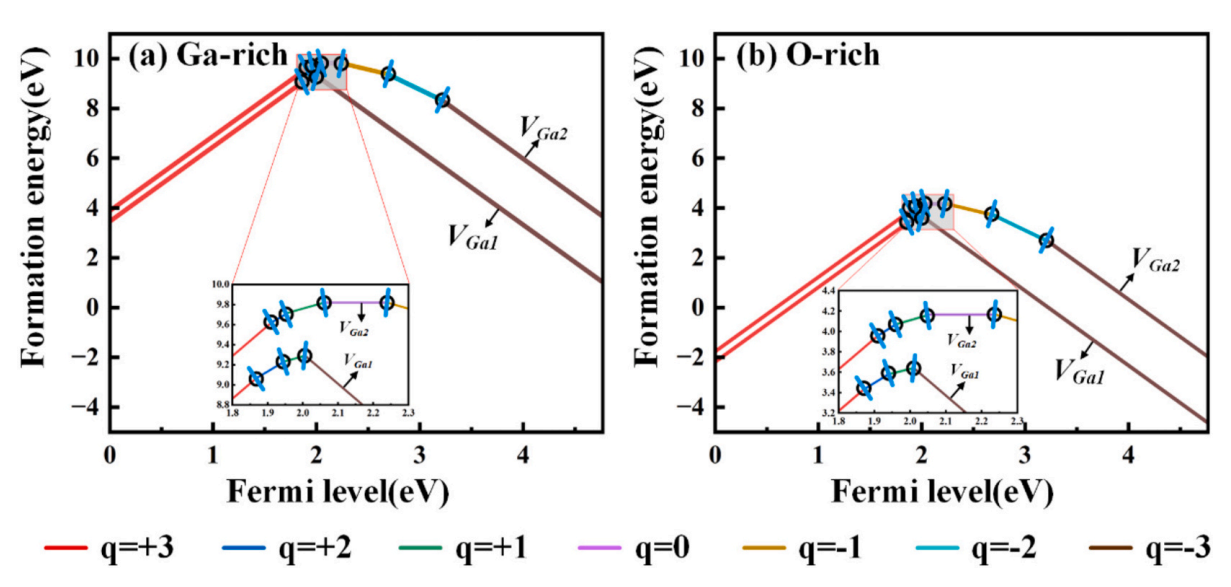
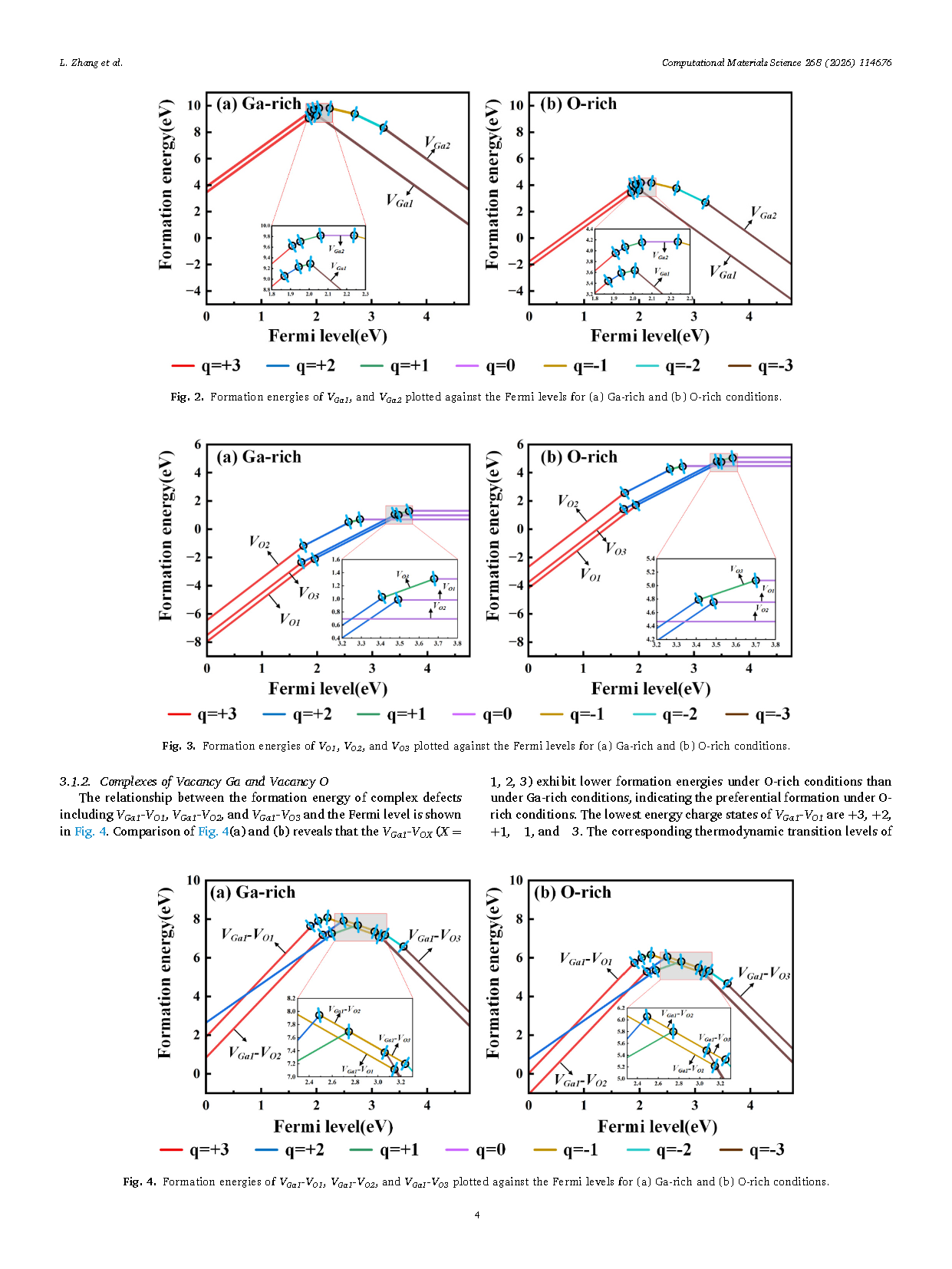
Fig. 2. Formation energies of VGa1 and VGa2 plotted against the Fermi levels for (a) Ga-rich and (b) O-rich conditions.
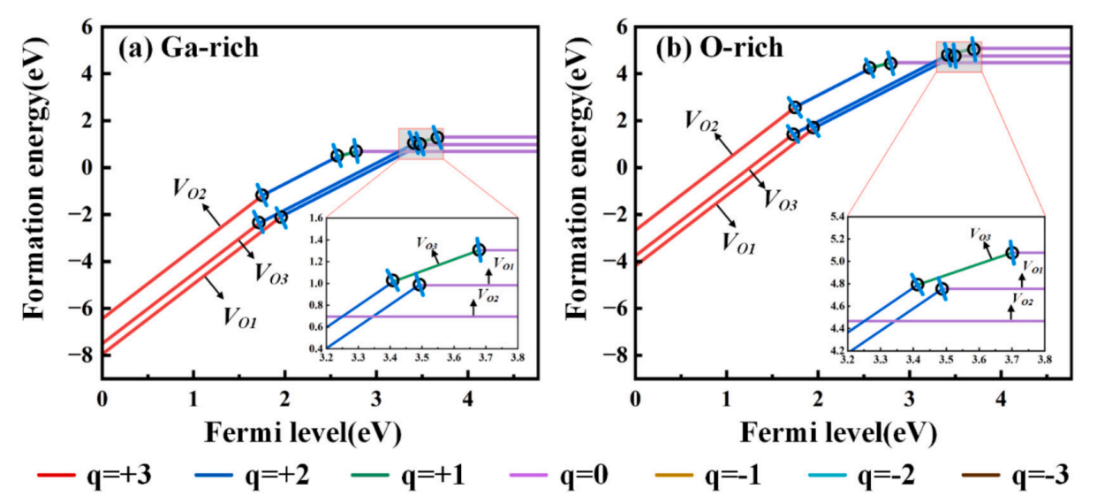
Fig. 3. Formation energies of VO1, VO2, and VO3 plotted against the Fermi levels for (a) Ga-rich and (b) O-rich conditions.
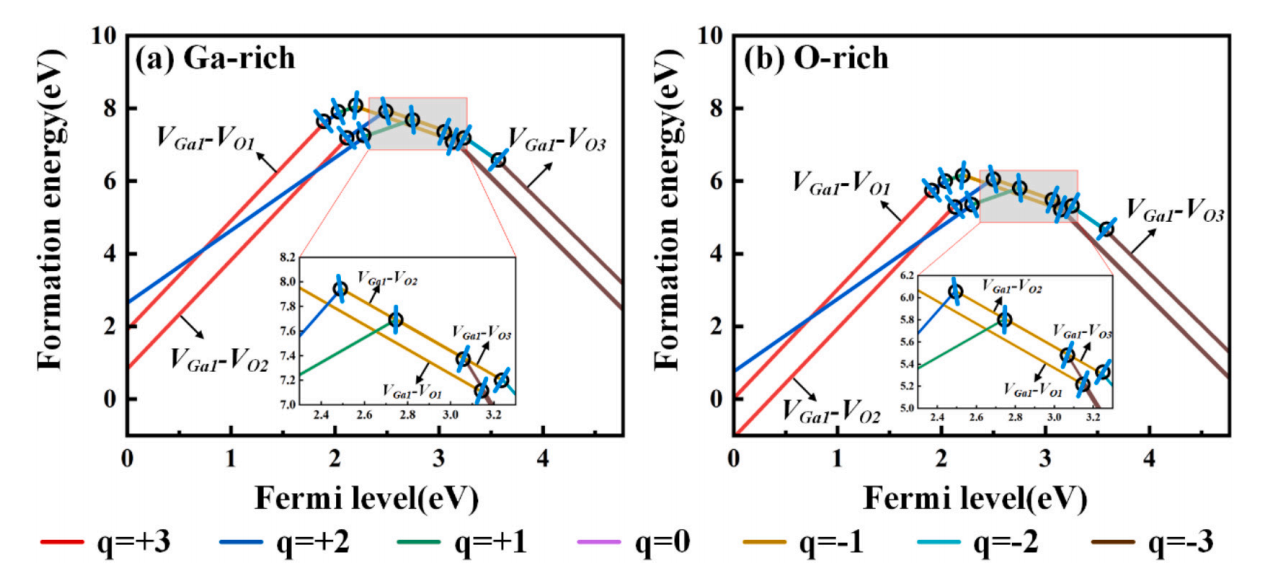
Fig. 4. Formation energies of VGa1‑VO1, VGa1‑VO2 and VGa1‑VO3 plotted against the Fermi levels for (a) Ga-rich and (b) O-rich conditions.
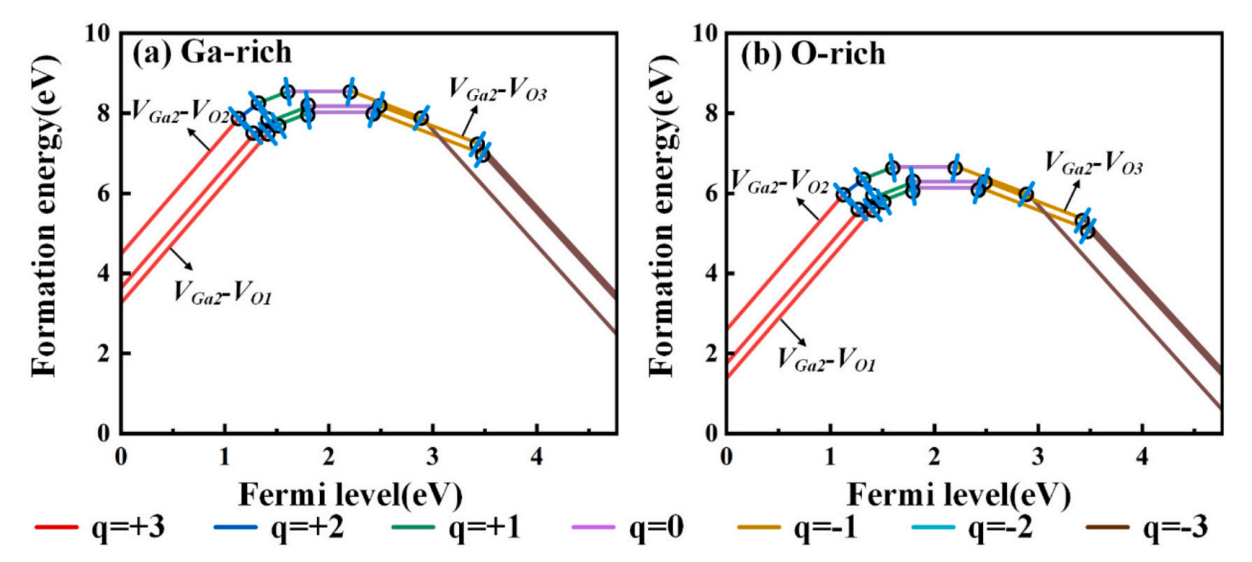
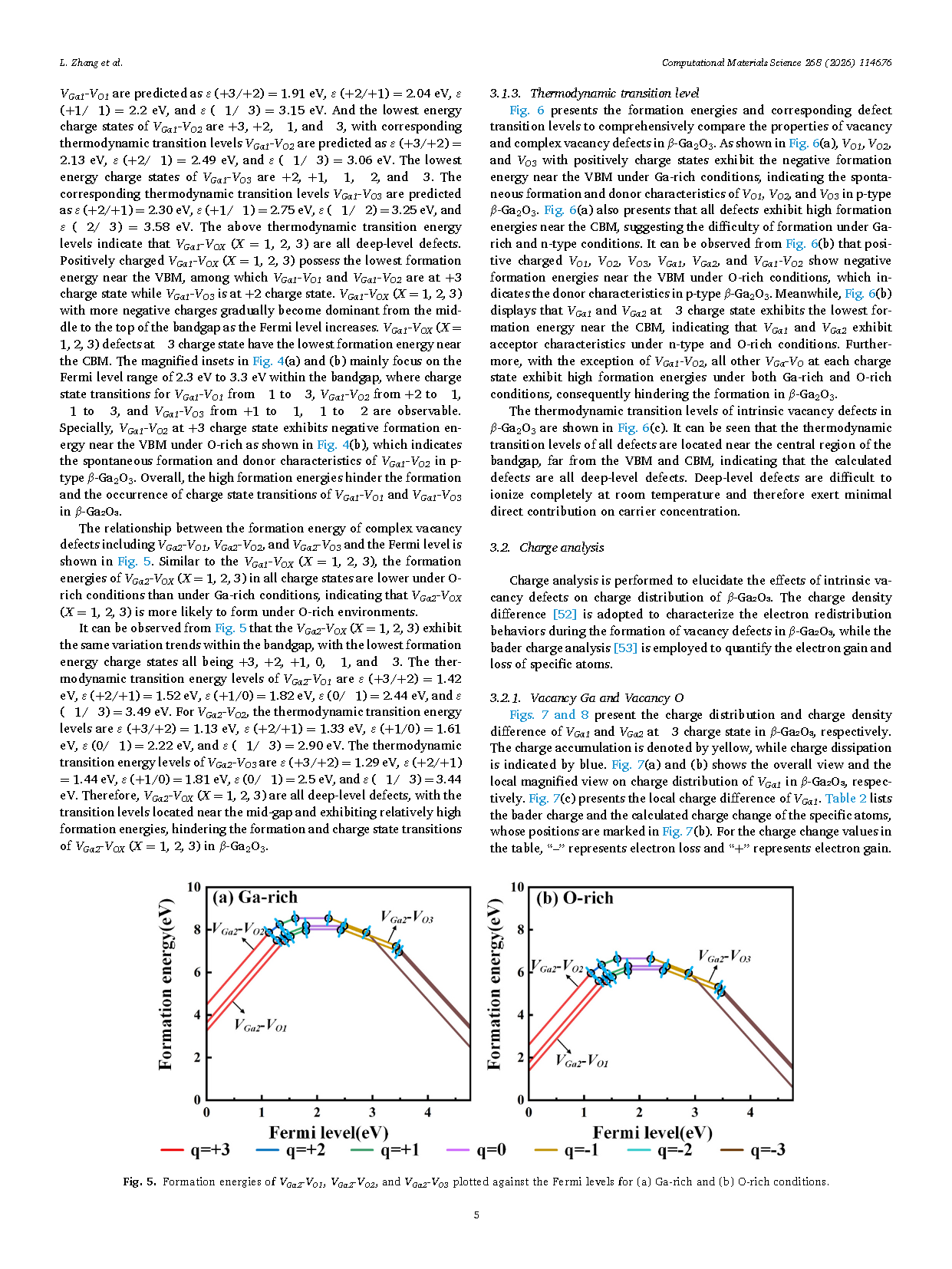
Fig. 5. Formation energies of VGa2‑VO1, VGa2‑VO2 and VGa2‑VO3 plotted against the Fermi levels for (a) Ga-rich and (b) O-rich conditions.
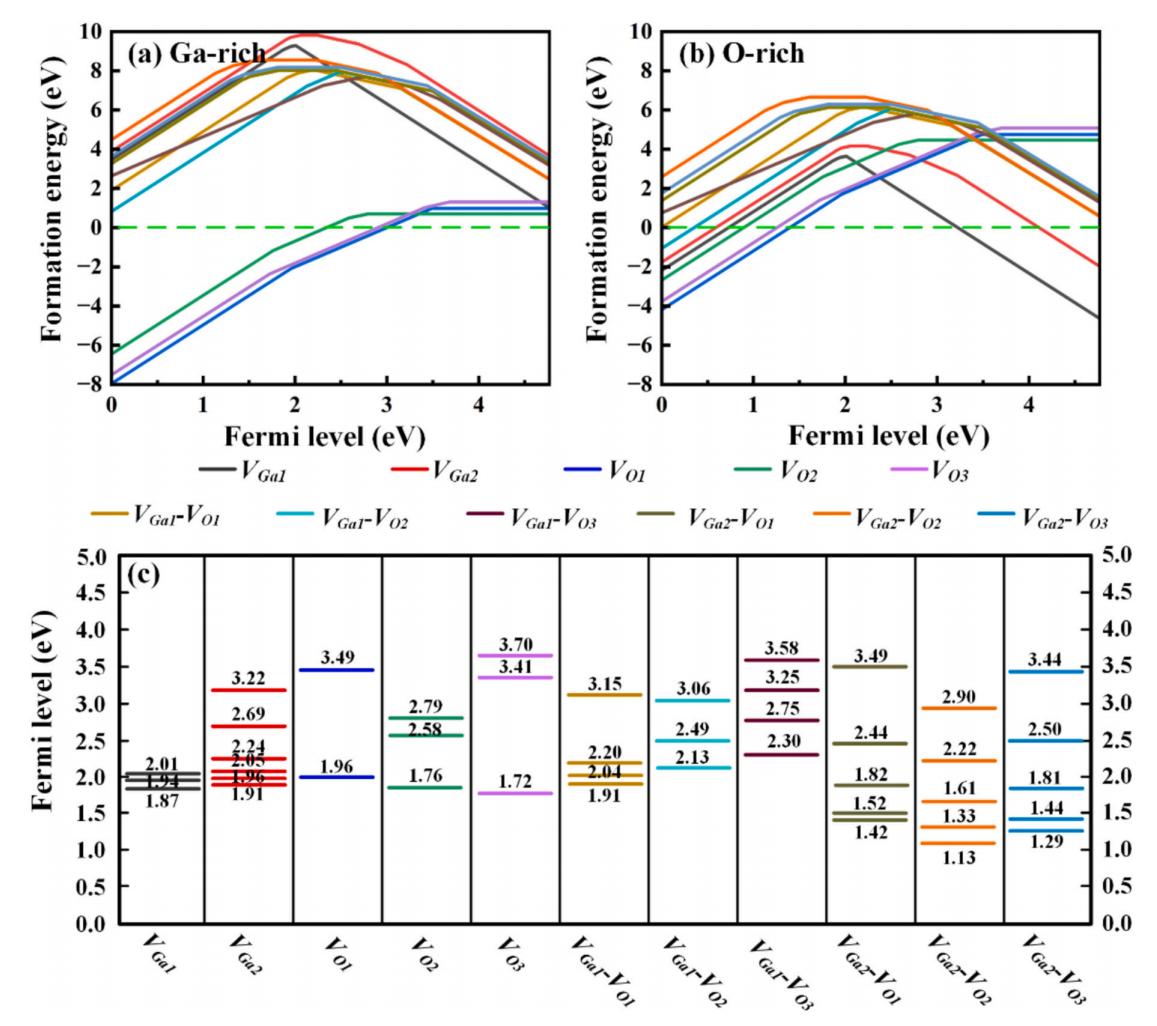
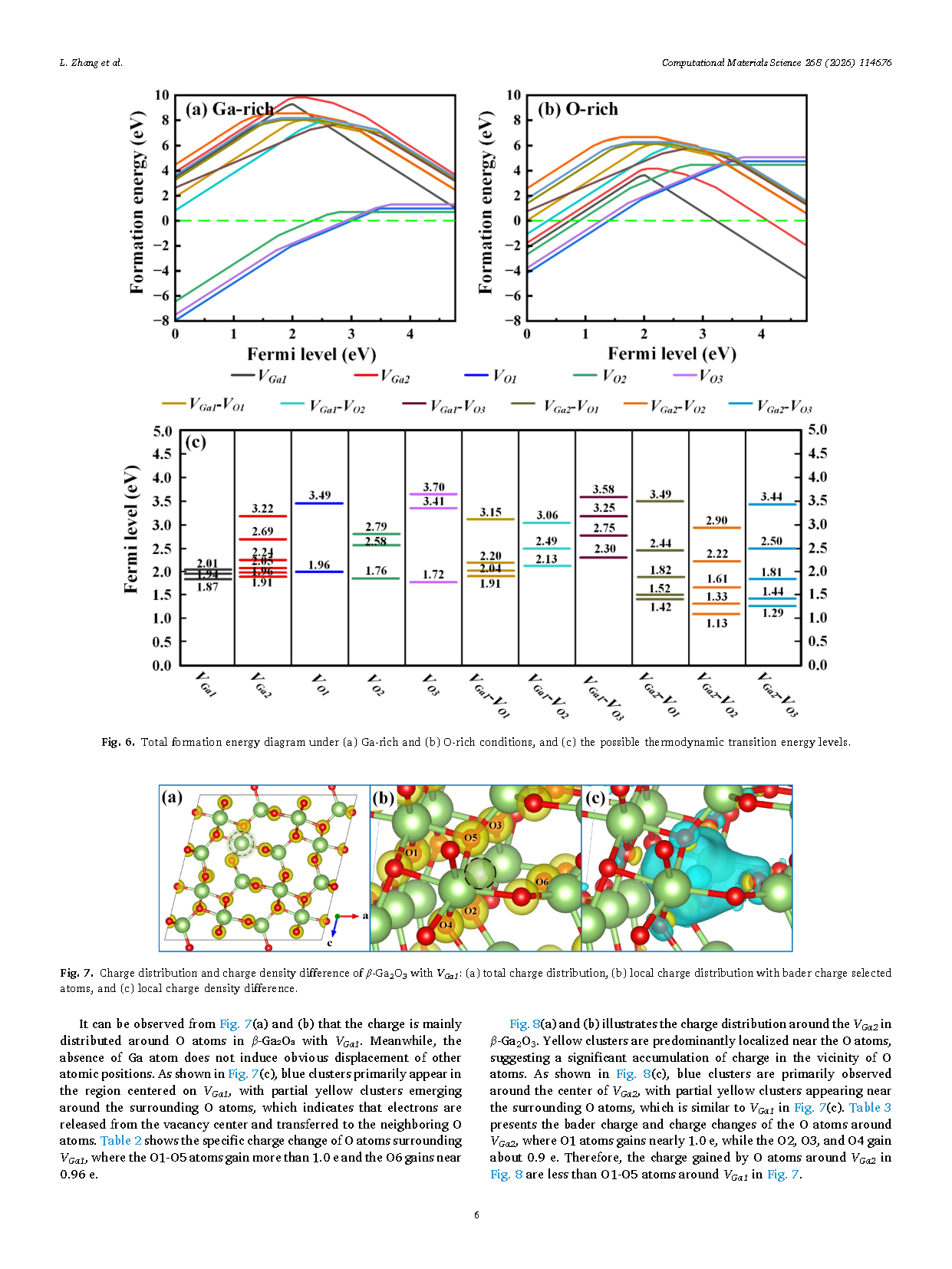
Fig. 6. Total formation energy diagram under (a) Ga-rich and (b) O-rich conditions, and (c) the possible thermodynamic transition energy levels.
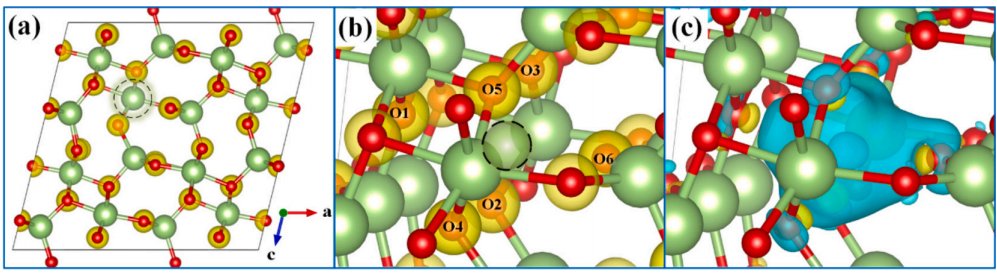
Fig. 7. Charge distribution and charge density difference of β‑Ga₂O₃ with VGa1: (a) total charge distribution, (b) local charge distribution with bader charge selected atoms, and (c) local charge density difference.
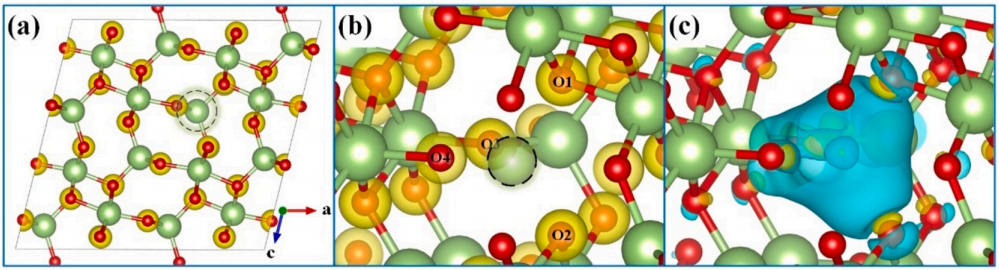
Fig. 8. Charge distribution and charge density difference of β‑Ga₂O₃ with VGa2: (a) total charge distribution, (b) local charge distribution with bader charge selected atoms, and (c) local charge density difference.
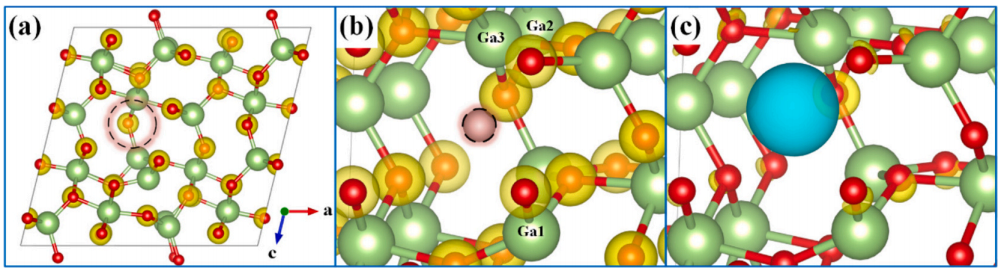
Fig. 9. Charge distribution and charge density difference of β‑Ga₂O₃ with VO1: (a) total charge distribution, (b) local charge distribution with bader charge selected atoms, and (c) local charge density difference.
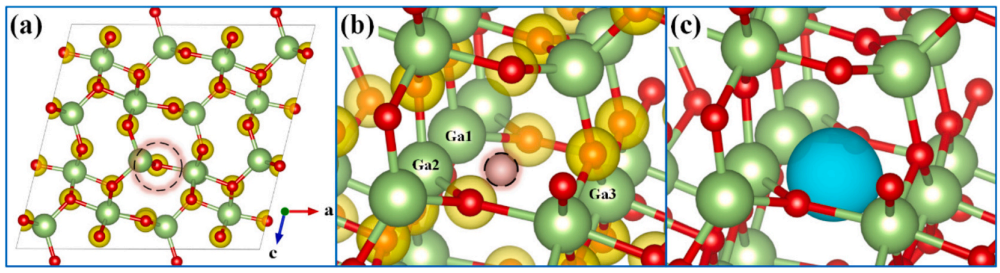
Fig. 10. Charge distribution and charge density difference of β‑Ga₂O₃ with VO2: (a) total charge distribution, (b) local charge distribution with bader charge selected atoms, and (c) local charge density difference.
DOI:
doi.org/10.1016/j.commatsci.2026.114676
Instruction
Official Account

Cooperation
Top