


Researchers from Chongqing University of Arts and Sciences, Tomsk Polytechnic University, and SPIC Yuanda Environmental-Protection Engineering Co., Ltd. have published a dissertation titled “Realization of high-performance solar-blind UV detector via a ZrO₂/Ga₂O₃/LaOₓ p-i-n heterostructure” in Optics Express.
Background
Solar-blind ultraviolet detection is critically important for applications such as missile warning and secure communication. β-Ga₂O₃ is a promising material for inherent solar-blind detection. However, conventional photoconductive detectors based on β-Ga₂O₃ suffer from low responsivity and slow response speed. Although vertical heterojunctions enable self-powered operation and rapid carrier separation, they face bottlenecks including improper band alignment of partner materials and strong absorption of conventional transparent electrodes in the solar-blind region, making it difficult to achieve strict solar-blind selectivity, high efficiency, and fast response simultaneously.
Abstract
Solar-blind ultraviolet (UV) detection, operating in the 200–280 nm wavelength range, is of critical importance for applications such as missile warning and secure communication due to the inherent absence of solar background radiation. While β-Ga₂O₃ is a promising material for inherent solar-blind detection, conventional photoconductive detectors based on it suffer from low responsivity and slow response speed. This work presents a self-powered, vertical heterojunction solar-blind photodetector designed to overcome these limitations. The device features an innovative n-ZrO₂/β-Ga₂O₃/p-LaOₓ ternary thin-film structure that forms a p-i-n junction with nearly ideal band alignment, creating a strong built-in electric field for efficient carrier separation. A high-transmittance silver nanowire (AgNWs) network serves as the top window electrode, enabling high photon flux. The fabricated detector operates at 0 V bias, achieving a responsivity of 5.2 mA W⁻¹, a specific detectivity (D*) of 2.59 ×10¹² Jones, and a photo-to-dark current ratio exceeding 4.1 ×10⁴ under 254 nm illumination. Furthermore, the response speed is significantly enhanced, with 0.36/0.58 s under lower illumination (20 μW cm⁻²) and 56/150 ms under higher intensity (350 μW cm⁻²). The detector’s exceptional performance was further validated through a solar-blind UV imaging system, where it successfully reconstructed clear patterns with high contrast and a clean background, demonstrating its potential for practical imaging applications. This work provides a novel device architecture for high-performance, self-powered solar-blind photodetection and offers valuable insights for the design of wide-bandgap semiconductor optoelectronic devices.
Highlights
A novel n-ZrO₂/β-Ga₂O₃/p-LaOₓ p-i-n heterostructure composed entirely of wide-bandgap materials is proposed for strict solar-blind detection without optical filters.
Nearly ideal band alignment and strong built-in electric field enable efficient separation and extraction of photogenerated carriers.
A high-transmittance AgNWs window electrode ensures high photon flux in the solar-blind region.
The self-powered detector achieves high D* of 2.59 ×10¹² Jones and fast response speed down to 56/150 ms.
Clear solar-blind UV imaging with high contrast and no background interference is successfully demonstrated.
Conclusion
Overall, we have successfully developed a high-performance, self-powered solar-blind UV photodetector based on a solution-processed n-ZrO₂/β-Ga₂O₃/p-LaOₓ vertical heterojunction. This design effectively overcomes two major drawbacks of conventional β-Ga₂O₃ photoconductive detectors: low photon utilization and slow response. The key advances of this work are fourfold. (1) The device features a novel p-i-n heterojunction entirely composed of wide-bandgap materials (ZrO₂, β-Ga₂O₃, LaOₓ), which provides inherent solar-blind spectral selectivity without requiring external optical filters. (2) The nearly ideal band alignment and strong built-in electric field enable efficient separation and extraction of photogenerated carriers. (3) A highly transparent silver nanowire (AgNWs) electrode (>80% transmittance in the solar-blind region) ensures sufficient photon flux for high responsivity and detectivity. (4) The detector exhibits outstanding overall performance, including a detectivity of 2.59 ×10¹² Jones in self-powered mode, a photo-to-dark current ratio >10⁴, and excellent long-term stability. Its clear UV imaging capability further confirms practical applicability. This study not only proposes a promising device architecture for next-generation solar-blind detection, but also demonstrates the effectiveness of bandgap and heterojunction engineering in enhancing wide-bandgap optoelectronics. Furthermore, the all-solution, vacuum-free fabrication method offers a cost-effective route toward scalable device production.
Project Support
This work was supported by National Key R&D Program of China (Grant No. 2022YFB3603202), National Natural Science Foundation of China (Grant No. 62171069), Natural Science Foundation of Chongqing (CSTB2024NSCQ-LZX0009, CSTB2024TIAD-KPX0004, CSTB2023NSCQ-LZX0058, CSTB2023TIAD-KPX0022), Scientific and Technological Research Program of Chongqing Municipal Education Commission (KJQN202301315).
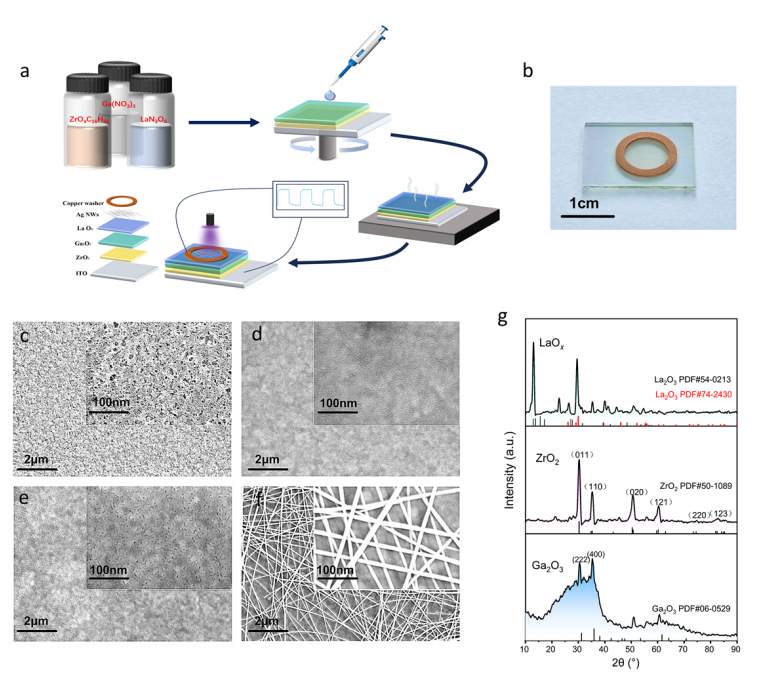
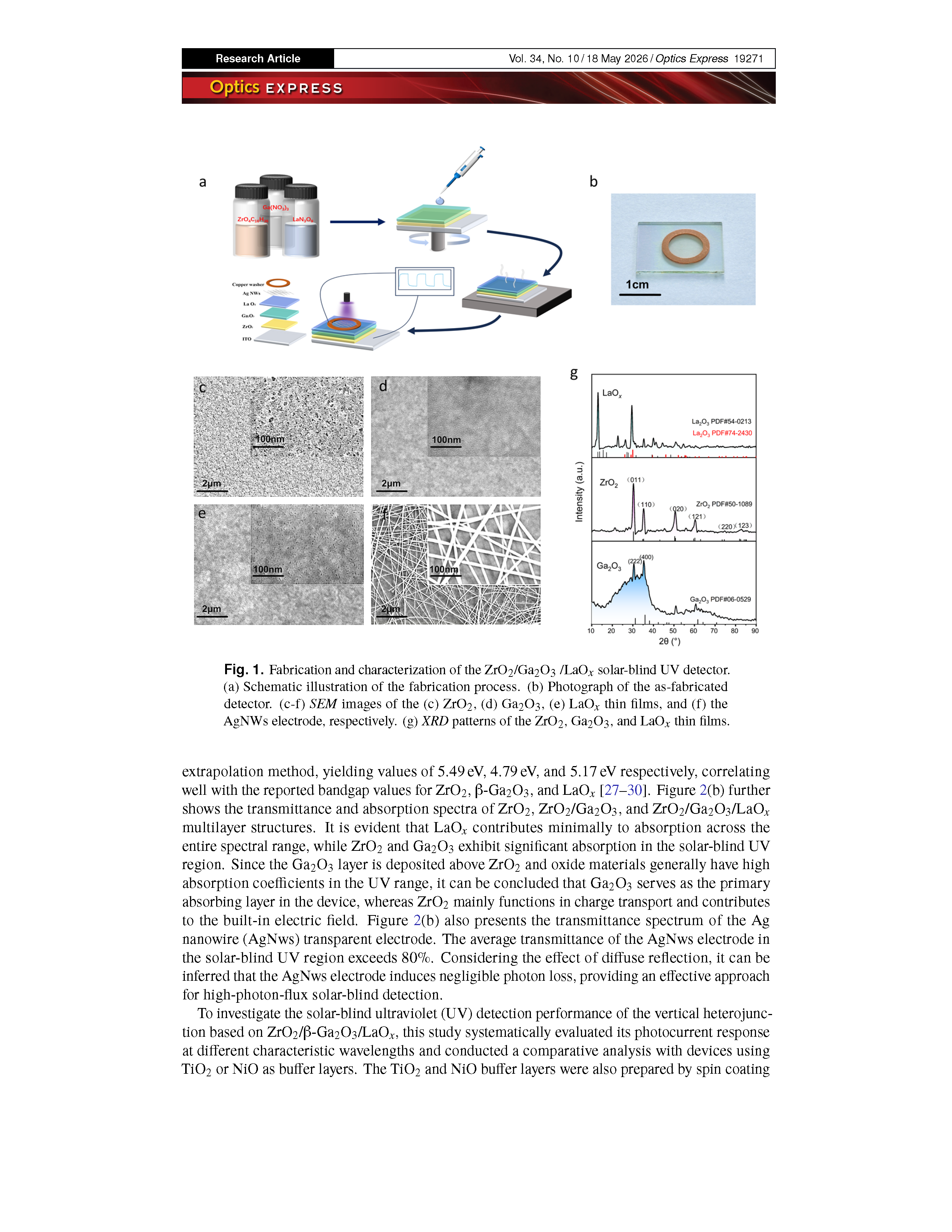
Fig. 1. Fabrication and characterization of the ZrO₂/Ga₂O₃/LaOₓ solar-blind UV detector. (a) Schematic illustration of the fabrication process. (b) Photograph of the as-fabricated detector. (c-f) SEM images of the (c) ZrO₂, (d) Ga₂O₃, (e) LaOₓ thin films, and (f) the AgNWs electrode, respectively. (g) XRD patterns of the ZrO₂, Ga₂O₃, and LaOₓ thin films.
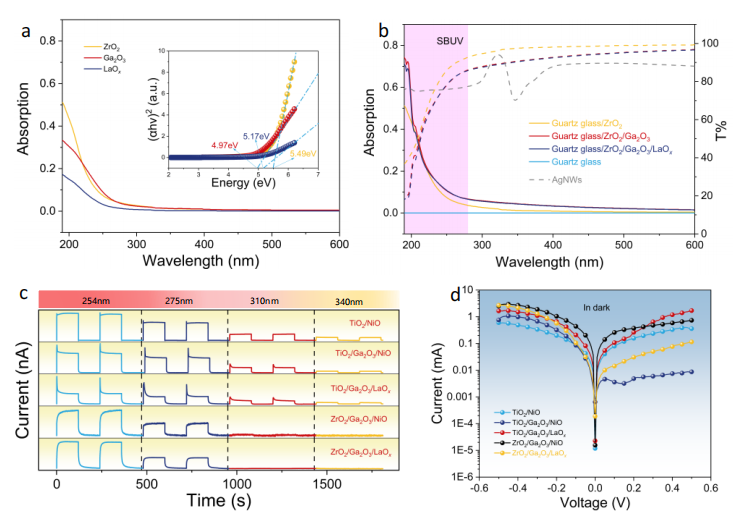
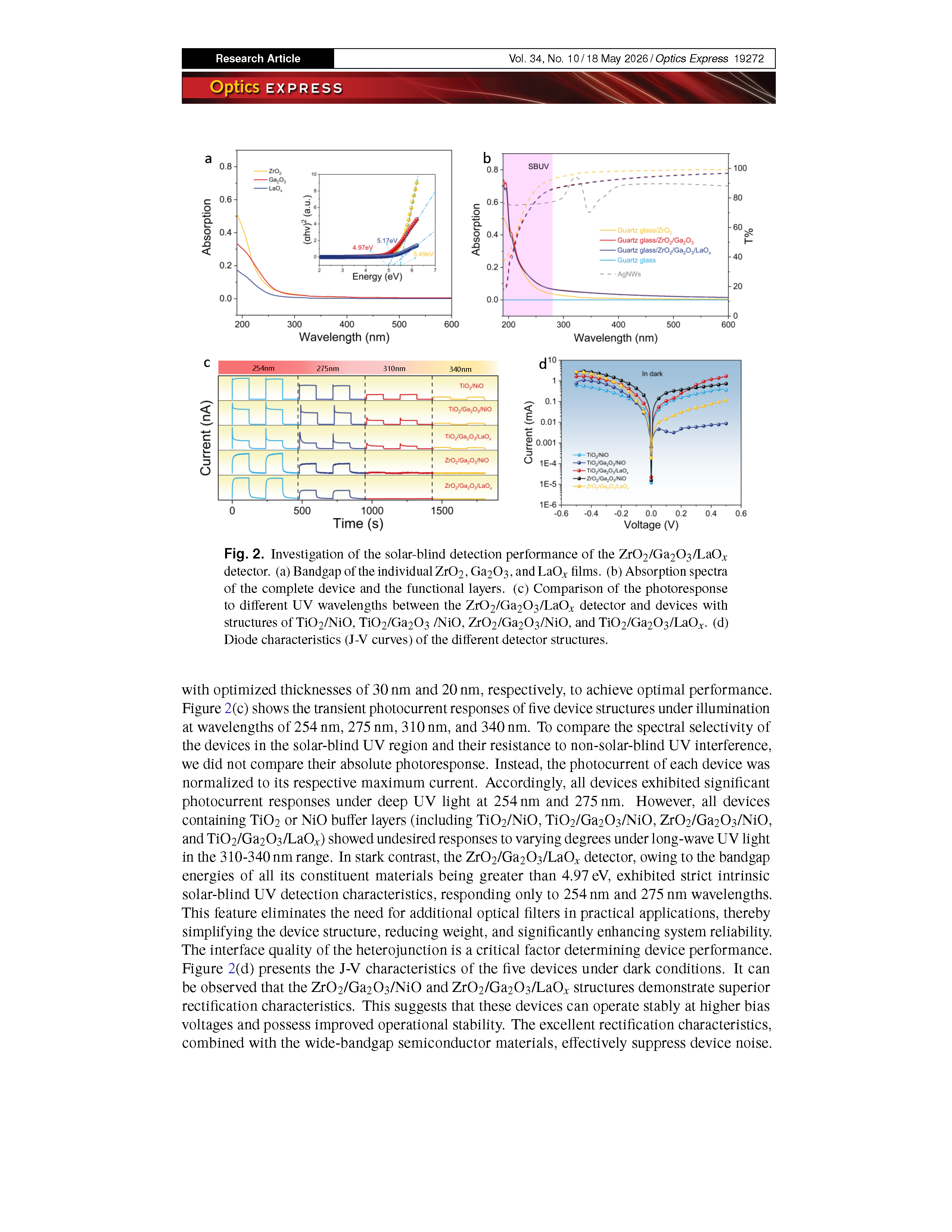
Fig. 2. Investigation of the solar-blind detection performance of the ZrO₂/Ga₂O₃/LaOₓ detector. (a) Bandgap of the individual ZrO₂, Ga₂O₃, and LaOₓ films. (b) Absorption spectra of the complete device and the functional layers. (c) Comparison of the photoresponse to different UV wavelengths between the ZrO₂/Ga₂O₃/LaOₓ detector and devices with structures of TiO₂/NiO, TiO₂/Ga₂O₃/NiO, ZrO₂/Ga₂O₃/NiO, and TiO₂/Ga₂O₃/LaOₓ. (d) Diode characteristics (J-V curves) of the different detector structures.
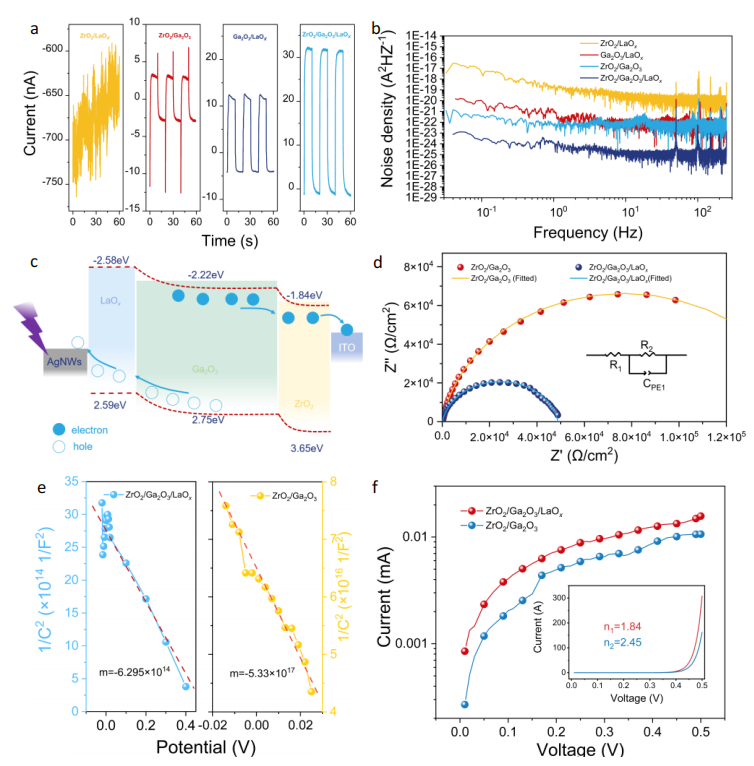
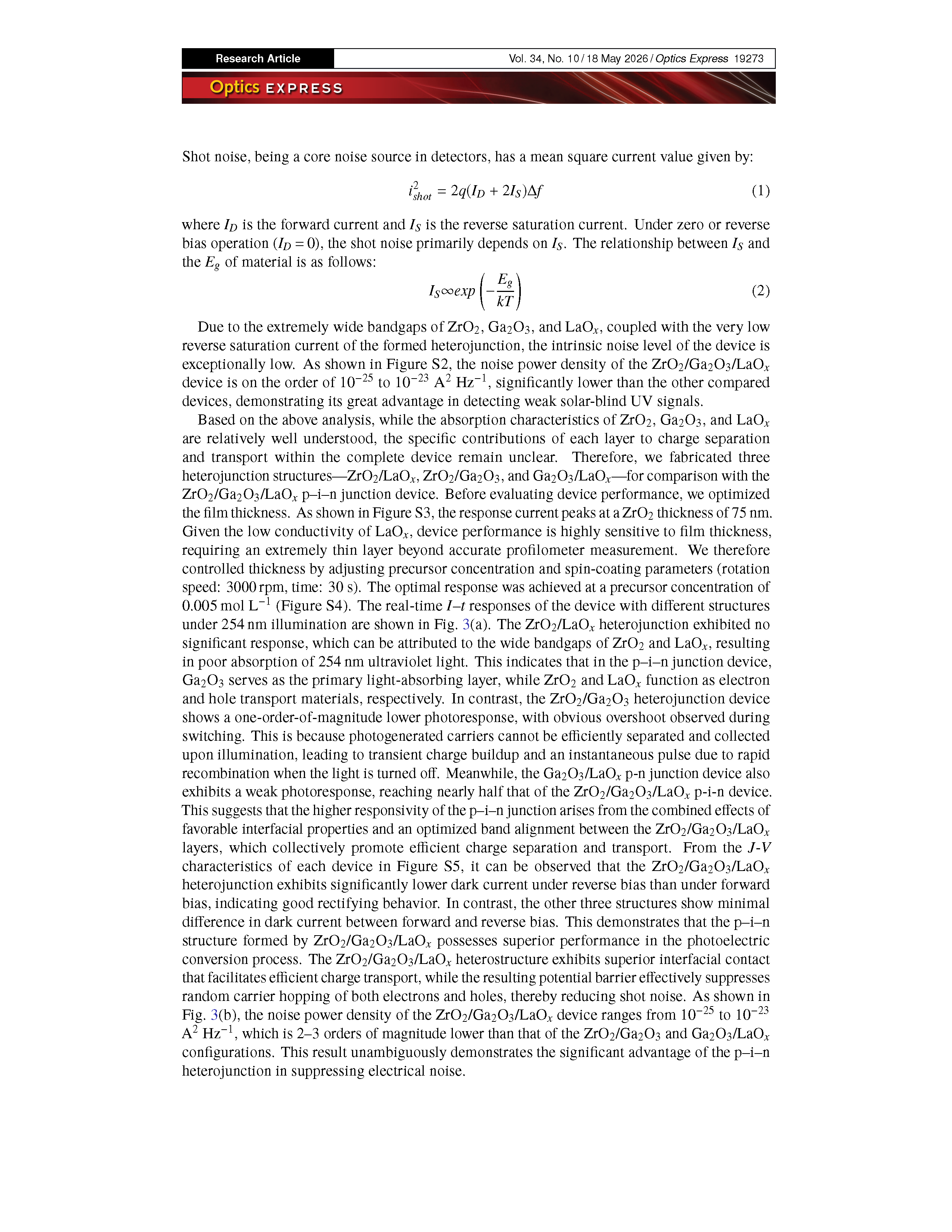
Fig. 3. Mechanism behind the enhanced performance of the p-i-n heterojunction. (a) Comparison of the photoresponse among the ZrO₂/Ga₂O₃/LaOₓ p-i-n device and the ZrO₂/Ga₂O₃, Ga₂O₃/LaOₓ, and ZrO₂/LaOₓ control devices. (b) Noise density of the different device configurations. (c) Proposed energy band diagram of the ZrO₂/Ga₂O₃/LaOₓ p-i-n heterojunction. (d) Nyquist plots with equivalent circuit fitting. (e) Mott–Schottky analysis and (f) logarithmic I–V characteristics with ideality factor analysis of the ZrO₂/Ga₂O₃/LaOₓ p-i-n heterojunction and the ZrO₂/Ga₂O₃ p–n heterojunction.
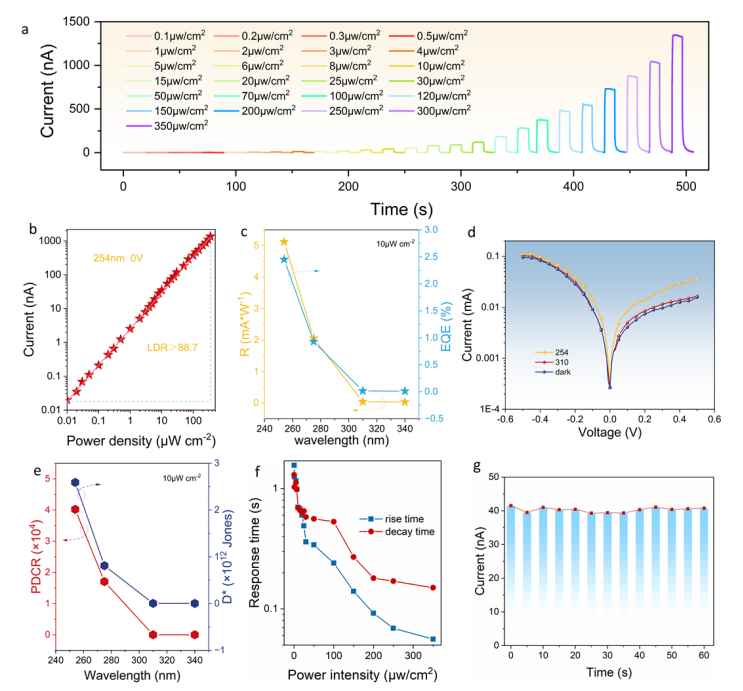
Fig. 4. Performance evaluation of the ZrO₂/Ga₂O₃/LaOₓ detector under weak light, bias, and extended duration. (a) Response of the photocurrent to varying optical power density. (b) LDR analysis. (c) D* and response time comparison with previously reported values. (d) J-V characteristics of the device measured in the dark and under 254 nm and 310 nm illumination. (e) Long-term stability test. (f) Intensity-dependent response time and (g) environmental stability test results of the device.
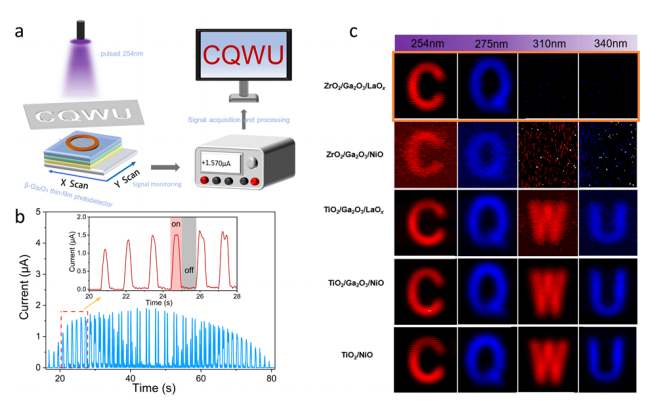
Fig. 5. Imaging performance of the ZrO₂/Ga₂O₃/LaOₓ solar-blind UV detector. (a) Schematic diagram of the homemade two-dimensional scanning imaging setup. (b) Current signals recorded by the detector during the imaging process. (c) Comparative imaging results, highlighting the clear advantage and strict solar-blind selectivity of our device.
DOI:
doi.org/10.1364/OE.596765
Instruction
Official Account

Cooperation
Top