


Researchers from the University of Utah, Rice University and Kyungpook National University have published a dissertation titled "Thermal stability and phase transformation of conductive α-(AlₓGa₁₋ₓ)₂O₃/Ga₂O₃ heterostructure on sapphire substrates" in Applied Physics Letters.
Background
Gallium oxide serves as a critical material for next-generation power electronics and solar-blind photodetectors owing to its ultra-wide bandgap and high breakdown electric field. Monoclinic β-Ga₂O₃ features outstanding thermodynamic stability, while corundum-structured α-Ga₂O₃ possesses a wide bandgap of up to 5.3 eV and delivers a superior figure of merit for power devices. The α-(AlₓGa₁₋ₓ)₂O₃ alloy enables broad bandgap tuning and forms a type-I heterostructure with α-Ga₂O₃ capable of carrier confinement, making it an ideal candidate for high-electron-mobility transistors (HEMTs). Nevertheless, α-phase Ga₂O₃ is metastable and prone to α-to-β phase transformation during ohmic contact annealing and high-power high-temperature device operation. Previous thermal stability experiments have only focused on single-layer α-based thin films, with no investigations into high-temperature phase evolution of fluorine-doped conductive α-(AlₓGa₁₋ₓ)₂O₃/Ga₂O₃ heterostructures. Under high-power operation, the channel temperature of practical devices can exceed 330 °C, and phase-transition-induced polycrystallization and interfacial cracking severely degrade device performance. To address these challenges, this work systematically investigates the critical phase transition temperature, crystalline defect evolution and surface morphological variation of sapphire-based conductive heterostructures via in-situ high-temperature XRD, AFM and SEM characterizations.
Abstract
Thermal stability and phase transformation of conductive α-(Al₀.₁₆Ga₀.₈₄)₂O₃/Ga₂O₃ heterostructure on sapphire substrates were investigated via in situ high temperature x-ray diffraction, scanning electron microscopy (SEM), and atomic force microscopy (AFM). The conductive α-(Al₀.₁₆Ga₀.₈₄)₂O₃/Ga₂O₃ heterostructure with fluorine (F) doping was grown by mist-chemical vapor deposition on sapphire substrates, achieving a Hall mobility of 28 cm²/(V s). The heterostructure exhibited thermal stability up to 550575 C before transforming to β-(AlₓGa₁₋ₓ)₂O₃/Ga₂O₃. The transformed β-Ga₂O₃ is mainly polycrystalline rather than a high-quality epitaxial phase. Reciprocal space mapping results reveal that the edge dislocation density remains consistently higher than the screw dislocation density throughout the heating process, indicating that the crystalline imperfection in α-Ga₂O₃ is dominated by in-plane mosaicity. After the phase transformation from the a phase to the β phase, catastrophic damage to the film and upheaval of the surface were observed by SEM and AFM.
Highlights
For the first time, the thermal stability and phase transition temperature of F-doped conductive α-(AlₓGa₁₋ₓ)₂O₃/Ga₂O₃ heterostructure were systematically characterized, and the critical phase transition temperature was confirmed as 550–575 ℃.
In-situ HT-XRD combined with RSM quantitatively analyzed the evolution law of screw and edge dislocation density during high-temperature heating, clarifying the dominant defect type of α-Ga₂O₃ epitaxial layer.
Verified by AFM/SEM that α→β phase transition leads to serious surface roughening and film cracking, the post-transition β-Ga₂O₃ is polycrystalline instead of epitaxial single crystal.
The prepared F-doped barrier layer realizes effective electron supply, and the heterostructure obtains 28 cm²/(V·s) Hall mobility, providing data reference for α-Ga₂O₃ HEMT thermal design.
Conclusion
In summary, the thermal stability and phase transformation of conductive α-(Al₀.₁₆Ga₀.₈₄)₂O₃/Ga₂O₃ heterostructure on sapphire substrates were investigated via in situ HT-XRD and microscopy. The heterostructure exhibited thermal stability up to 550–575 C before transforming to the b-phase. The resulting β-Ga₂O₃ phase exhibited a broadened diffraction response, indicating that the transformed film is predominantly polycrystalline rather than a high-quality epitaxial layer. Reciprocal space mapping further suggests that the crystalline imperfection in the α-Ga₂O₃ layer is dominated by in-plane mosaicity. After phase transformation from the α phase to β phase, catastrophic damage to the film and upheaval of the surface were observed by SEM and AFM. These results are an important reference for the thermal stability of α-(AlₓGa₁₋ₓ)₂O₃-based devices.
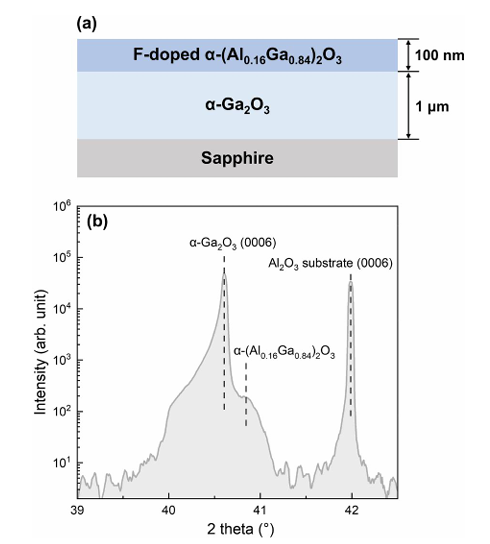
Figure 1 (a) Schematic of α-(AlₓGa₁₋ₓ)₂O₃/Ga₂O₃ heterostructures on sapphire substrate. (b) XRD 2θ–ω scans at room temperature.
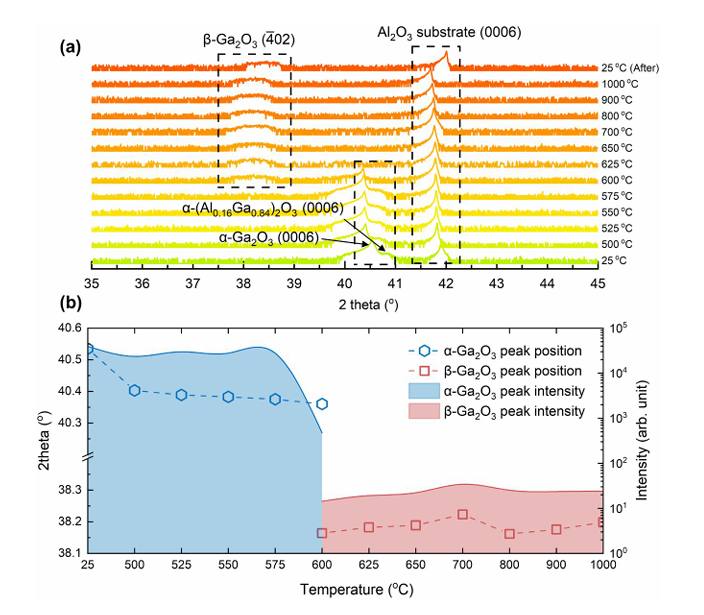
Figure 2 (a) Temperature-dependent 2θ–ω XRD scans of the α-(Al₀.₁₆Ga₀.₈₄)₂O₃/Ga₂O₃ sample measured from room temperature to 1000 °C. (b) Extracted peak positions and intensities of the α-Ga₂O₃ and β-Ga₂O₃ diffraction peaks as a function of temperature.
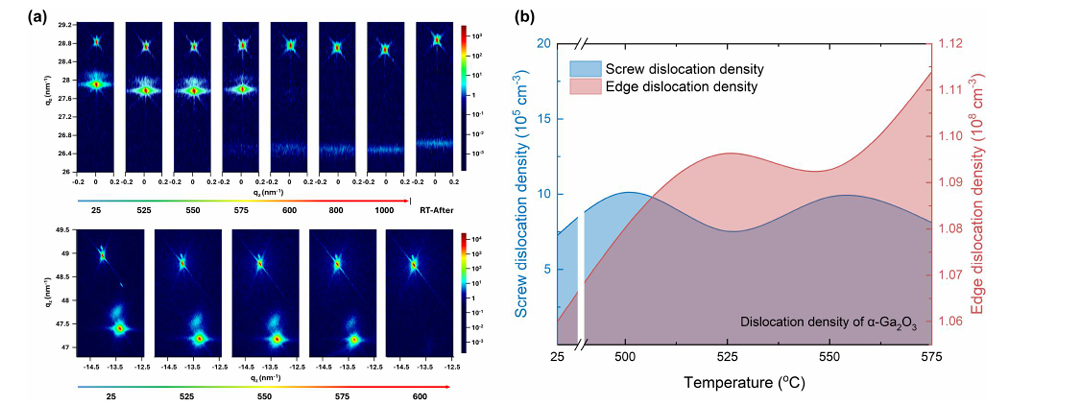
Figure 3 (a) Temperature-dependent symmetric and asymmetric RSMs of the α-(Al₀.₁₆Ga₀.₈₄)₂O₃ heterostructure measured at selected temperatures during heating. (b) Extracted screw and edge dislocation densities of the α-Ga₂O₃ layer as a function of temperature.
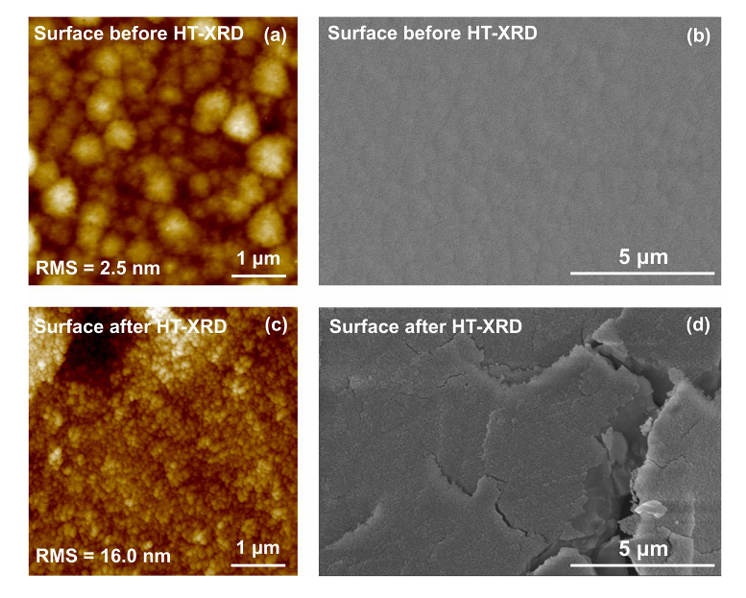
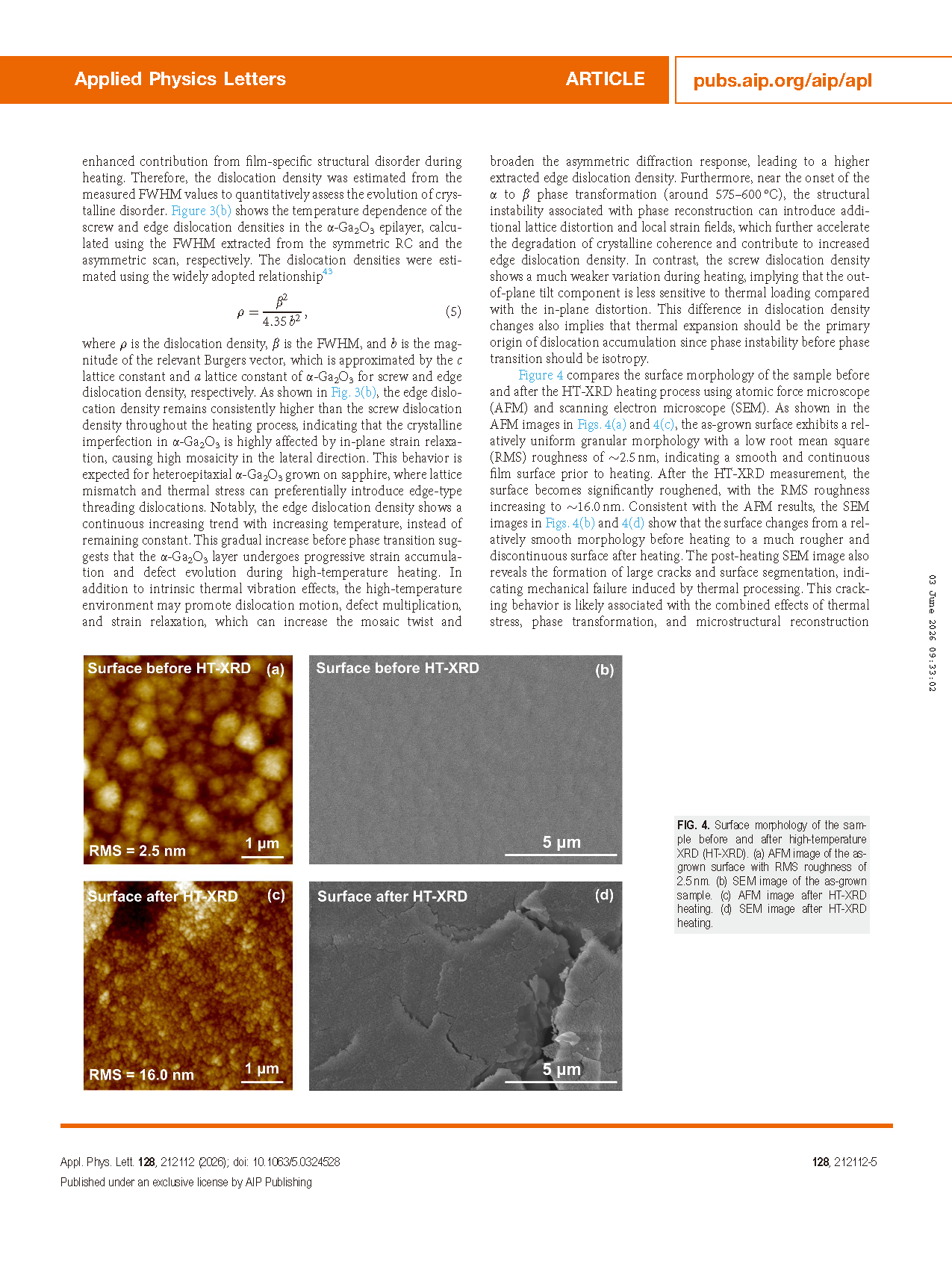
Figure 4 Surface morphology of the sample before and after high-temperature XRD (HT-XRD). (a) AFM image of the as-grown surface with RMS roughness of 2.5 nm. (b) SEM image of the as-grown sample. (c) AFM image after HT-XRD heating. (d) SEM image after HT-XRD heating.
DOI:
10.1063/5.0324528
Instruction
Official Account

Cooperation
Top