


Researchers from the Chongqing Jiaotong University, Chongqing Institute of Green and Intelligent Technology, Chinese Academy of Sciences, and Chongqing School, University of Chinese Academy of Sciences have published a dissertation titled “Effect of oxygen annealing on the optoelectronic performance and long-term stability of amorphous Ga₂O₃ deep-ultraviolet photodetectors“ in Optical Materials.
Background
High-performance solar-blind deep-ultraviolet photodetectors have attracted extensive attention in industrial and defense applications due to their extremely low background noise. Annealing is an indispensable process for achieving high-performance Ga₂O₃-based DUV photodetectors, as it significantly improves crystalline quality and optoelectronic properties. However, the influence of annealing on long-term device stability has not been fully clarified. Amorphous Ga₂O₃ exhibits advantages including large-area uniformity, low-temperature compatibility, and low cost, but its device performance is limited by intrinsic structural disorders and high defect densities. Oxygen vacancies usually act as unstable trapping centers and lead to performance degradation. This work systematically investigates the effect of oxygen-vacancy-related defects by precisely controlling the oxygen partial pressure during annealing, aiming to synergistically optimize the optoelectronic efficiency and long-term reliability of the devices.
Abstract
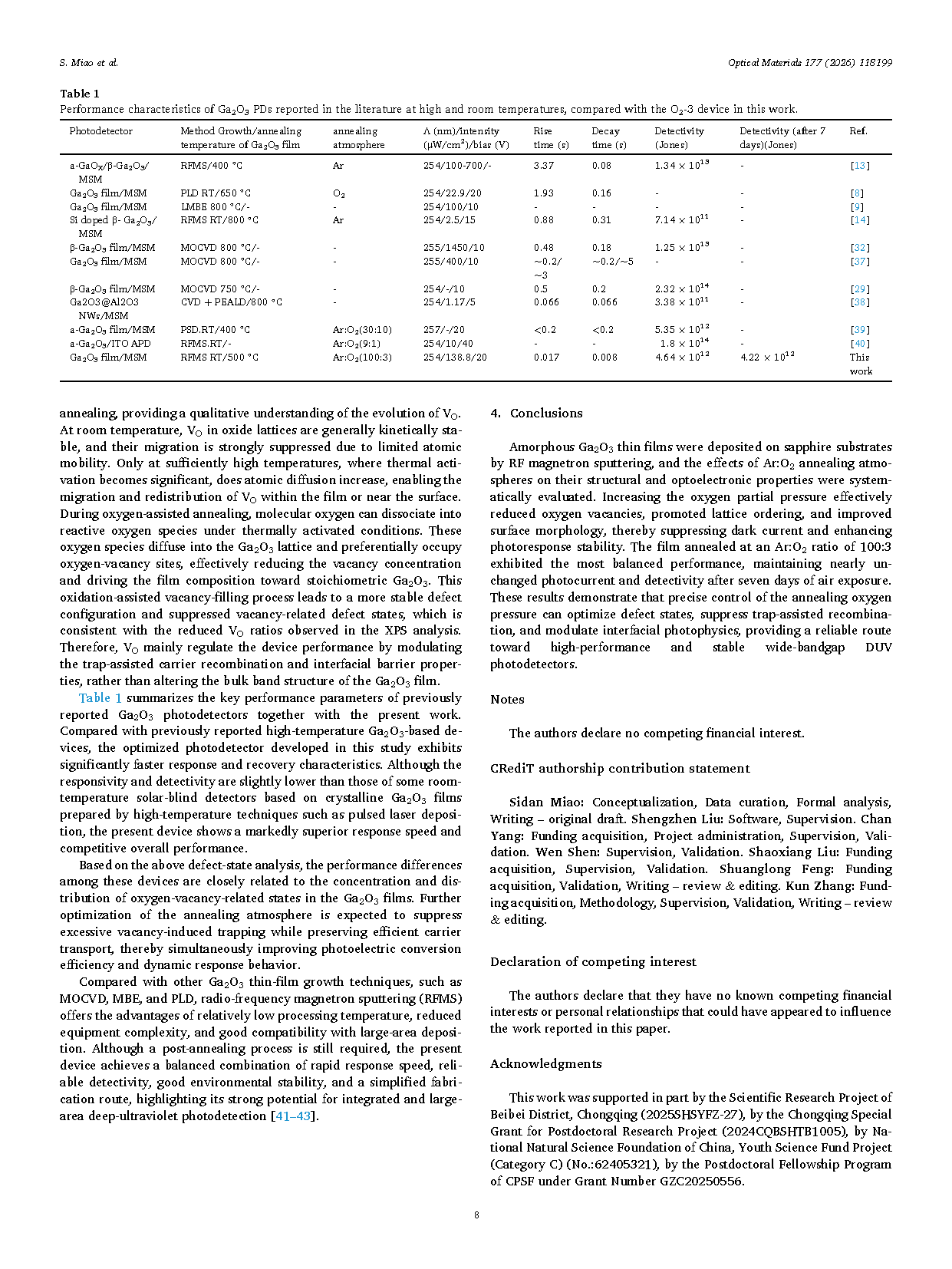
Owing to their extremely low background noise, high-performance and highly stable solar-blind deep-ultraviolet (DUV) photodetectors (PDs) have attracted considerable attention for industrial and defense applications. Annealing is an indispensable process for achieving high-performance Ga₂O₃-based deep-ultraviolet photodetection devices, as it significantly improves the crystalline quality and enhances the overall optoelectronic properties. However, the influence of annealing on the long-term stability of Ga₂O₃-based photodetectors has not been fully clarified. In this work, the effect of intrinsic oxygen-vacancy-related defects on the optoelectronic characteristics of amorphous Ga₂O₃ thin films deposited by magnetron sputtering was systematically investigated. By precisely controlling the oxygen partial pressure in the annealing atmosphere, the dark current was markedly suppressed, leading to substantial enhancements in both the photoelectric conversion efficiency and the long-term operational stability of these solar-blind detection units. Under the optimized annealing condition (Ar: O₂=100:3), the Ga₂O₃ thin film exhibited the lowest surface roughness (Rₐ=1.45 nm), a reduced dark current of 22.5 nA, a high responsivity of 1.02 A W⁻¹, a detectivity of 4.64 × 10¹² Jones, and fast rise and decay times of 17 ms and 8 ms, respectively. Compared with annealing in pure argon, annealing in an atmosphere consisting of 100 sccm Ar and 3 sccm O₂ resulted in superior environmental stability, as the deep-ultraviolet photodetector maintained nearly unchanged performance after 7 days of air exposure. X-ray photoelectron spectroscopy (XPS) analysis revealed that the increased oxygen partial pressure during annealing effectively suppressed oxygen vacancies, thereby enhancing the device stability. These results indicate that annealing under a moderate oxygen partial pressure effectively regulates oxygen-vacancy-related defects and modulates the interfacial carrier dynamics, leading to simultaneous enhancement in both the performance and stability of Ga₂O₃ deep-ultraviolet photodetectors, and providing valuable guidance for the development of next-generation high-performance deep-ultraviolet detection devices.
Highlights
First systematic study on the effect of oxygen partial pressure annealing on the long-term stability of amorphous Ga₂O₃ DUV photodetectors
Optimized Ar:O₂=100:3 annealing achieves the lowest surface roughness and significantly suppressed dark current
Device exhibits high responsivity of 1.02 A/W, detectivity of 4.64×10¹² Jones, and fast response (17/8 ms)
Excellent stability with nearly unchanged performance after 7 days in air
XPS confirms oxygen annealing effectively suppresses oxygen vacancies and modulates interfacial carrier dynamics
Conclusion
Amorphous Ga₂O₃ thin films were deposited on sapphire substrates by RF magnetron sputtering, and the effects of Ar: O₂ annealing atmospheres on their structural and optoelectronic properties were systematically evaluated. Increasing the oxygen partial pressure effectively reduced oxygen vacancies, promoted lattice ordering, and improved surface morphology, thereby suppressing dark current and enhancing photoresponse stability. The film annealed at an Ar: O₂ ratio of 100:3 exhibited the most balanced performance, maintaining nearly unchanged photocurrent and detectivity after seven days of air exposure. These results demonstrate that precise control of the annealing oxygen pressure can optimize defect states, suppress trap-assisted recombination, and modulate interfacial photophysics, providing a reliable route toward high-performance and stable wide-bandgap DUV photodetectors.
Project Support
This work was supported in part by the Scientific Research Project of Beibei District, Chongqing (2025SHSYFZ-27), by the Chongqing Special Grant for Postdoctoral Research Project (2024CQBSHTB1005), by National Natural Science Foundation of China, Youth Science Fund Project (Category C) (No.:62405321), by the Postdoctoral Fellowship Program of CPSF under Grant Number GZC20250556.
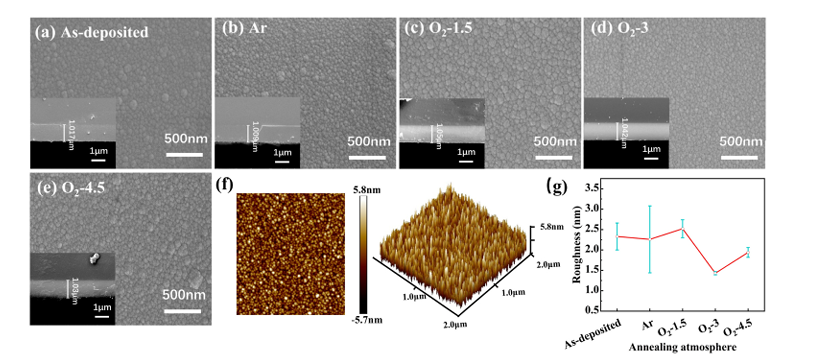
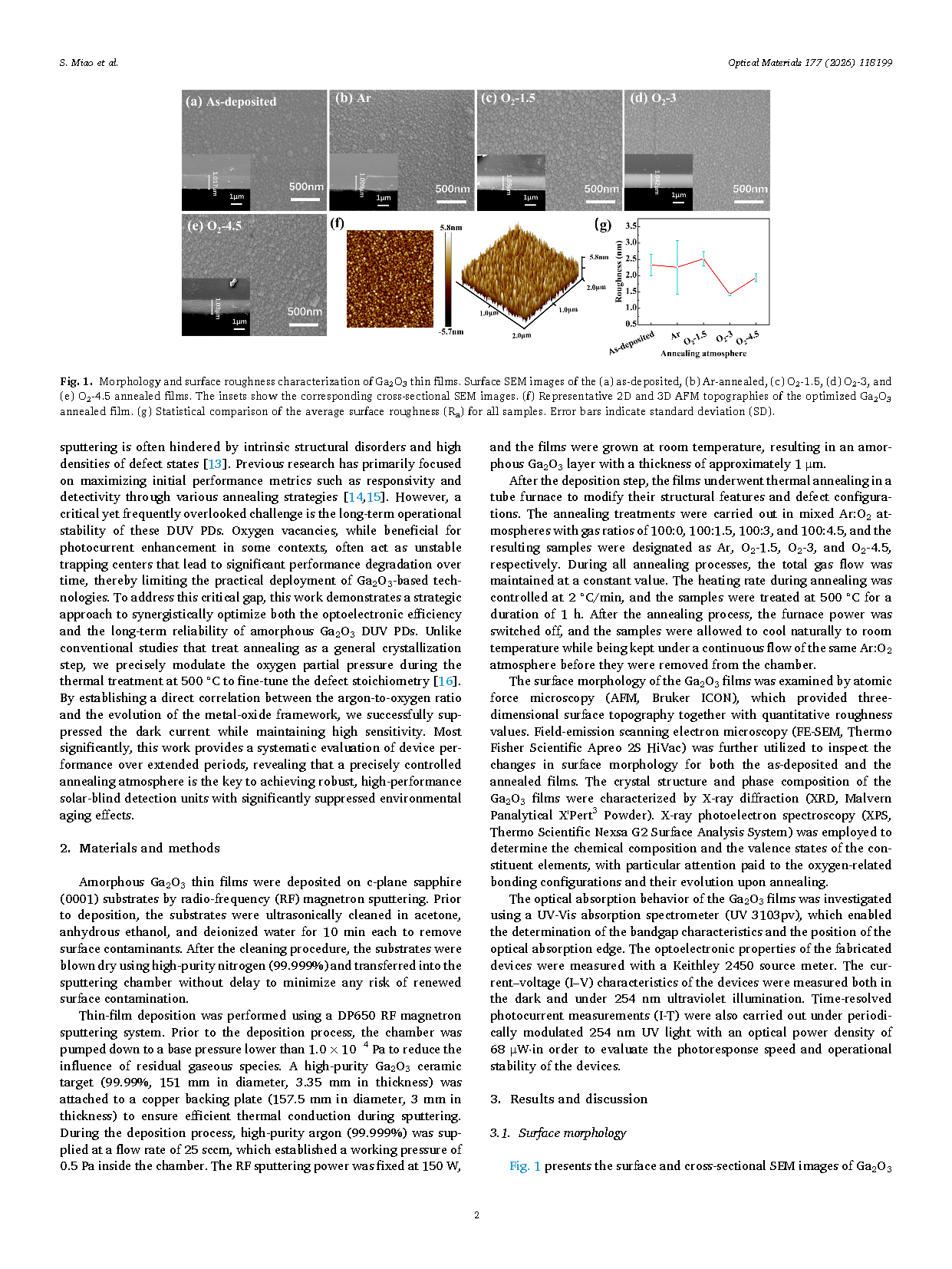
Figure 1 Morphology and surface roughness characterization of Ga₂O₃ thin films. Surface SEM images of the (a) as-deposited, (b) Ar-annealed, (c) O₂-1.5, (d) O₂-3, and (e) O₂-4.5 annealed films. The insets show the corresponding cross-sectional SEM images. (f) Representative 2D and 3D AFM topographies of the optimized Ga₂O₃ annealed film. (g) Statistical comparison of the average surface roughness (Rₐ) for all samples. Error bars indicate standard deviation (SD).
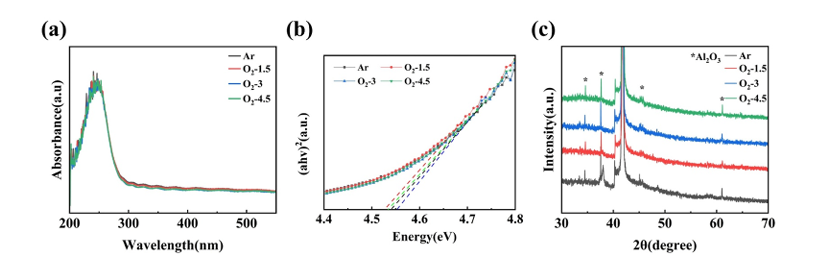
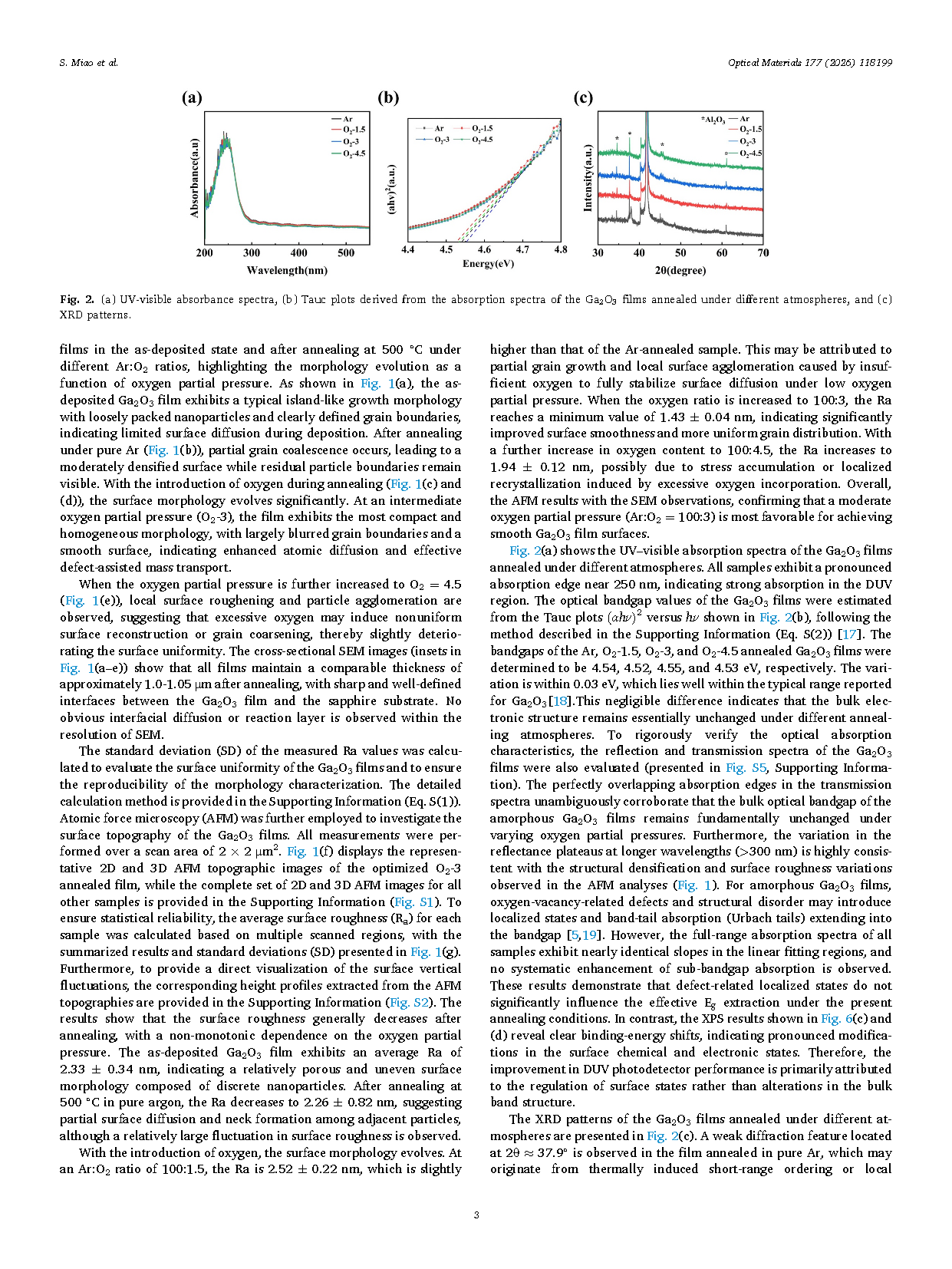
Figure 2 (a) UV-visible absorbance spectra, (b) Tauc plots derived from the absorption spectra of the Ga₂O₃ films annealed under different atmospheres, and (c) XRD patterns.
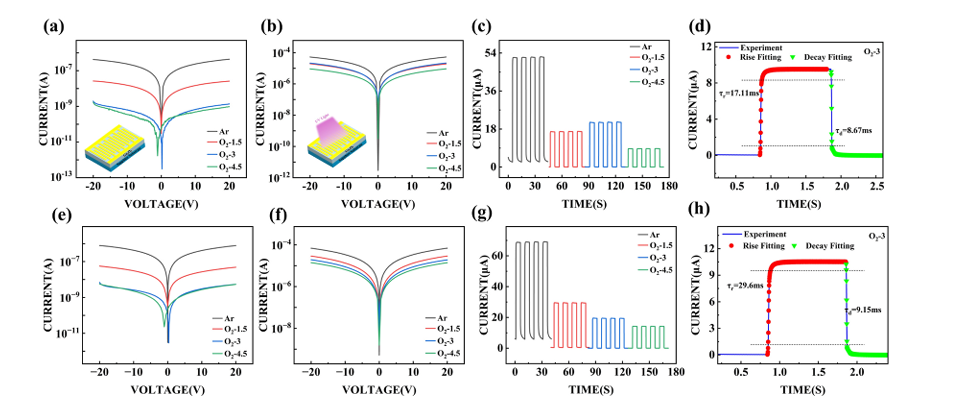
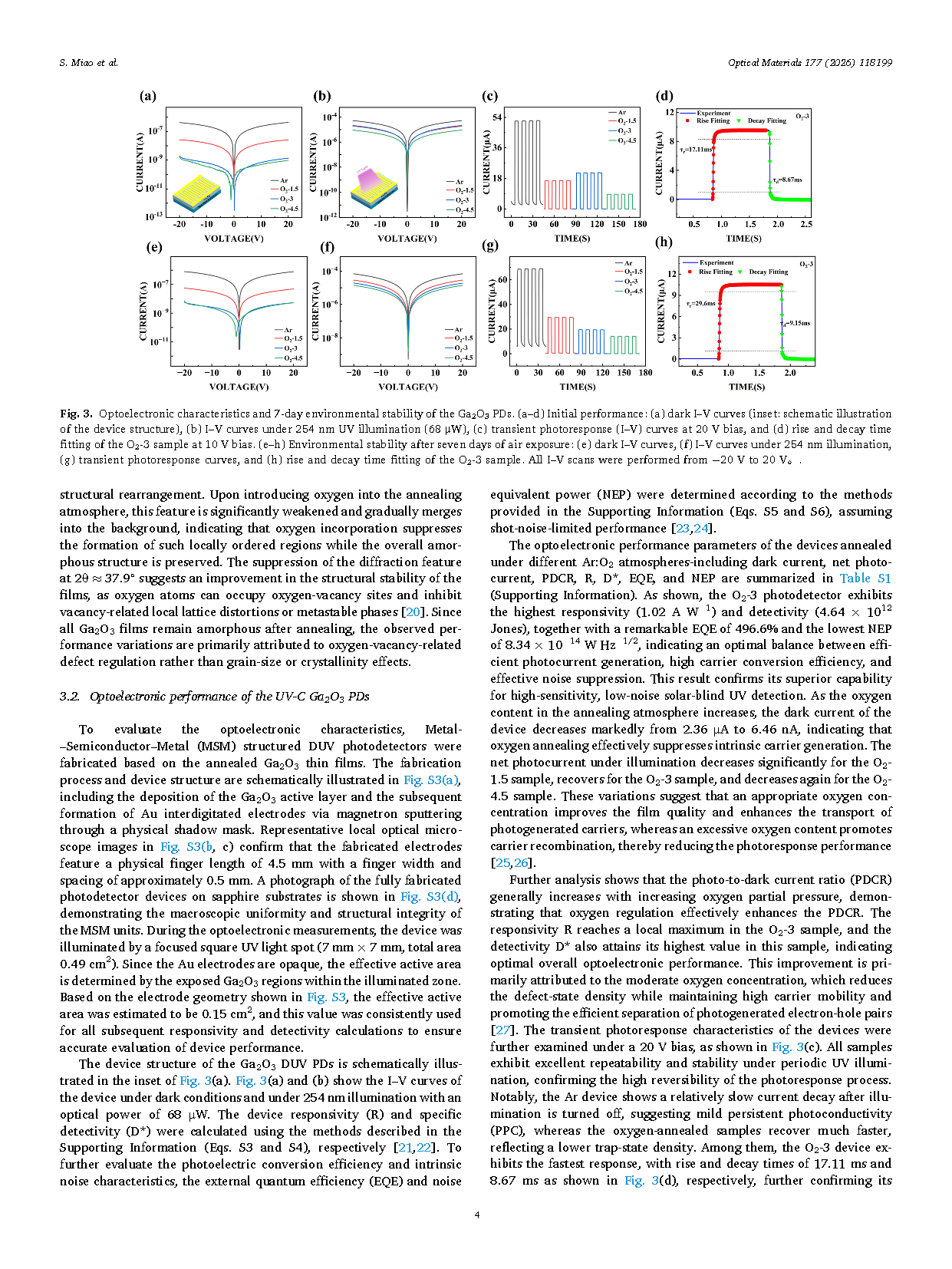
Figure 3 Optoelectronic characteristics and 7-day environmental stability of the Ga₂O₃ PDs. (a–d) Initial performance: (a) dark I–V curves (inset: schematic illustration of the device structure), (b) I–V curves under 254 nm UV illumination (68 μW), (c) transient photoresponse (I–T) curves at 20 V bias, and (d) rise and decay time fitting of the O₂-3 sample at 10 V bias. (e–h) Environmental stability after seven days of air exposure: (e) dark I–V curves, (f) I–V curves under 254 nm illumination, (g) transient photoresponse curves, and (h) rise and decay time fitting of the O₂-3 sample. All I–V scans were performed from −20 V to 20 V.
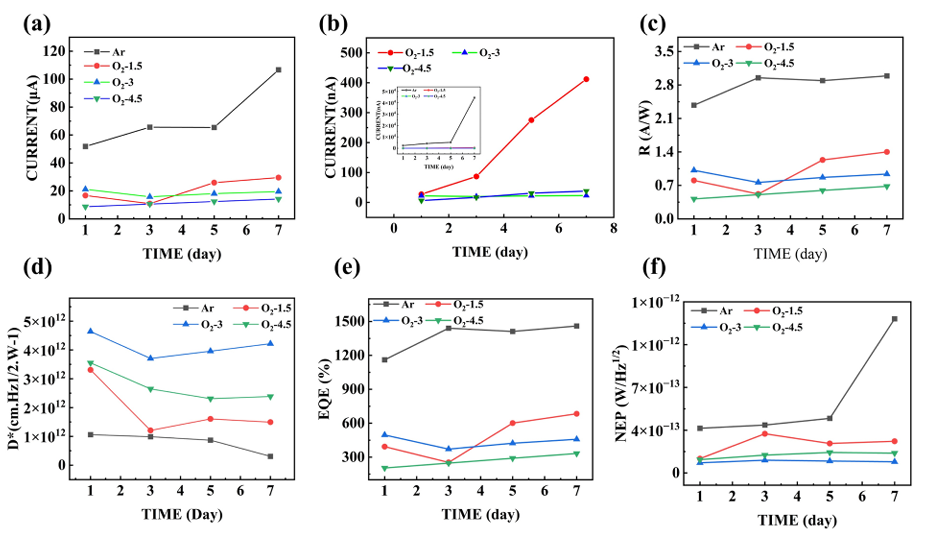
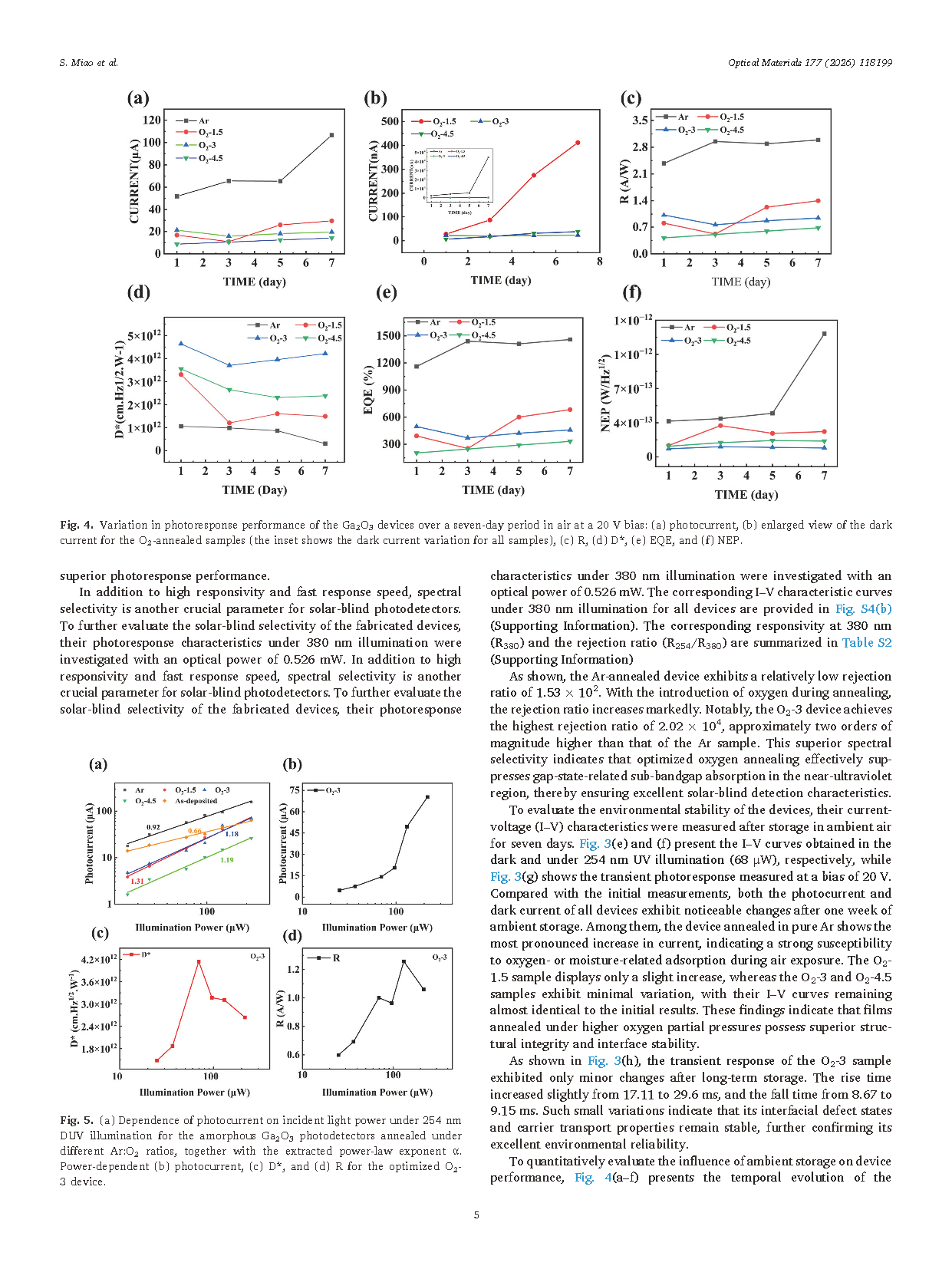
Figure 4 Variation in photoresponse performance of the Ga₂O₃ devices over a seven-day period in air at a 20 V bias: (a) photocurrent, (b) enlarged view of the dark current for the O₂-annealed samples (the inset shows the dark current variation for all samples), (c) R, (d) D*, (e) EQE, and (f) NEP.
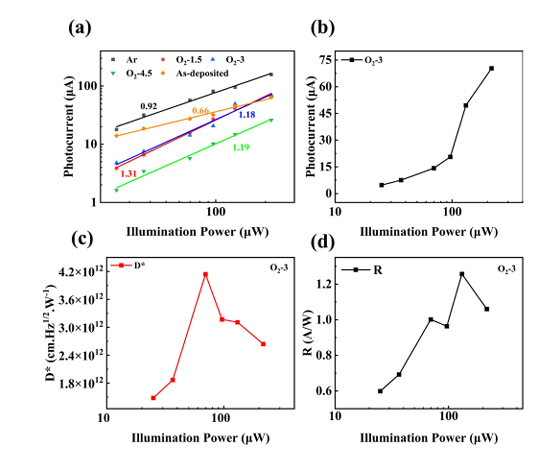
Figure 5 (a) Dependence of photocurrent on incident light power under 254 nm DUV illumination for the amorphous Ga₂O₃ photodetectors annealed under different Ar: O₂ ratios, together with the extracted power-law exponent α. Power-dependent (b) photocurrent, (c) D*, and (d) R for the optimized O₂-3
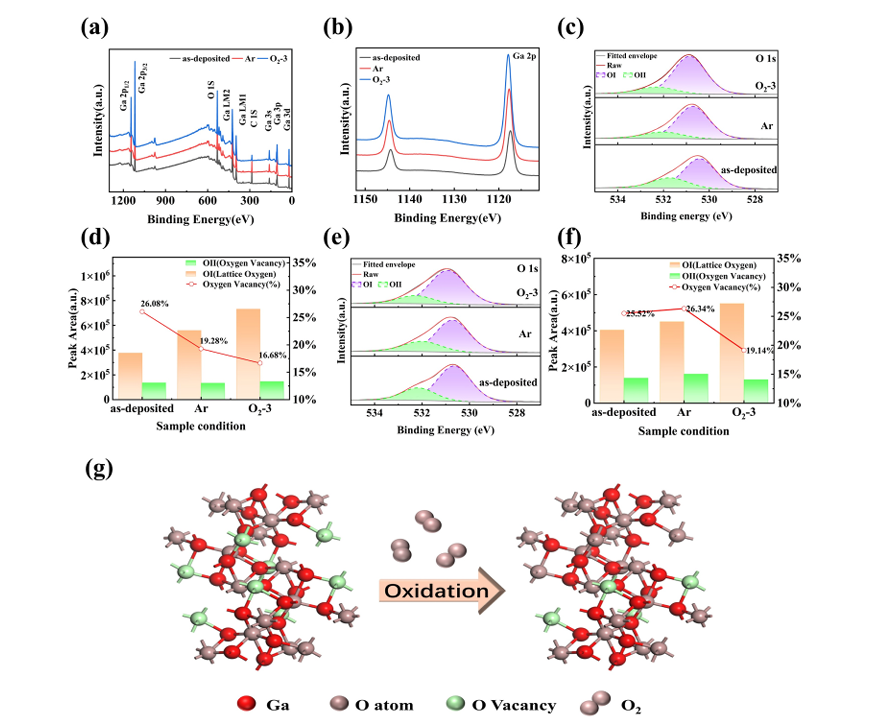
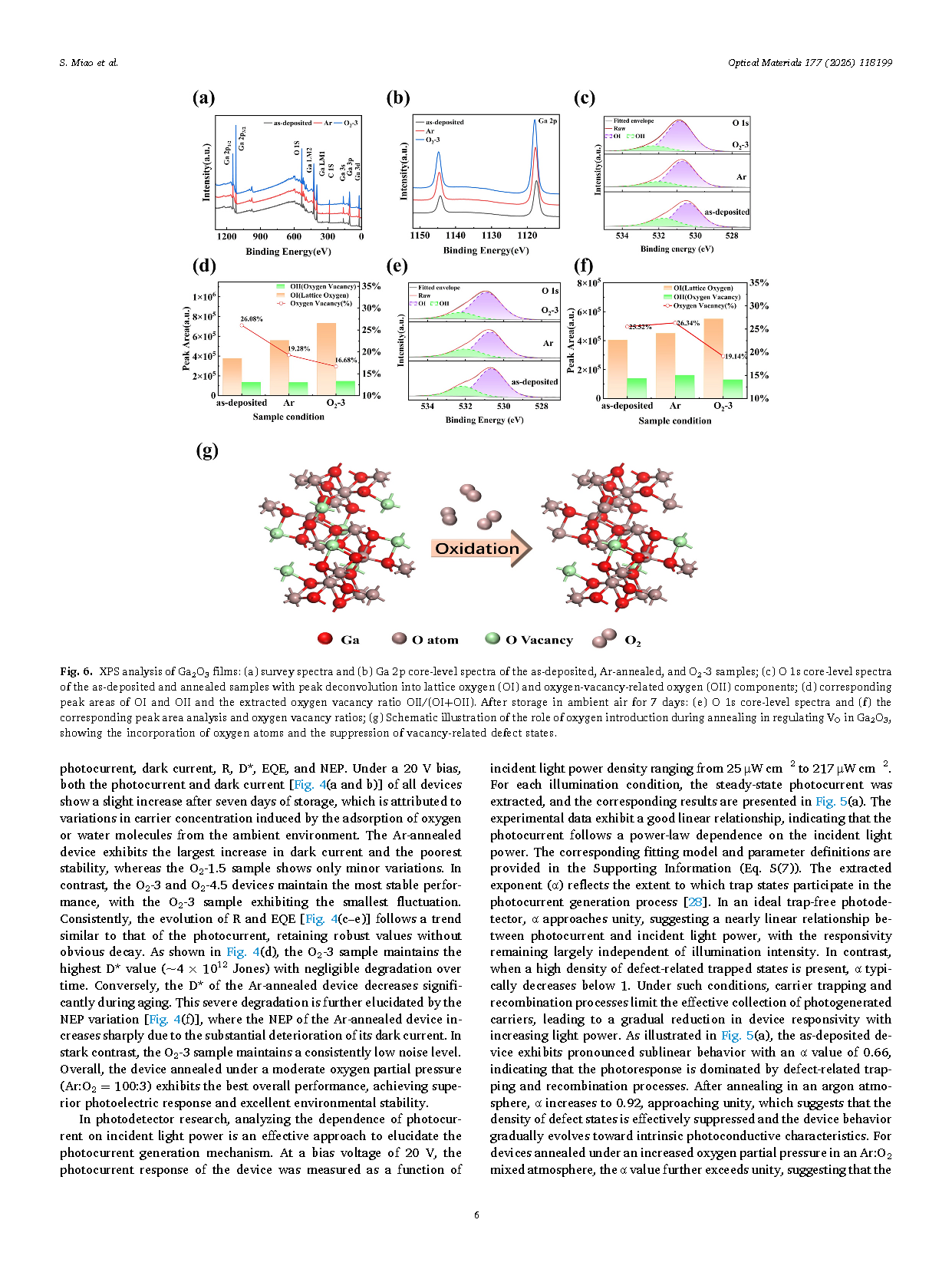
Figure 6 XPS analysis of Ga₂O₃ films: (a) survey spectra and (b) Ga 2p core-level spectra of the as-deposited, Ar-annealed, and O₂-3 samples; (c) O 1s core-level spectra of the as-deposited and annealed samples with peak deconvolution into lattice oxygen (OI) and oxygen-vacancy-related oxygen (OII) components; (d) corresponding peak areas of OI and OII and the extracted oxygen vacancy ratio OII/(OI+OII). After storage in ambient air for 7 days: (e) O 1s core-level spectra and (f) the corresponding peak area analysis and oxygen vacancy ratios; (g) Schematic illustration of the role of oxygen introduction during annealing in regulating Vₒ in Ga₂O₃ showing the incorporation of oxygen atoms and the suppression of vacancy-related defect states.
DOI:
10.1016/j.optmat.2026.118199

Instruction
Official Account

Cooperation
Top