


Researchers from Zhejiang Sci-Tech University have published a paper titled "Illumination-intensity-controlled bipolar photoresponse in α-Ga₂O₃ nanoarray photoelectrode for edge-enhanced solar-blind imaging" in Applied Physics Letters.
Background
Underwater solar-blind imaging suffers severe degradation of edge contrast caused by light attenuation, scattering and illumination fluctuation, which brings great difficulty to target identification. Traditional optimization strategies only rely on post-processing algorithms or extra optical-electrical modulation units, lacking hardware-native target contour recognition solutions. Photoelectrochemical (PEC) solar-blind photodetectors operate in self-powered mode without hermetic packaging. α-Ga₂O₃ has an ultrawide bandgap of 4.8–5.1 eV and outstanding chemical stability, making it an ideal photosensitive material for underwater detection. Conventional unipolar Ga₂O₃ photoelectrodes only generate single-direction photocurrent and fail to distinguish light-dark boundaries. Existing bipolar devices require complicated heterophase/heterojunction fabrication with poor repeatability and high cost. No reports realize polarity tuning merely by illumination and bias co-regulation based on single-phase Ga₂O₃. To solve these limitations, mesoporous α-Ga₂O₃ nanorod arrays are synthesized via hydrothermal route. The device achieves light-intensity-dependent polarity switching originating from intrinsic interfacial states without complex heterostructures. An underwater imaging simulation model is constructed to verify that the native positive-negative-zero photocurrent profile of the device enhances edge contrast at hardware level, offering a novel strategy for solar-blind underwater imaging optimization.
Abstract
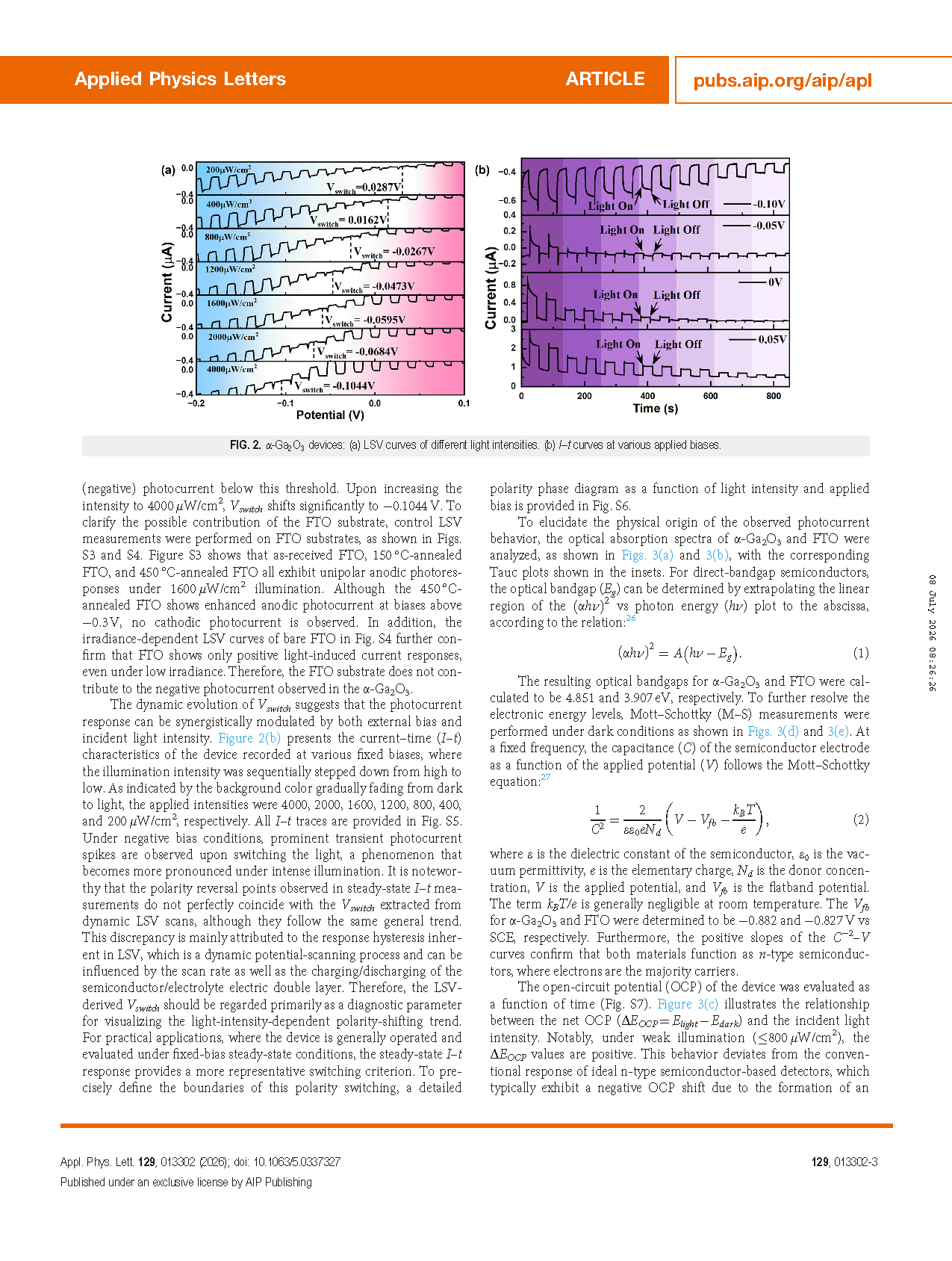
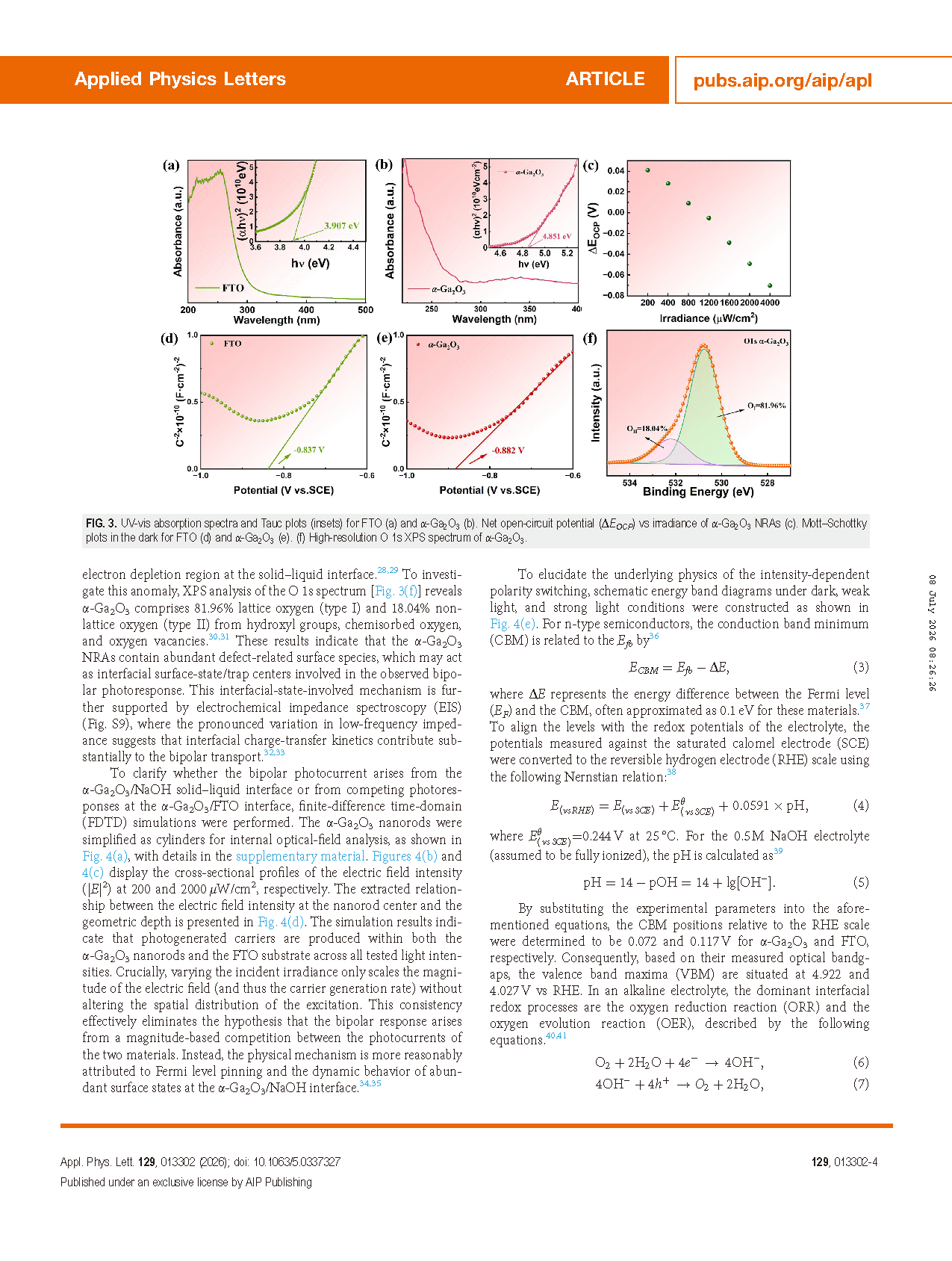
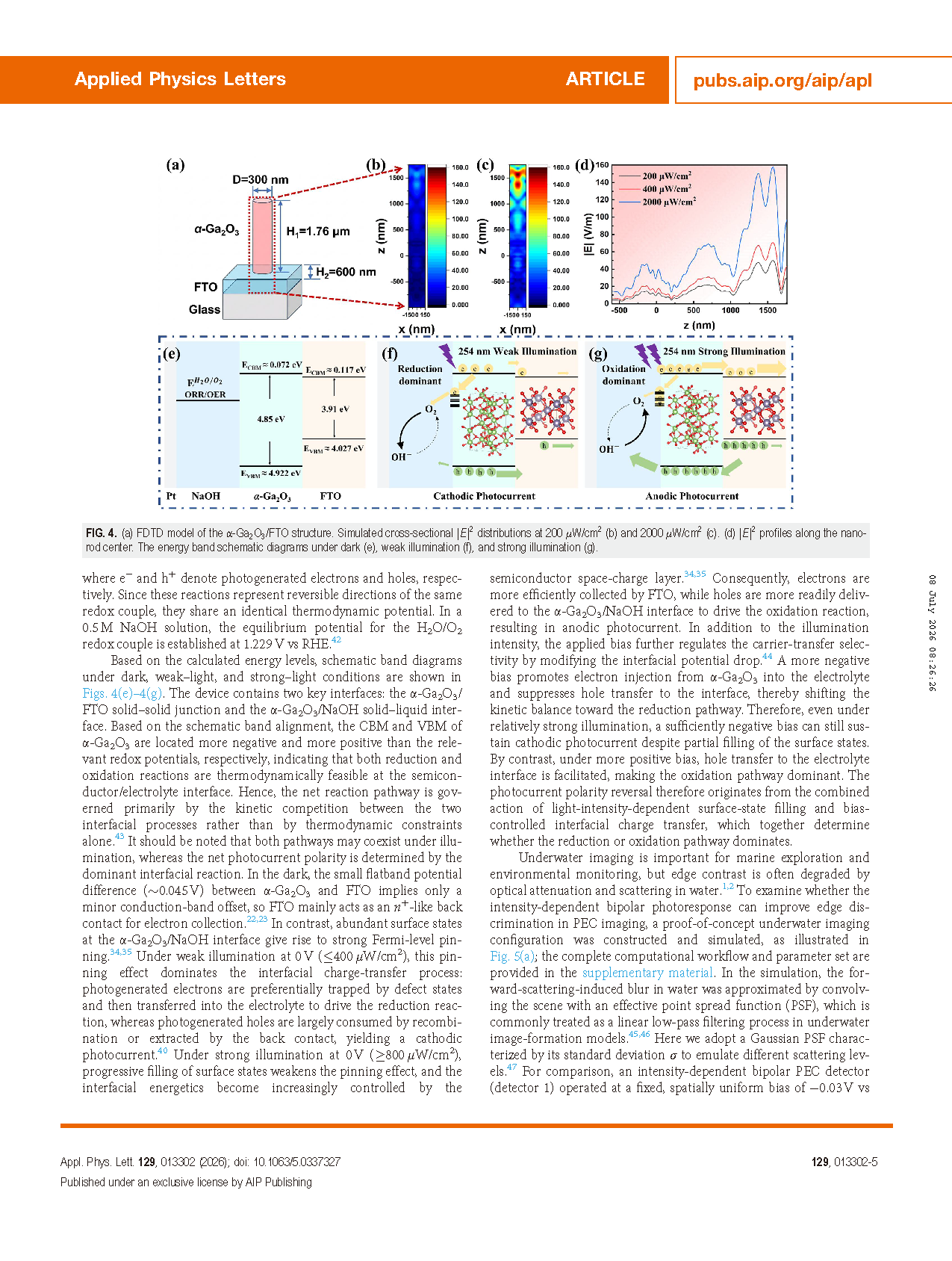
Underwater imaging often suffers from reduced edge contrast due to light attenuation, scattering, and fluctuations in illumination intensity, leading to difficulties in target recognition. Existing solutions primarily rely on post-processing algorithms or additional optical and electrical modulation techniques. To address this challenge, we propose a hardware-embedded target recognition strategy utilizing α-Ga₂O₃ nanorod arrays grown on fluorine-doped tin oxide substrates, which achieve a negative photocurrent response under low-light conditions and thereby enable automatic delineation of target contours. Unlike conventional unipolar photoelectrochemical (PEC) electrodes, this device achieves deterministic control over the polarity of the photocurrent through the synergistic modulation of incident light intensity and applied bias. Linear sweep voltammetry measurements reveal that as the irradiance increases from 200 to 4000 μW / cm², the polarity transition potential systematically shifts negatively from +0.0287 V (vs saturated calomel electrode) to −0.1044 V. This intensity-dependent bipolar response is attributed to a transition in the device operating mechanism from surface-state-pinning-dominated to space-charge-layer-dominated behavior, reflecting the evolution of the photoelectrode interface barrier height with varying light intensity. To evaluate its imaging potential, a proof-of-concept underwater PEC imaging model was constructed, in which the bipolar device generates an intrinsic positive–negative–zero photocurrent profile across intensity boundaries and delivers consistently higher edge contrast than that of a conventional unipolar detector under different scattering conditions. These findings provide a viable pathway for hardware-level edge contrast enhancement in solar-blind PEC imaging.
Highlights
Single-phase α-Ga₂O₃nanorod photoelectrode without heterojunction / phase junction; light-intensity-controllable photocurrent polarity switching is realized via intrinsic interfacial defects, featuring simple synthesis and excellent repeatability;
The polarity transition potential continuously shifts negative within 200–4000 μW / cm² illumination range; output polarity can be precisely tuned by the cooperation of light intensity and applied bias;
The bipolar mechanism is clarified: weak light leads to surface state pinning for cathodic photocurrent, while strong light dominates by space-charge effect to generate anodic photocurrent;
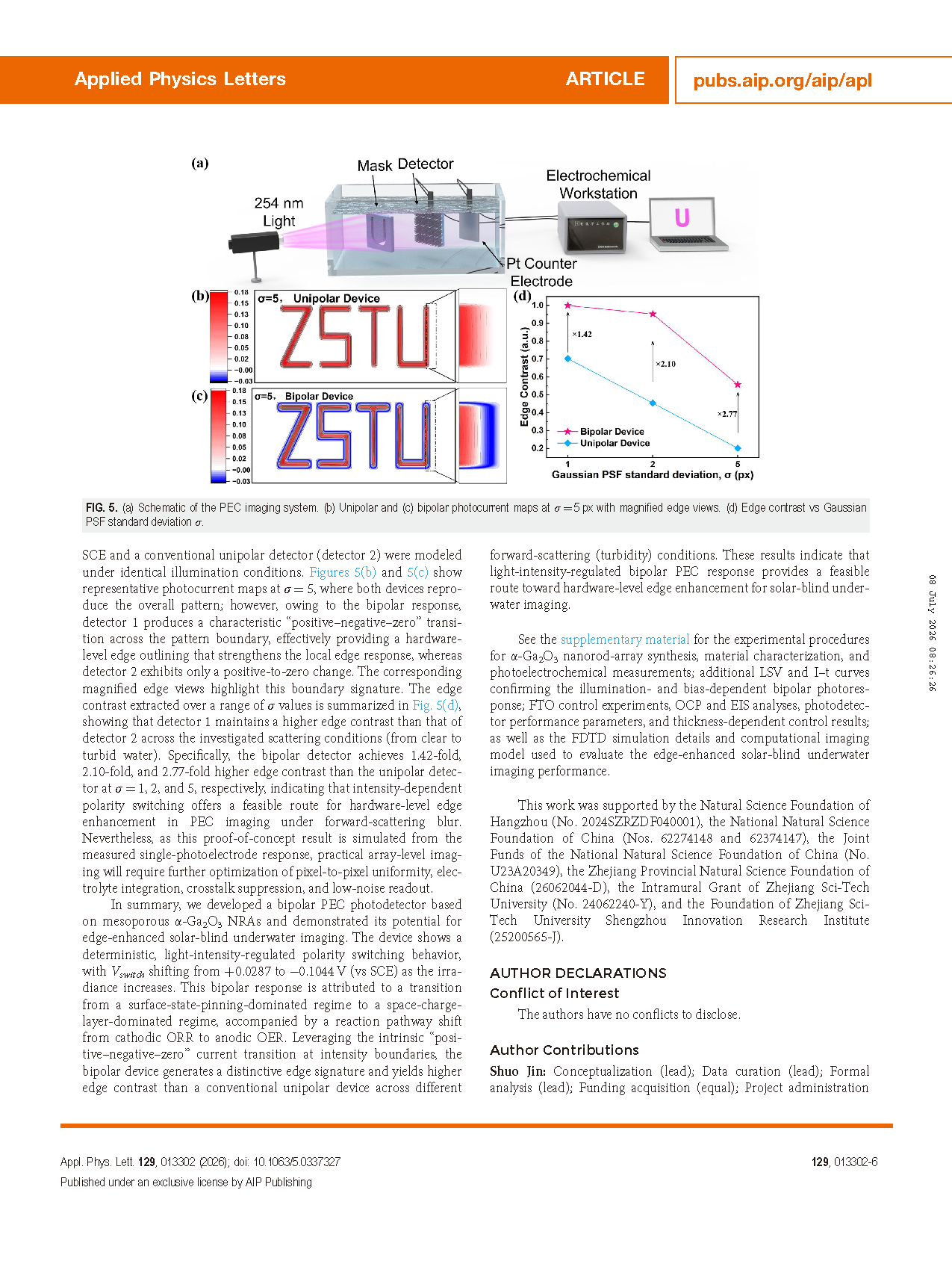
Native positive-negative-zero photocurrent profile enables edge contrast enhancement at hardware level without post-processing, with contrast increased by up to 2.77 times under high turbidity scattering;
Mesoporous nanorod arrays are fabricated via hydrothermal annealing with specific surface area of 23.1 m² / g, providing large solid-liquid interface and improved photoelectrochemical reaction efficiency.
Conclusion
In summary, we developed a bipolar PEC photodetector based on mesoporous α-Ga₂O₃ NRAs and demonstrated its potential for edge-enhanced solar-blind underwater imaging. The device shows a deterministic, light-intensity-regulated polarity switching behavior, with Vswitch shifting from +0.0287 to −0.1044 V (vs SCE) as the irradiance increases. This bipolar response is attributed to a transition from a surface-state-pinning-dominated regime to a space-charge-layer-dominated regime, accompanied by a reaction pathway shift from cathodic ORR to anodic OER. Leveraging the intrinsic “positive–negative–zero” current transition at intensity boundaries, the bipolar device generates a distinctive edge signature and yields higher edge contrast than a conventional unipolar device across different forward-scattering (turbidity) conditions. These results indicate that light-intensity-regulated bipolar PEC response provides a feasible route toward hardware-level edge enhancement for solar-blind underwater imaging.
Project Support
This work was supported by the Natural Science Foundation of Hangzhou (No. 2024SZRZDF040001), the National Natural Science Foundation of China (Nos. 62274148 and 62374147), the Joint Funds of the National Natural Science Foundation of China (No. U23A20349), the Zhejiang Provincial Natural Science Foundation of China (26062044-D), the Intramural Grant of Zhejiang Sci-Tech University (No. 24062240-Y), and the Foundation of Zhejiang Sci-Tech University Shengzhou Innovation Research Institute (25200565-J).
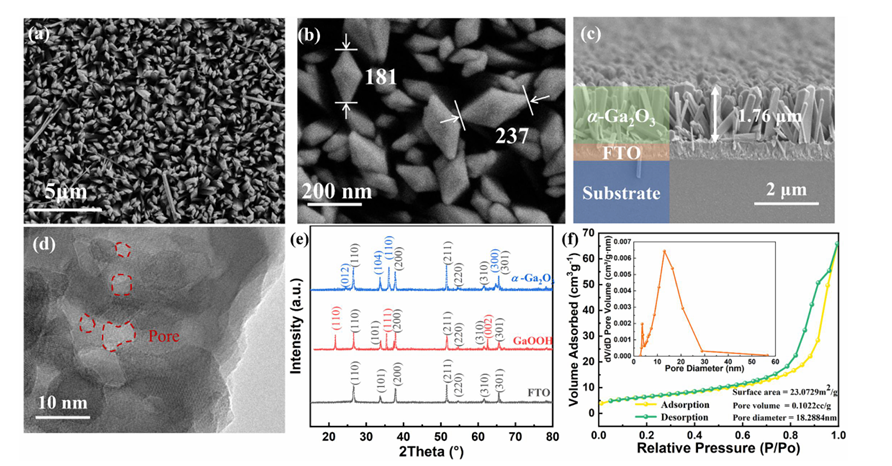
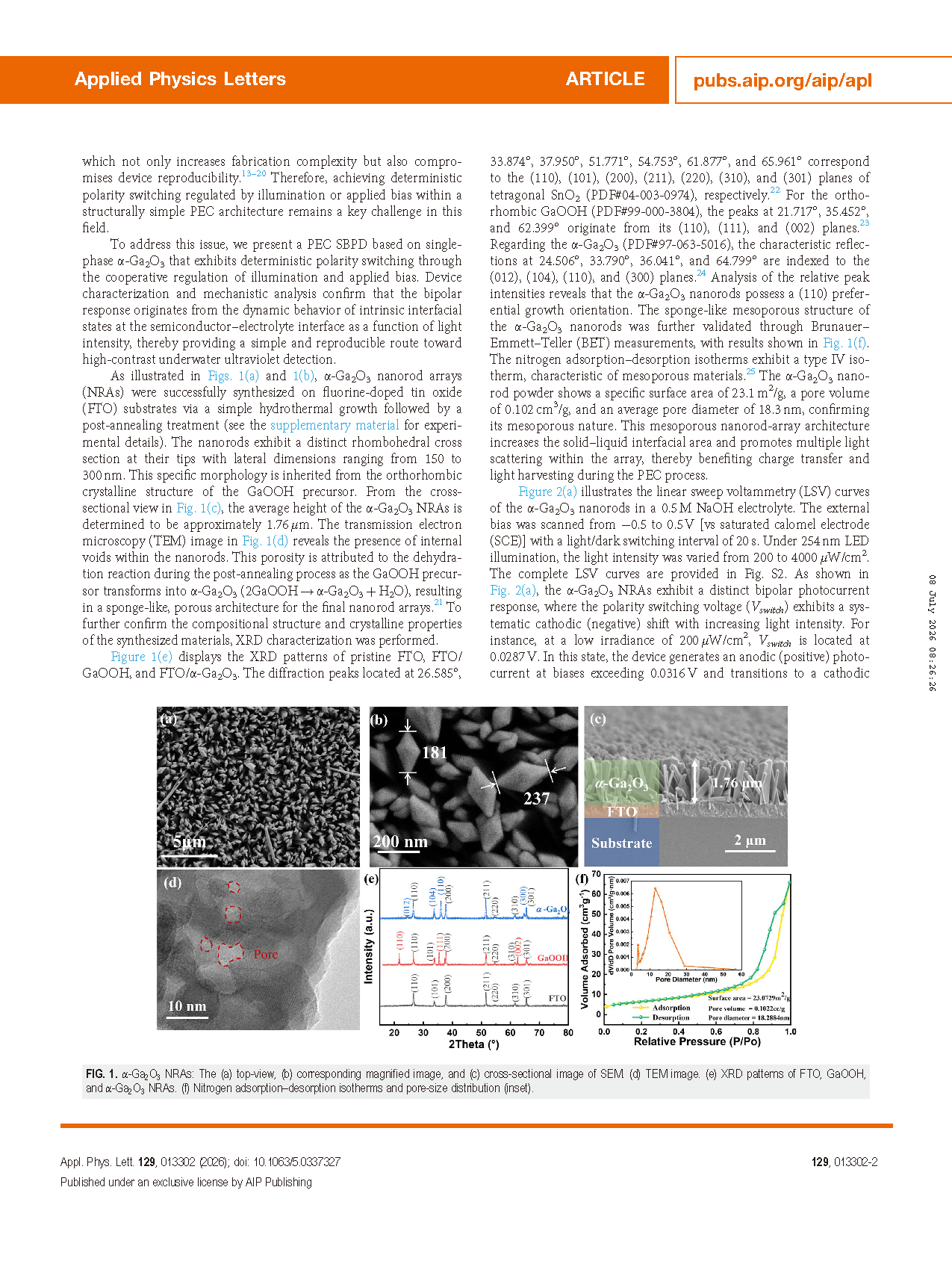
Figure 1 (a) Top-view SEM image of α-Ga₂O₃ nanoarrays; (b) Magnified SEM image; (c) Cross-sectional SEM image; (d) TEM image of single nanorod; (e) XRD patterns of bare FTO, GaOOH precursor and α-Ga₂O₃; (f) N₂ adsorption-desorption isotherms with pore size distribution inset
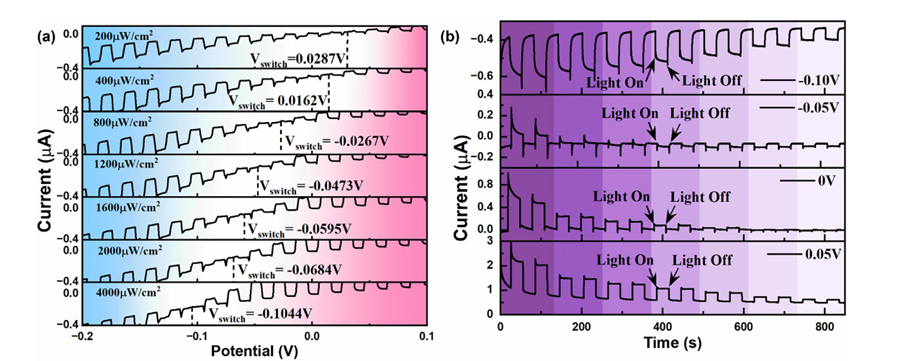
Figure 2 (a) Linear sweep voltammetry (LSV) curves under varied illumination power; (b) Time-resolved I-t curves at multiple fixed applied biases
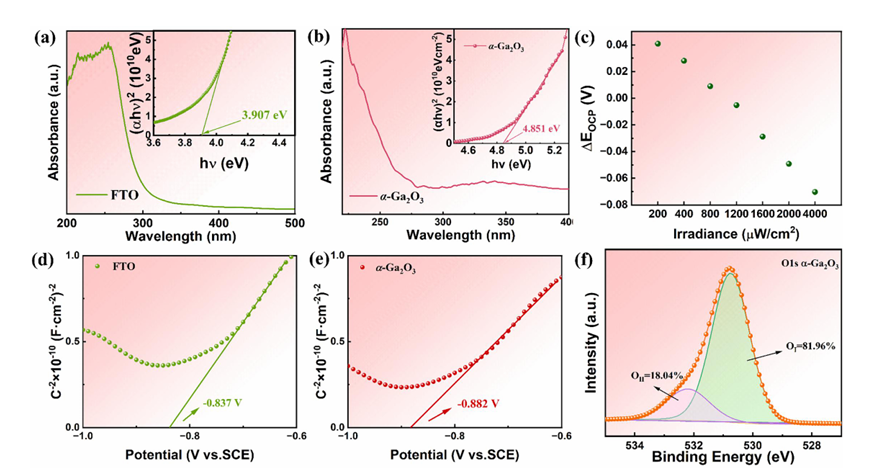
Figure 3 (a) UV-Vis absorption of FTO and α-Ga₂O₃ with Tauc plot inset; (b) Net open-circuit potential versus irradiance; (c) Mott-Schottky plots of two materials; (d) High-resolution O 1s XPS spectrum of α-Ga₂O₃
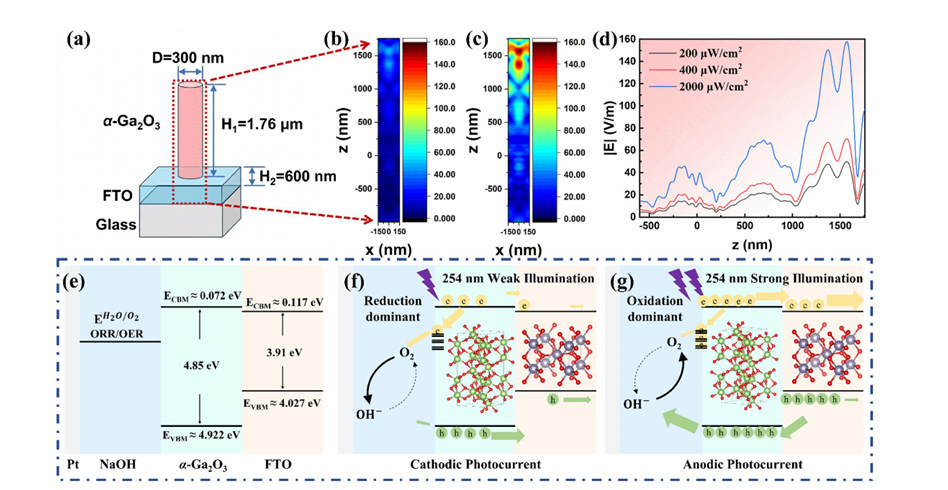
Figure 4 (a) FDTD simulation model of nanorod structure; (b) Cross-section electric field distribution at 200 μW / cm²; (c) Cross-section electric field distribution at 2000 μW / cm²; (d) Electric field intensity along nanorod central axis; (e-g) Energy band diagrams under dark, weak and strong illumination
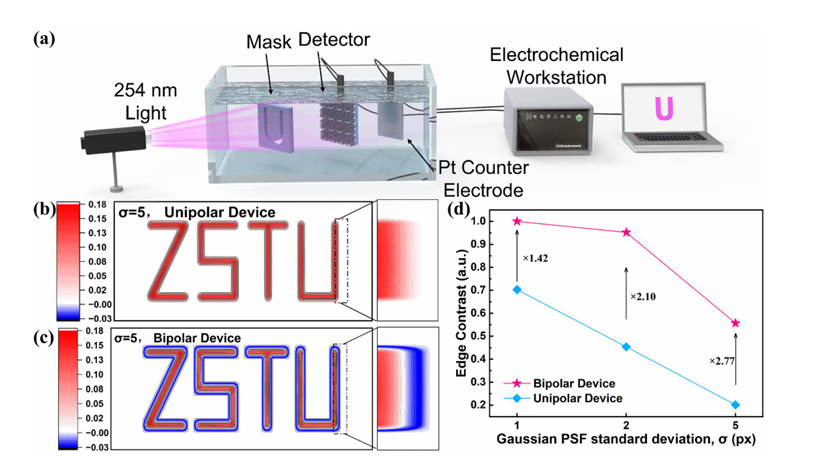
Figure 5 (a) Schematic diagram of underwater PEC imaging simulation system; (b) Photocurrent map of unipolar detector; (c) Photocurrent map of bipolar device; (d) Edge contrast comparison under different Gaussian PSF standard deviations
DOI:
doi.org/10.1063/5.0337327

Instruction
Official Account

Cooperation
Top