


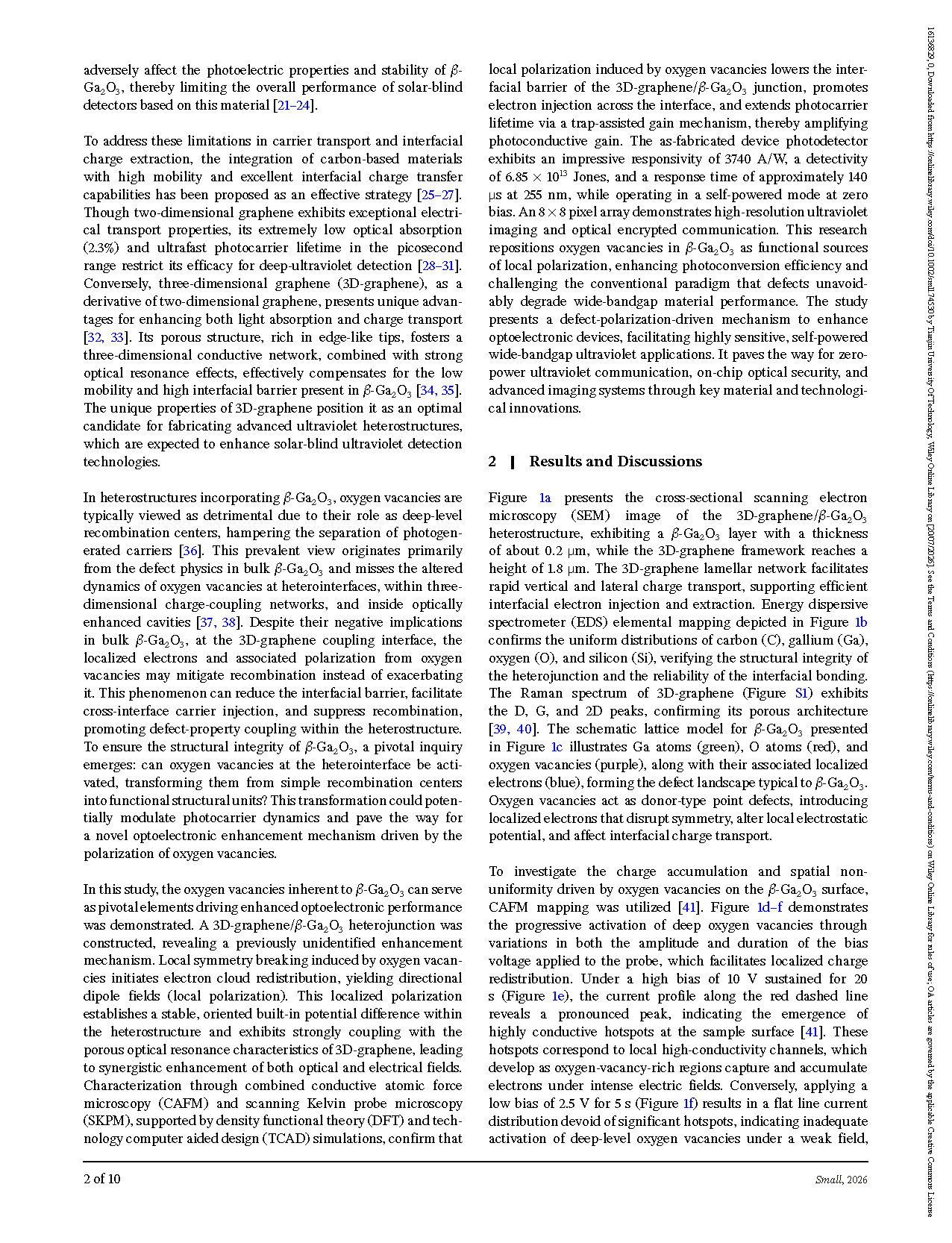
Researchers from Ningbo University have published a dissertation titled " Defect-Polarization Coupling in 3D-Graphene/β-Ga₂O₃ Heterostructures for Self-Powered and Multifunctional Solar-Blind Ultraviolet Photodetection " in Small.
Background
Solar-blind ultraviolet photodetectors operating in the 200 – 280 nm range are valuable for space communication, biochemical sensing, early missile warning systems, and information security. Their insensitivity to solar background radiation ensures high sensitivity and reliable optical signal transmission even amid intense background interference. Monoclinic phase gallium oxide (β-Ga₂O₃) is a promising candidate due to its ultra-wide bandgap of 4.8 eV, high breakdown field (∼ 8 MV/cm), great thermal stability, and strong radiation resistance. However, the potential of β-Ga₂O₃ is limited by low carrier mobility and significant recombination processes, affecting its performance in high-gain, high-speed, and low-power photodetectors. Notably, oxygen vacancies inevitably formed during synthesis create deep-level traps that adversely affect the photoelectric properties and stability of β-Ga₂O₃, thereby limiting the overall performance of solar-blind detectors based on this material.
Abstract
Solar-blind ultraviolet photodetectors are promising for secure communication, early warning systems, and information security. Monoclinic phase gallium oxide (β-Ga₂O₃) is an ideal candidate due to its ultra-wide bandgap. Unavoidable oxygen vacancies in β-Ga₂O₃ have been viewed as detrimental defects that degrade performance. However, this study introduces an innovative approach that reinterprets these oxygen vacancies as beneficial for optoelectronic enhancement, accomplished through a 3D-graphene/β-Ga₂O₃ heterojunction.
Oxygen vacancies cause localized lattice symmetry breaking, generating dipole fields and local polarization. This interacts with the optical resonance of 3D-graphene, enhancing optical and electrical fields in the heterojunction, which improves the separation and transport of photogenerated carriers. Experimental investigations, along with DFT and TCAD calculations, reveal that oxygen-vacancy-induced local polarization reduces the interfacial barrier, enhances electron injection, and increases photoconductive gain through a trap-assisted mechanism. The photodetector achieves weak-light detection at 255 nm (0.002 µW/mm²) with a responsivity of 3740 A/W and specific detectivity of 6.85×10¹³ Jones, a response of 140 µs, and enabling zero-bias self-powered operation. The 8×8 array allows for ultraviolet imaging and optical encrypted communication. This study reframes oxygen vacancies as functional mechanisms for enhancing polarization, paving the way for advanced wide-bandgap optoelectronic device design.
Conclusion
This study investigates the role of oxygen vacancies in the 3D-graphene/β-Ga₂O₃ heterostructure and puts forth a mechanism for photodetection enhancement based on defect-induced polarization. Comprehensive analyses through CAFM, SKPM, DFT, and responsivity simulations demonstrate that while oxygen vacancies in bulk β-Ga₂O₃ are typically seen as deep-level recombination centers, their presence creates localized dipole fields at the heterointerface when integrated with 3D-graphene. This localized polarization results in symmetry breaking that decreases the interfacial barrier, promotes the cross-interface injection of photogenerated electrons, and extends carrier lifetimes through a trap-gain mechanism, thereby enhancing the separation, injection, and transport efficiencies of photogenerated carriers. The as-fabricated photodetector utilizing this mechanism displays remarkable performance in the 255 nm solar-blind ultraviolet range, achieving weak-light detection down to 0.002 µW/mm², a responsivity of 3740 A/W at a bias of 10 V, a specific detectivity of 6.85 × 10¹³ Jones, and a response time of about 140 µs, alongside self-powered operation without external bias. The constructed 8 × 8 pixel array facilitates high-resolution ultraviolet imaging and optical encrypted communication, demonstrating strong scalability and applicability across systems. This work redefines oxygen vacancies in β-Ga₂O₃ from detrimental to beneficial, contributing to localized polarization and challenging the view that defects in wide-bandgap semiconductors always degrade performance. The insights pave the way for high-gain, high-speed, self-powered solar-blind ultraviolet photodetectors, supporting advancements in ultraviolet communication, on-chip optical security, and intelligent imaging chips.
Project Support
This study was supported by the National Natural Science Foundation of China (Nos. 62174093 and 12474273), the Open Research Fund of China State Key Laboratory of Materials for Integrated Circuits (No. SKLJC-K2025-06), the Yong jiang talents program (No. 2022 A-218-G), the Ningbo Youth Science and Technology Innovation Leading Talent Project under Grant (Nos. 2024QL013 and 2023QL016), and the Natural Science Foundation of Ningbo (No. 2024J148).
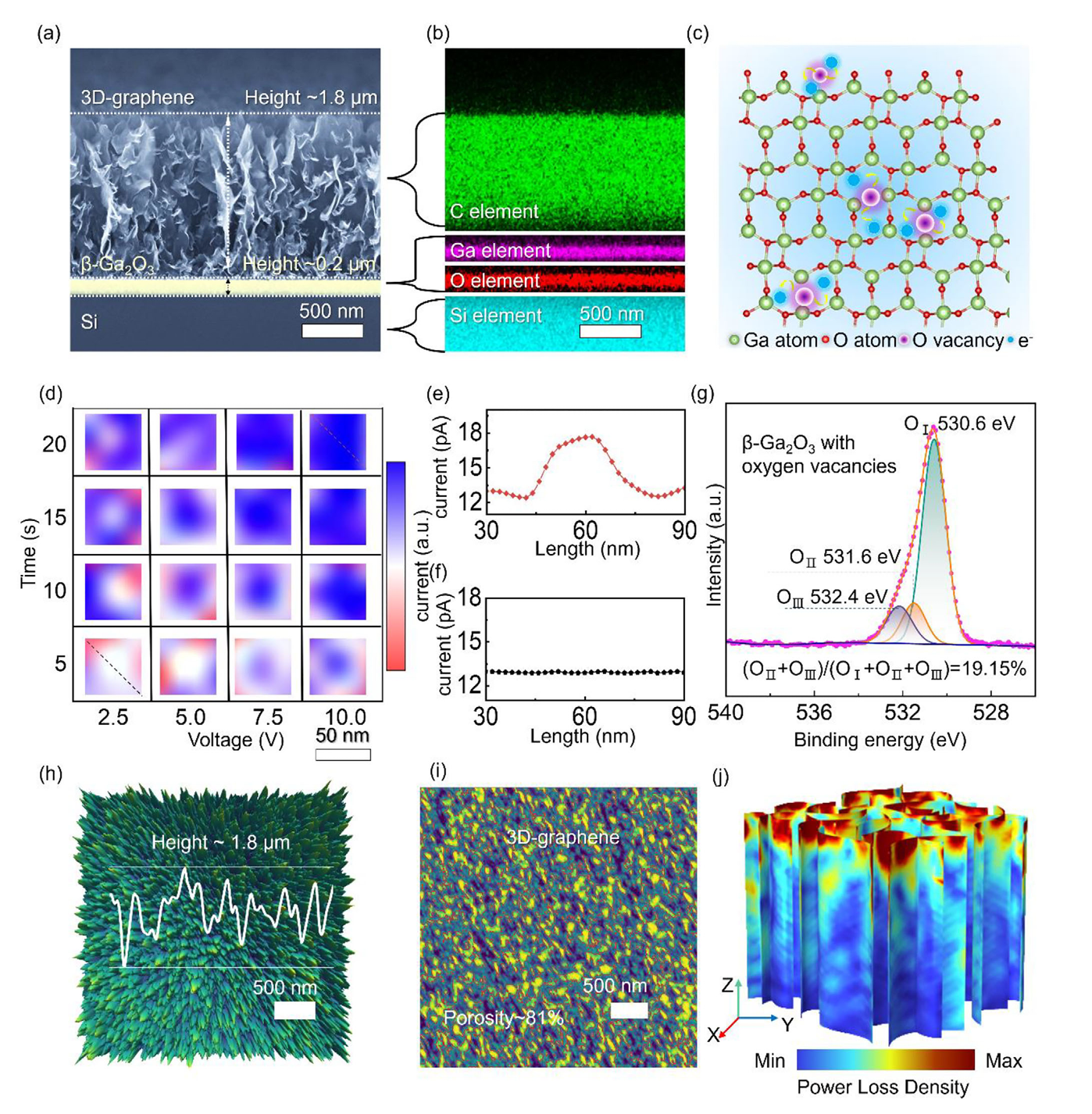
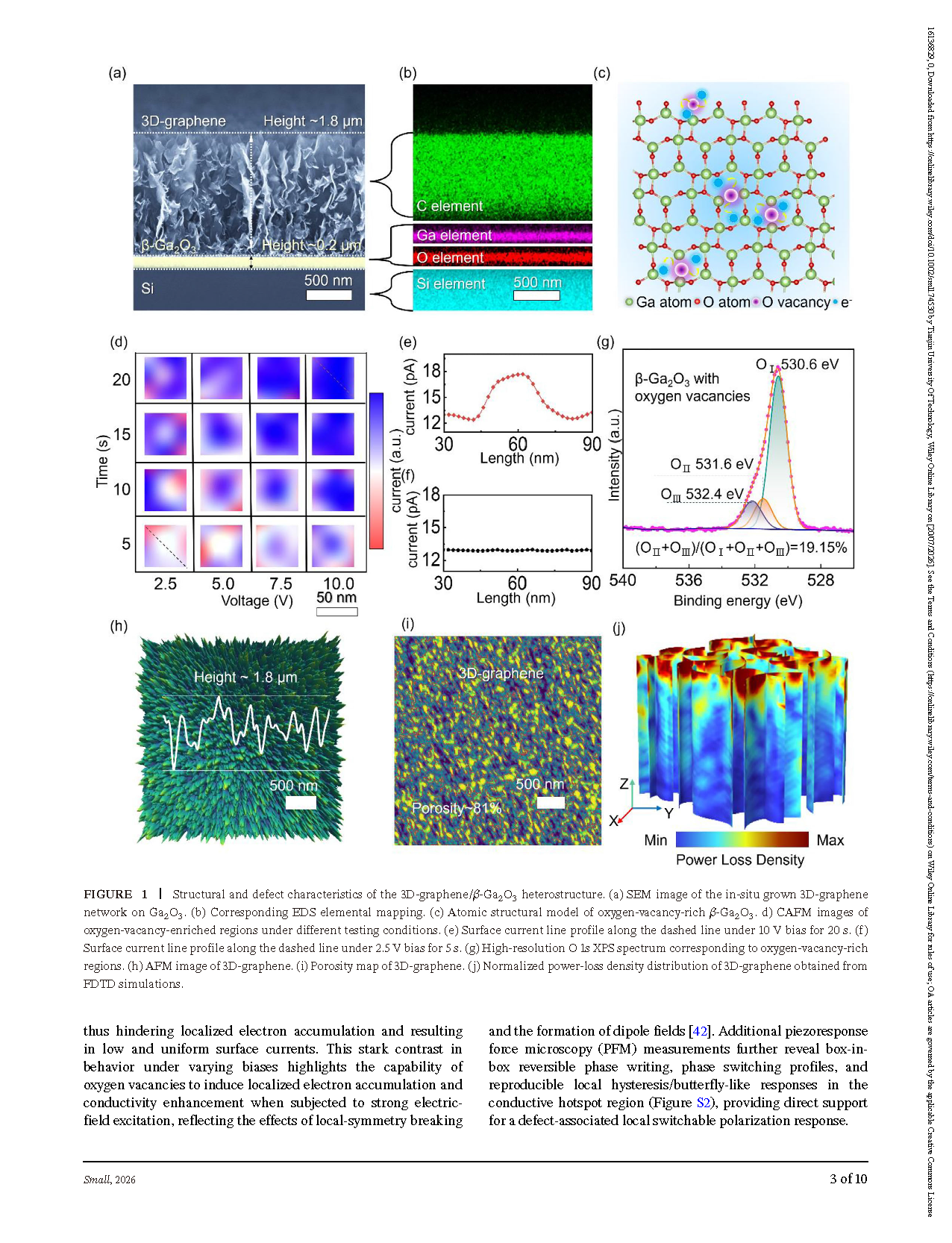
FIGURE 1 Structural and defect characteristics of the 3D-graphene/β-Ga₂O₃ heterostructure. (a) SEM image of the in-situ grown 3D-graphene network on Ga₂O₃. (b) Corresponding EDS elemental mapping. (c) Atomic structural model of oxygen-vacancy-rich β-Ga₂O₃. d) CAFM images of oxygen-vacancy-enriched regions under different testing conditions. (e) Surface current line profile along the dashed line under 10 V bias for 20 s. (f) Surface current line profile along the dashed line under 2.5 V bias for 5 s. (g) High-resolution O 1s XPS spectrum corresponding to oxygen-vacancy-rich regions. (h) AFM image of 3D-graphene. (i) Porosity map of 3D-graphene. (j) Normalized power-loss density distribution of 3D-graphene obtained from FDTD simulations.
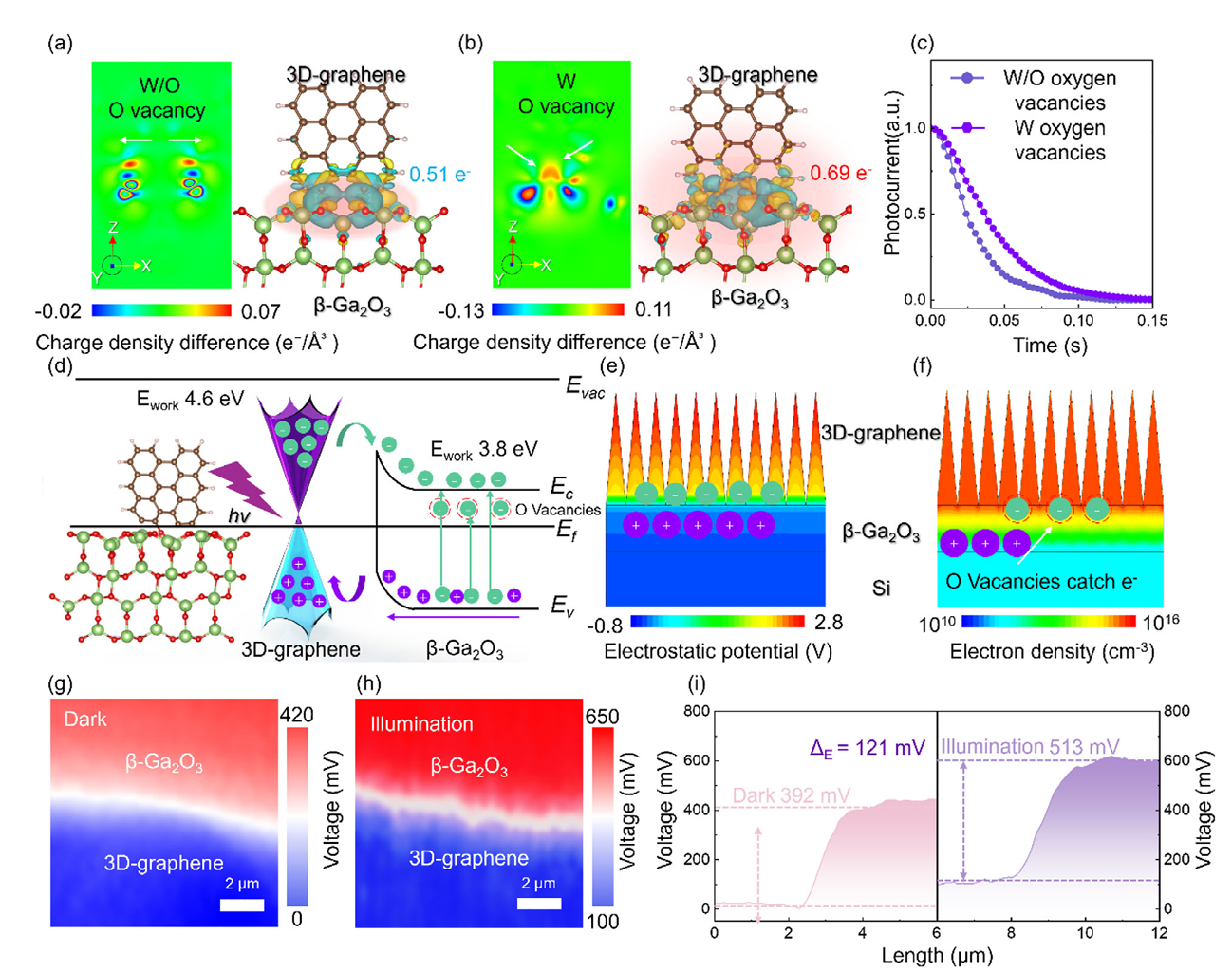
FIGURE 2 Oxygen-vacancy-induced charge redistribution and built-in field enhancement in the 3D-graphene/β-Ga₂O₃ heterojunction. (a–b) Charge density difference maps of the 3D-graphene/β-Ga₂O₃ heterojunction with and without oxygen vacancies. The red and blue regions indicate electron accumulation and depletion, respectively. (c) Transient photocurrent response spectra of heterostructures with and without oxygen vacancies. (d) Schematic representation of the work functions and band alignment of 3D-graphene and β-Ga₂O₃. (e–f) TCAD-simulated potential distribution and electron density maps of the heterostructure under 255 nm illumination. (g–h) Interfacial potential distribution of the heterostructure in the dark and under illumination. (i) Variation of surface potential extracted from (g–h).
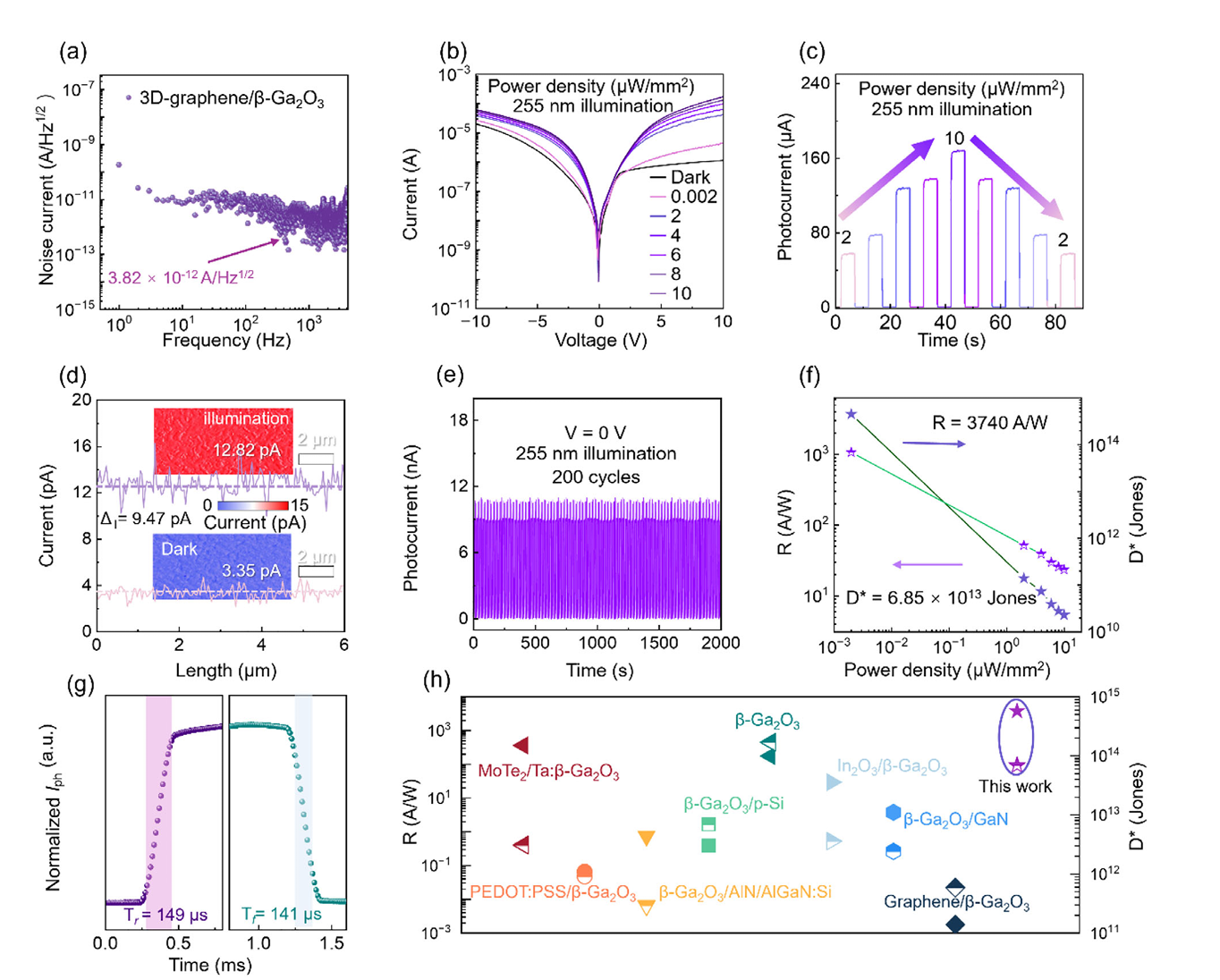
FIGURE 3 Self-powered solar-blind ultraviolet detection performance of the as-fabricated photodetector. (a) Noise-equivalent power spectrum of the 3D-graphene/β-Ga₂O₃ solar-blind ultraviolet photodetector. (b) I-V characteristics under illumination powers ranging from 0.002 to 10 µW/mm2.(c) Transient photo response (I-T) curves under 255 nm illumination at different optical power densities with a 10 V bias. (d) Local photocurrent mapping measured by CAFM under zero bias. (e) Device-level self-powered photo response measured under zero bias. (f) Dependence of responsivity (R) and specific detectivity (D*) on optical power density. (g) Rise and decay times of the as-fabricated photodetector. (h) Performance comparison between this work and previously reported β-Ga₂O₃-based solar-blind ultraviolet photodetectors.
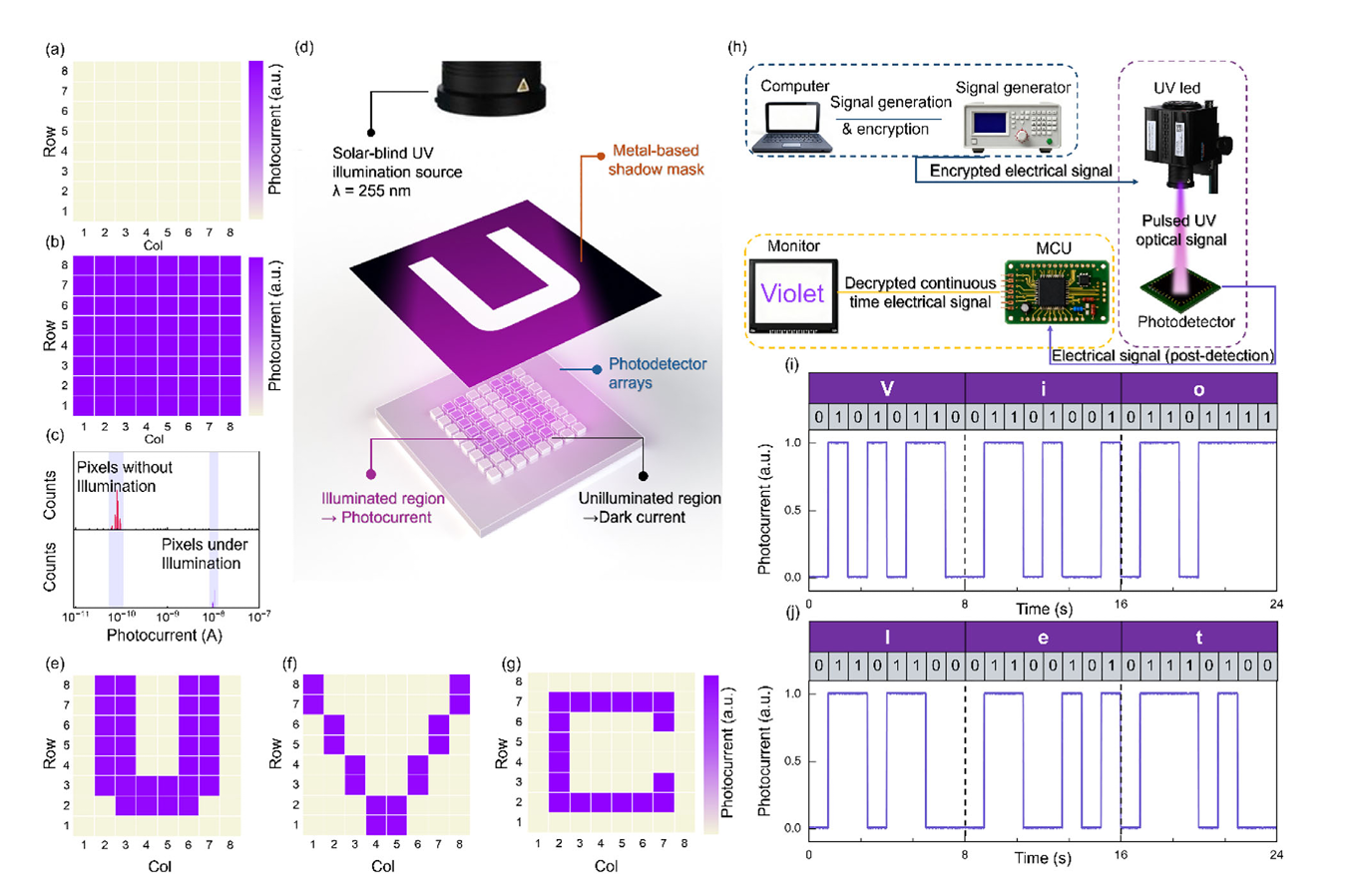
FIGURE 4 System-level demonstration of self-powered ultraviolet imaging and secure optical communication. (a–b) Two-dimensional photocurrent maps of the 8×8 self-powered detector array based on the 3D-graphene/β-Ga₂O₃ heterostructure under dark and 255 nm illumination conditions. (c) Statistical histogram of photocurrents for all pixels in the array. (d) Schematic of the mask-projection imaging experiment. (e–g) Reconstructed ultraviolet images of letters “U,” “V,” and “C” under zero-bias operation. (h) Schematic of the ultraviolet optical-encryption communication system based on the 3D-graphene/β-Ga₂O₃ array. (i–j) Real-time photocurrent pulse response curves recorded during the decryption process.
DOI:
doi.org/10.1002/smll.74530
Instruction
Official Account

Cooperation
Top