


Researchers from University of Kansas, Lawrence Livermore National Laboratory and University of California, Santa Barbara have published a paper titled "2D Small Hole Polarons in Ga₂O₃" in Nano Letters.
Background
Polarons are quasiparticles formed by holes or electrons coupled with lattice distortion. Small polarons dominate the physical properties such as conductivity and luminescence in materials with strong carrier-lattice coupling. Existing characterization methods can only indirectly verify polarons via EPR, optical absorption, and other means, while real-space observation of lattice distortion induced by polarons is unavailable because atomic displacement is below experimental resolution. As an ultrawide bandgap semiconductor, β-Ga₂O₃ has promising prospects in high-voltage devices and solar-blind UV photodetectors. Its valence band consists of O 2p orbitals, which easily support the formation of small hole polarons, and relevant theoretical and experimental studies have been widely reported. Previous works mainly focus on bulk Ga₂O₃, while the regulation of polaron structure and stability under 2D confinement remains unclear, as mechanically exfoliated ultrathin (100) Ga₂O₃ nanolayers can be readily fabricated. Ultrathin films enable atomic-resolution imaging via TEM, which may realize direct observation of polaron-induced lattice deformation. However, the bonding configuration, self-trapping energy and lattice distortion of polarons in 2D systems lack systematic first-principles verification. In this work, DFT calculations with HSE06 hybrid functional are performed to compare polarons at three types of O sites between bulk and 2D nanolayers. A metastable polaron with extremely large lattice distortion is found at 4-fold coordinated O sites, offering theoretical guidance for direct TEM observation of polarons.
Abstract
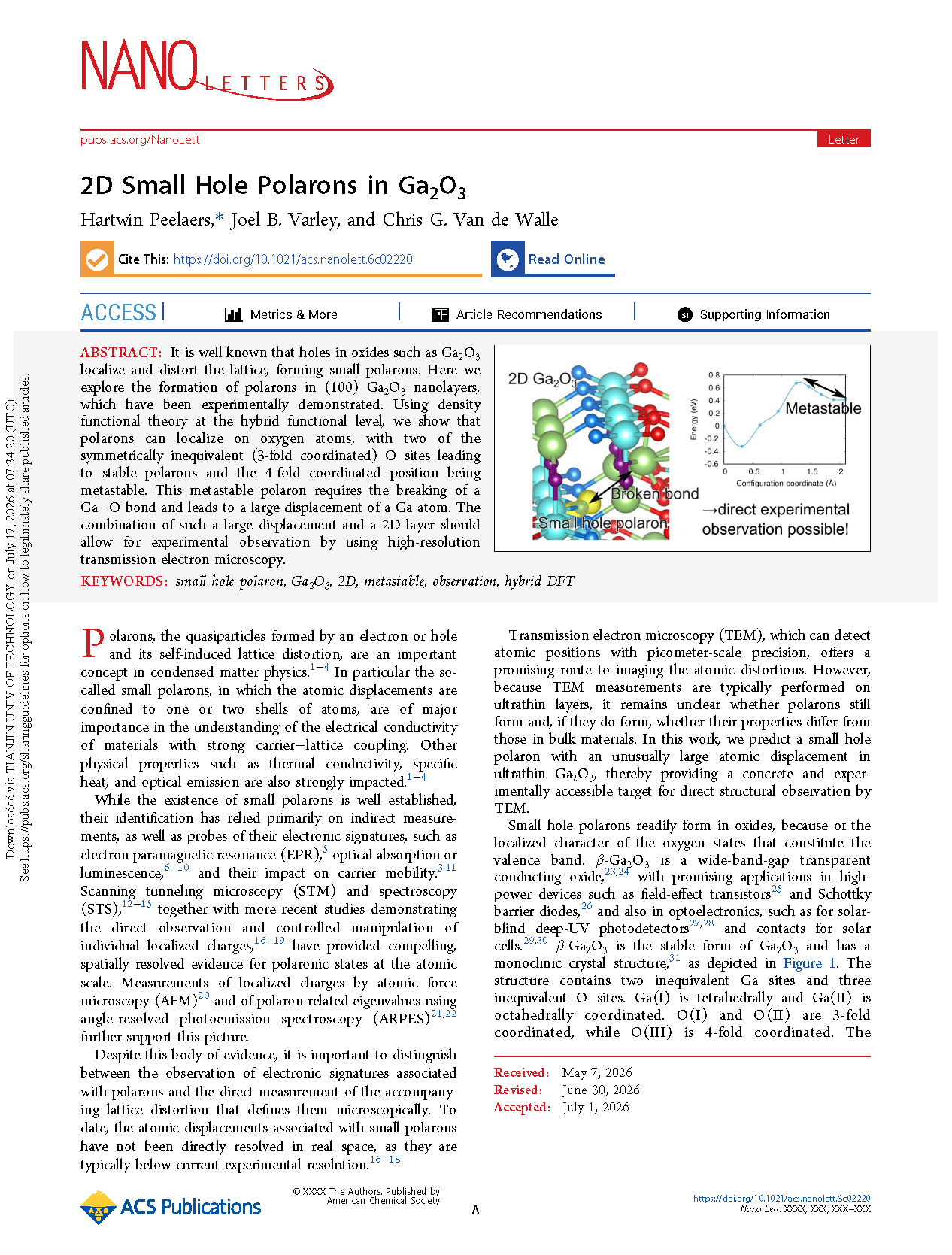
It is well known that holes in oxides such as Ga₂O₃ localize and distort the lattice, forming small polarons. Here we explore the formation of polarons in (100) Ga₂O₃ nanolayers, which have been experimentally demonstrated. Using density functional theory at the hybrid functional level, we show that polarons can localize on oxygen atoms, with two of the symmetrically inequivalent (3-fold coordinated) O sites leading to stable polarons and the 4-fold coordinated position being metastable. This metastable polaron requires the breaking of a Ga-O bond and leads to a large displacement of a Ga atom. The combination of such a large displacement and a 2D layer should allow for experimental observation by using high-resolution transmission electron microscopy.
Highlights
① HSE06 hybrid functional DFT calculations are adopted to systematically compare the structure, self-trapping energy and lattice distortion of hole polarons at three inequivalent O sites in bulk and (100) 2D Ga₂O₃;
② It is first discovered that polarons at 4-fold O(III) sites in 2D Ga₂O₃ break Ga-O bonds with Ga atomic displacement up to 1.21 A, whose distortion far exceeds stable polarons at 3-fold O sites;
③ Quantitative self-trapping energies of O(I), O(II), O(III) polarons in bulk and 2D systems are provided, verifying O(II) polarons own the best thermodynamic stability under 2D confinement;
④ The O(III) polaron is proven metastable with negative formation energy and low transition barrier, possessing sufficient lifetime for direct atomic-scale observation via TEM;
⑤ It is clarified that independent surface polarons can form at surface O atoms of 2D Ga₂O₃, the minimum energy migration path of polarons is revealed, and polarization variation of photoluminescence for ultrathin Ga₂O₃ films is predicted.
Conclusion
In conclusion, we used first-principles hybrid functional calculations to demonstrate that small hole polarons can form in ultrathin Ga₂O₃ layers and discuss the similarities and differences between bulk polarons and nanolayer polarons. Since there are three symmetry inequivalent O atoms, three distinct polarons can form. We identify similar trapping energetics that should lead to a surprisingly weak dependence of the self-trapped luminescence peaks to the nanolayer confinement. We also find that the polaron on the 4-fold coordinated O(III) site is metastable in (100) nanolayers and is characterized by a very large displacement (1.21 A) of a Ga atom. Combined with the demonstrated ability to produce ultrathin Ga₂O₃ layers, we predict this should allow for direct microscopic observation of this hole polaron.
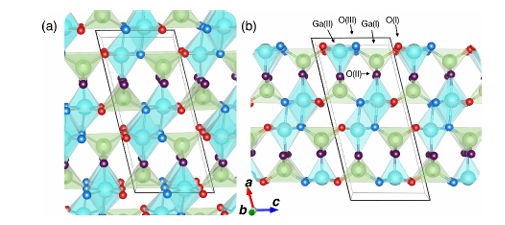
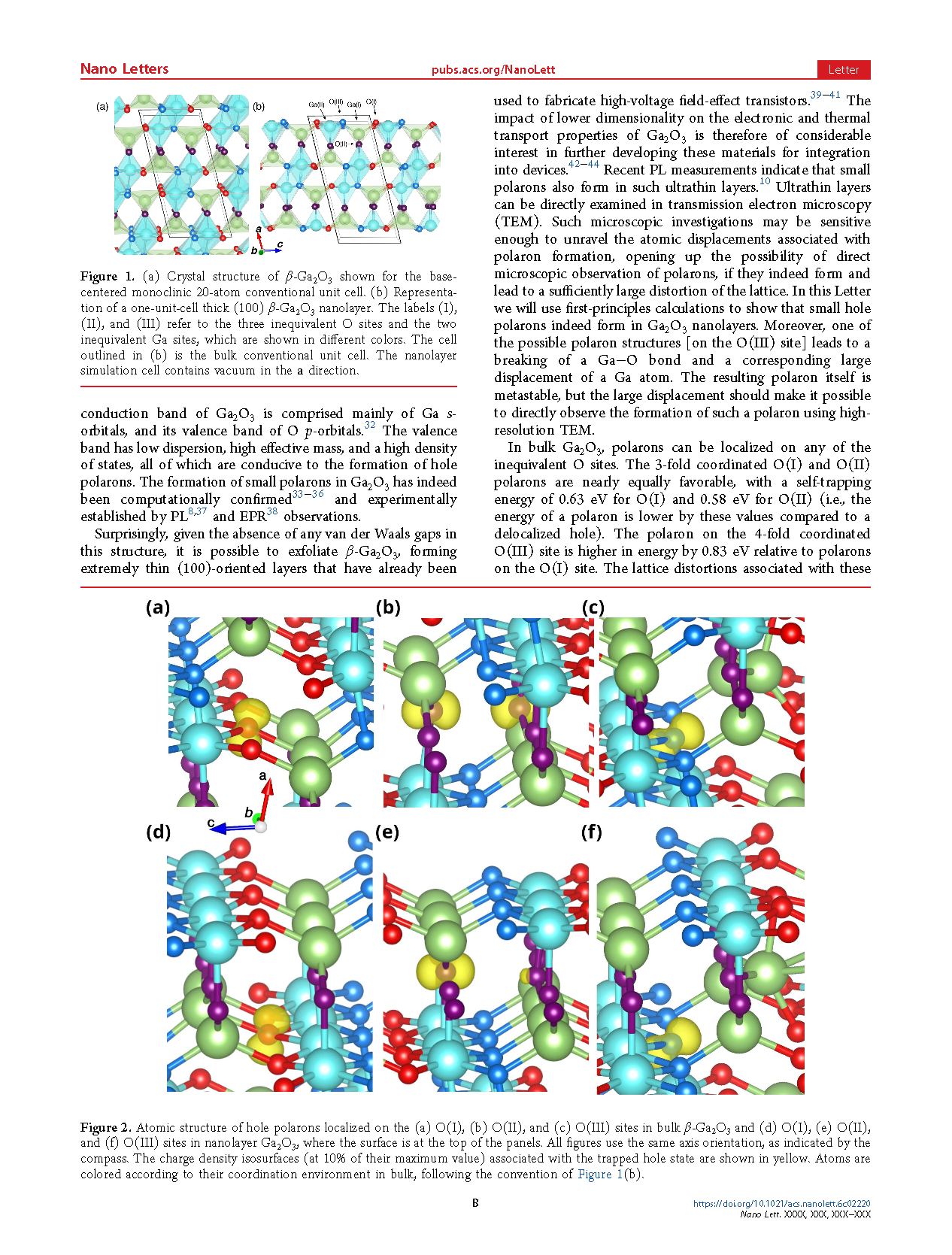
Figure 1 (a) Crystal structure of bulk monoclinic β-Ga₂O₃ conventional unit cell; (b) Simulation supercell of one-unit-cell thick (100) Ga₂O₃ nanolayer, labeling two inequivalent Ga sites and three inequivalent O(I)/O(II)/O(III) sites
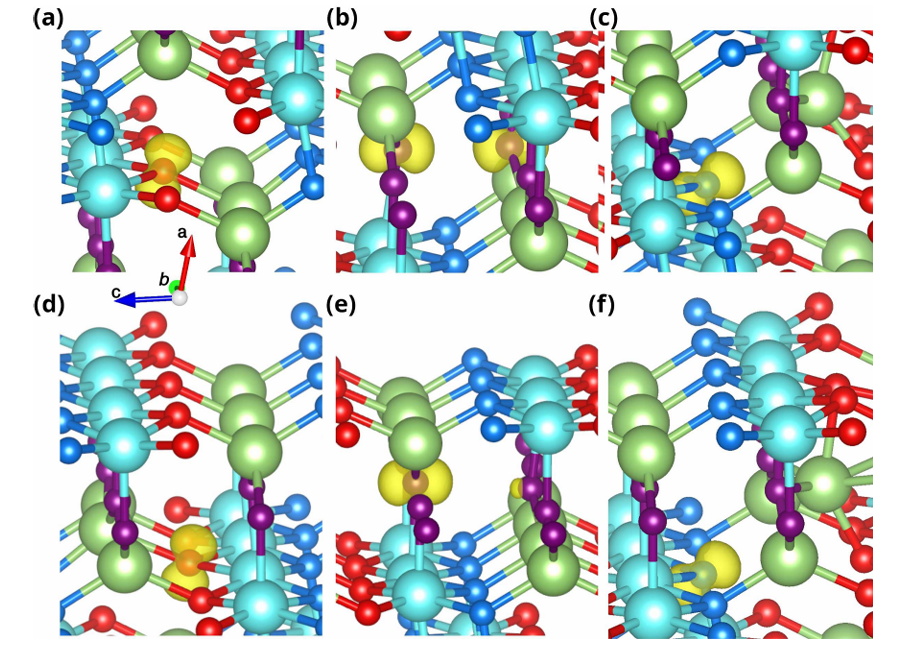
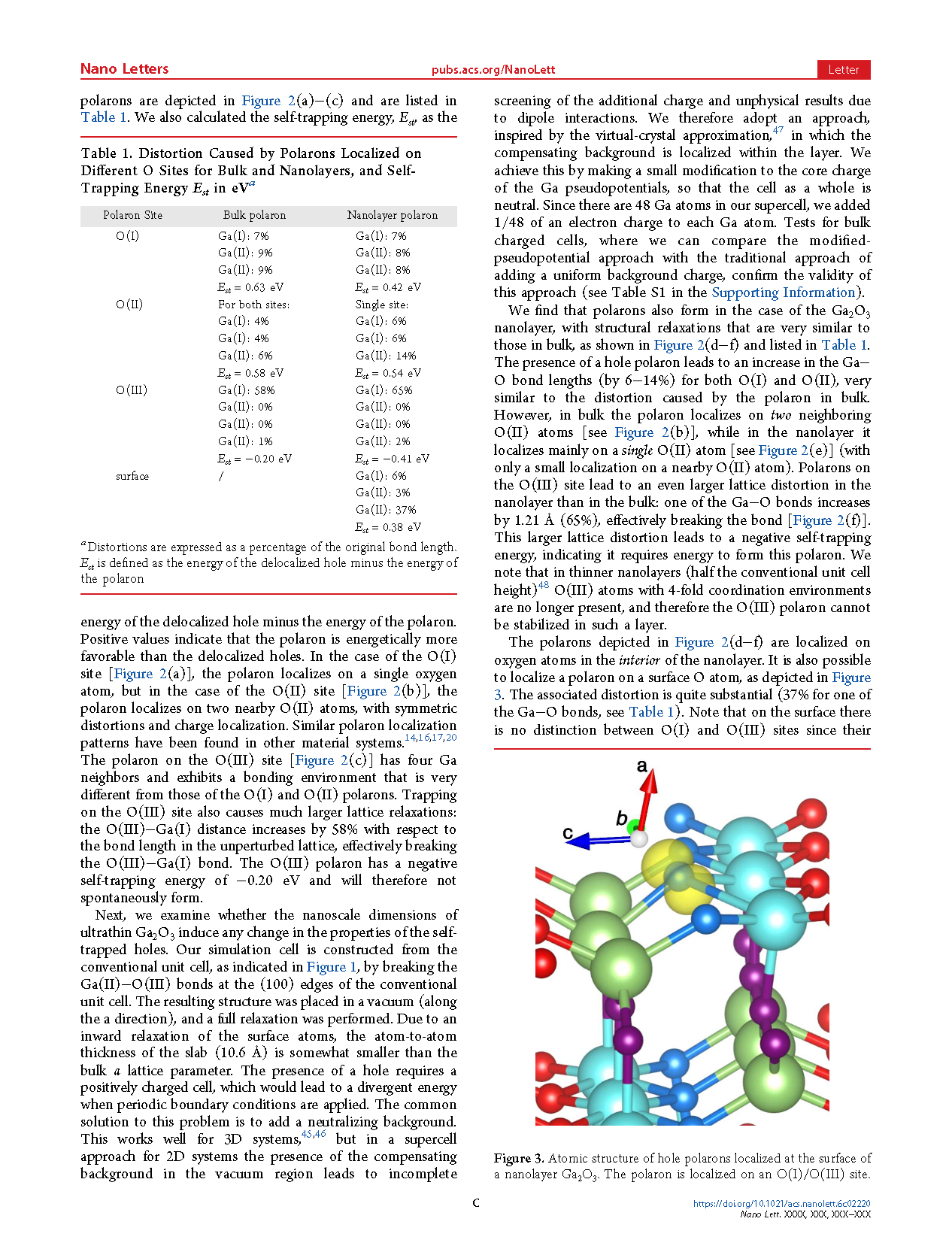
Figure 2 (a)(b)(c) Atomic structures of hole polarons at O(I), O(II), O(III) sites in bulk β-Ga₂O₃; (d)(e)(f) Corresponding polarons in Ga₂O₃ nanolayers, yellow isosurfaces denote charge density of trapped holes
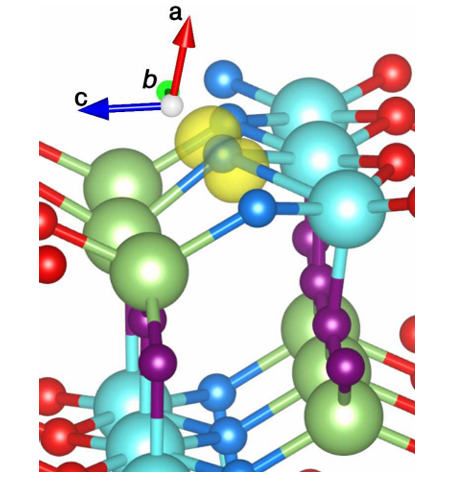
Figure 3 Atomic structure of surface hole polaron localized at surface O sites of Ga₂O₃ nanolayer
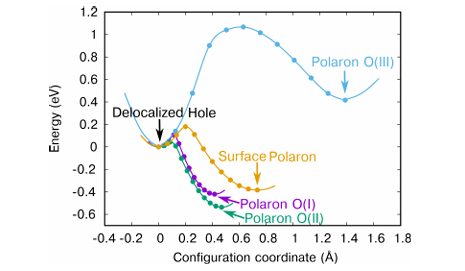
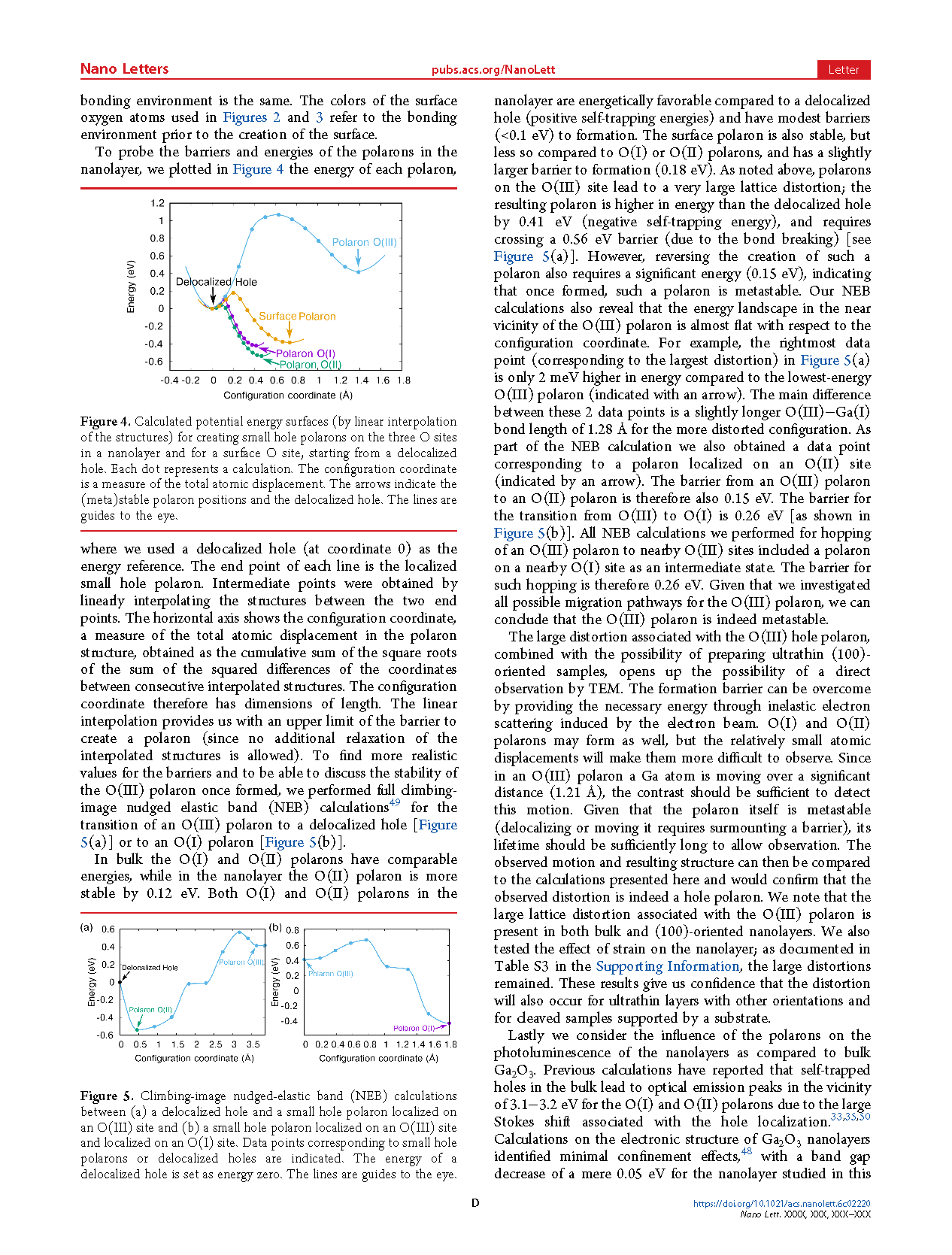
Figure 4 Calculated potential energy surfaces as a function of configuration coordinate for delocalized hole, surface polaron, O(I), O(II), O(III) polarons in Ga₂O₃ nanolayers
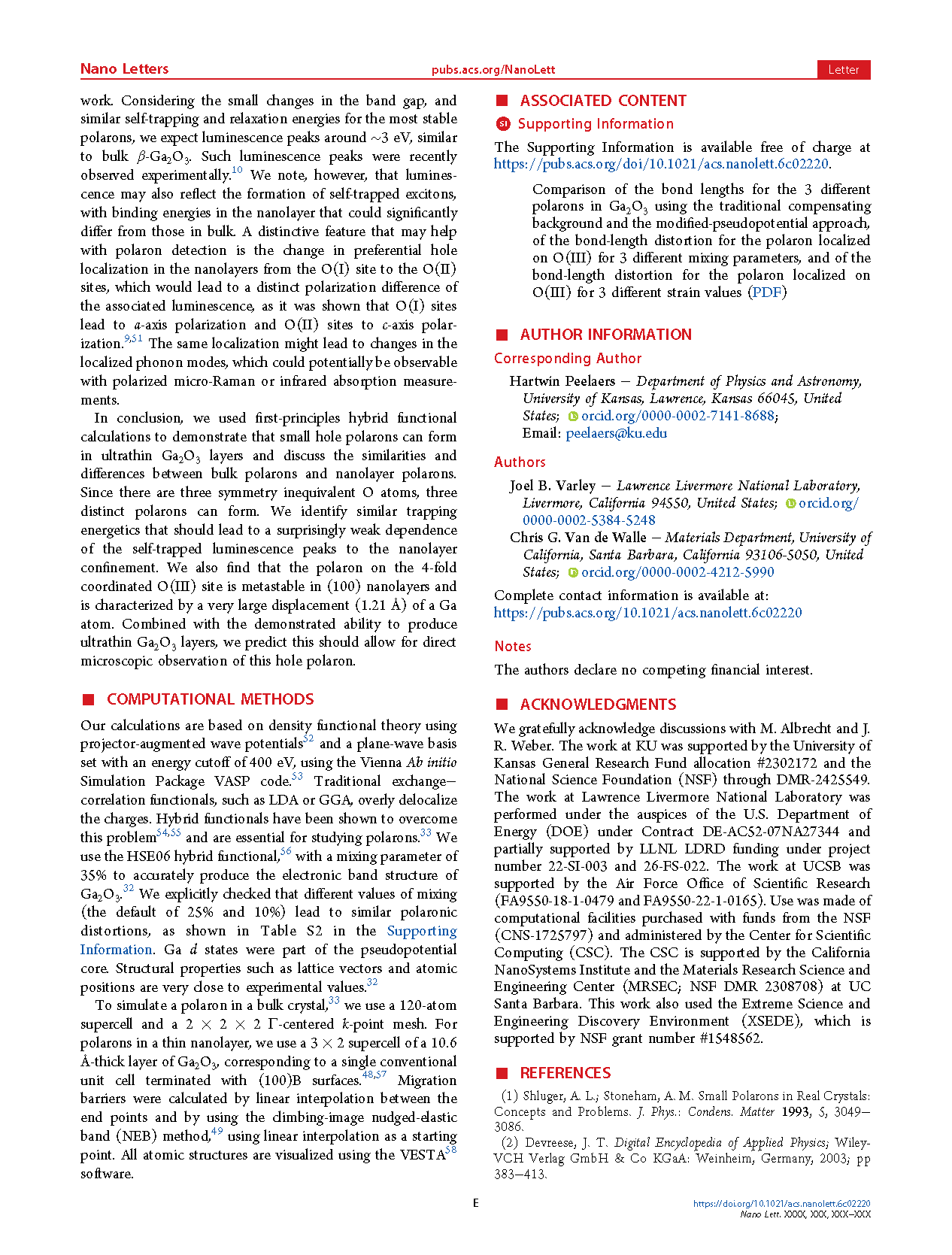
Figure 5 (a) NEB energy path between O(III) polaron and delocalized hole; (b) Energy curve for polaron transition from O(III) to O(I) sites
DOI:
doi.org/10.1021/acs.nanolett.6c02220
Instruction
Official Account

Cooperation
Top