


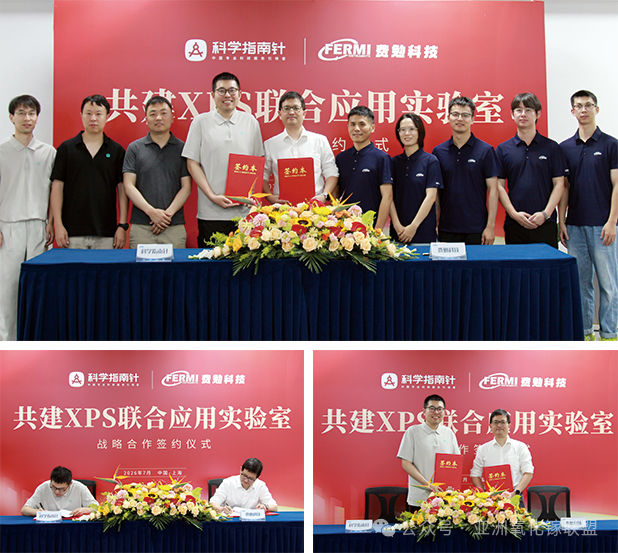
Recently, Fermion Instruments (Shanghai) Co., Ltd. and Shiyanjia, one of China's leading third-party materials characterization platforms, officially signed a comprehensive strategic cooperation agreement covering the entire XPS ecosystem. Under the partnership, the two parties will jointly establish an XPS Application Laboratory to collaborate on the next generation of domestically developed X-ray Photoelectron Spectroscopy (XPS) systems, including hardware development, application validation, AI-powered data analysis tools, and industry standardization. Together, they aim to accelerate the localization and commercialization of high-end surface analysis instrumentation in China.
The signing ceremony was attended by Jiafeng Zhao, Chairman and Founder of Fermion Instruments, and Yu Pan, Chairman and CEO of Shiyanjia, along with representatives from both organizations. Following the ceremony, the participants toured the XPS cleanroom facilities, exchanged insights on XPS equipment research and manufacturing, and held in-depth discussions on the establishment of the joint application laboratory and the implementation of future collaborative projects.
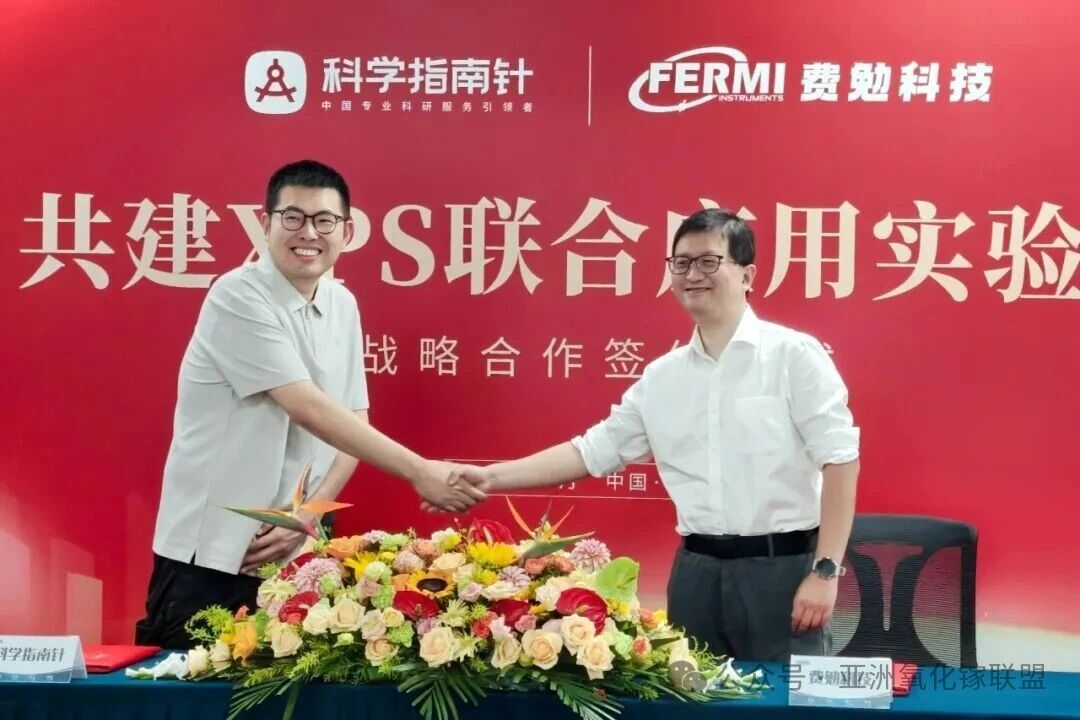
Yu Pan, Chairman and CEO of Shiyanjia (left)
Dr. Jiafeng Zhao, Chairman and Founder of Fermion Instruments (right)
Independent Innovation Builds a Strong Hardware Foundation
For decades, the global XPS market has been dominated by international manufacturers. Developing competitive domestic alternatives has become not only an industrial necessity but also a strategic priority.
Founded in 2012, Fermion Instruments has built strong technological expertise in four core areas: ultra-high vacuum systems, temperature control, thin-film deposition, and plasma technologies. The company has been granted nearly 200 patents and is among the few Chinese high-end instrumentation manufacturers capable of independently developing the entire technology chain—from key components to complete instrument systems.
In the field of X-ray Photoelectron Spectroscopy (XPS), Fermion Instruments has launched two flagship product lines: the Jingwei Series for scientific research and the Titan Series for industrial applications, both benchmarked against leading international systems. In 2023, the company introduced China's first domestically developed industrial in-line XPS system, capable of non-destructive inspection of 12-inch wafers. In December 2025, the first Jingwei 100 Series system was officially delivered to a customer.
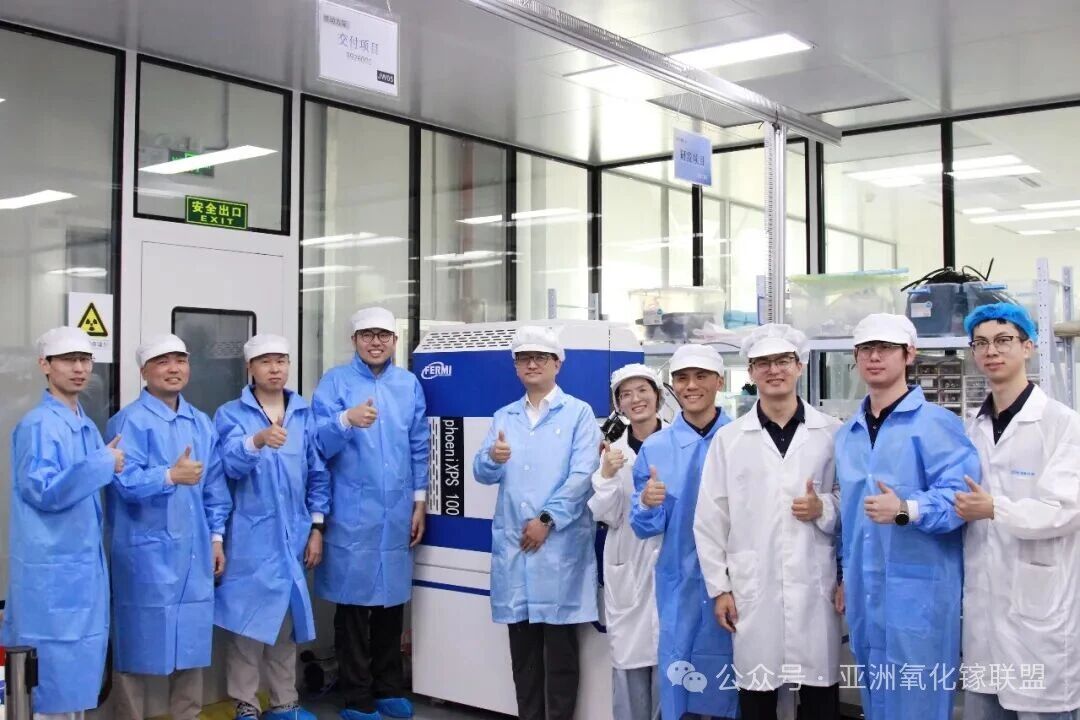
The Shiyanjia team (left) tours the Fermion Instruments XPS cleanroom production facility.
A Nationwide Laboratory Network Driving Real-World Validation
As one of China's leading providers of scientific research services, Shiyanjia has established 20 self-operated laboratories across the country, equipped with advanced analytical instruments valued at more than RMB 320 million. The platform serves a research community of over one million users and has supported more than 4,000 projects spanning materials characterization, environmental testing, life sciences, industry-specific solutions, and computational simulation.
Shiyanjia's AI-powered XPS data analysis platform has already served 31,000 users and generated more than 97,000 analytical reports.
Under this strategic partnership, Shiyanjia's nationwide laboratory network will provide large-scale, multi-scenario, and high-throughput validation for Fermion Instruments' XPS systems, enabling continuous optimization and iterative improvement of domestically developed instruments through real-world application and user feedback.
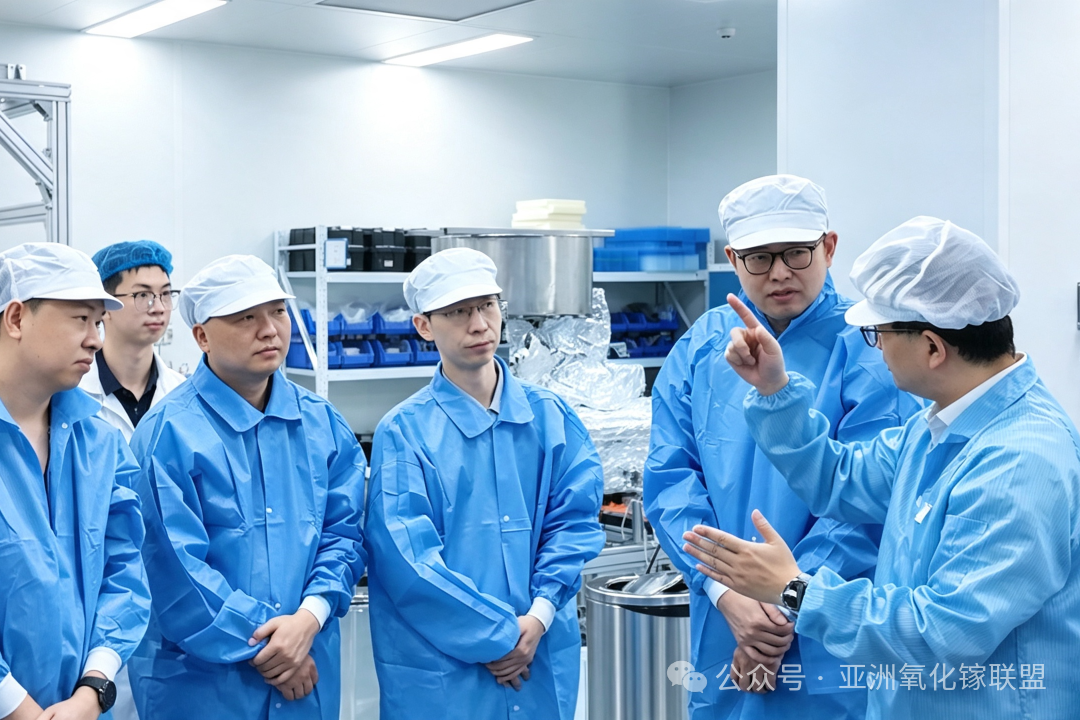
Dr. Jiafeng Zhao (first from right),
Chairman and Founder of Fermion Instruments, presents the progress of the XPS project to the Shiyanjia team.
Building an Integrated Ecosystem Through End-to-End Collaboration
Looking ahead, Fermion Instruments and Shiyanjia will focus their partnership on three strategic priorities.
First, the two companies will jointly advance hardware development, leveraging large-scale application data to support performance validation and methodology development for the Jingwei and Titan XPS product lines.
Second, they will co-develop AI-powered analysis tools by integrating Fermion Instruments' deep-learning spectral interpretation technology with Shiyanjia's intelligent analysis platform. Together, they aim to develop dedicated software and standardized analysis workflows for domestically developed XPS systems, helping to establish a more complete software ecosystem.
Third, the partnership will strengthen market synergy by combining Fermion Instruments' manufacturing capabilities with Shiyanjia's extensive customer network, accelerating the large-scale adoption of domestically developed XPS systems in both scientific research and industrial applications.
This strategic collaboration marks a new stage in the development of China's domestic XPS industry—from isolated technological breakthroughs to a fully integrated innovation ecosystem. Hardware development will be driven by real-world applications, performance validation will become increasingly independent of imported systems, and data analysis will no longer rely solely on overseas software platforms. For end users, this means more affordable instruments, solutions better tailored to local research needs, and application-oriented technical support, enabling researchers to access, adopt, and fully benefit from high-end domestically developed scientific instruments.
Supporting National Innovation Through Homegrown Scientific Instrumentation
Against the backdrop of China's 15th Five-Year Plan and the nation's strategic push to strengthen scientific and technological capabilities while achieving greater self-reliance in critical equipment, Fermion Instruments and Shiyanjia are committed to building a complete innovation chain—from independent R&D to large-scale market adoption. Together, they aim to accelerate the deployment of Chinese-developed surface analysis instruments across research laboratories and industrial production lines, contributing to the development of national strategic scientific capabilities and advancing the localization of high-end scientific instrumentation in China.
Instruction
Official Account

Cooperation
Top