


Researchers from Nanjing University of Posts and Telecommunications, Beijing University of Posts and Telecommunications have published a dissertation titled "Enhanced Performance and Reliability in Ga₂O₃ Schottky Barrier Diodes with Field Plate Assisted Mesa Termination" in Chinese Physics B.
Background
Ultra-wide-bandgap Ga₂O₃ semiconductors possess a theoretical breakdown field of 8 MV/cm, showing great prospect for high-voltage power electronic devices. As unipolar power devices with simple fabrication processes, Schottky barrier diodes represent an important development direction for Ga₂O₃ power devices. Nevertheless, electric-field crowding at the anode edge triggers premature avalanche breakdown and deteriorated leakage current, leading to actual breakdown voltage far below the material theoretical limit. Various existing termination techniques can mitigate field crowding, while single mesa termination merely shifts the electric-field peak and cannot sufficiently suppress edge electric field, resulting in limited performance improvement. Compound termination structures lack systematic quantitative investigation on electric-field modulation mechanism, temperature-dependent characteristics and long-term electrical-stress reliability, which restricts practical application of high-performance Ga₂O₃ Schottky diodes. It is urgent to develop compound-terminated device architectures that simultaneously realize high breakdown voltage, favorable conduction performance and operational stability.
Abstract
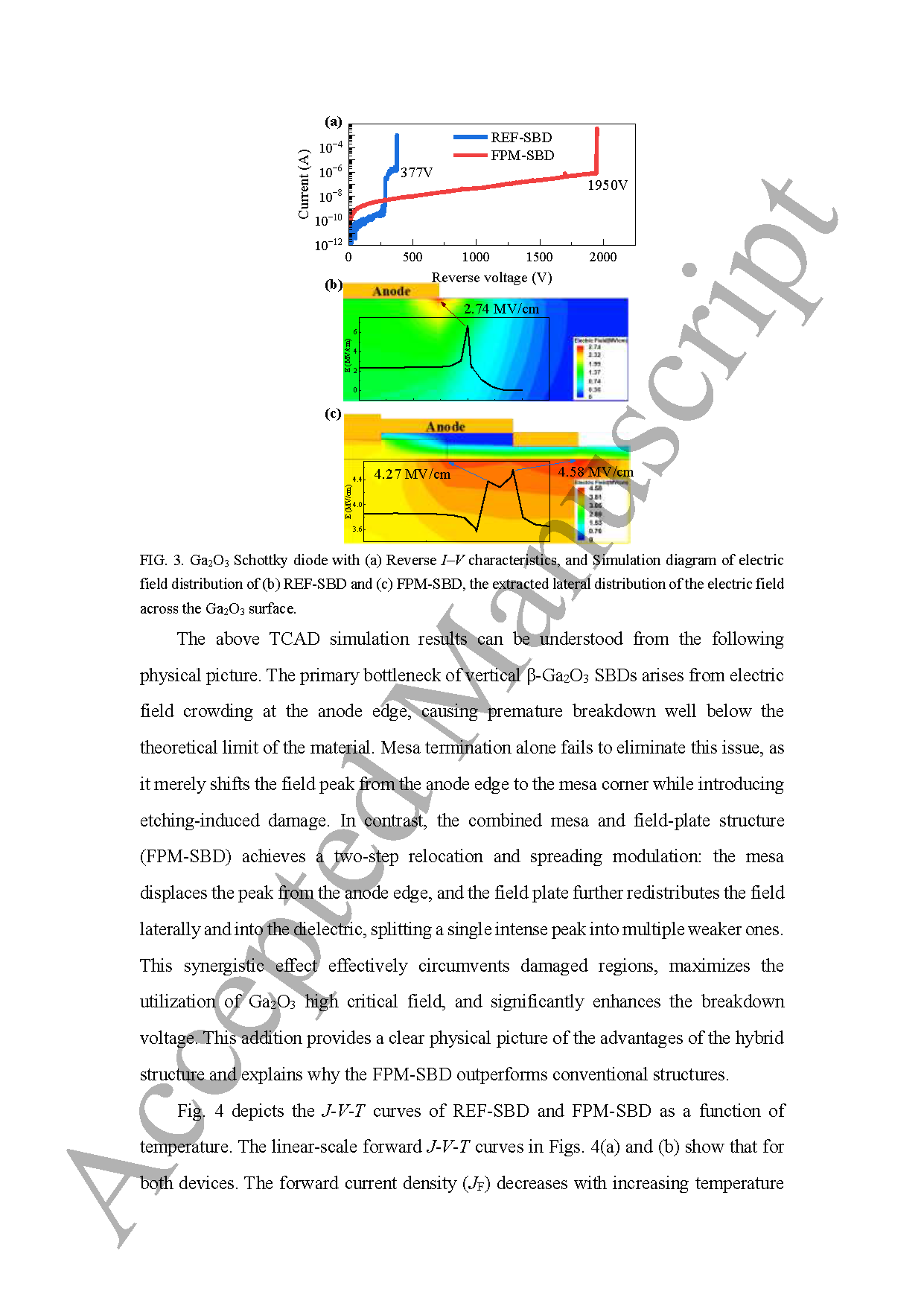
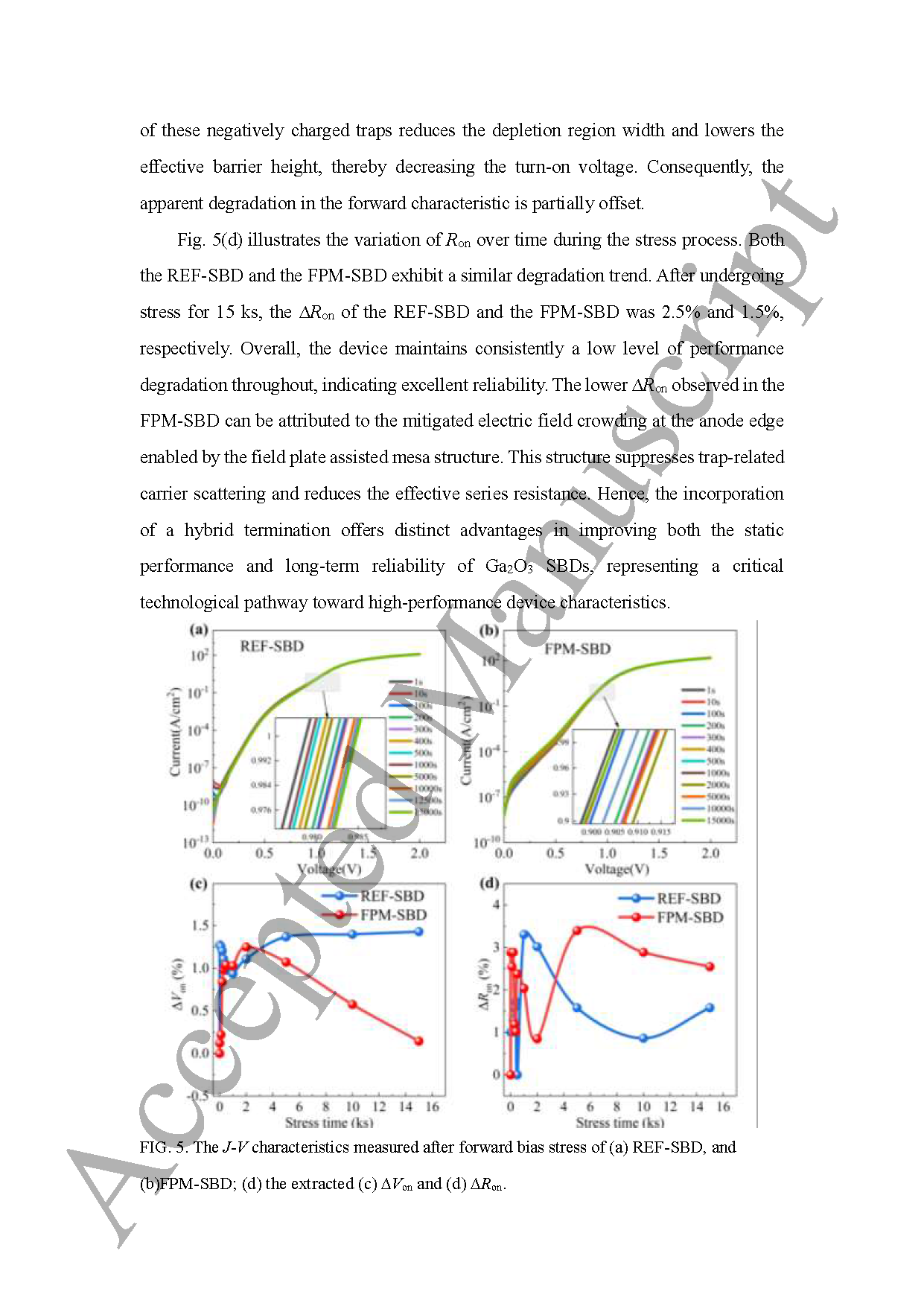
This work investigates the enhancement of breakdown voltage in Ga₂O₃ Schottky barrier diodes through edge electric field concentration achieved by field-plate-assisted mesa diodes (FPM-SBD). Moreover, the study examines the temperature behavior and long-term reliability. The mesa is etched to mitigate electric field crowding at the anode edge. Subsequently, a field plate is employed to further reduce the electric field at the anode edge. Due to the effective termination, the fabricated FPM-SBD increases the breakdown voltage to 1950 V, which is 5.2 times higher than that of the unterminated SBDs. It suppresses the reverse leakage current by one orders of magnitude from 3.0 × 10⁻⁷ A/cm² to 8.0 × 10⁻⁸ A/cm² (REF-SBD). The specific on resistance of FPM-SBD is 7.9 mΩ·cm². TCAD simulations validate that this hybrid design decouples forward conductivity from reverse breakdown physics through optimal carrier transport suppression at the heterojunction and distributed electric field management at the termination. Moreover, it exhibits characteristics of high stability under high temperatures and long working hours. After the forward bias stress for 15 ks, only a 1.5% degradation in the turn-on voltage increase (ΔVon) was observed. This research lays a robust experimental foundation for the design and advancement of higher-power Ga₂O₃ Schottky diodes with simple structures.
Highlights
Propose field-plate-assisted mesa composite termination (FPM-SBD) for Ga₂O₃Schottky barrier diodes to alleviate anode-edge electric-field crowding.
Realize 1950 V breakdown voltage, one-order-magnitude suppressed reverse leakage current and 7.9 mΩ·cm²specific on-
TCAD simulation clarifies the physical mechanism of electric-field redistribution for hybrid mesa-field-plate termination.
Systematically evaluate temperature-dependent characteristics and 15 ks long-term forward-bias-stress reliability of the device.
Conclusion
In summary, we fabricated high-performance Ga₂O₃ vertical SBD by designing a simple structure with field plate assisted mesa termination. The field plate can be employed to mitigate the electric field crowding effects and possess a uniform surface electric field distribution. The integration of the mesa termination restricts the movement of charge carriers and expands the depletion layer, resulting in an increase in BV and a reduction in reverse leakage current. The structural design effectively reduces the peak electric field while having minimal impact on forward current transport, enabling devices to achieve high forward current density ratios of 6 × 10¹¹, a large BV of 1950 V, and a low reverse leakage current of 1 × 10⁻¹⁰ A. This study offers significant insights into the substantial potential for advancing the commercial application of future Ga₂O₃-based high-power devices.
Project Support
This work was funded by the Frontier Technologies R&D Program of Jiangsu (Grant No. BF2025078), the Natural Science Foundation of Jiangsu Province (Grant Nos. BK20230361 and BK20250657), and the Natural Science Research Start-up Foundation of Recruiting Talents of NJUPT (Grant No. NY224052).
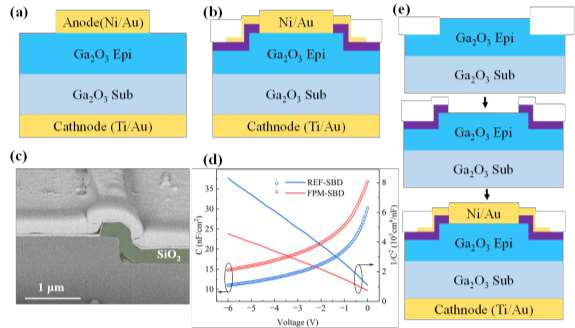
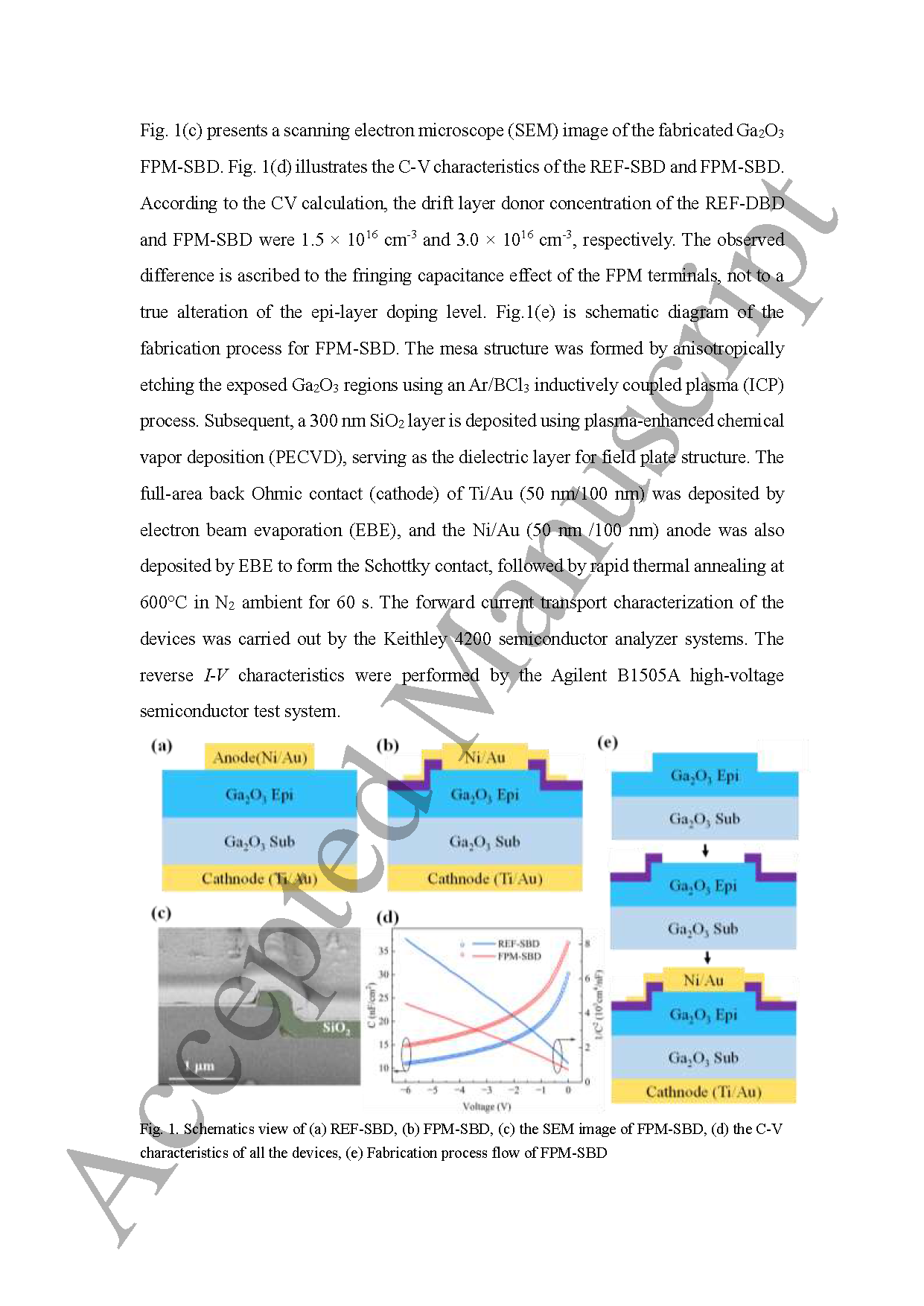
Fig. 1. Schematics view of (a) REF-SBD, (b) FPM-SBD, (c) the SEM image of FPM-SBD, (d) the C-V characteristics of all the devices, (e) Fabrication process flow of FPM-SBD.
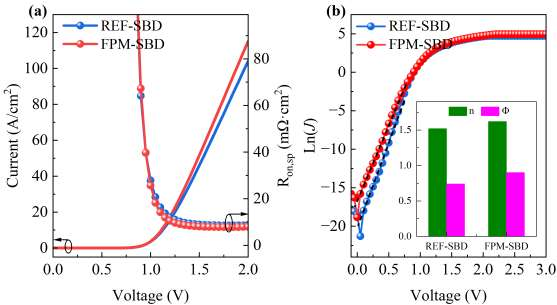
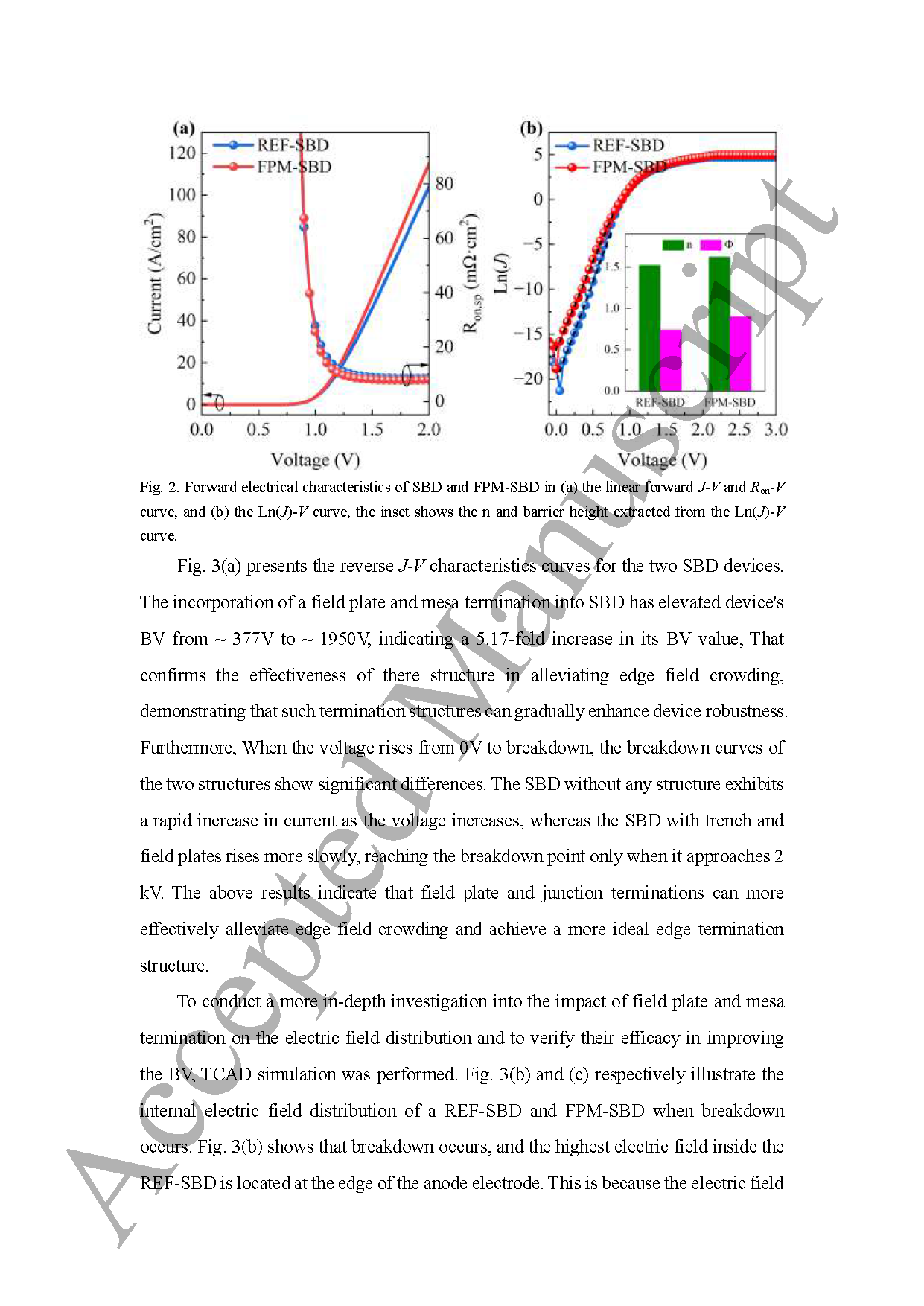
Fig. 2. Forward electrical characteristics of SBD and FPM-SBD in (a) the linear forward J-V and Ron-V curve, and (b) the Ln (J)-V curve, the inset shows the n and barrier height extracted from the Ln (J)-V curve.
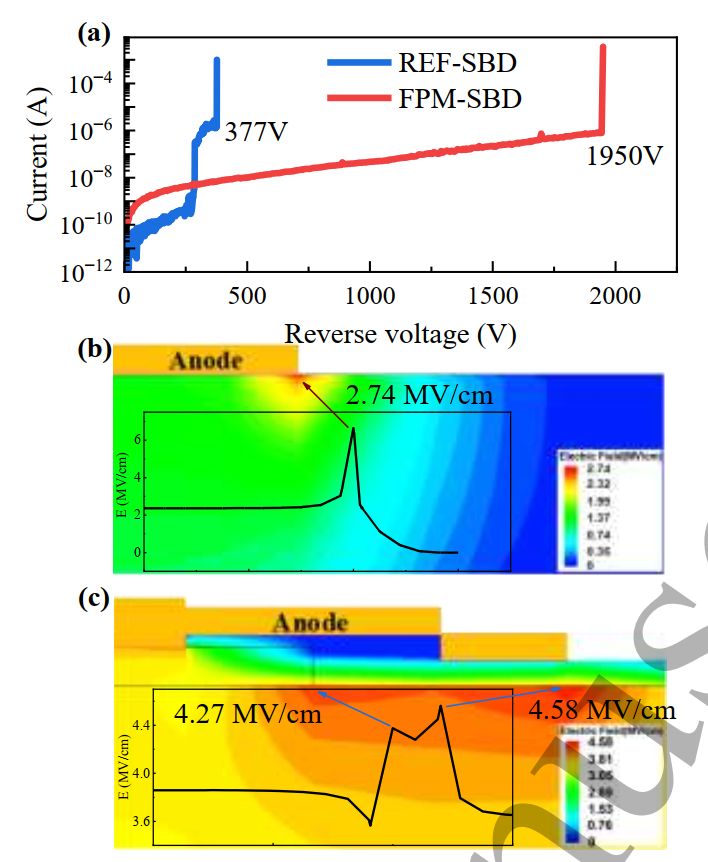
FIG. 3. Ga₂O₃ Schottky diode with (a) Reverse I-V characteristics, and Simulation diagram of electric field distribution of (b) REF-SBD and (c) FPM-SBD, the extracted lateral distribution of the electric field across the Ga₂O₃ surface.
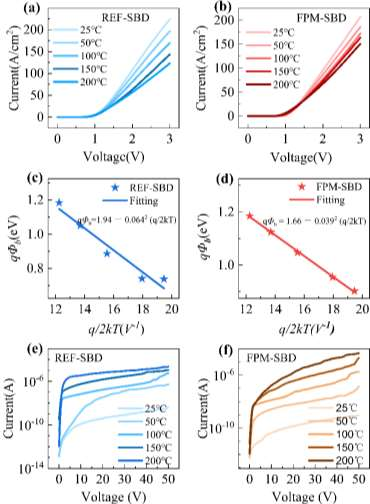
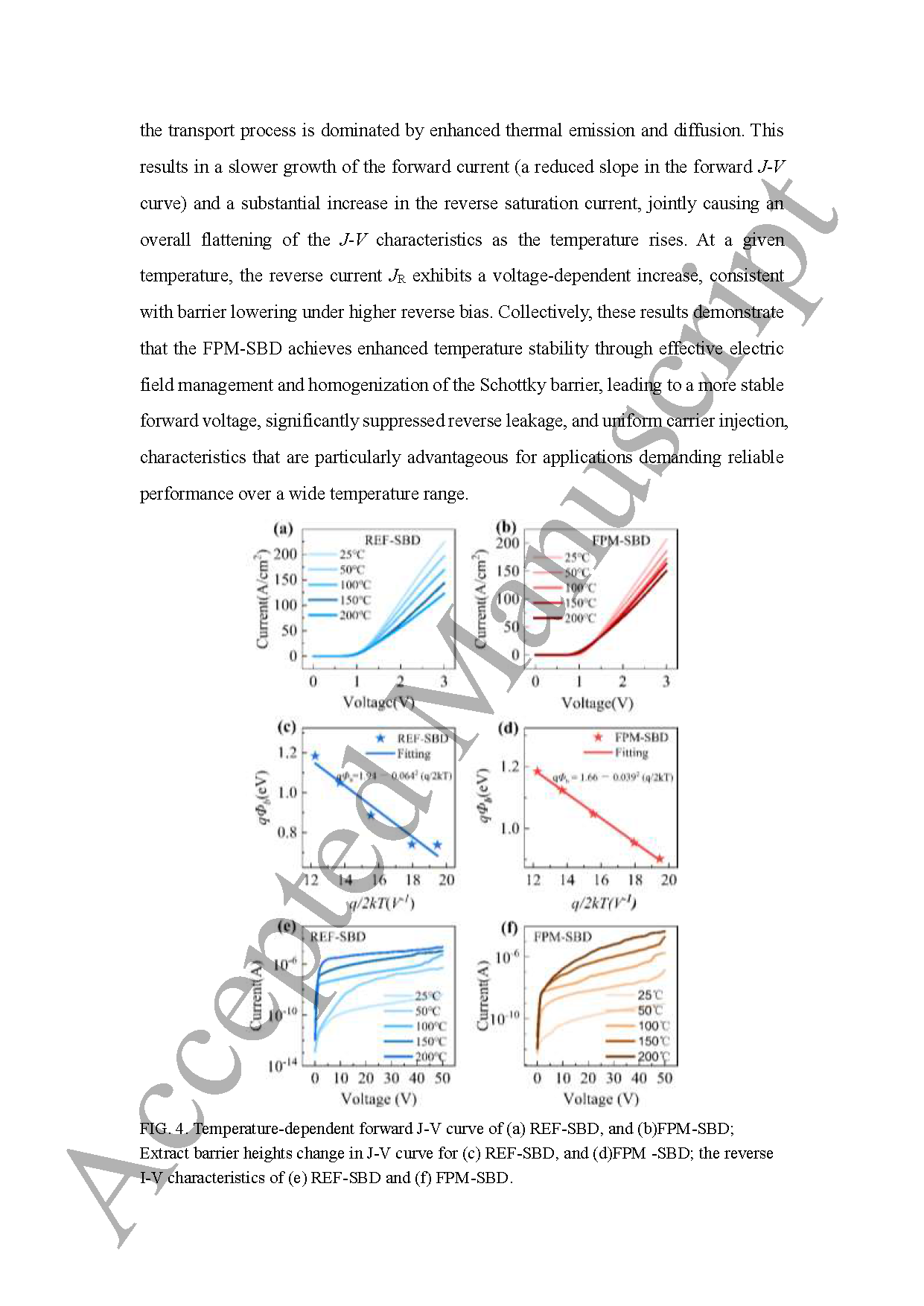
FIG. 4. Temperature-dependent forward J-V curve of (a) REF-SBD, and (b) FPM-SBD; Extract barrier heights change in J-V curve for (c) REF-SBD, and (d) FPM-SBD; the reverse I-V characteristics of (e) REF-SBD and (f) FPM-SBD.
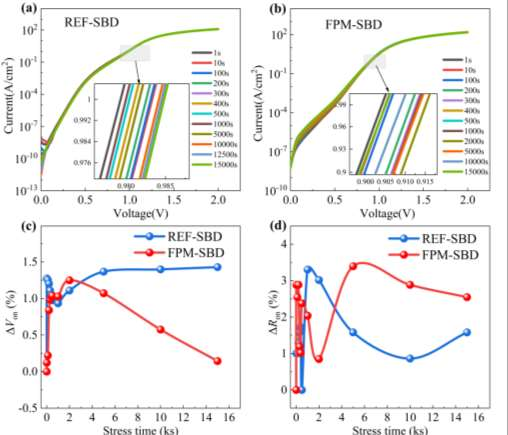
FIG. 5. The J-V characteristics measured after forward bias stress of (a) REF-SBD, and (b) FPM-SBD; (d) the extracted (c) ΔVon and (d) ΔRon.
DOI:
doi.org/10.1088/1674‑1056/ae9c20







Instruction
Official Account

Cooperation
Top