


Researchers from the Beijing University of Posts and Telecommunications, in collaboration with CFM-MPC (CSIC-UPV/EHU, Spain) and the Institute of Microelectronics, CAS, have published a paper titled "Small-data machine learning uncovers decoupled control mechanisms of crystallinity and surface morphology in β-Ga₂O₃ epitaxy" in Applied Surface Science.
Background
β-Ga₂O₃ has emerged as a frontrunner among ultrawide-bandgap semiconductors, featuring a bandgap of 4.8–4.9 eV, a theoretical breakdown field of 8 MV·cm⁻¹, and a Baliga figure of merit that substantially surpasses those of SiC and GaN. These attributes render it highly attractive for high-power switching devices, solar-blind photodetectors, and harsh-environment electronics. Although melt-grown bulk crystals with low defect densities are now available, the limited size, high cost, and poor thermal conductivity of native substrates motivate the development of high-quality heteroepitaxial thin films on foreign substrates such as sapphire, which is a prerequisite for cost-effective device integration and heterostructure engineering.
Among the various deposition techniques explored for β-Ga₂O₃, including molecular beam epitaxy (MBE), metal–organic chemical vapor deposition (MOCVD), halide vapor phase epitaxy (HVPE), and sputtering pulsed laser deposition (PLD) offers a unique combination of precise stoichiometry transfer, wide process flexibility, and straightforward doping control. However, PLD growth is governed by strongly coupled parameters (substrate temperature, oxygen pressure, laser fluence, etc.), and the conventional trial-and-error approach to process optimization is both time-consuming and resource-intensive, often failing to locate the narrow window for high-quality epitaxy within a limited experimental budget.
Abstract
The ultrawide-bandgap semiconductor β-Ga₂O₃ holds exceptional promise for next-generation power electronics and deep-ultraviolet optoelectronics, yet its widespread application is hindered by the lack of cost-effective, high-quality heteroepitaxial thin films. Here, we demonstrate an interpretable machine learning framework to efficiently navigate the complex process space of pulsed laser deposition (PLD), enabling high-crystallinity β-Ga₂O₃ epitaxy on sapphire. By systematically benchmarking 13 regression algorithms under limited-data conditions, we identify quadratic polynomial ridge regression as the optimal surrogate model, achieving high predictive accuracy (R² ≈ 0.86) while retaining full interpretability via explicit analytical coefficients. Combined with SHAP (SHapley Additive exPlanations) analysis and iterative experimental design, we construct a closed-loop optimization workflow that converges within only three experimental rounds. This data-efficient strategy reduces the X-ray rocking curve full-width at half-maximum by 70% from > 3° to 0.92°, which is the best reported value for PLD-grown β-Ga₂O₃ on sapphire. Notably, concurrent modeling uncovers a decoupled control mechanism, in which temperature governs bulk crystallinity, while oxygen pressure dictates surface kinetics and morphology. This insight enables independent optimization of structural and surface properties and establishes a general, resource-efficient paradigm for intelligent process development in oxide epitaxy and beyond.
Conclusions
In summary, we have developed an interpretable machine learning framework for efficient process optimization of β-Ga₂O₃ heteroepitaxy on sapphire via pulsed laser deposition. By systematically benchmarking regression algorithms and selecting quadratic polynomial ridge regression as the optimal surrogate model, we established a closed-loop workflow integrating SHAP-based feature analysis with iterative experimental design. This data-efficient strategy reduced the X-ray rocking curve FWHM by > 70% from > 3° to 0.92°, within only three optimization rounds using ∼ 30 samples, representing the best reported value for PLD-grown β-Ga₂O₃ on sapphire. Comparative analysis further revealed that crystalline quality and surface morphology are governed by distinct dominant factors, providing mechanistic insight for independent property optimization. The framework demonstrated here requires no specialized equipment and is readily transferable to other oxide epitaxial systems, offering a resource-efficient paradigm for intelligent thin-film process development.
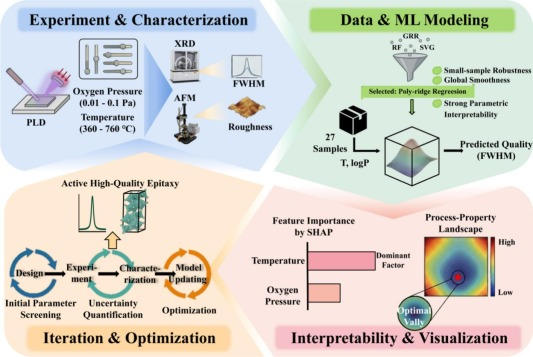
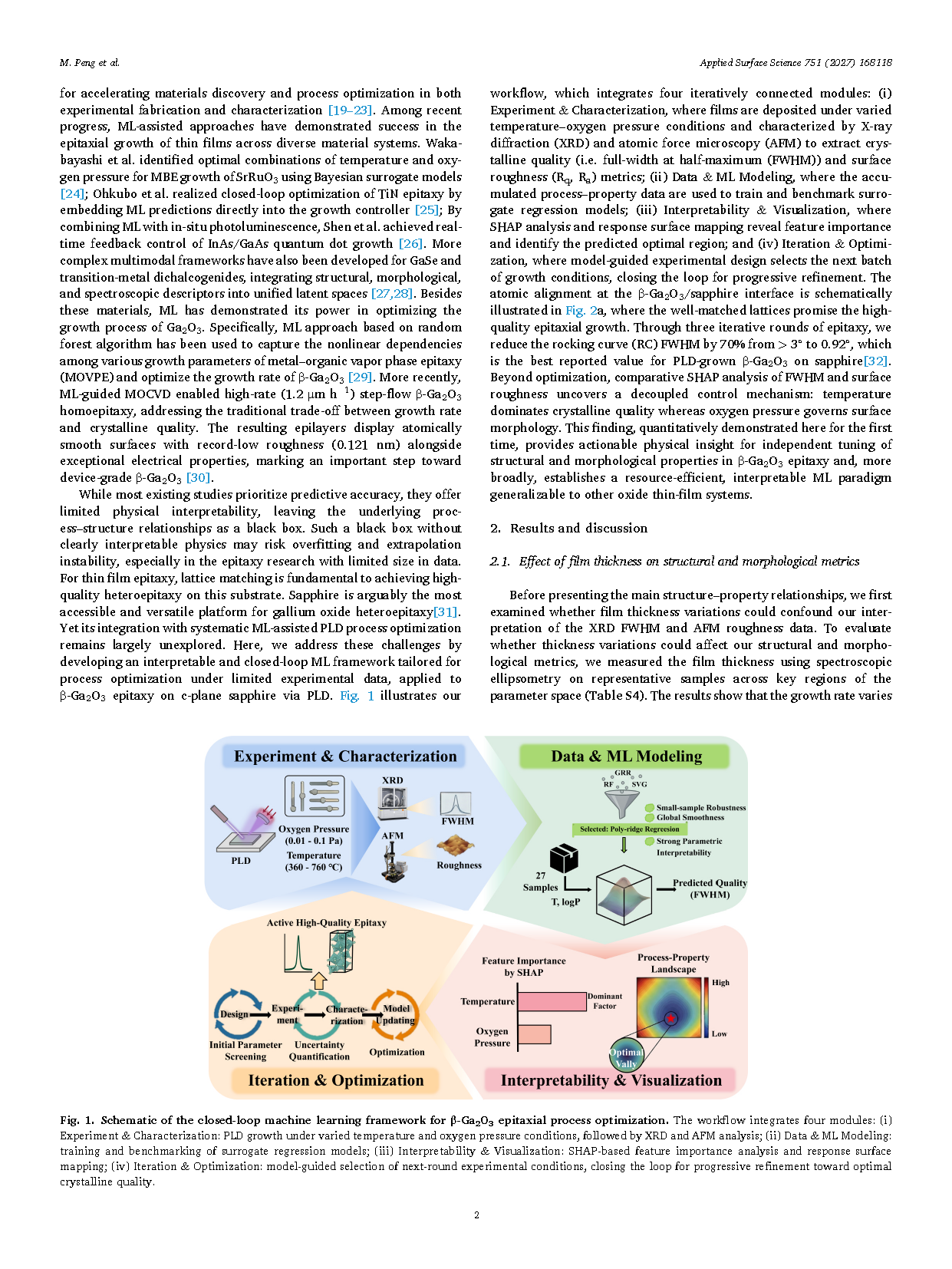
Fig. 1. Schematic of the closed-loop machine learning framework for β-Ga₂O₃ epitaxial process optimization.
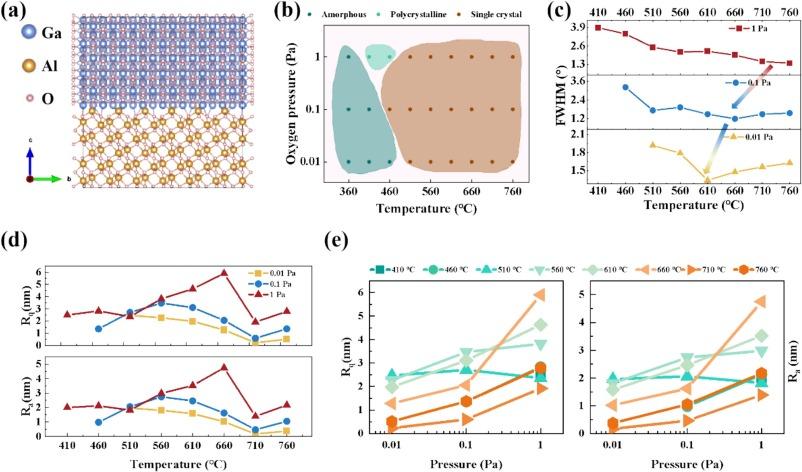
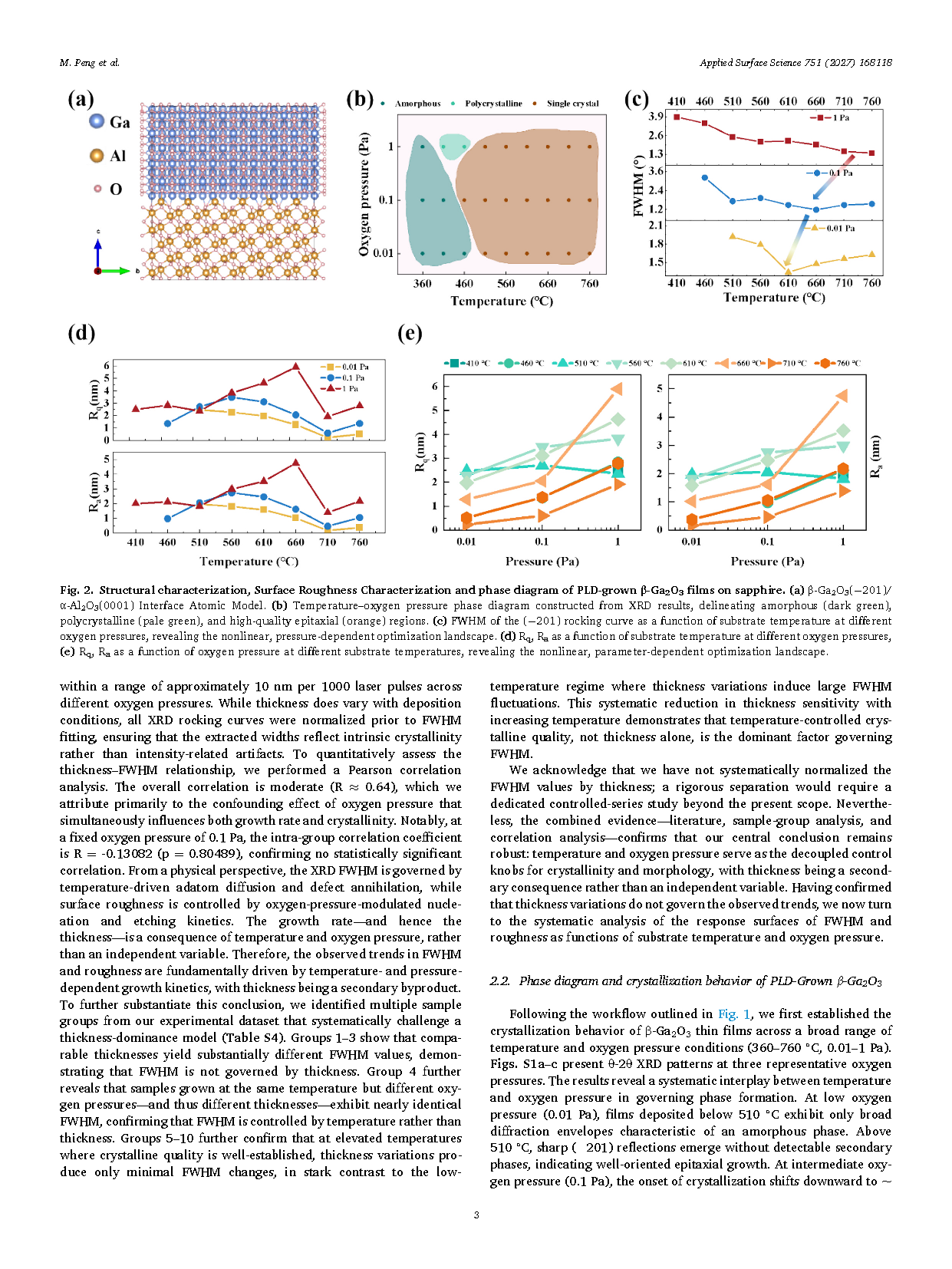
Fig. 2. Structural characterization, Surface Roughness Characterization and phase diagram of PLD-grown β-Ga₂O₃ films on sapphire. (a) β-Ga₂O₃(−201)/α-Al₂O₃(0001) Interface Atomic Model. (b) Temperature–oxygen pressure phase diagram constructed from XRD results, delineating amorphous (dark green), polycrystalline (pale green), and high-quality epitaxial (orange) regions. (c) FWHM of the (−201) rocking curve as a function of substrate temperature at different oxygen pressures, revealing the nonlinear, pressure-dependent optimization landscape. (d) Rq, Ra as a function of substrate temperature at different oxygen pressures, (e) Rq, Ra as a function of oxygen pressure at different substrate temperatures, revealing the nonlinear, parameter-dependent optimization landscape.
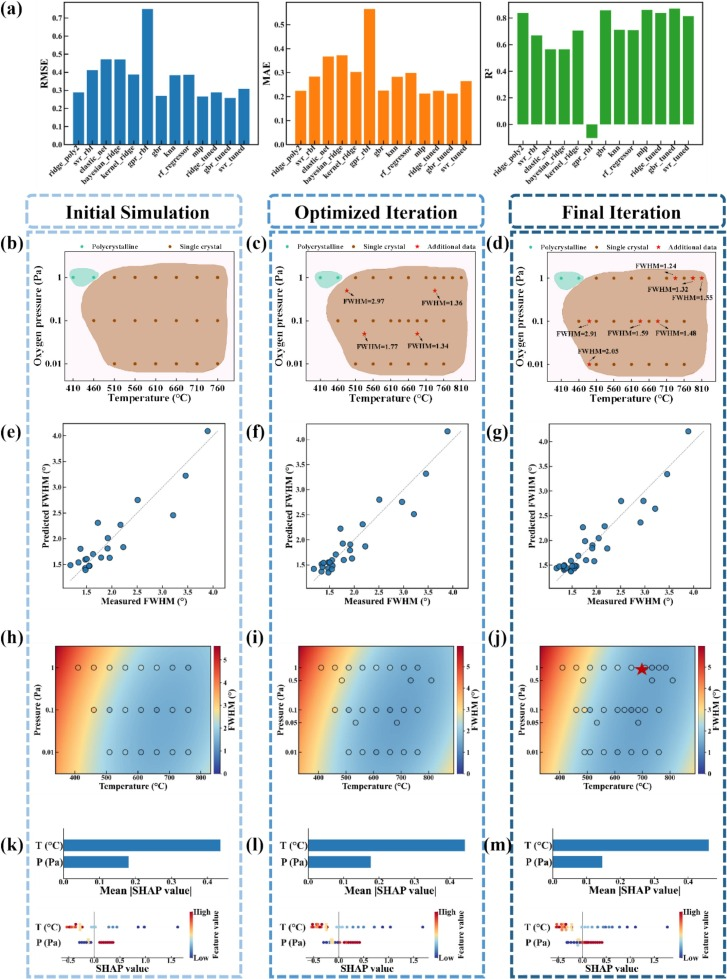
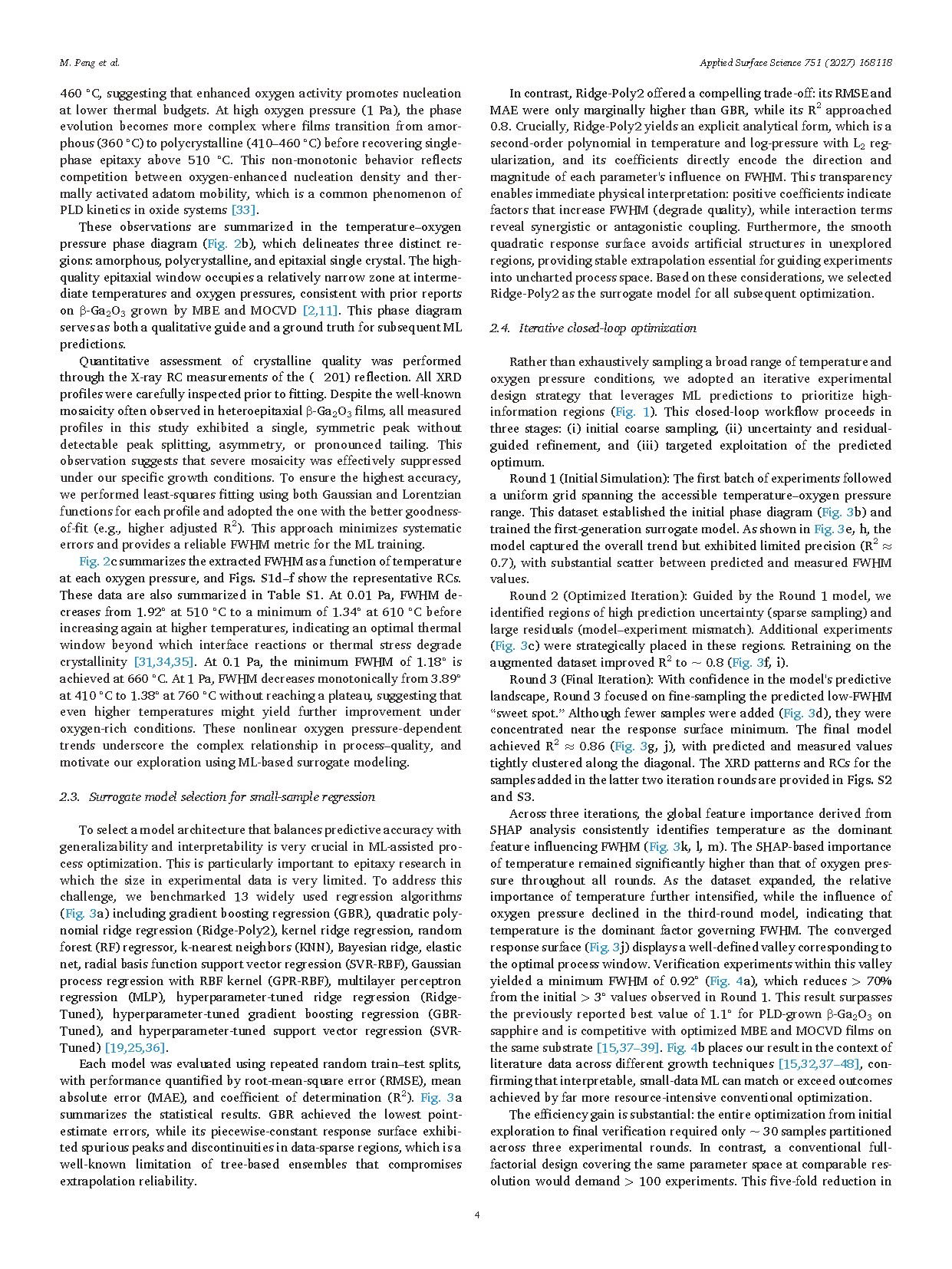
Fig. 3. Evolution of model performance, response surface, and feature importance across three optimization rounds via Surrogate model benchmarking and iterative data augmentation. (a) Comparison of 13 regression algorithms evaluated by RMSE, MAE, and R² under repeated random train–test splits. Error bars represent standard deviations. Quadratic polynomial ridge regression (Ridge-Poly2) was selected based on its balance of predictive accuracy and physical interpretability. Subsequent panels illustrate the evolution of the iterative optimization strategy: Initial Simulation (Round 1), Optimized Iteration (Round 2), and Final Iteration (Round 3). Specifically, (b-d) Temperature–oxygen pressure coordinates of samples, illustrating the progression from uncertainty-guided refinement to exploitation of the predicted optimal region. (e-g) Predicted versus measured FWHM scatter plots, showing progressive improvement in model accuracy (R² from ∼ 0.7 to ∼ 0.86). Dashed lines indicate ideal 1:1 correspondence. (h-j) FWHM response surfaces in the temperature–log₁₀p(O2) parameter space, with experimental data points overlaid. The predicted optimal region (dark blue valley) sharpens and converges with successive iterations. (k-m) SHAP analysis results: mean absolute SHAP values indicating global feature importance; T and P denote substrate temperature and oxygen pressure, respectively. SHAP dependence plots showing the directional influence of temperature and oxygen pressure on predicted FWHM. The progressive rebalancing of feature importance reflects improved model capture of the underlying process–property relationships.
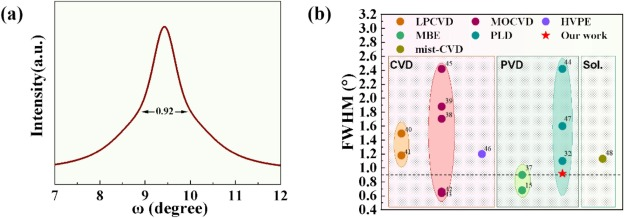
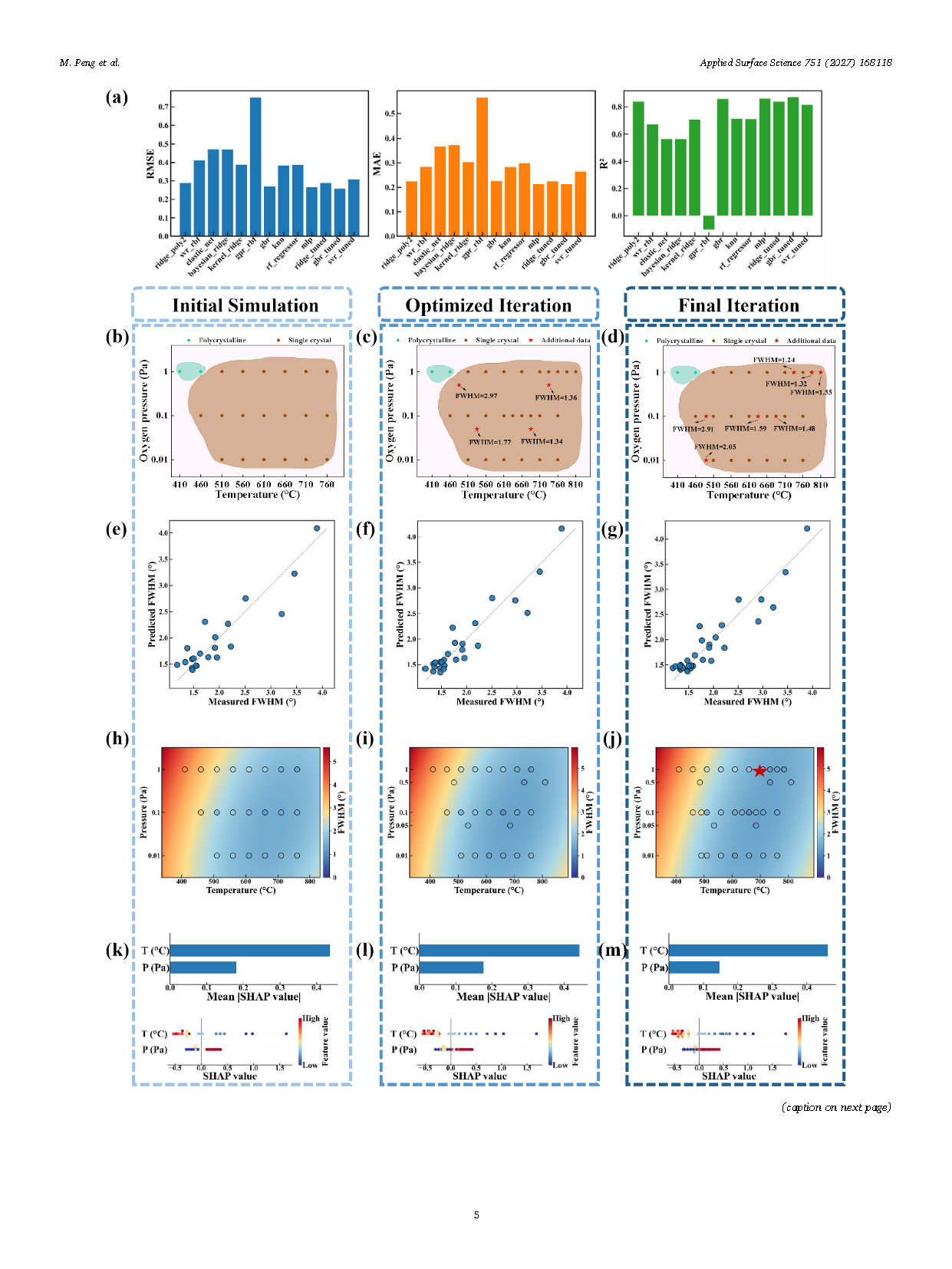
Fig. 4. Optimized epitaxial quality and comparison with literature. (a) X-ray rocking curve of the (−201) reflection for the sample grown under ML-predicted optimal conditions, yielding FWHM = 0.92°. (b) Comparison of FWHM values for β-Ga₂O₃ films on sapphire across different growth techniques (e.g., PLD, MBE, MOCVD, HVPE) reported in the literature. The result from this work (red star) represents the best reported value for PLD-grown β-Ga₂O₃ on sapphire.
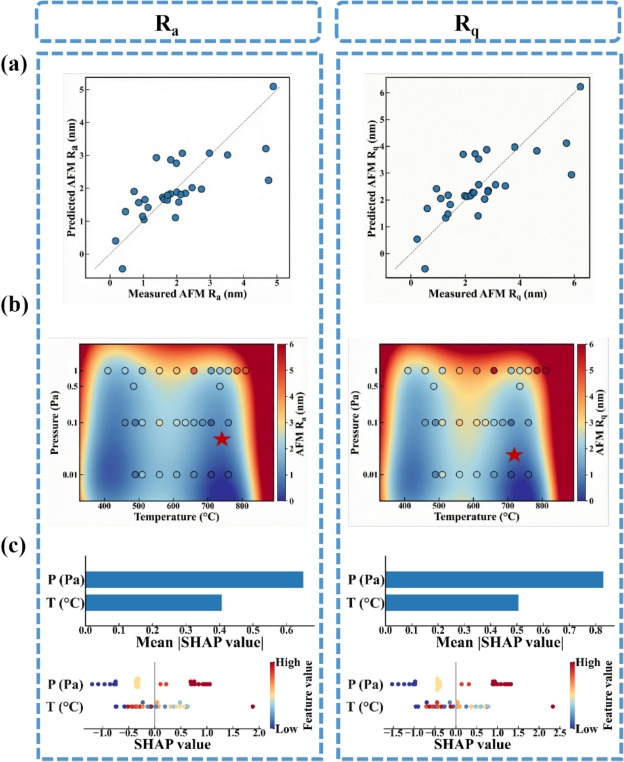
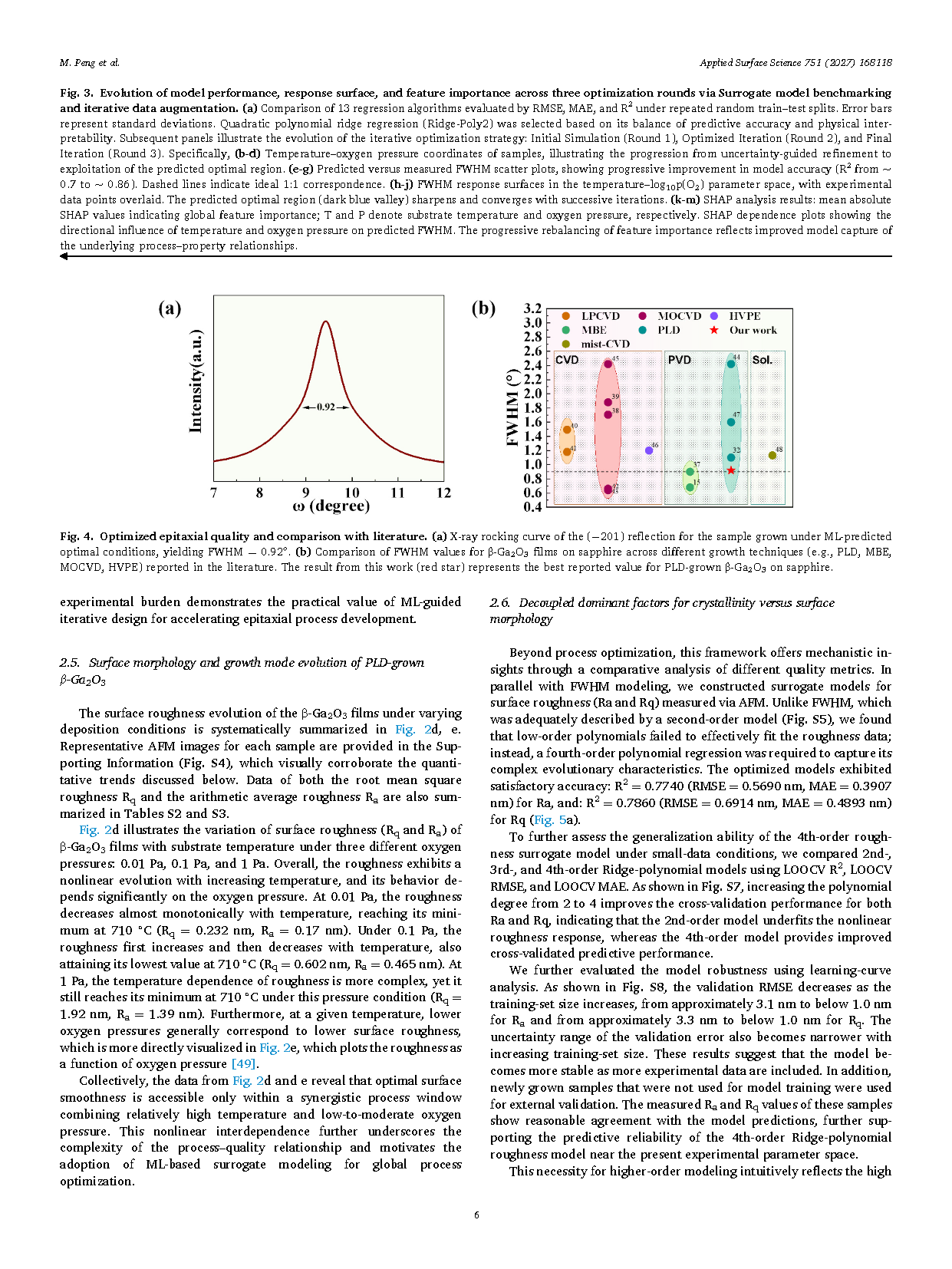
Fig. 5. Surface roughness fourth-order model performance, response surfaces and feature importance. (a) Predicted versus measured Ra, Rq scatter plots, the model achieved R² = 0.7740 (Ra) and 0.7860 (Rq). (b) Ra, Rq response surfaces in the temperature – log₁₀p(O2) parameter space, with experimental data points overlaid. Two distinct optimal regions for Ra and Rq offer selection flexibility for multi-objective optimization. (c) SHAP analysis results and SHAP dependence plots showing the directional influence of temperature and oxygen pressure on predicted AFM. Oxygen pressure emerges as the primary factor influencing surface Ra, Rq. T and P denote substrate temperature and oxygen pressure, respectively.
DOI:
doi.org/10.1016/j.apsusc.2026.168118
Instruction
Official Account

Cooperation
Top