


Researchers from Northeast Normal University have published a paper titled “Self-powered flexible solar-blind ultraviolet photodetectors enabled by freestanding MXene/γ-Ga₂O₃ quantum dots Schottky junctions” in Optics Letters.
Background
Flexible solar-blind ultraviolet photodetectors have great application prospects in wearable electronics and harsh environment monitoring, yet existing devices cannot balance mechanical durability and photoelectric response. Traditional β-Ga₂O₃ single crystals are intrinsically brittle and require high-temperature fabrication, incompatible with flexible substrates. Organic semiconductors can be solution-processed and flexible but suffer terrible environmental stability. γ-Ga₂O₃ quantum dots maintain the outstanding solar-blind optoelectronic properties of gallium oxide and enable low-temperature solution synthesis, which is an ideal active layer for flexible devices. However, conventional PET/PI polymer substrates easily induce interfacial defects and thermal mismatch, limiting device performance.
Ti₃C₂Tₓ MXene possesses metallic conductivity, excellent flexibility and hydrophilic surface, which simultaneously acts as flexible substrate, conductive electrode and carrier for quantum dot assembly, fundamentally eliminating heterogeneous interface defects. Few researches construct Schottky junctions between MXene and γ-Ga₂O₃ QDs to realize strain-modulated self-powered flexible solar-blind detection. In this work, freestanding MXene thin films are combined with γ-Ga₂O₃ QDs to form Schottky junctions. The built-in interfacial electric field enables zero-bias self-powered operation. The strain modulation effect on photoresponse, bending stability and practical arc transient signal detection are systematically investigated, offering a novel all-inorganic platform for flexible solar-blind optoelectronics.
Abstract
Flexible solar-blind ultraviolet photodetectors hold immense promise for wearable electronics and environment monitoring yet face critical challenges in balancing mechanical robustness with photoresponse performance. This work demonstrates a novel, to the best of our knowledge, self-powered photodetector based on a Schottky junction formed between solution-processed γ-Ga₂O₃ quantum dots and a freestanding Ti₃C₂Tₓ MXene film.The MXene film contributes metallic conductivity, mechanical flexibility, and a hydrophilic surface that facilitates solution-based assembly of γ-Ga₂O₃ QDs. The built-in electric field at the γ-Ga₂O₃ QDs/MXene interface enables efficient charge separation, allowing self-powered operation without external bias. Under 250 nm illumination, the device exhibits a photocurrent 10× higher than that of a rigid FTO-based counterpart. Notably, the photoresponse is further enhanced by applied tensile strain, which improves the conductivity of the MXene electrode. The device demonstrates millisecond-scale response to transient UV signals (e.g., arc discharges) and maintains stability after repeated bending. This strain-engineered architecture provides a promising platform for flexible optoelectronics capable of reliable operation in extreme conditions.
Highlights
Substrate-free freestanding Ti₃C₂TₓMXene film serves as integrated flexible substrate and conductive electrode, removing polymer support and eliminating traditional interfacial defects and thermal mismatch;
Solution-synthesized γ-Ga₂O₃QDs form Schottky junction with MXene, and interfacial built-in electric field realizes zero-bias self-powered solar-blind detection. The photocurrent is 10 times larger than rigid FTO device with 15.6-fold enhanced on/off ratio;
Tensile strain positively boosts photoresponse for the first time, bending reduces device resistance and accelerates carrier transport, establishing a new strain-modulated high-performance flexible detection mechanism;
Ultra-fast response speed (rise/decay: 15.4 μs/1.54 ms) enables real-time monitoring of transient arc discharge UV signals, applicable to industrial fault and electrical safety inspection;
All-inorganic structure delivers outstanding mechanical robustness, photoelectric performance barely degrades after 1000 bending cycles, satisfying long-term wearable device requirements.
Conclusion
In summary, we have successfully demonstrated a self-powered flexible solar-blind ultraviolet photodetector based on γ-Ga₂O₃ quantum dots and freestanding Ti₃C₂Tₓ MXene film. The freestanding MXene film serves a dual role as both an efficient bottom electrode and a robust flexible substrate, eliminating interfacial issues common in conventional heterogeneous structures. The γ-Ga₂O₃ quantum dots absorb solar-blind UV light, and the energy band alignment at the heterojunction creates a built-in electric field that enables efficient charge separation for self-powered operation. The device exhibits a significantly enhanced photoresponse, with an on/off ratio 15.6 times higher and a photocurrent over 10× greater than that of a rigid FTO-based counterpart. A notable feature is the strain-engineered performance, where applied tensile strain enhances the photoresponse by improving interfacial contact and modulating the conductivity of the MXene electrode. The PD also shows a fast response speed of 15.4 μs/1.54 ms and excellent stability. Furthermore, its practical capability is confirmed through the real-time monitoring of transient arc discharges. The proposed architecture presents a promising strategy for next-generation flexible optoelectronics capable of reliable long-term operation, with potential applications in wearable safety systems and industrial monitoring.
Project Support
The National Key R&D Program of China (2021YFA0716404); National Natural Science Foundation of China (52302166, 62404038, 12474164); the Fund from Jilin Province (SKL202602014JC); the Science Technology Program of Jilin Province (20240602060RC); the National Postdoctoral Program for Innovative Talents (BX20230064); Department of Education of Jilin Province (JJKH20241412KJ, JJKH20250300KJ); the Postdoctoral Fellowship Program of CPSF (GZC20240240).
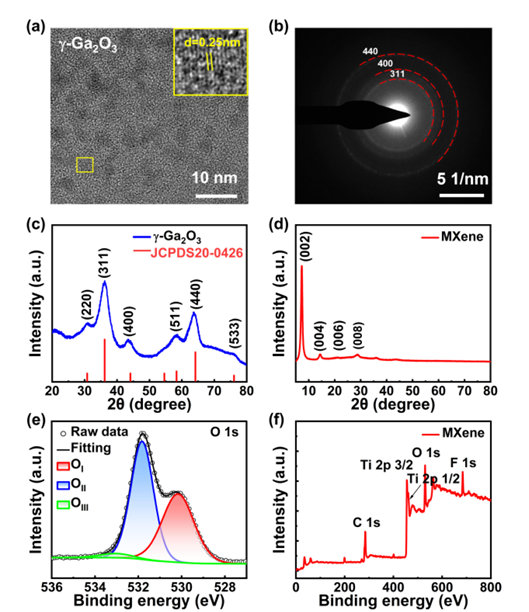
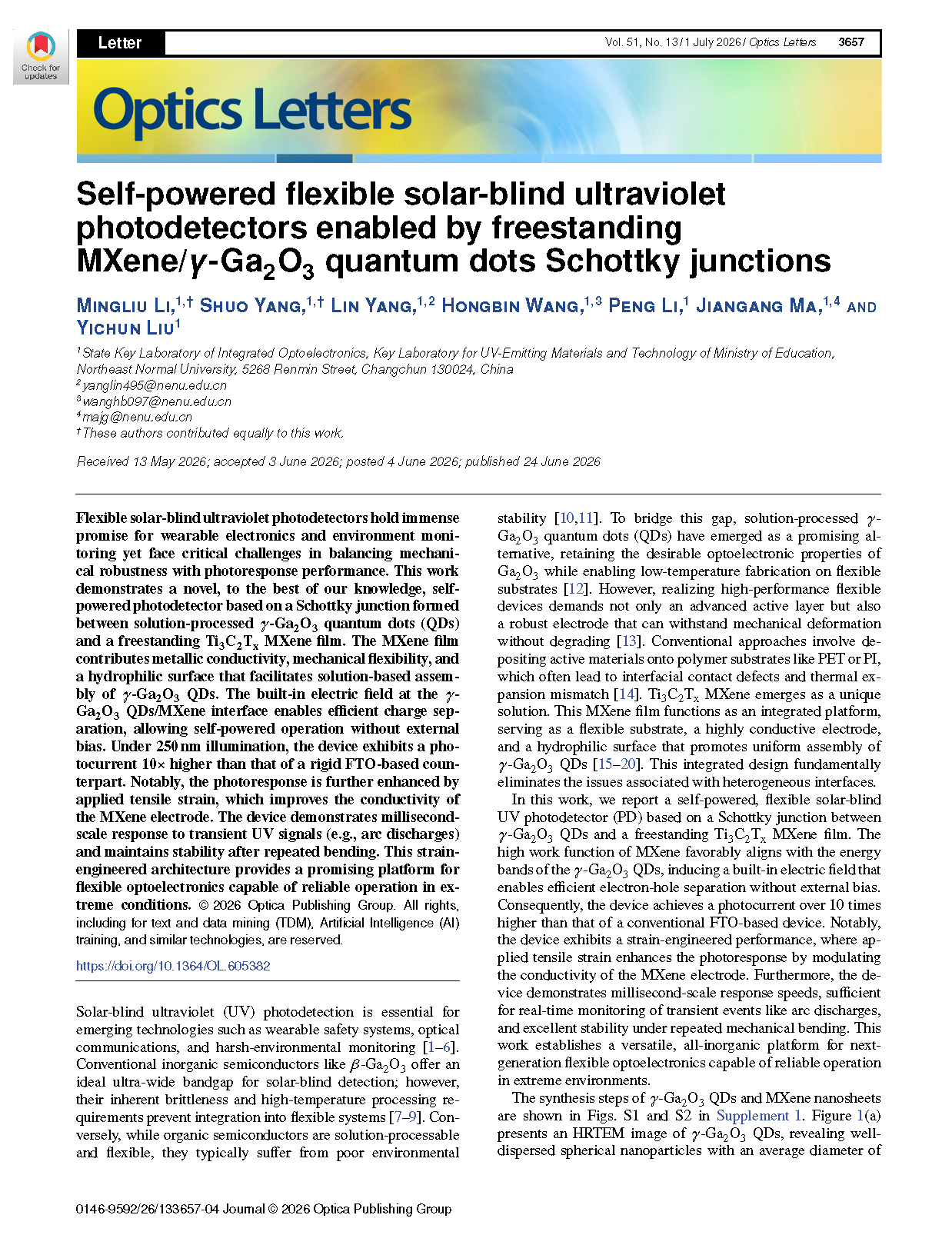
Figure 1 Crystallographic analysis of γ-Ga₂O₃ QDs. (a) HRTEM image. Inset: magnified lattice image with marked d-spacing. (b) SAED pattern indexing the major diffraction rings. (c) The XRD pattern of γ-Ga₂O₃ film. (d) The XRD pattern of MXene film. (e) The high-resolution XPS spectrum of the O 1s peak of γ-Ga₂O₃ film. (f) The XPS spectrum of the MXene film.
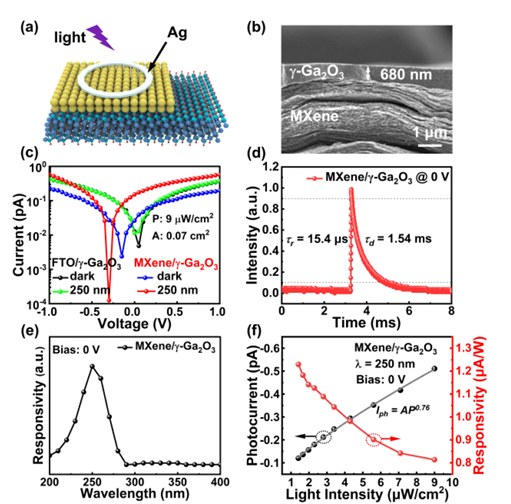
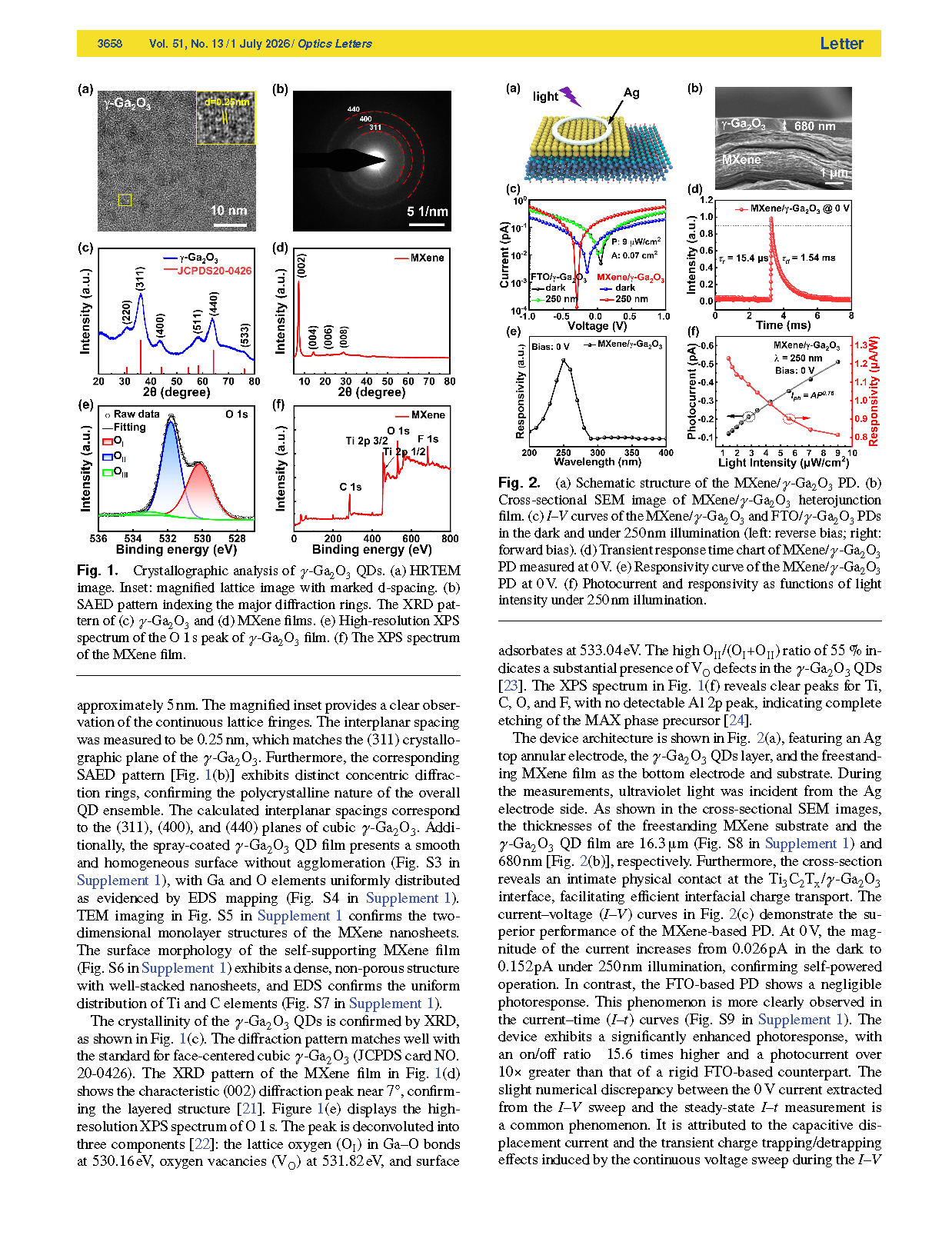
Figure 2 (a) Schematic structure of the MXene/γ-Ga₂O₃ PD. (b) Cross-sectional SEM image of MXene/γ-Ga₂O₃ film. (c) I-V curves of FTO/γ-Ga₂O₃ and MXene/γ-Ga₂O₃ in the dark and under 250 nm illumination. (d) Time-resolved photoresponse curve of MXene/γ-Ga₂O₃ PD at 0 V. (e) Spectral responsivity curve measured at 0 V. (f) Photocurrent and responsivity as functions of light intensity under 250 nm illumination.
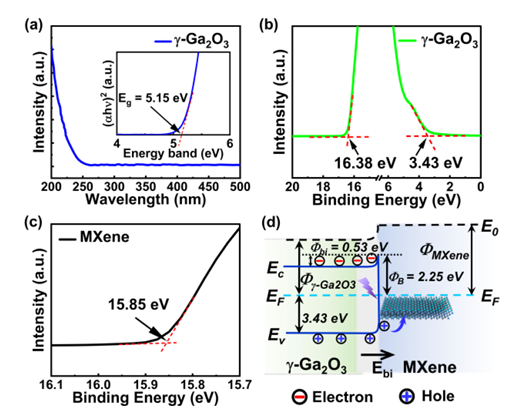
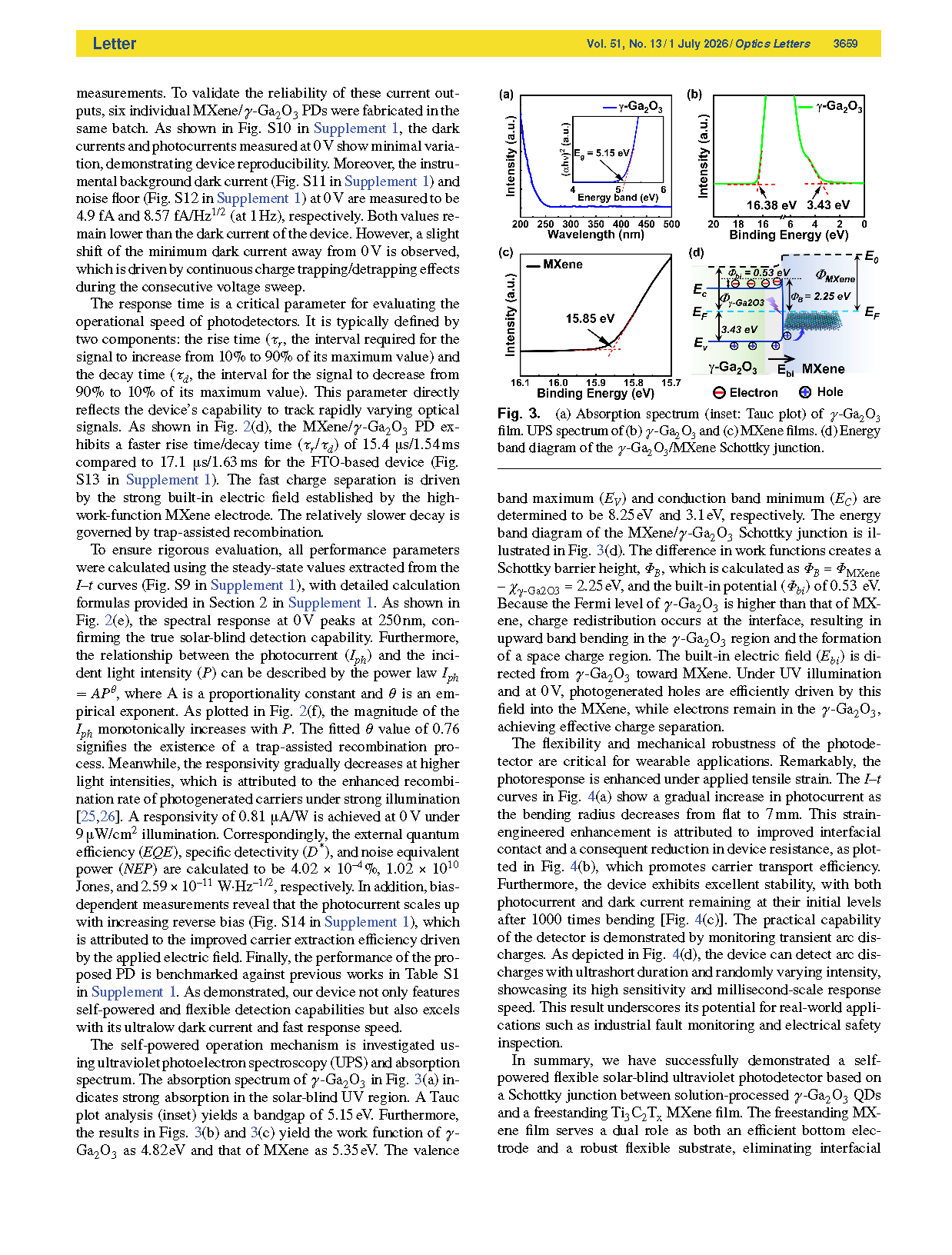
Figure 3 (a) Absorption spectrum of γ-Ga₂O₃ film, inset: Tauc plot for bandgap calculation. (b) UPS spectrum of γ-Ga₂O₃ film. (c) UPS spectrum of MXene film. (d) Energy band diagram of the γ-Ga₂O₃/MXene Schottky junction.
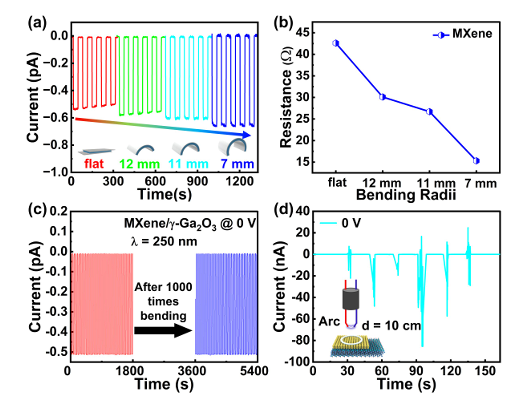
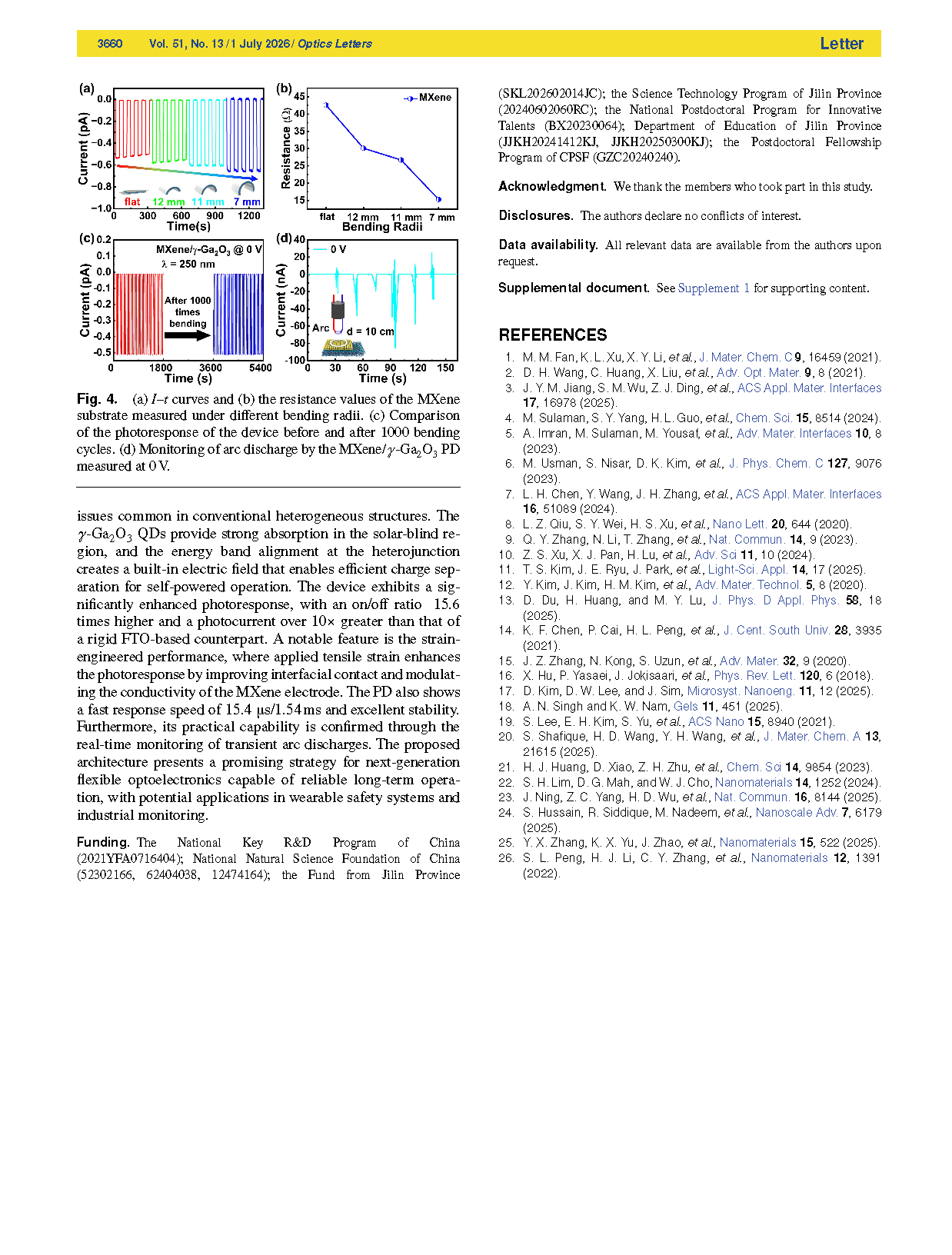
Figure 4 (a) I-t curves measured under different bending radii. (b) Resistance values of the MXene substrate under different bending radii. (c) Comparison of the photoresponse before and after 1000 bending cycles. (d) Real-time monitoring curve of arc discharge measured by the MXene/γ-Ga₂O₃ PD at 0 V.
DOI:
doi.org/10.1364/OL.605382
Instruction
Official Account

Cooperation
Top