


The team led by Prof. Jiayu Dai and Associate Prof. Xiaoxiang Yu at the National University of Defense Technology has published a research article entitled “Experimental observation of a fourfold difference in thermal conductivity yet comparable maximum phonon mean free path in α-alumina and α-gallium oxide” in Applied Physics Letters.
Background
For materials in the same group, does a lighter element necessarily mean higher thermal conductivity and a longer phonon mean free path?
Lattice thermal conductivity (LTC) is a key parameter in energy transport and conversion. In semiconductors and dielectrics, phonons are the main heat carriers, and their mean free path determines the thermal transport behavior of materials.
The traditional view is that, for materials with the same crystal structure, materials composed of lighter elements usually have higher LTC, because lighter elements often bring higher phonon group velocities and longer phonon mean free paths. However, recent theoretical calculations have reported an anomalous phenomenon: compared with α-Al2O3, α-Ga2O3 has a lattice thermal conductivity only one-third to one-quarter as large, but its maximum phonon mean free path is actually larger.
This counterintuitive phenomenon urgently needs experimental verification. The problem, however, is that the maximum phonon mean free paths of both α-Al2O3 and α-Ga2O3 are very short, on the order of hundreds of nanometers. Resolving their phonon mean free path spectra requires extremely high modulation frequencies and very small thermal penetration depths, making experimental measurement highly challenging.
Abstract
The research team used broadband frequency-domain thermoreflectance(BB-FDTR) technology to measure the lattice thermal conductivity and phonon mean free path spectra of corundum-structured α-Al2O3 and α-Ga2O3 single crystals over an ultrawide frequency range of 100kHz–172MHz. The measured lattice thermal conductivity of α-Al2O3 is 34.9±1.1W m⁻¹ K⁻¹, with a maximum phonon mean free path of less than 135nm. For α-Ga2O3, the out-of-plane thermal conductivity along the [0001] direction is 9.2±0.53W m⁻¹ K⁻¹, the in-plane thermal conductivity is 14.1±0.93W m⁻¹ K⁻¹, and the maximum phonon mean free path is about 120nm. The experiment confirms that the two materials have comparable maximum phonon mean free paths, but their thermal conductivities differ by about a factor of four.
Highlights
An improved broadband frequency-domain thermoreflectance(BB-FDTR) method, developed based on a new surface-heterodyne scheme, enables accurate measurement of thermal phase signals at very high heating frequencies of 100 MHz. It measures phonon mean free path spectra contributing to thermal conductivity down to the ten-nanometer scale, providing a new approach for probing nanoscale ballistic phonon transport.
The experiment measured the counterintuitive phenomenon that at room temperature α-Al2O3 has a thermal conductivity four times that of α-Ga2O3 while their maximum phonon mean free paths are comparable, providing new experimental insights for understanding and regulating thermal transport.
The thermal conductivity and phonon mean free path spectrum of single-crystal α-Ga2O3 were measured experimentally, filling multiple gaps in the thermophysical property data of gallium oxide and providing key data support for the thermal design of gallium-oxide-based devices.
Conclusion
In summary, this study successfully measured the lattice thermal conductivity and phonon mean free path spectra of α-Al2O3 and α-Ga2O3 through BB-FDTR experiments. The experiments confirmed that the two materials have comparable maximum phonon mean free paths, about 120–135 nm, while the lattice thermal conductivity of α-Al2O3 is about four times that of α-Ga2O3. The study further points out that when evaluating the thermal transport performance of emerging semiconductor materials, one cannot judge the phonon mean free path solely by elemental weight, nor judge thermal conductivity solely by the maximum phonon mean free path. The phonon spectrum, anharmonicity, and contributions of individual phonon modes must be comprehensively considered. This work provides an important reference for wide-bandgap semiconductors, thermal management of power electronic devices, and thermal transport design of functional materials.
Project Support
This work was supported by the National Natural Science Foundation of China under Grant Nos. 12534013 and 12304307 and the Science and Technology Innovation Program of Hunan Province under Grant Nos. 2025ZYJ001 and 2021RC4026.
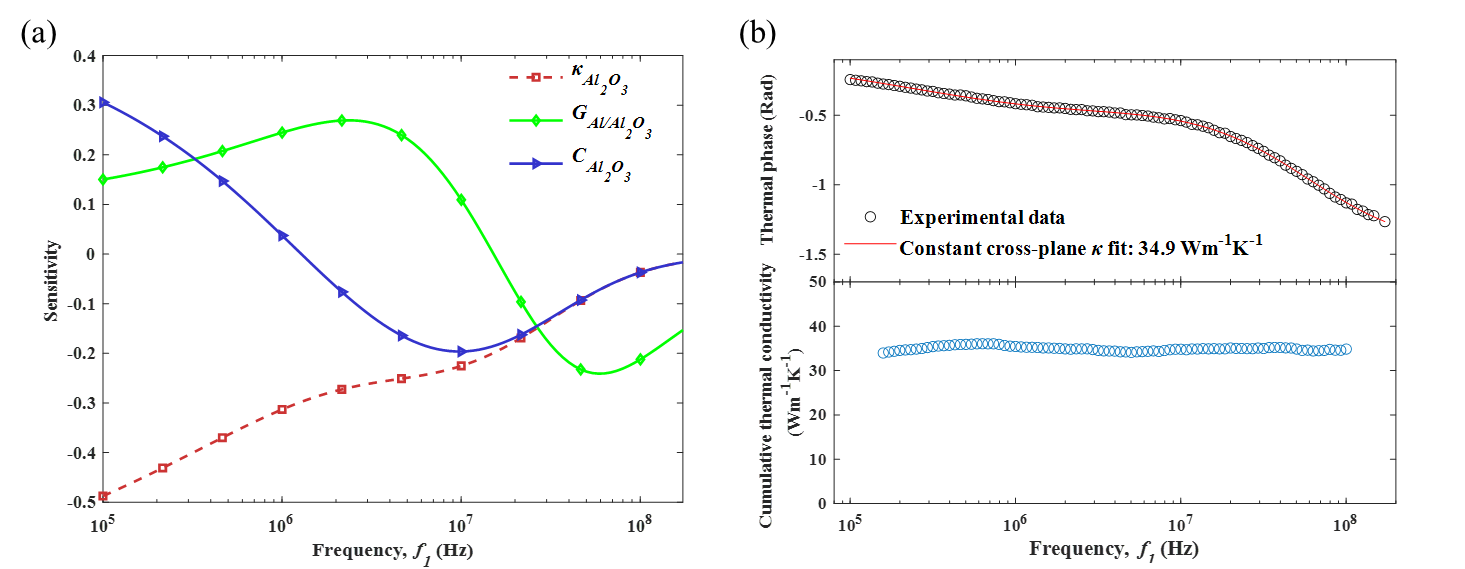
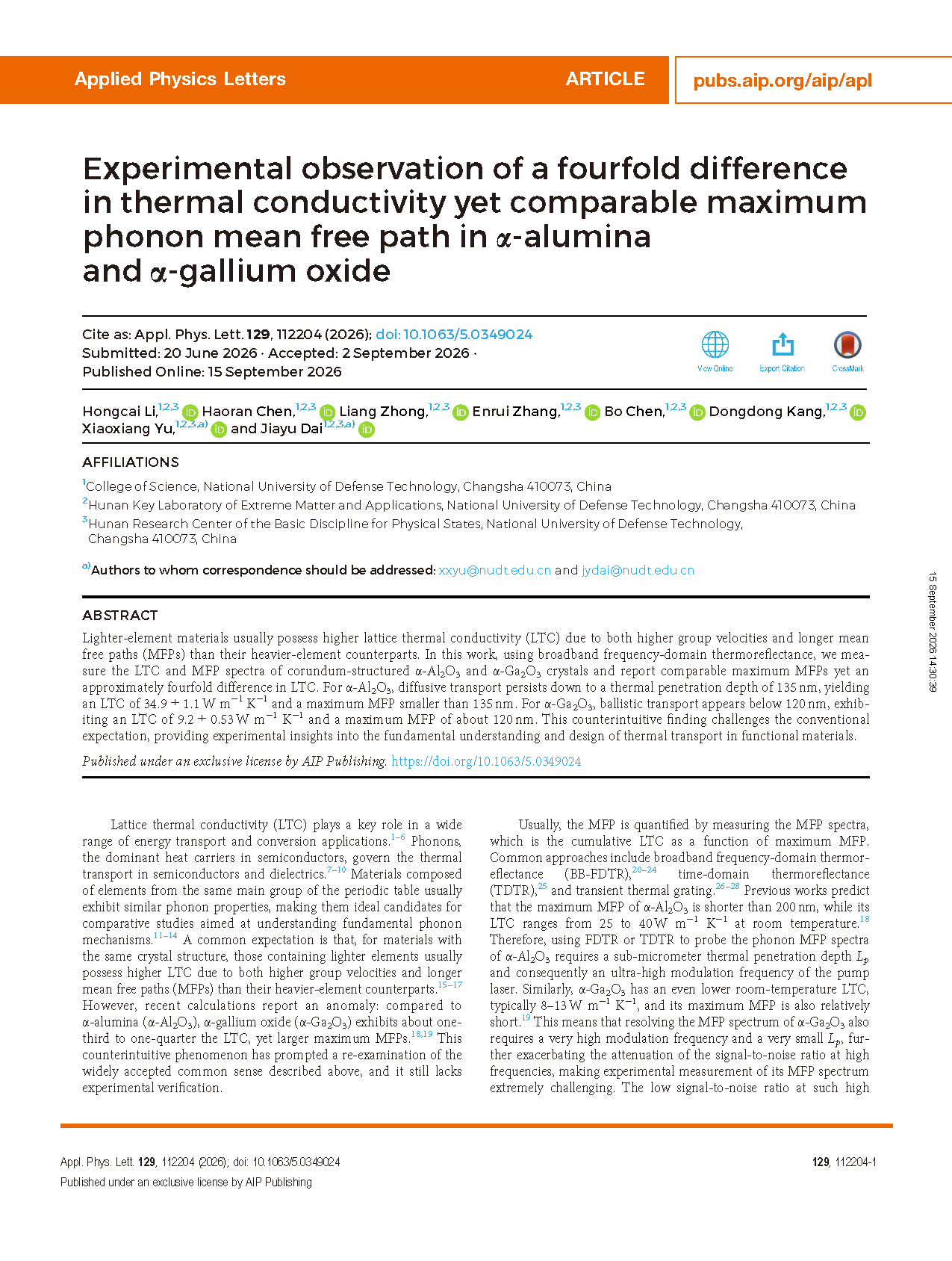
FIG. 1. (a) Sensitivity curve over 100 kHz–172 MHz, showing high sensitivity that enables reliable fitting and MFP extraction. (b) Full-band and segmental fitting of the thermal conductivity of α-Al2O3, giving κ = 34.9 ± 1.1 W m⁻¹ K⁻¹ with no frequency dependence.
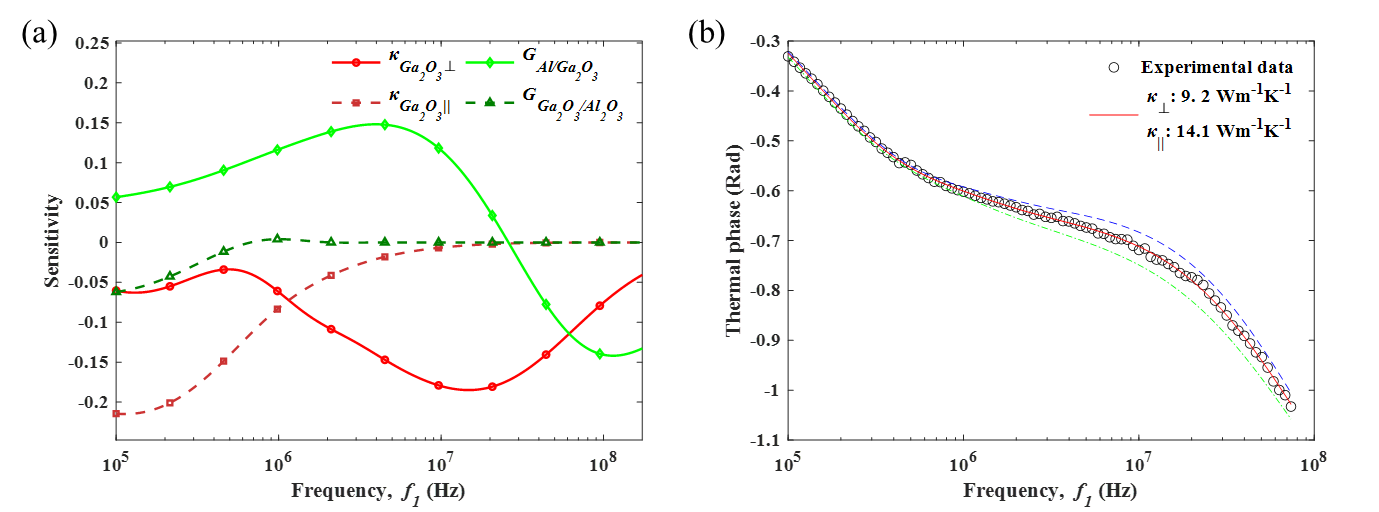
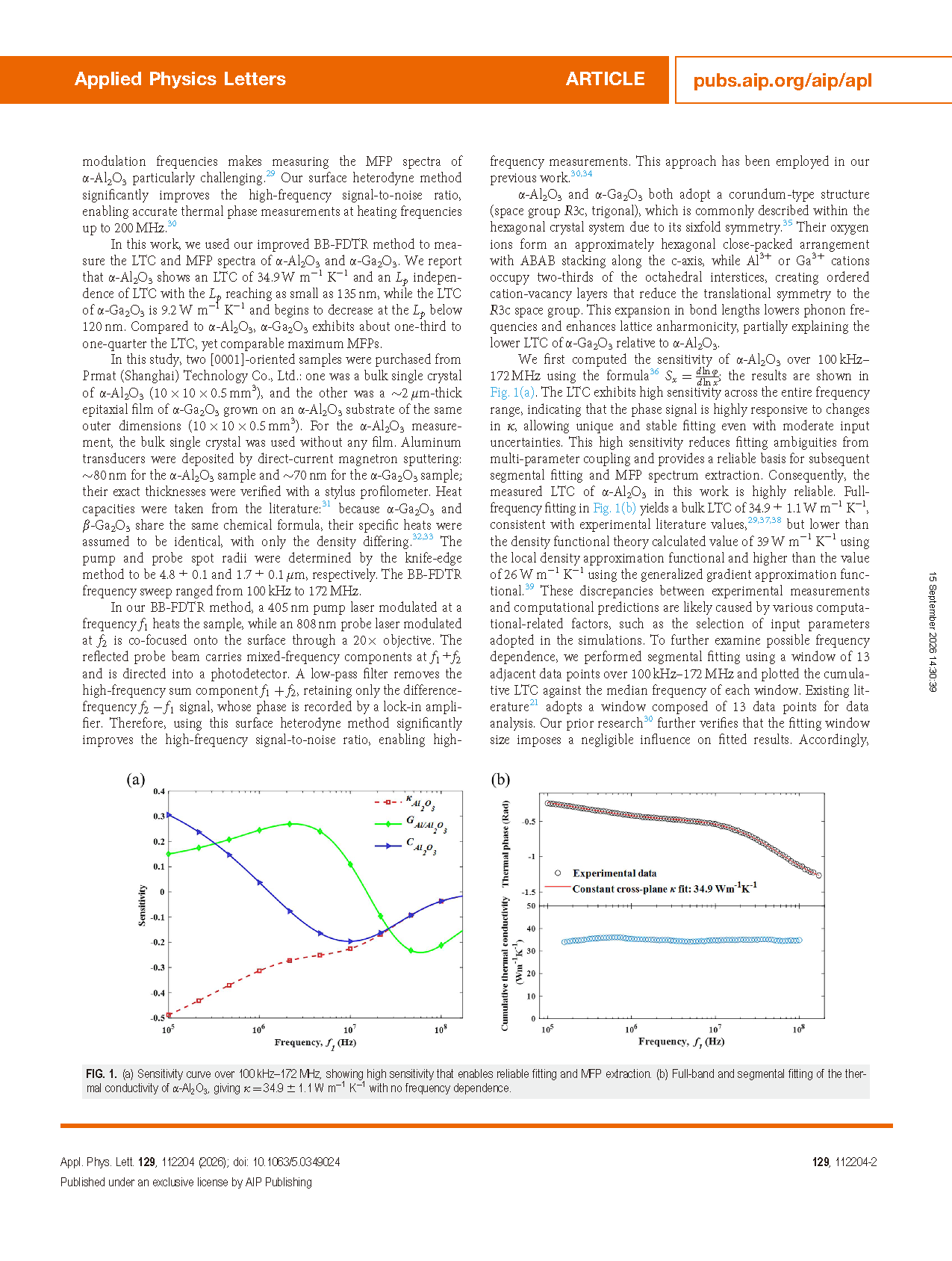
FIG. 2. (a) Sensitivity curves of α-Ga2O3 over 100 kHz–172 MHz, showing strong anisotropy and negligible interface and substrate effects. (b) Full-frequency fitting (0.1–75 MHz), giving cross-plane κ⊥= 9.2 ± 0.53 W m⁻¹ K⁻¹ and effective in-plane κ∥ =14.1 ± 0.93 W m⁻¹ K⁻¹.
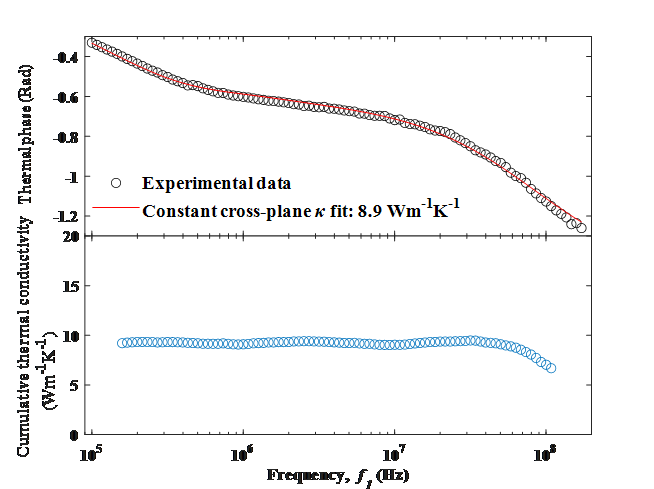
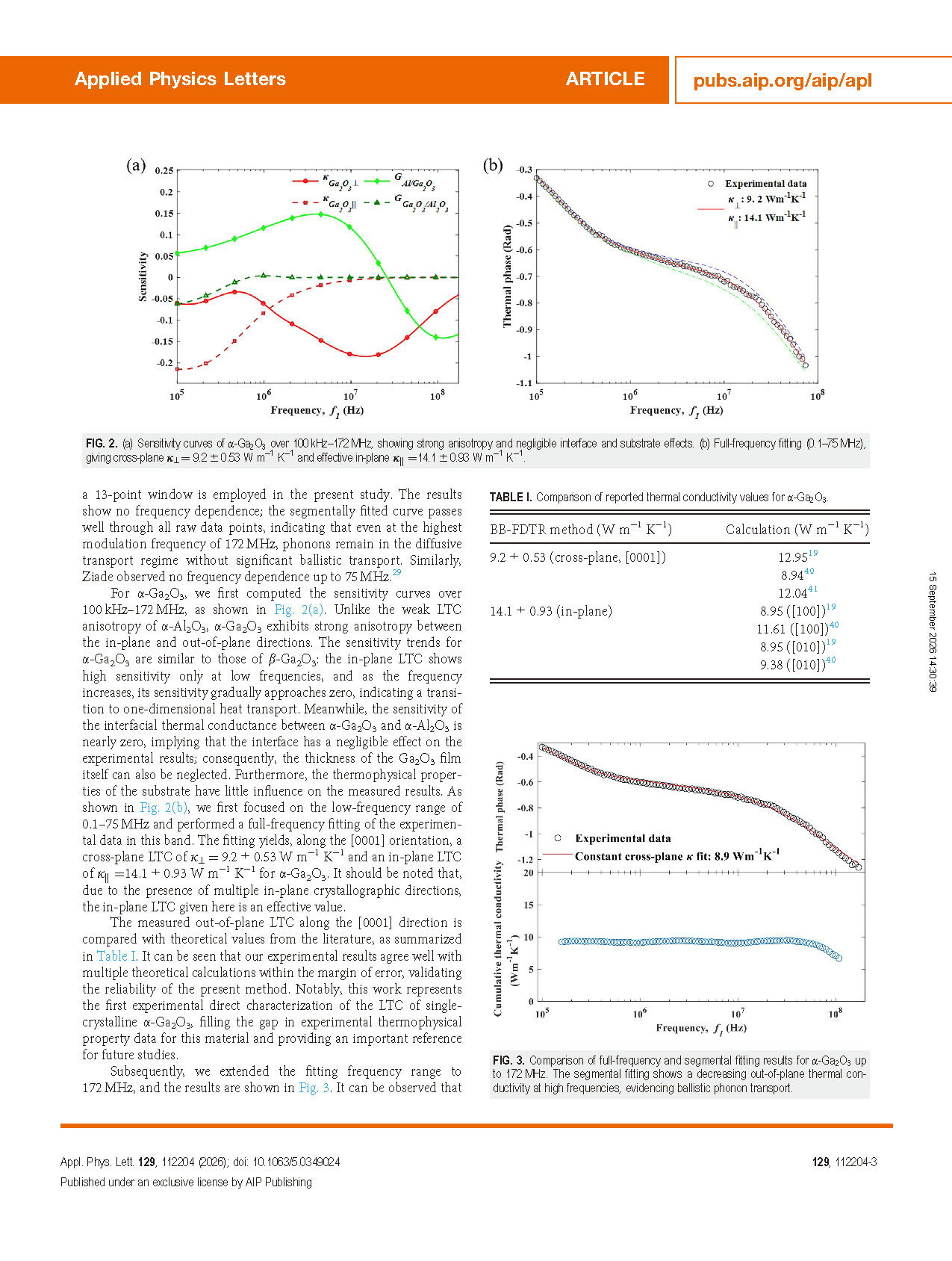
FIG. 3. Comparison of full-frequency and segmental fitting results for α-Ga2O3 up to 172 MHz. The segmental fitting shows a decreasing out-of-plane thermal conductivity at high frequencies, evidencing ballistic phonon transport.
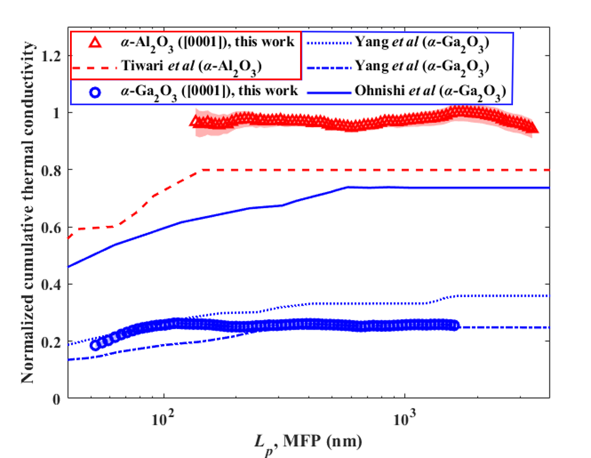
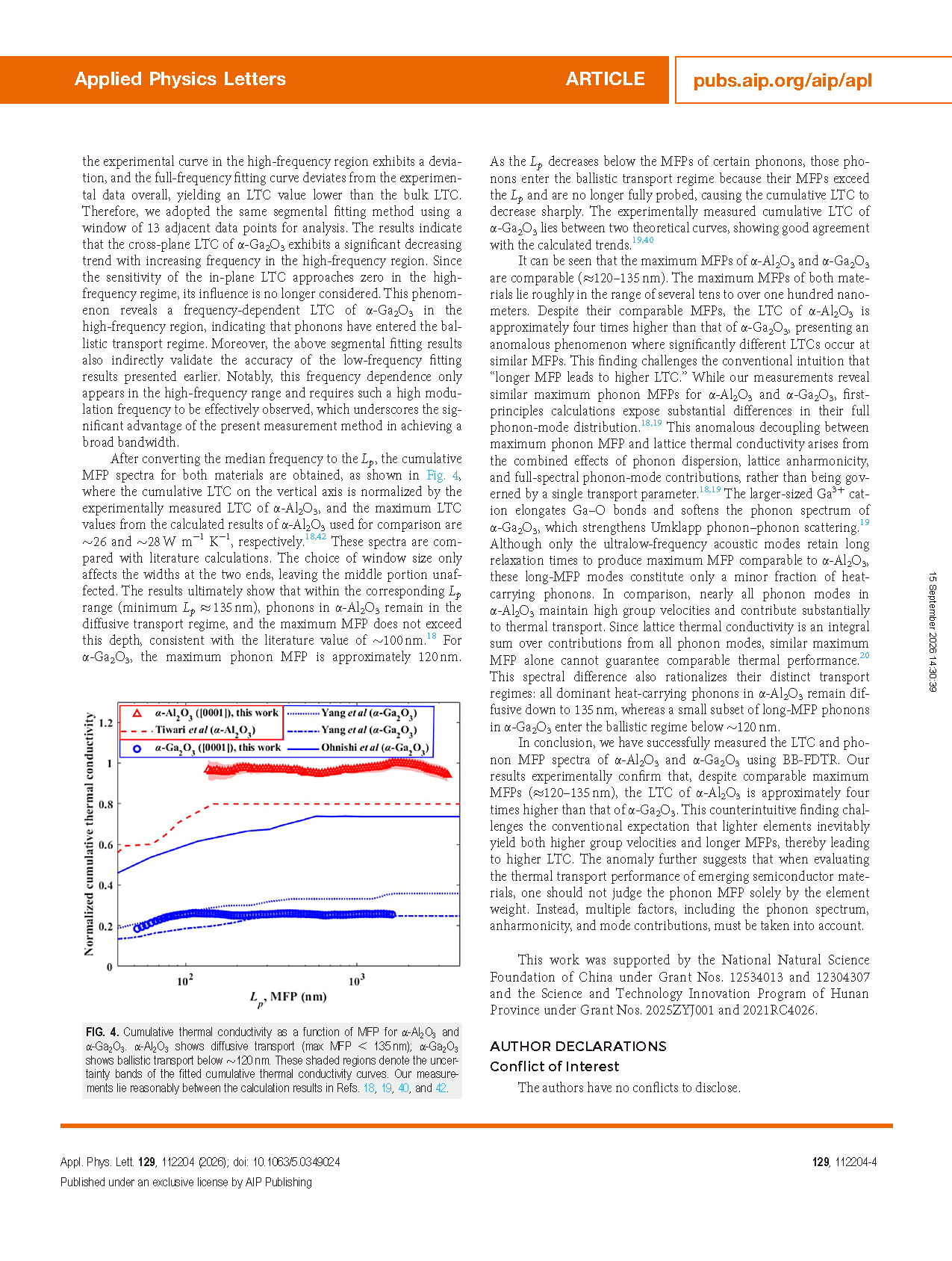
FIG. 4. Cumulative thermal conductivity as a function of MFP for α-Al2O3 and α-Ga2O3. α-Al2O3 shows diffusive transport (max MFP ≤135 nm); α-Ga2O3 shows ballistic transport below ~120 nm. These shaded regions denote the uncertainty bands of the fitted cumulative thermal conductivity curves. Our measurements lie reasonably between calculation results from Refs. [18, 19, 40, 42].
Introduction of the Corresponding Authors

Corresponding author: Jiayu Dai, Professor at the College of Science, National University of Defense Technology. He is mainly engaged in research on matter science under extreme conditions and has published more than 100 papers in journals such as Nature Materials, Physical Review Letters, Nature Communications, The Innovation, and National Science Review.

Corresponding author: Xiaoxiang Yu, Associate Researcher at the College of Science, National University of Defense Technology. He is mainly engaged in research on thermophysics under service conditions and device thermal management and has published more than 50 papers in journals such as Physical Review Letters and Nature Communications.
DOI:
doi.org/10.1063/5.0349024
Instruction
Official Account

Cooperation
Top