


Researchers from the Nanjing University have published a dissertation titled " Strain-mediated compositional pulling effect in α-(AlₓGa₁₋ₓ)₂O₃ heteroepitaxy(α-(AlₓGa₁₋ₓ)₂O₃" in Applied Physics Letters.
Background
Gallium oxide (Ga2O3), with its ultrawide bandgap and high theoretical breakdown field, has emerged as a compelling semiconductor for high-power and high-frequency electronic devices. Among its various polymorphs, monoclinic β-Ga2O3 has received particular attention owing to the availability of large-area, high-quality single-crystal substrates grown by melt-based techniques. Nevertheless, the relatively modest electron mobility of bulk β-Ga2O3 remains a key obstacle to realizing high-performance radio frequency (RF) transistors, as it fundamentally limits carrier transport and frequency response. To overcome this limitation, extensive efforts have focused on heterostructure engineering. In particular, high-quality β-(AlxGa1−x)2O3/β-Ga2O3 heterostructures grown on various β-Ga2O3 substrate orientations have enabled the formation of two-dimensional electron gases (2DEGs) through band-offset engineering and modulation doping, providing a viable route toward β-Ga2O3-based high-frequency and high-power transistors.
Abstract
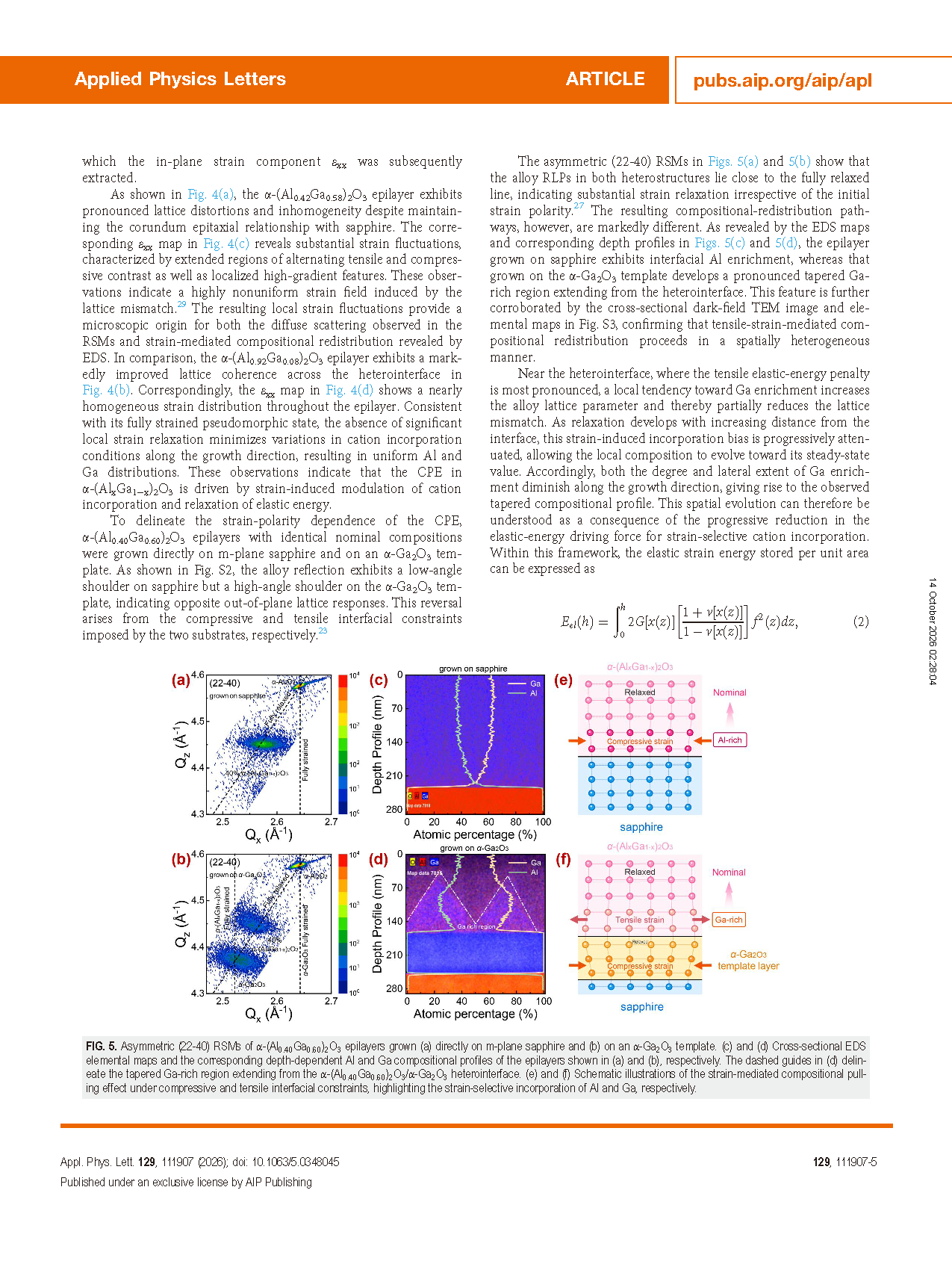
Precise compositional control is essential for tailoring α-(AlxGa1−x)2O3 heterostructures, yet is often compromised by the compositional pulling effect (CPE) during heteroepitaxy. Here, α-(AlxGa1−x)2O3 epilayers spanning a broad Al-composition range of x = 0.42–0.92 were grown on nonpolar m-plane sapphire substrates to elucidate the strain-mediated origin of the CPE. Critical-thickness calculations, reciprocal-space mapping, energy-dispersive x-ray spectroscopy, and geometric phase analysis collectively identify a composition-dependent transition from strain-relaxed growth of α-(AlxGa1−x)2O3 at x = 0.42–0.62 to fully strained pseudomorphic growth at x = 0.71–0.92. The relaxed α-(AlxGa1−x)2O3 epilayers exhibit pronounced Al enrichment near the heterointerface, with the compositional grading length contracting from approximately 72 to 22 nm as the Al composition increases, whereas the fully strained α-(AlxGa1−x)2O3 epilayers are compositionally uniform. Comparative growth of α-(Al0.40Ga0.60)2O3 on sapphire and α-Ga2O3 templates further reveals a reversal of the cation-redistribution pathway: compressive strain promotes Al incorporation, while tensile strain drives Ga enrichment. These results establish the CPE as a bidirectional, strain-mediated cation-incorporation response and provide a physical basis for interfacial composition engineering in α-(AlxGa1−x)2O3 heterostructures.
Highlights
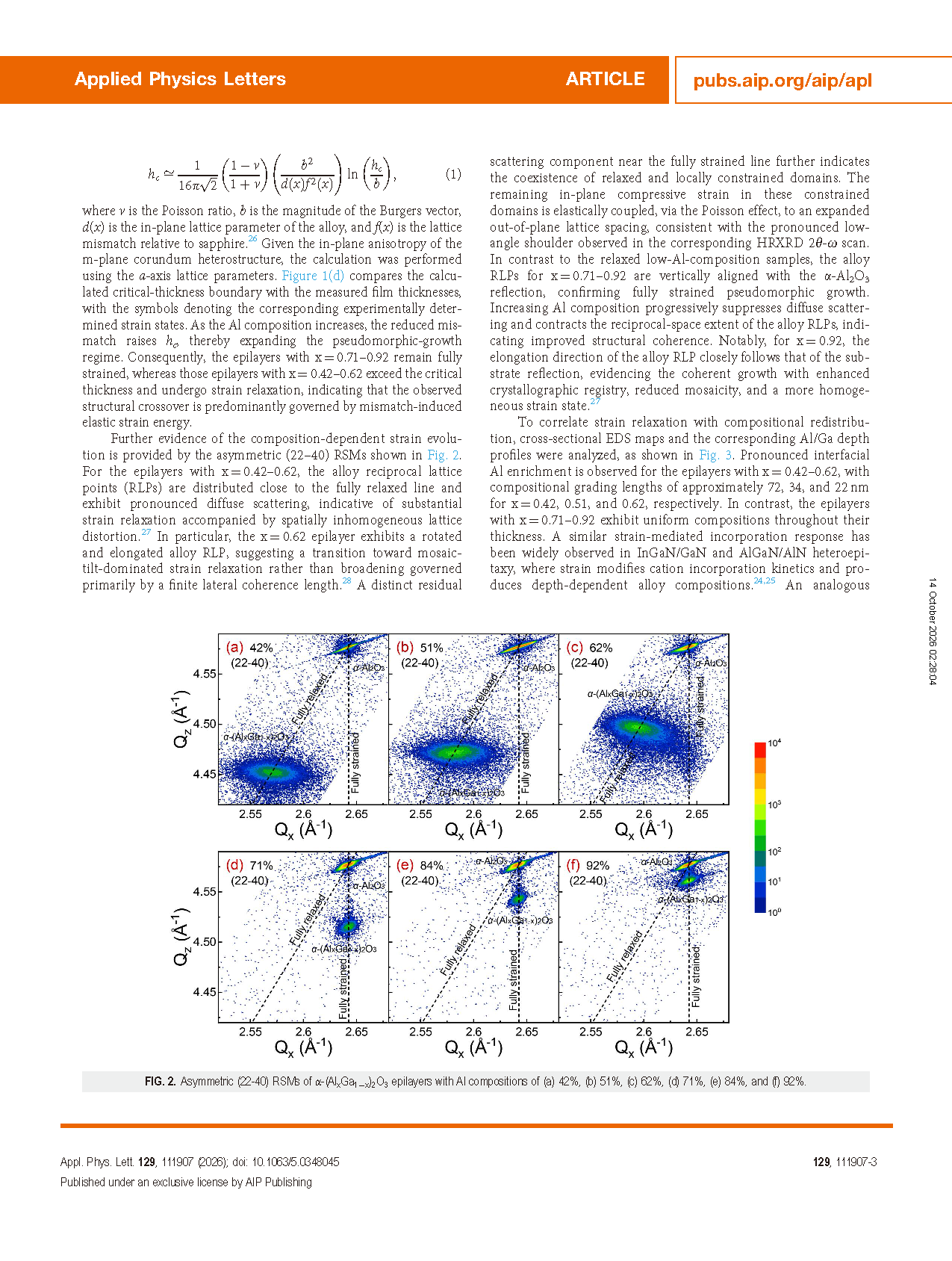
In α-(AlₓGa₁₋ₓ)₂O₃epitaxial layers with an Al composition ranging from 0.42 to 0.92, strain relaxation and interfacial Al enrichment were observed when the Al composition was between 0.42 and 0.62, whilst fully strain-controlled growth and essentially uniform composition were maintained in the range of 0.71 to 0.92.
Compressive strain promotes Al incorporation, whilst tensile strain promotes Ga enrichment, indicating that the direction of interfacial strain determines the direction of compositional redistribution.
By linking the composition pull effect with strain relaxation and elastic strain energy, this study provides both theoretical and experimental grounds for the design and control of interfacial composition in α-(AlₓGa₁₋ₓ)₂O₃heterostructures.
Conclusion
In summary, we uncover a strain-mediated, bidirectional compositional pulling effect in α-(AlₓGa₁₋ₓ)₂O₃ heteroepitaxy. A composition-dependent transition from relaxed, compositionally graded growth to fully strained pseudomorphic growth is identified and directly correlated with the evolution of local strain fields. We further demonstrate that the polarity of the interfacial strain selectively favors Al or Ga incorporation, establishing elastic strain energy as the governing driving force for alloy redistribution. This mechanism provides a foundation for strain-engineered composition control and the rational design of corundum-structured oxide heterostructures.
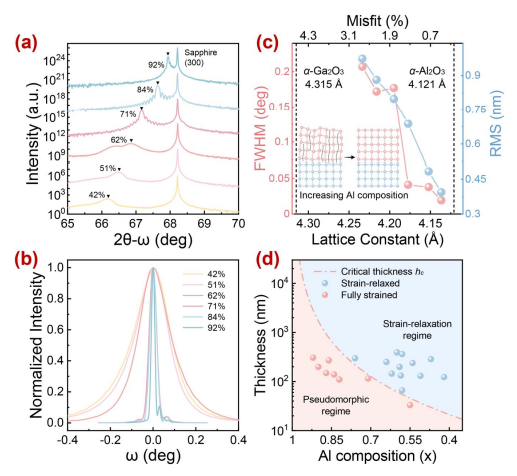
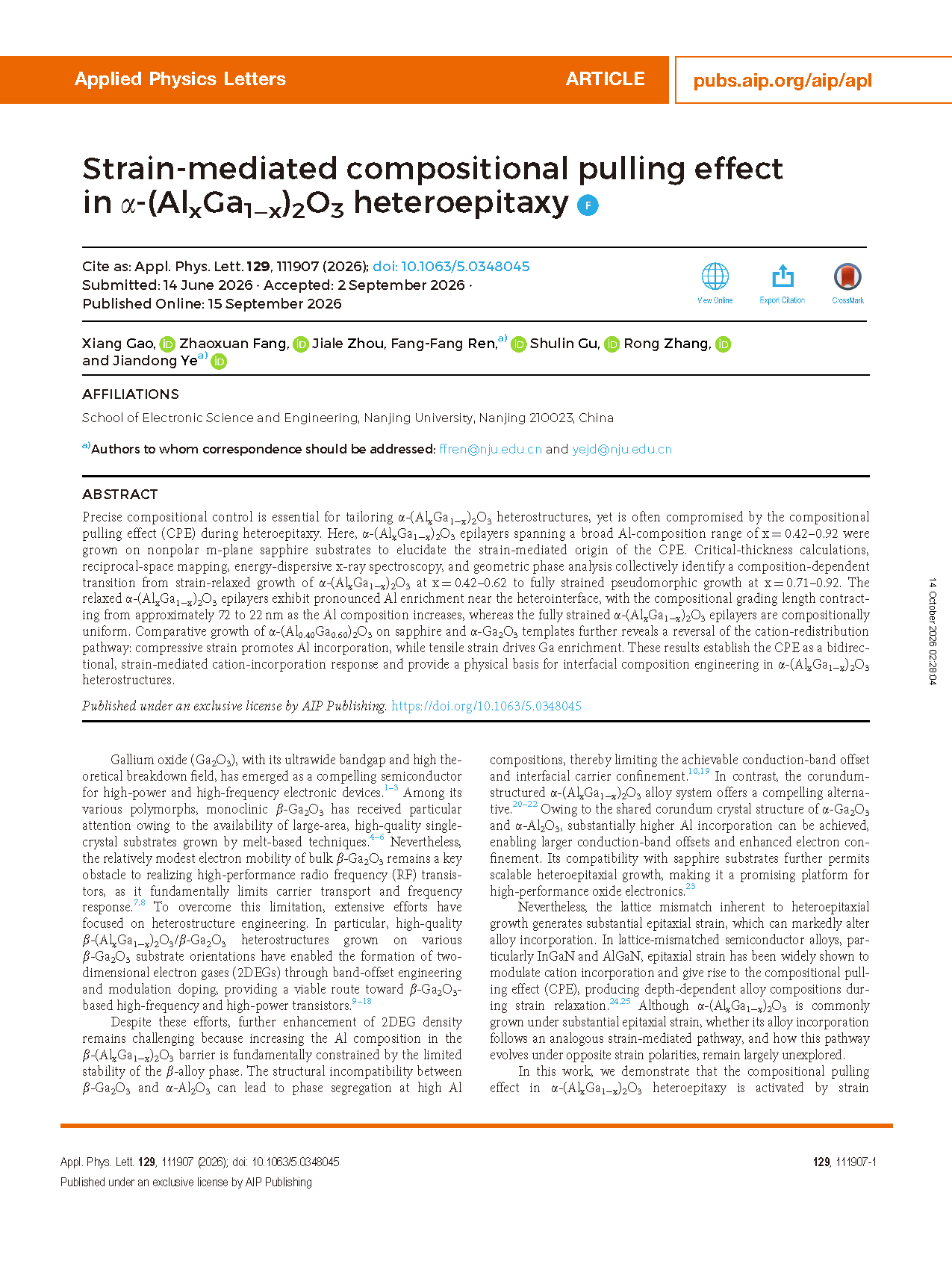
FIG. 1. (a) Symmetric HRXRD 2θ-ω scans and (b) normalized XRCs of α-(AlₓGa₁₋ₓ)₂O₃ epilayers with Al compositions ranging from 42% to 92%. (c) FWHM and RMS plotted as a function of the alloy lattice parameter. The corresponding lattice mismatches relative to sapphire are indicated on the upper axis. (d) Critical thickness hc, calculated using the People–Bean model as a function of the Al composition. The experimentally measured film thicknesses are superimposed, with the symbols denoting the experimentally determined strain states.
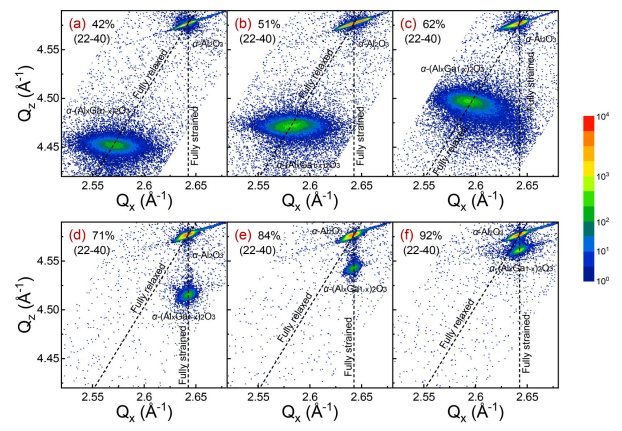
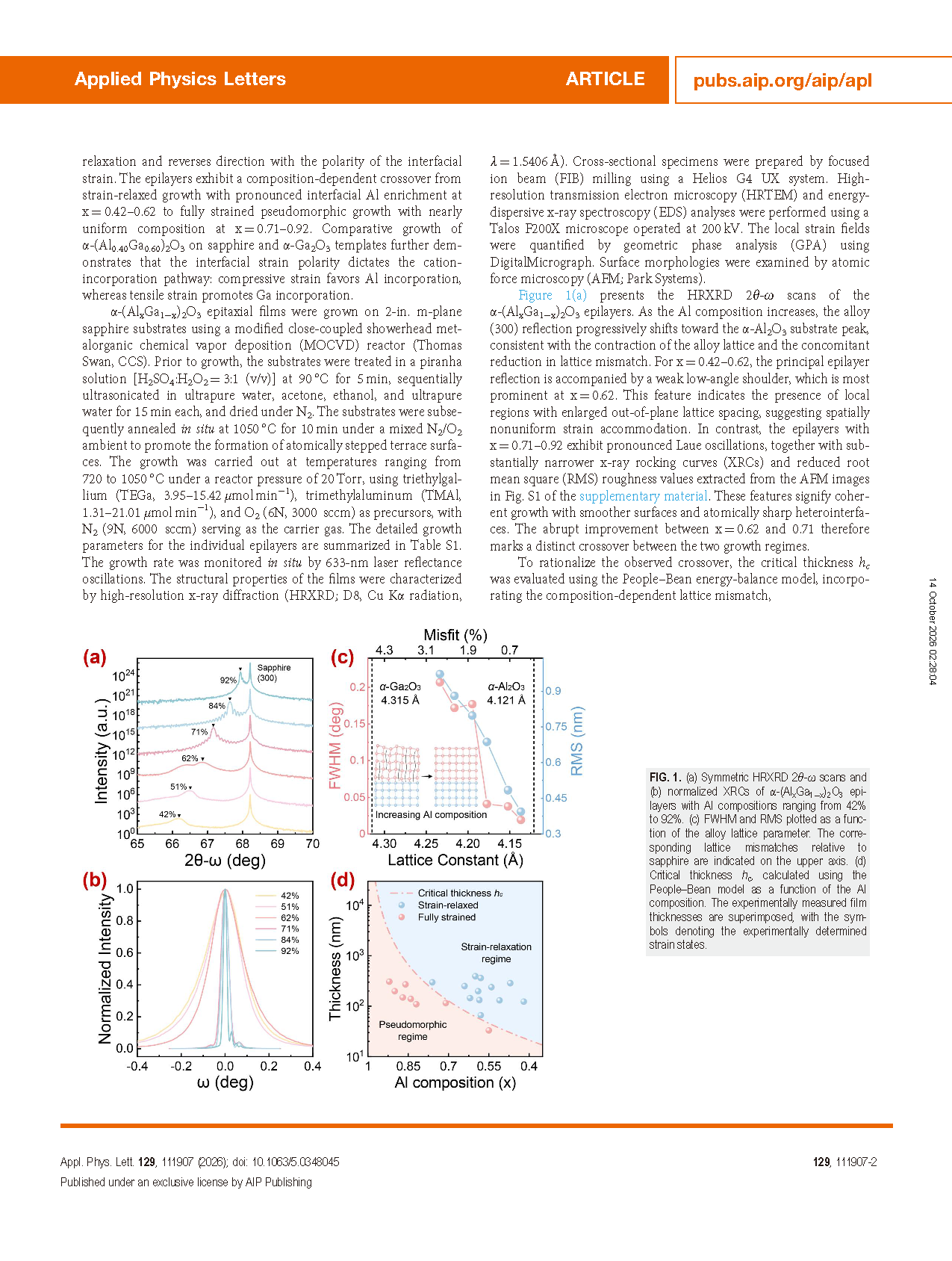
FIG. 2. Asymmetric (22-40) RSMs of α-(AlₓGa₁₋ₓ)₂O₃ epilayers with Al compositions of (a) 42%, (b) 51%, (c) 62%, (d) 71%, (e) 84%, and (f) 92%.

FIG. 3. Cross-sectional EDS elemental maps and the corresponding depth-dependent Al and Ga atomic-percentage profiles of α-(AlₓGa₁₋ₓ)₂O₃ epilayers with Al compositions of (a) 42%, (b) 51%, (c) 62%, (d) 71%, (e) 84%, and (f) 92%.
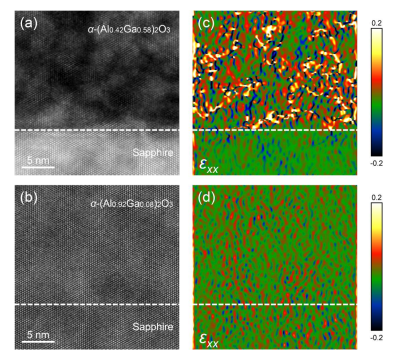
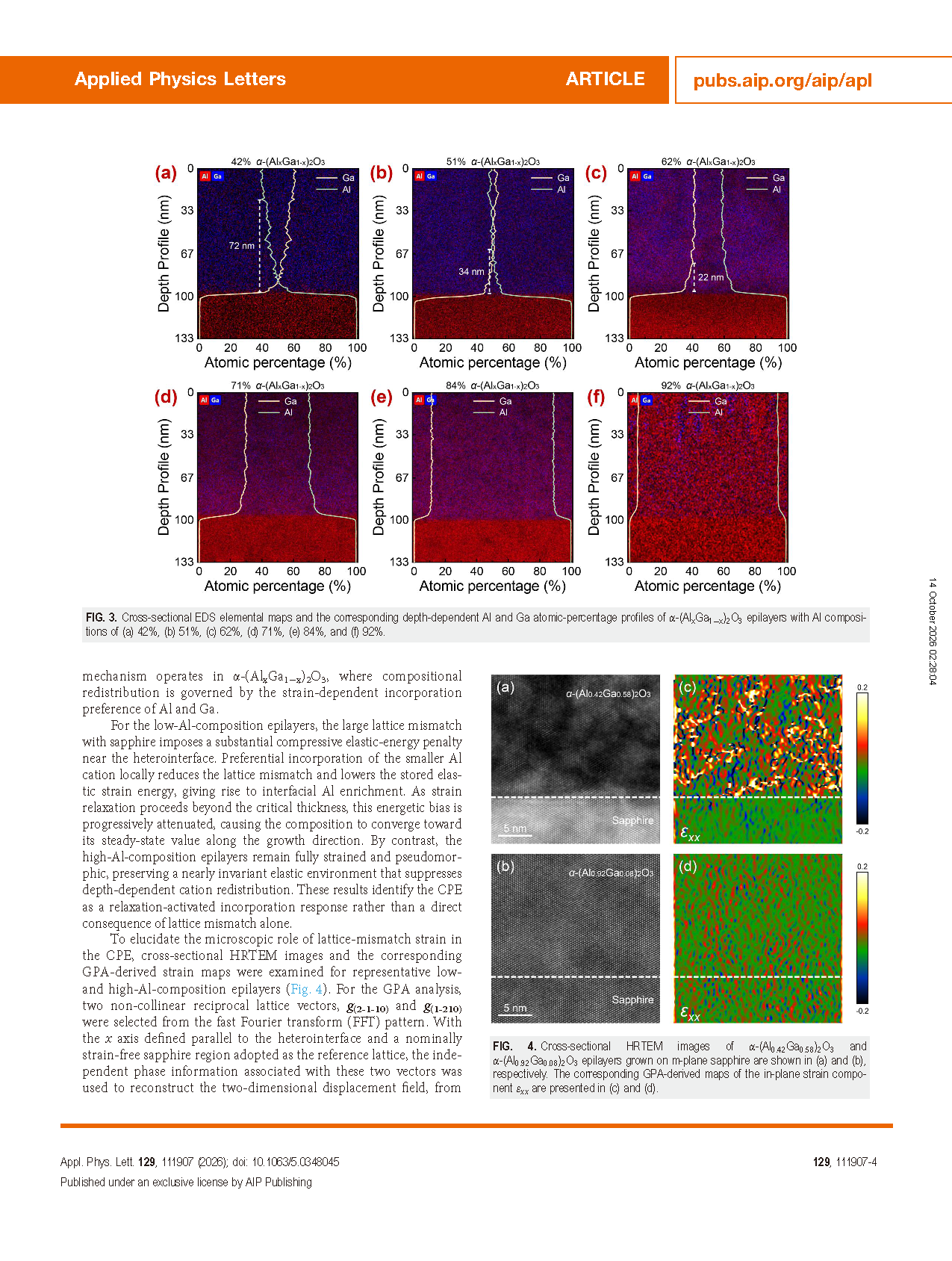
FIG. 4. Cross-sectional HRTEM images of α-(Al0.42Ga0.58)2O3 and α-(Al0.92Ga0.08)2O3 epilayers grown on m-plane sapphire are shown in (a) and (b), respectively. The corresponding GPA-derived maps of the in-plane strain component εxx are presented in (c) and (d).
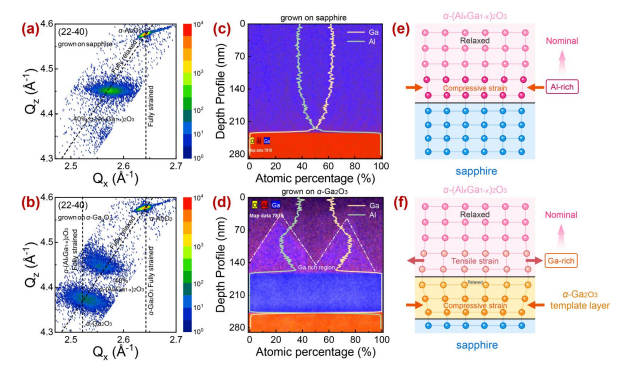
FIG. 5. Asymmetric (22-40) RSMs of α-(Al0.40Ga0.60)2O3 epilayers grown (a) directly on m-plane sapphire and (b) on an α-Ga2O3 template. (c) and (d) Cross-sectional EDS elemental maps and the corresponding depth-dependent Al and Ga compositional profiles of the epilayers shown in (a) and (b), respectively. The dashed guides in (d) delineate the tapered Ga-rich region extending from the α-(Al0.40Ga0.60)2O3/α-Ga2O3 heterointerface. (e) and (f) Schematic illustrations of the strain-mediated compositional pulling effect under compressive and tensile interfacial constraints, highlighting the strain-selective incorporation of Al and Ga, respectively.
DOI:
https://doi.org/10.1063/5.0348045
Instruction
Official Account

Cooperation
Top